




- Hardware & Software IT Services
- SOP Management Solution Market
SOP Management Solution Market Size, Share, and Growth Forecast, 2026 - 2033
SOP Management Solution Market by Deployment Type (On-Premise, Cloud-Based, Hybrid), Application (Quality Management, Others), End-user (Manufacturing, Healthcare, Finance, Retail, Education), and Regional Analysis for 2026 - 2033

SOP Management Solution Market Size and Trends Analysis
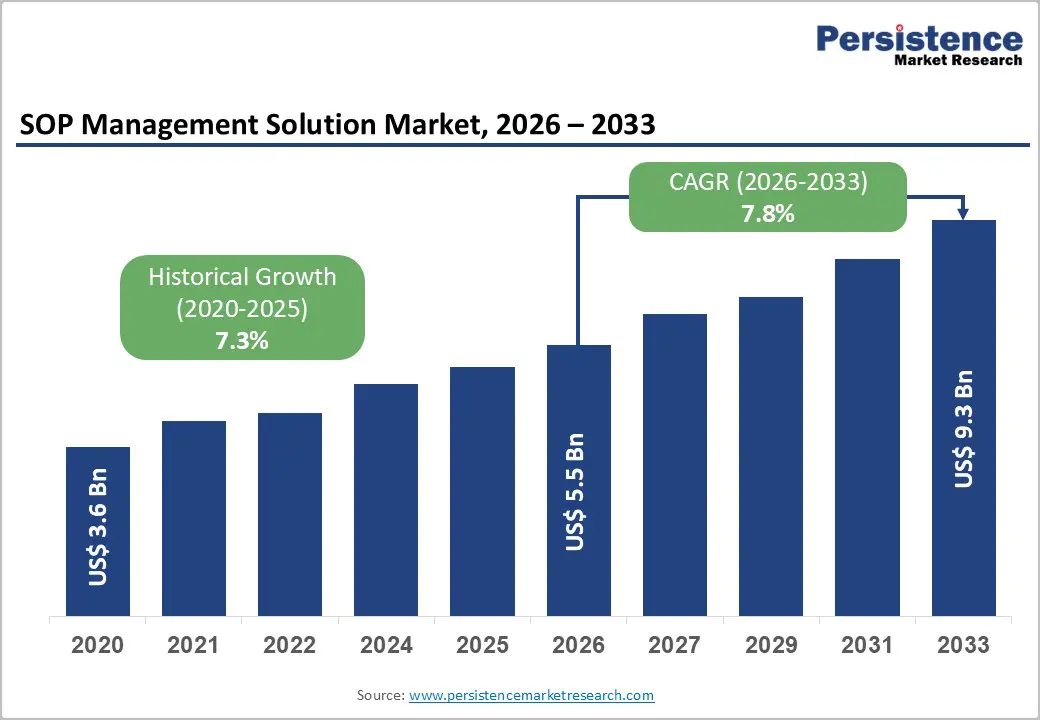
The global SOP management solution market size is likely to be valued at US$5.5 billion in 2026, and is expected to reach US$9.3 billion by 2033, growing at a CAGR of 7.8% during the forecast period from 2026 to 2033, driven by the increasing prevalence of regulatory compliance needs, rising demand for digital process standardization in manufacturing and healthcare, and advancements in cloud-based workflow automation.
The growing demand for efficient, scalable SOP management solutions, especially in quality and compliance management, is accelerating adoption across various end-use industries. Advances in cloud-based and hybrid deployments are further boosting uptake by offering more secure, collaborative options. Increasing recognition of SOP management solutions as critical for operational efficiency and audit readiness in emerging industries remains a major driver of market growth.
Key Industry Highlights:
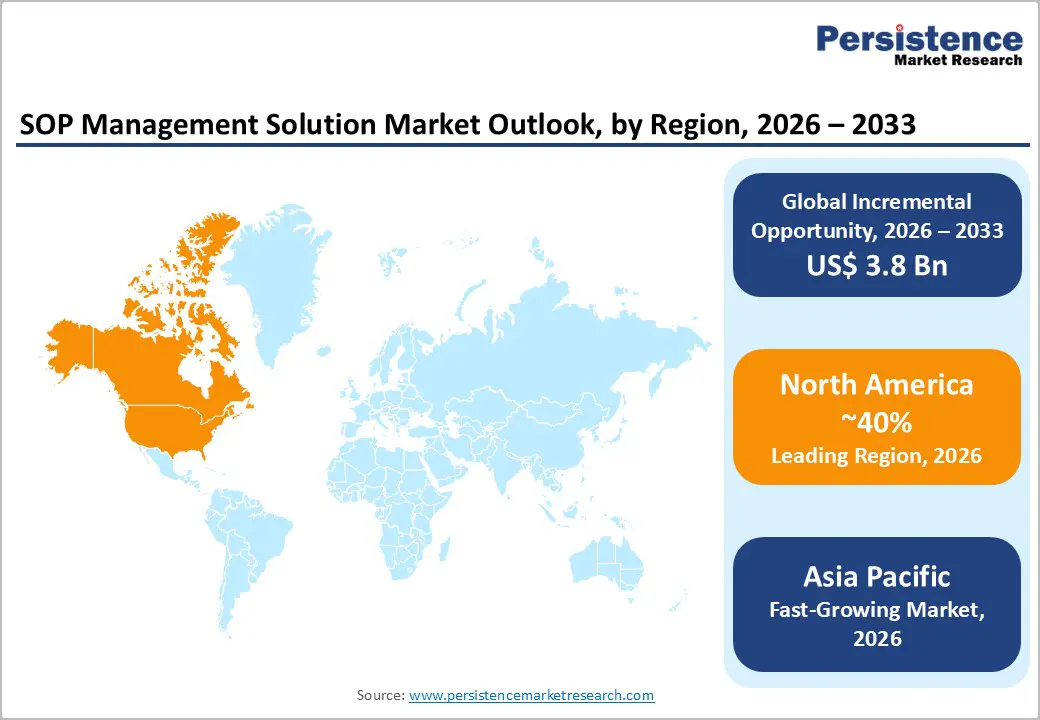
- Leading Region: North America, anticipated to account for a 40% market share in 2026, driven by stringent FDA and ISO regulations, high adoption in healthcare and manufacturing in the U.S.
- Fastest-growing Region: Asia Pacific, to be fueled by rapid industrialization, increasing compliance focus, and growing investments in digital transformation in China and India.
- Dominant Deployment Type: Cloud-based, to hold approximately 55% of the market share, as it provides scalability, remote access, and lower upfront costs.
- Leading Application: Compliance management is expected to account for over 35% of the market revenue in 2026, due to rising audit requirements and regulatory pressures.
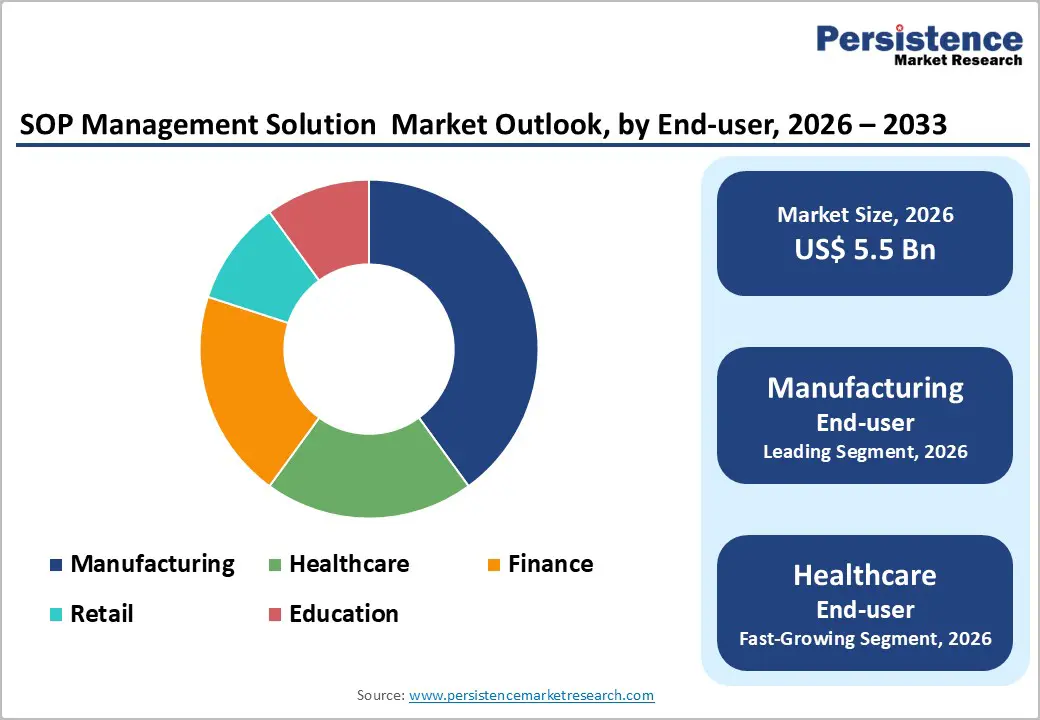
- Leading End-user: Manufacturing, to contribute nearly 40% of the market revenue, due to the need for standardized procedures and quality control.
| Key Insights | Details |
|---|---|
|
SOP Management Solution Market Size (2026E) |
US$5.5 Bn |
|
Market Value Forecast (2033F) |
US$9.3 Bn |
|
Projected Growth (CAGR 2026 to 2033) |
7.8% |
|
Historical Market Growth (CAGR 2020 to 2025) |
7.3% |
Market Factors - Growth, Barriers, and Opportunity Analysis
Increasing Demand for Regulatory Compliance Needs and for Digital Process Standardization
The increasing demand for regulatory compliance needs is quickly becoming a major opportunity for SOP management solution providers, driven by growing enforcement of standards such as ISO 9001 and FDA 21 CFR Part 11, and the reduction of non-compliance risks. Traditional paper-based SOPs often create version control issues, especially in manufacturing and healthcare, leading to higher audit failures and operational errors. Digital technologies, including cloud-based platforms, hybrid deployments, workflow automation, and AI-driven updates, address these concerns by offering a centralized, traceable alternative. These formats simplify revisions, reduce the need for manual training, and are particularly effective during remote work or multi-site operations where real-time access is critical.
SOP management solutions significantly lower the risk of penalties, recalls, and downtime, which remain major concerns in regulated settings. They also support improved collaboration and easier reporting, especially for cloud-based and hybrid grades, making them ideal for enterprise operations. As global regulatory organizations push for wider digital coverage and user-friendly tools, demand continues to expand across quality management, risk management, and document management.
Integration Complexity with Legacy Systems
Integration complexity with legacy systems remains a significant restraint in the SOP Management Solutions Market, particularly for large enterprises and regulated industries. Many organizations still operate on fragmented, outdated IT infrastructures built over the years, including legacy ERP, document management, and quality systems that were never designed for seamless digital interoperability. When a modern SOP management solution is introduced, aligning it with these older systems often requires extensive customization, middleware development, and prolonged testing cycles.
This complexity increases deployment timelines and raises implementation costs, discouraging rapid adoption. Inconsistent data formats, limited API support, and rigid system architectures further complicate real-time data exchange, version control, and workflow automation. As a result, organizations may struggle to achieve centralized SOP governance, undermining the core value of automation and standardization. Legacy environments often support mission-critical operations, making system downtime unacceptable. This forces companies to adopt cautious, phased integration approaches, slowing enterprise-wide rollouts. Internal IT teams may also lack specialized expertise to manage hybrid environments that combine cloud-based SOP platforms with on-premise systems.
Advancements in Cloud-Based and AI-Driven Delivery Platforms
Advancements in cloud-based and AI-driven SOP management solution delivery platforms are transforming the global compliance landscape by addressing two major challenges, accessibility barriers and manual update dependency. Cloud-based platforms are engineered to achieve real-time collaboration, reducing reliance on on-premise servers and enabling remote workforce management. Innovations, such as SaaS models, multi-tenant architecture, mobile apps, and automated notifications, significantly improve adoption and reduce IT overhead, lowering costs for enterprises and compliance campaigns.
Advancements in AI-driven platforms, such as intelligent revision suggestions, predictive compliance checks, natural language search, and automated training modules, enable more proactive management by detecting errors early, serving as the system’s first line of defense against non-compliance. These solutions reduce the need for manual reviews, improve accuracy, and support flexible usage without constant oversight, making them particularly effective for highly regulated environments. Emerging technologies, including blockchain-based logging, bio-adhesive workflows, and VLP analytics, further strengthen traceability and response capabilities.
Category-wise Analysis
Deployment Type Insights
Cloud-based is anticipated to dominate, accounting for approximately 55% of the revenue share in 2026. Its dominance is driven by scalability, remote access, and lower maintenance, making it preferred for multi-site operations. Cloud-based solutions provide real-time updates, ensure security, and contribute to cost savings, making them suitable for large-scale enterprise campaigns. Process Street operates as a fully cloud-hosted solution, meaning all SOPs and workflows are stored, managed, and executed in the cloud rather than on local servers. This enables real-time access to the latest procedures from any location, device, or team, ideal for multi-site operations and distributed workforces.
Hybrid is likely to be the fastest-growing segment, due to its flexibility and expanding use in regulated industries. Its balanced profile makes it ideal for targeted data control, reducing full-cloud risks. Continuous innovations in integration are further strengthening its appeal, driving rapid adoption across North America and Europe, where demand for secure, customizable solutions is accelerating. IBM’s hybrid cloud architecture allows organizations to retain sensitive SOP data and processes on-premises while using public cloud services for collaborative workflows, analytics, and remote access. This model is especially important for regulated industries (such as healthcare, finance, and life sciences) that must preserve strict data governance and compliance while modernizing operations.
Application Insights
The compliance management segment is anticipated to lead the market, holding approximately 35% of the share in 2026, driven by regulatory needs, large audit programs, and strong global demand for traceability. Their dominance continues as industries expand standards adherence. Rising adoption of quality management and expanded risk campaigns highlight the growing focus on integrated solutions. MetricStream’s compliance management solution is designed to help large enterprises in highly regulated industries such as financial services, healthcare, energy, and manufacturing to automate regulatory compliance, maintain audit trails, and provide end-to-end traceability of policies, risks, and controls across business units. This capability is critical as regulatory frameworks tighten, and organizations must demonstrate real-time compliance and audit readiness.
Quality management is likely to be the fastest-growing segment, due to strong momentum in process optimization and expanding inclusion of SOPs in ISO frameworks. The growing shift toward efficiency platforms, along with better control, accelerates the adoption. Advancements in AI monitoring and the continued progress of workflow automation entering enterprise trials drive market growth. AmpleLogic’s system uses AI to analyze deviations and recommend corrective actions, enabling faster and more accurate resolution of quality issues and reducing manual workloads. This automation accelerates continuous improvement and drives adoption, especially in regulated environments such as pharmaceuticals.
End-user Insights
The manufacturing segment is expected to dominate, accounting for nearly 40% of revenue in 2026, as it remains the central hub for standardization, large-scale process management, and operations that require strict adherence to SOPs. Its strong integration capabilities, skilled workforce, and ability to handle high-volume or complex workflows drive higher adoption. Manufacturing sectors are also leading the implementation of cloud-based solutions and emerging hybrid trials. MasterControl’s system helps manufacturers create, manage, and enforce SOPs across production lines and departments, ensuring that every step, from assembly to quality checks, follows standardized procedures, reducing variability and maintaining consistent product quality.
The healthcare segment represents the fastest-growing segment, driven by its strong regulatory presence and expanding role in patient safety protocols. It offers convenient, quick, and accessible documentation, attracting facilities that prefer digital, audit-ready settings. Increased outreach programs, FDA focus, and wider availability of routine and premium solutions further accelerate uptake, boosting rapid adoption across both urban and semi-urban areas. One of the largest hospitals in Belgium uses TPSC Cloud to manage incident reporting, risk events, quality processes, and compliance workflows across departments. This platform replaces manual paper-based systems and ensures timely, audit-ready documentation of critical safety and quality events.
Regional Insights
North America SOP Management Solution Market Trends
North America is projected to dominate, accounting for approximately 40% of the global SOP management solution market in 2026, driven by the region’s stringent regulatory environment, strong research and development capabilities, and high public awareness of compliance benefits. Systems in the U.S. and Canada provide extensive support for management programs, ensuring wide accessibility of SOP management solutions across manufacturing, healthcare, and finance populations. Increasing demand for cloud-based, convenient, and easy-to-integrate forms is further accelerating adoption, as these formats improve collaboration and reduce barriers associated with legacy systems.
Innovation in SOP management solution technology, including stable AI workflows, improved hybrid delivery, and targeted compliance enhancement, is attracting significant investment from both public and private sectors. Government initiatives and FDA campaigns continue to promote use against audit failures, operational risks, and emerging digital threats, creating sustained market demand. The growing focus on quality grades and specialty uses, particularly for pharmaceuticals and others, is expanding the target applications for SOP management solutions.
Europe SOP Management Solution Market Trends
Europe’s market growth is driven by rising awareness of compliance benefits, robust regulatory frameworks, and government-led digital initiatives. Countries such as Germany, France, and the U.K. have well-established industrial infrastructures that support routine SOP management and encourage the adoption of innovative delivery methods, including SOP management solutions. These solutions appeal to manufacturers, regulation-conscious operators, and healthcare users by enhancing audit readiness and coverage.
Technological advancements, including enhanced cloud integration, application-specific deployment, and improved AI capabilities, are further expanding market potential. European authorities increasingly support research and trials addressing both routine and specialized compliance needs, bolstering market confidence. The region’s emphasis on convenient and secure solutions aligns with a focus on preventive compliance and minimizing manual errors. Public awareness campaigns and digital transition initiatives are extending reach across urban and rural areas, while suppliers are investing in automation and new solution variants to improve effectiveness and efficiency.
Asia Pacific SOP Management Solution Market Trends
Asia Pacific is likely to be the fastest-growing market for SOP management solutions, driven by rising regulatory awareness, increasing government initiatives, and expanding application programs across the region. Countries such as India, China, Japan, and Southeast Asian nations are actively promoting SOP management solutions to address industrial growth and emerging compliance needs. SOP management solutions are particularly attractive in these regions due to their scalable administration, ease of integration, and suitability for large-scale manufacturing drives in both urban and rural populations.
Technological advancements are supporting the development of stable, effective, and easy-to-deploy SOP management solutions, which can withstand challenging operational conditions and minimize error dependence. These innovations are critical for reaching remote facilities and improving overall process coverage. Growing demand for manufacturing, healthcare, and finance applications is contributing to market expansion. Public-private partnerships, increased industrial expenditure, and rising investment in digital research and manufacturing capacity are further accelerating growth. The convenience of solution delivery, combined with improved traceability and reduced risk of non-compliance, positions SOP management solutions as a preferred choice.
Competitive Landscape
The global SOP management solution market features competition between established compliance leaders and emerging digital providers. In North America and Europe, MasterControl and Veeva Systems lead through strong R&D, distribution networks, and industry ties, bolstered by innovative cloud platforms and regulatory programs. In Asia Pacific, Qualio advances with localized solutions, enhancing accessibility. Cloud-based delivery boosts collaboration, cuts manual risks, and enables mass integrations across regions. Strategic partnerships, collaborations, and acquisitions merge expertise, expand features, and speed commercialization. AI-driven formulations solve complexity issues, aiding penetration in regulated areas.
Key Industry Developments
- In October 2025, Flowingly, the no-code process mapping and automation platform trusted by councils across Australia and New Zealand, announced the launch of its AI SOP Recorder, designed to help local governments quickly capture, standardize, and govern their Standard Operating Procedures (SOPs).
- In September 2025, Veeva Systems (US) launched a new suite of AI-driven tools aimed at automating document management processes. This initiative reflects Veeva's commitment to harnessing artificial intelligence to improve efficiency and reduce manual errors in SOP management. The introduction of these tools is likely to enhance customer satisfaction and retention, as organizations increasingly seek solutions that minimize administrative burdens.
- In August 2025, MasterControl (US) announced a strategic partnership with a leading analytics firm to enhance its compliance management solutions. This collaboration is expected to leverage advanced data analytics, enabling clients to gain deeper insights into their operational processes. Such a move not only strengthens MasterControl's product offerings but also positions the company as a thought leader in the compliance space, potentially attracting new clients seeking robust solutions.
Companies Covered in SOP Management Solution Market
- MasterControl
- Veeva Systems
- Qualio
- Zenith Technologies
- DocuWare
- SOPHIA
- Greenlight Guru
- Intellect
- ProcessMaker
- Others
Frequently Asked Questions
The global SOP management solution market is projected to reach US$5.5 billion in 2026.
The rising prevalence of regulatory compliance needs and demand for digital process standardization are key drivers.
The SOP management solution market is poised to witness a CAGR of 7.8% from 2026 to 2033.
Advancements in cloud-based and AI-driven delivery platforms are the key opportunities.
MasterControl, Veeva Systems, Qualio, Greenlight Guru, and DocuWare are the key players.


