




- Metalworking & Fabrication
- Machine Tool Touch Probe Market
Machine Tool Touch Probe Market Size, Share, and Growth Forecast 2026 - 2033
Machine Tool Touch Probe Market by Probe Type (3D Touch Probes, 2D Spindle Probes, Tool-Length Measuring Probes, Tool Touch-off Probes), Transmission (Optical, Radio, Hard-wired, Other), Machine Type (CNC Milling Machines, CNC Lathes, Coordinate Measuring Machines (CMM), Grinding Machines, EDM (Electrical Discharge Machines), Others), Industry (Automotive, Aerospace & Defense, Electronics & Semiconductor, Medical Devices, Industrial Machinery, Metal Fabrication, Others), and Regional Analysis, 2026 - 2033

Machine Tool Touch Probe Market Size and Trend Analysis
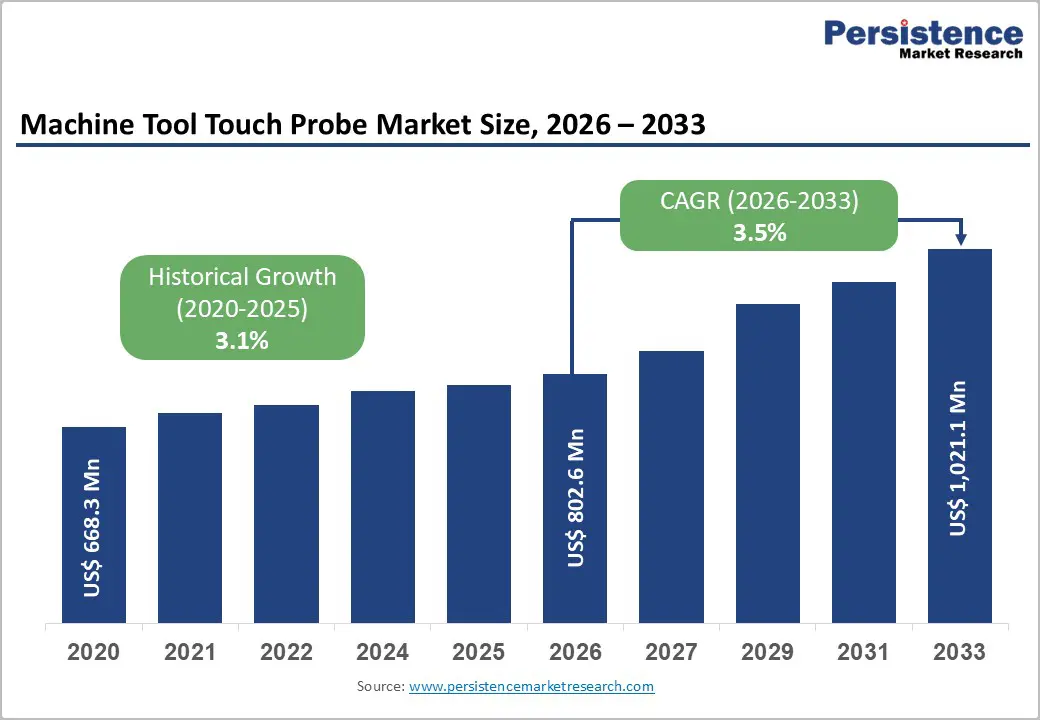
The global machine tool touch probe market size is expected to be valued at US$ 802.6 million in 2026 and projected to reach US$ 1,021.1 million by 2033, growing at a CAGR of 3.5% between 2026 and 2033.
This steady expansion is fundamentally driven by accelerating automation in precision manufacturing, rising quality-control standards across critical industries, and the proliferation of advanced CNC machining centers that require in-process measurement capabilities.
The automotive and aerospace sectors' pursuit of zero-defect manufacturing, combined with the growing adoption of lights-out manufacturing facilities, necessitates sophisticated touch-probe systems that enable real-time part verification, tool offset correction, and adaptive machining strategies, thereby reducing scrap rates and enhancing overall equipment effectiveness.
Key Industry Highlights:
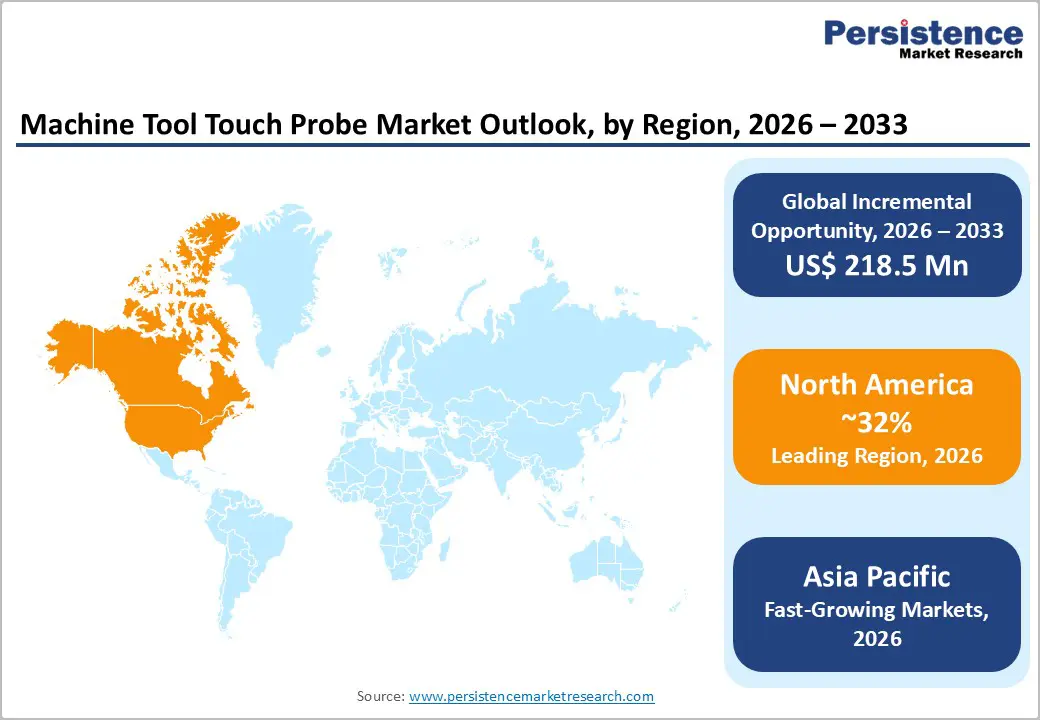
- Leading Region: North America leads the machine tool touch probe market with about 32% share in 2025, driven by strong aerospace and automotive manufacturing, strict regulatory standards, and sustained industry-research collaboration.
- Fastest Growing Region: Asia Pacific is the fastest-growing region with a 4.2% CAGR during 2026 - 2033, supported by manufacturing policy initiatives, advanced machine tool ecosystems, and expanding industrial bases across China, Japan, India, South Korea, and ASEAN.
- Dominant Segment: 3D touch probes dominate the market with roughly 52% share in 2025, owing to their multi-directional measurement capability, broad machining compatibility, and high-precision dimensional verification.
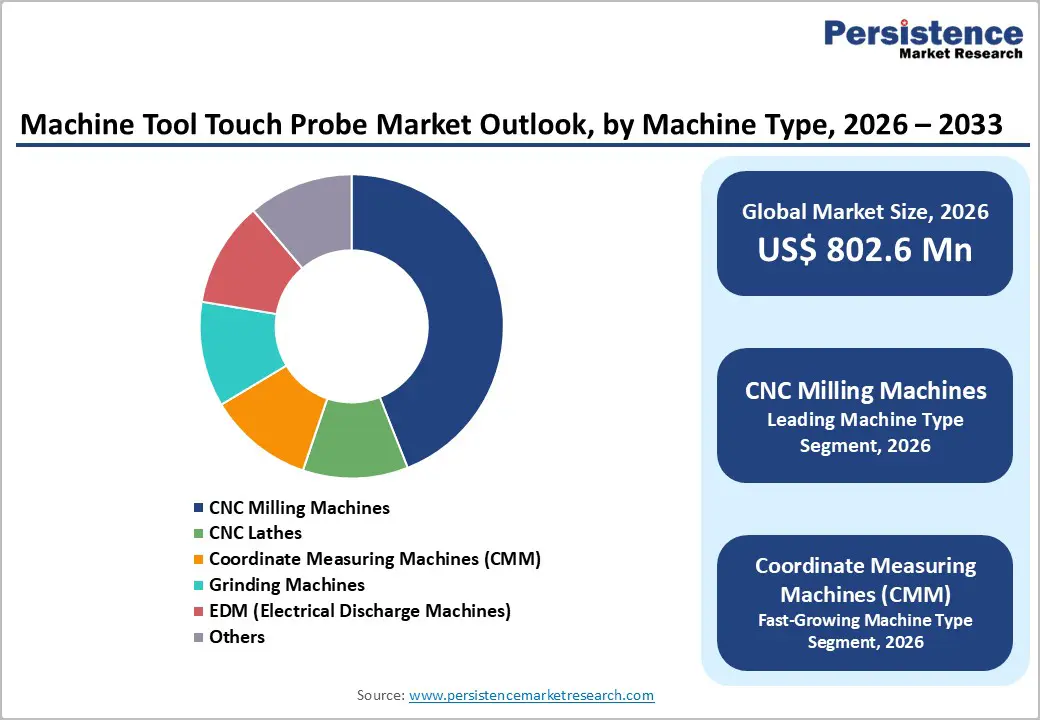
- Fastest Growing Segment: Coordinate Measuring Machines (CMMs) are the fastest-growing machine type segment at 4.3% CAGR, driven by rising shop-floor adoption and tighter integration of inspection with real-time manufacturing control.
- Key Opportunity: Additive-subtractive hybrid manufacturing presents the most significant opportunity, as multi-process systems increasingly require advanced touch probe solutions for alignment, in-process inspection, and workflow coordination.
| Key Insights | Details |
|---|---|
| Machine Tool Touch Probe Market Size (2026E) | US$ 802.6 million |
| Market Value Forecast (2033F) | US$ 1,021.1 million |
| Projected Growth CAGR (2026 - 2033) | 3.5% |
| Historical Market Growth (2020 - 2025) | 3.1% |
Market Dynamics
Drivers - Industry 4.0 and Smart Manufacturing Integration Driving Automated Inspection Demand
The global transition toward Industry 4.0 principles and smart manufacturing ecosystems is fundamentally transforming precision machining operations, creating substantial demand for intelligent touch probe systems.
According to the International Federation of Robotics (IFR), global industrial robot installations reached approximately 517,000 units in 2023, with manufacturing automation investments accelerating across major economies. Machine tool touch probes are critical enablers of adaptive machining, enabling CNC systems to automatically compensate for thermal expansion, tool wear, and fixture variations without operator intervention.
The Association for Manufacturing Technology (AMT) reports that manufacturers implementing automated in-process measurement systems achieve productivity gains of 15-25% and reduce scrap rates by up to 40%. Germany's Industrie 4.0 initiative emphasizes the digital integration of measurement systems into manufacturing execution systems, enabling real-time quality monitoring and predictive maintenance. Leading machine tool manufacturers, including DMG MORI, MAZAK, and Haas Automation, increasingly offer touch probe systems as standard equipment on premium CNC machining centers, reflecting the technology's evolution from an optional accessory to an essential manufacturing capability.
Stringent Quality Standards in Aerospace and Medical Device Manufacturing
Escalating regulatory requirements and quality assurance protocols in the aerospace and medical device sectors are driving sustained demand for precision measurement technologies, including advanced touch probe systems. The Federal Aviation Administration (FAA) and European Union Aviation Safety Agency (EASA) mandate comprehensive dimensional verification procedures for critical aircraft components, with tolerances frequently specified in micrometers. According to the Aerospace Industries Association (AIA), the global aerospace manufacturing sector delivered products valued at approximately US$838 billion in 2023, with each component requiring rigorous quality documentation throughout production. Touch probe systems enable manufacturers to perform statistical process control directly at the machine tool, reducing cycle times associated with traditional coordinate-measuring-machine inspections.
The Food and Drug Administration (FDA) enforces stringent Quality System Regulation (QSR) requirements under 21 CFR Part 820 for medical device manufacturers, necessitating validated measurement systems and comprehensive process documentation. The International Organization for Standardization (ISO) ISO 13485 standard for medical device quality management emphasizes risk-based approaches to manufacturing process control, with in-process measurement serving as a critical risk mitigation strategy.
Implantable medical devices, including orthopedic implants and cardiovascular components, require dimensional accuracy within ±10 micrometers, achievable only through sophisticated measurement systems integrated within machining operations.
Restraints - High Initial Investment and Integration Complexity
The substantial capital expenditure required for advanced touch probe systems and associated integration costs present significant barriers, particularly for small and medium-sized manufacturing enterprises. Premium 3D touch probe systems with wireless transmission capabilities can cost between US$ 8,000 to US$ 25,000, depending on accuracy specifications and environmental protection ratings, while comprehensive system integration, including software licensing, calibration equipment, and operator training, may double total investment.
According to the National Institute of Standards and Technology (NIST), successful implementation of automated measurement systems requires careful consideration of probe qualification procedures, coordinate system alignment protocols, and thermal stability management. Many contract manufacturers operating on thin profit margins struggle to justify touch probe investments when facing inconsistent production volumes and competitive pricing pressures.
The technical complexity of programming measurement routines and interpreting probe data requires skilled machinists with an understanding of geometric dimensioning and tolerancing, creating workforce development challenges in regions facing skilled labor shortages.
Accuracy Limitations in Challenging Machining Environments
Environmental factors, including vibration, thermal variations, and coolant contamination, can compromise touch-probe measurement accuracy, limiting its applicability in certain high-speed or harsh machining scenarios. The American Society of Mechanical Engineers (ASME) B89.4.1 standard for coordinate measuring machine performance verification acknowledges that machine tool environments present significantly greater measurement uncertainty compared to controlled metrology laboratories.
High-speed machining operations generating substantial thermal energy can cause dimensional variations exceeding touch probe repeatability specifications, typically ±1-2 micrometers for precision systems.
Coolant spray and chip accumulation on probe tips introduce contamination risks, requiring frequent cleaning cycles that disrupt production flow. According to the Coordinate Metrology Society, touch probe measurements represent screening inspections rather than definitive dimensional verification, with critical features often requiring secondary confirmation using dedicated metrology equipment. These limitations constrain market expansion in applications demanding the highest measurement confidence or operating under extreme environmental conditions.
Opportunity - Expansion in Electric Vehicle Manufacturing and Battery Production
The accelerating global shift toward electric mobility is creating strong growth opportunities for machine tool touch probe manufacturers as automotive production increasingly centers on battery-electric vehicle platforms. Electric vehicles rely on precision-machined components such as motor housings, gear assemblies, and thermal management systems, all of which require tight dimensional tolerances to ensure efficiency, safety, and durability. Battery manufacturing further expands measurement demand through complex machining of cell housings, cooling plates, and structural enclosures, often using aluminum and composite materials that require advanced probing strategies.
Large-scale investments in gigafactories across Asia, Europe, and North America are driving the adoption of automated, in-process measurement systems to maintain consistent quality at high production volumes. As EV penetration rises and battery designs evolve toward integrated and structural architectures, demand for reliable touch-probe systems that support high-precision, high-throughput machining environments is expected to increase significantly.
Additive-Subtractive Hybrid Manufacturing System Integration
The integration of additive and subtractive processes in hybrid manufacturing systems presents a growing opportunity for advanced touch-probe solutions that support multi-process coordination and quality assurance. Hybrid platforms enable manufacturers to combine additive design flexibility with the dimensional accuracy and surface finish of conventional machining, but this convergence increases the need for precise in-process measurement. Touch probes play a critical role by verifying build plate alignment, inspecting intermediate geometries during additive deposition, and validating final dimensions after finishing machining.
In-process probing allows real-time detection of geometric deviations, reducing scrap rates and enabling corrective adjustments during production. As hybrid manufacturing transitions from experimental use to full-scale industrial deployment, particularly in aerospace, defense, medical devices, and tooling, demand is rising for probing systems optimized for complex geometries and multi-axis environments. This shift favors suppliers offering specialized, application-ready measurement solutions.
Category-wise Analysis
Probe Type Insights
3D touch probes dominate the market, with approximately 52% market share in 2025, driven by their ability to perform comprehensive part-geometry inspection across multiple axes within a single setup. These probes support workpiece alignment, coordinate system establishment, feature location, and in-process dimensional verification, significantly improving machining accuracy and reducing reliance on separate offline inspection systems.
High repeatability enabled by advanced sensing technologies makes them indispensable in precision-critical sectors such as aerospace, medical devices, and high-end automotive manufacturing. The productivity benefits arising from reduced setup times and increased first-pass yield continue to reinforce 3D touch probes as the preferred choice for modern CNC machining centers.
Transmission Insights
Radio transmission systems lead the market, with an estimated 48% share in 2025, reflecting their reliability, signal stability, and durability in CNC machining environments. These systems eliminate cable wear and signal disruption associated with wired connections, while outperforming infrared alternatives in terms of operational range and interference resistance. High transmission reliability ensures consistent probe triggering and automatic identification across multiple machine tools, enhancing automated setup and measurement workflows. Their compatibility with high-density manufacturing cells and support for simultaneous multi-probe configurations further strengthen adoption. As factories increase automation and adopt lights-out machining practices, radio transmission remains critical for uninterrupted, high-precision touch-probe communications.
Machine Type Insights
CNC milling machines account for approximately 44% of the market in 2025, thereby driving demand for touch probe systems due to their widespread use in precision manufacturing. These machines execute complex multi-axis operations, in which accurate workpiece setup and in-process inspection directly affect quality and efficiency. Touch probes integrated into CNC milling machines facilitate automated part alignment, quick verification of critical dimensions, and adaptive compensation during runs.
The rapid adoption of advanced 5-axis milling centers, which require higher measurement accuracy and complex setup routines, has further entrenched the use of probes. The significant installed base and continual replacement cycles associated with CNC milling machines ensure sustained market demand for touch probes across industries.
Industry Insights
The automotive industry accounts for approximately 36% of the machine tool touch probe market in 2025, driven by the sector’s high production volumes, stringent quality standards, and extensive automation infrastructure. Automotive manufacturing involves machining critical components, such as engine parts, transmission housings, and chassis elements, for which precision verification is essential to meet specifications. Touch probes enable in-process inspection and statistical process control across high-speed production lines, reducing scrap and downtime.
As automakers adopt flexible and electric-vehicle manufacturing platforms, reliance on automated measurement systems intensifies. Robust integration of touch probes with manufacturing execution systems supports real-time quality feedback, reinforcing the automotive sector’s leadership in overall market demand.
Regional Insights
North America Machine Tool Touch Probe Market Trends and Insights
North America retains a leading position in the machine tool touch probe market, accounting for approximately 32% of the market in 2025, supported by its mature aerospace, automotive, and medical manufacturing base. The United States anchors regional demand through high-value aerospace and defense production, where precision machining and stringent quality control drive consistent adoption of in-process measurement technologies. Federal initiatives promoting advanced manufacturing, including programs supporting small and mid-sized enterprises, further accelerate probe system integration.
Canada complements regional growth with a strong aerospace cluster concentrated in Quebec and Ontario, sustaining demand for high-accuracy machining and inspection solutions. Medical device manufacturing is an increasingly important end-use segment, as regulated production environments emphasize automated measurement for compliance and traceability.
The region’s strong innovation ecosystem, reinforced by industry-academia collaboration, continues to advance probe performance in areas such as wireless connectivity, reliability, and miniaturization.
Europe Machine Tool Touch Probe Market Trends and Insights
Europe represents a structurally strong and technologically advanced market, driven by its leadership in machine tool manufacturing, aerospace engineering, and automotive production. Germany dominates regional demand owing to its global leadership in precision engineering and machine tool manufacturing, in which touch probes are widely integrated into advanced CNC systems. Harmonized regulatory frameworks and CE conformity requirements facilitate the adoption of standards across member states, thereby improving market consistency.
The United Kingdom and France sustain demand through aerospace manufacturing, particularly in aircraft engines and structural components requiring tight dimensional control. Italy contributes through its strength in metrology and automotive-oriented machining, while Spain’s automotive assembly operations maintain steady requirements for quality assurance equipment. EU-backed research and innovation programs promote intelligent manufacturing and adaptive machining, reinforcing long-term demand for advanced touch probe systems across industrial applications.
Asia Pacific Machine Tool Touch Probe Market Trends and Insights
Asia-Pacific is the fastest-growing regional market, projected to expand at a CAGR of 4.2% from 2026 to 2033, driven by industrial expansion, growth in automotive production, and rising investments in precision manufacturing. China leads regional consumption as manufacturing upgrades emphasize quality, automation, and dimensional accuracy across high-volume production environments. Japan remains a technology hub for machine tools and precision measurement, with strong domestic demand supporting continuous innovation in probe systems.
South Korea’s semiconductor and electronics manufacturing sectors generate demand for ultra-precision machining and measurement solutions. India is emerging as a high-growth market as policy-led manufacturing initiatives accelerate the adoption of CNC equipment across automotive, aerospace, and general engineering sectors. Additionally, ASEAN economies benefit from foreign direct investment in automotive and electronics manufacturing, creating sustained opportunities for touch probe suppliers supporting multinational production facilities.
Competitive Landscape
The machine tool touch probe market is moderately consolidated, dominated by a few multinational players that leverage technological innovation, diverse product portfolios, and extensive distribution networks to maintain market leadership. Competition primarily revolves around technological differentiation, including measurement accuracy, transmission reliability, battery efficiency, environmental resilience, and software integration.
Leading players prioritize research and development, focusing on wireless communication, AI-enabled measurement analysis, and predictive maintenance capabilities to strengthen value propositions.
Strategic collaborations with CNC system providers enhance probe integration and optimize user experience, while geographic expansion through regional offices, support centers, and distributor networks ensures localized service. Alongside global leaders, specialized regional manufacturers target domestic markets by offering tailored solutions and competitive pricing, particularly in applications requiring specific expertise. Emerging manufacturers, especially in Asia, are gradually improving quality standards to capture price-sensitive segments, intensifying competition and prompting incumbents to continuously innovate and refine their strategies to protect market share and address evolving customer demands.
Key Developments
- March 2025: LK Metrology introduces a new range of modular probe rack systems for coordinate measuring machines (CMMs), enabling automatic tool exchanges and improved storage of styli, probes, adapters, and scanners to boost inspection efficiency.
- April 2025: Hexagon launches its Digital Factory as-a-Service offering to help manufacturers rapidly digitize facilities with millimeter-accurate 3D scanning, enabling faster planning, remote collaboration, and agile production redesign with reduced costs and site visits.
- July 2025: Mahr unveils the Micromar 844 EWR(i) digital 3-point bore measuring device designed to enhance speed, accuracy, and ergonomic handling for inside diameter measurement on the shop floor.
Companies Covered in Machine Tool Touch Probe Market
- Renishaw plc.
- Hexagon AB
- DR. Johannes Heidenhain GmbH
- Blum-Novotest GmbH
- Tormach, Inc.
- METROL Co., Ltd.
- Marposs S.p.A.
- P-Tech Industries Pvt. Ltd.
- Centroid Corporation
- J & M Precision Products Inc.
- Micro-Vu
- Quality Vision International, Inc.
- Mahr GmbH
- Magnescale Co. Ltd.
- Carl Zeiss AG
- Haimer GmbH
- M&H Inprocess Messtechnik GmbH
- Productive Process Solutions LLC
- Automated Precision Inc.
Frequently Asked Questions
The machine tool touch probe market is expected to reach approximately US$ 802.6 million in 2026.
Demand is driven by Industry 4.0 adoption, stricter quality regulations, precision machining needs, and automated in-process measurement.
North America leads with around 32% market share, supported by strong aerospace, automotive, and medical manufacturing bases.
Additive-subtractive hybrid manufacturing integration is the key opportunity requiring advanced probing solutions.
Leading companies include Renishaw plc., Hexagon AB, DR. Johannes Heidenhain GmbH, Blum-Novotest GmbH, METROL Co., Ltd., Marposs S.p.A., Carl Zeiss AG, Mahr GmbH, and Magnescale Co. Ltd.


