




- Food Ingredients & Additives
- Meat Dicing Machine Market
Meat Dicing Machine Market Size, Share, and Growth Forecast, 2026 - 2033
Meat Dicing Machine Market by Machine Type (Automatic, Semi-automatic, Manual), Meat Type (Pork, Mutton, Beef), End-user (Commercial, Household), and Regional Analysis for 2026 – 2033

Meat Dicing Machine Market Size and Trends Analysis
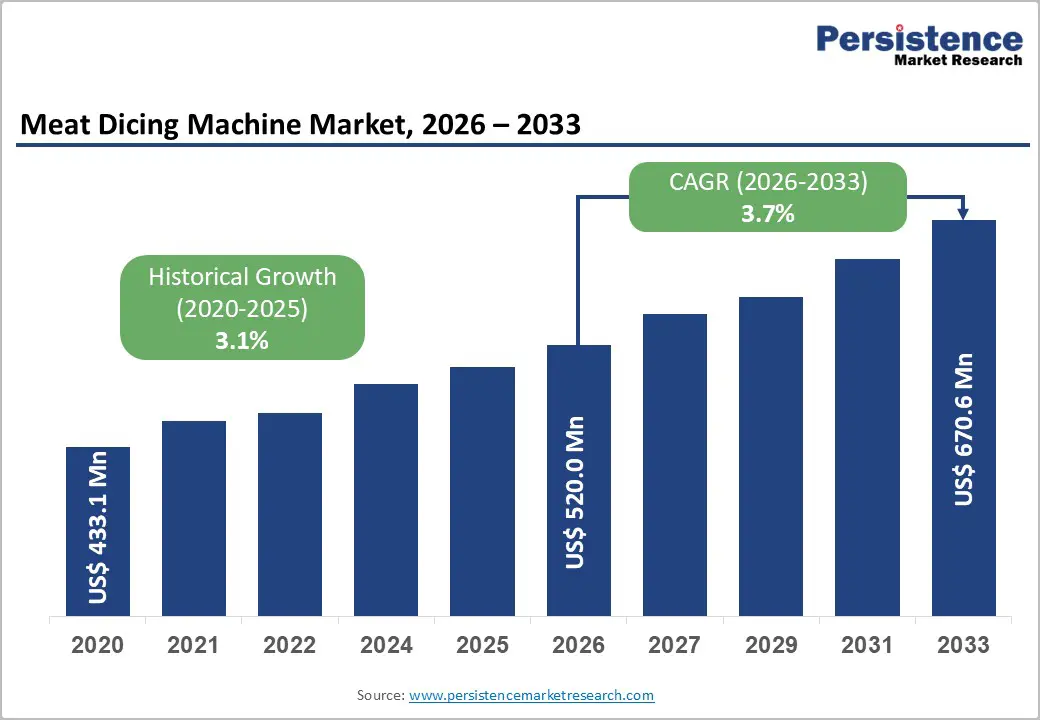
The global meat dicing machine market size is likely to be valued at US$520.0 million in 2026, and is expected to reach US$670.6 million by 2033, growing at a CAGR of 3.7% during the forecast period from 2026 to 2033, driven by the increasing prevalence of processed meat consumption, rising demand for uniform meat cubes in commercial kitchens and food manufacturing, and growing automation in meat processing facilities.
Growing demand for high-capacity automatic meat dicing machines, especially for pork and beef in commercial end-use, is accelerating adoption across food processors. Advances in stainless-steel blades, precision cutting technology, and hygienic design are further boosting uptake by offering better yield, reduced labor, and food safety compliance. Increasing recognition of meat dicing machines as critical for consistent product quality, production efficiency, and cost control in emerging meat processing and ready-to-cook markets remains a major driver of market growth.
Key Industry Highlights:
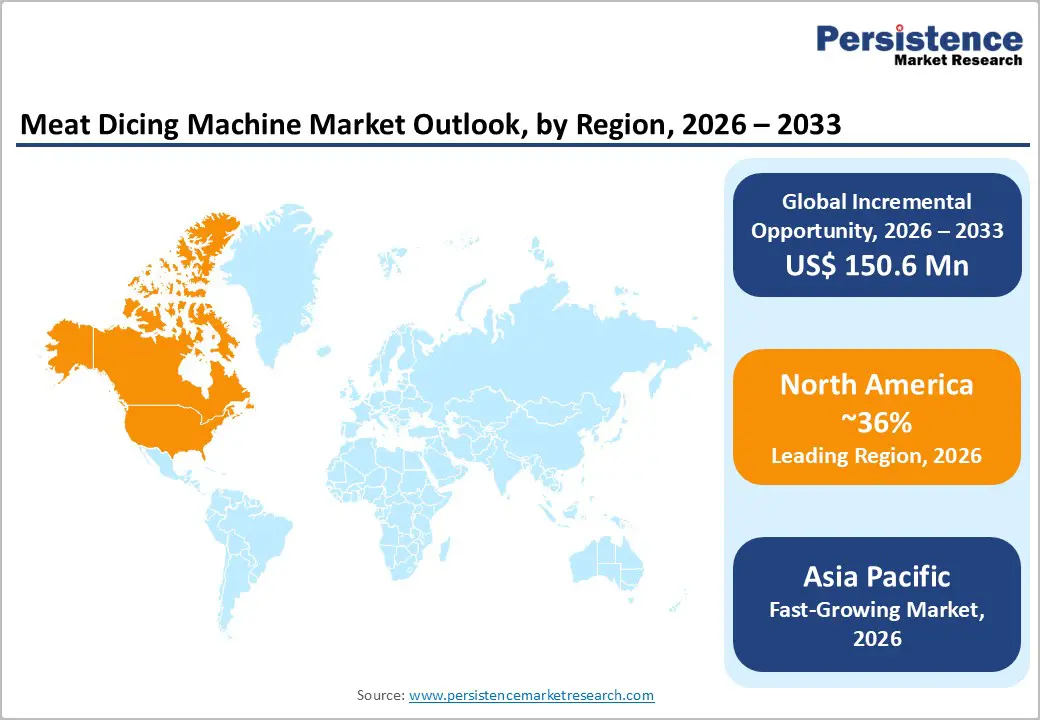
- Leading Region: North America is projected to account for nearly 36% of the share in 2026, supported by advanced meat processing capacity, strong food-service demand, and high awareness of efficiency benefits across the U.S. and Canada.
- Fastest-growing Region: Asia Pacific, fueled by expanding meat export volumes, increasing commercial kitchen automation, and rising organized retail of processed meat.
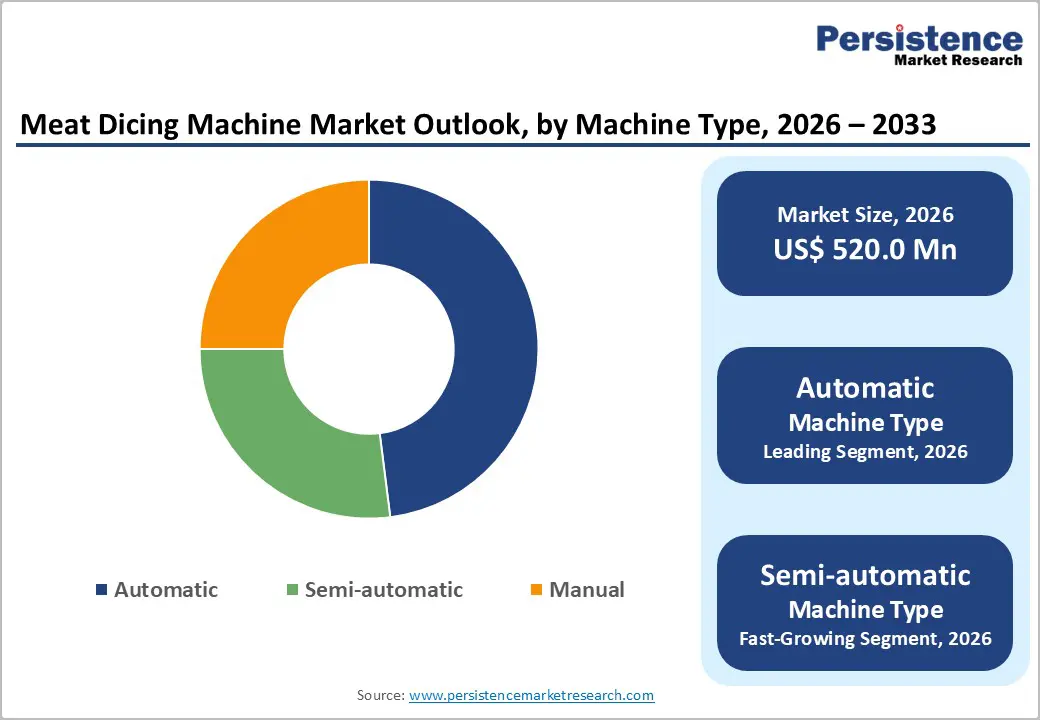
- Dominant Machine Type: Automatic, to hold approximately 58% of the market share, as it remains the preferred choice for high-volume processing.
- Leading Meat Type: Pork, to contribute nearly 48% of the market revenue, due to the highest global consumption volume.
| Key Insights | Details |
|---|---|
| Meat Dicing Machine Market Size (2026E) | US$ 520.0 Mn |
| Market Value Forecast (2033F) | US$ 670.6 Mn |
| Projected Growth (CAGR 2026 to 2033) | 3.7% |
| Historical Market Growth (CAGR 2020 to 2025) | 3.1% |
Market Factors – Growth, Barriers, and Opportunity Analysis
Growth Analysis – Rising Processed Meat Consumption and Commercial Kitchen Automation
Processed meat demand has been climbing due to changing diets and convenience orientation, which supports greater use of machines such as meat dicers in processing facilities. In India, official data shows that of 10.25 million tonnes of meat produced in 2023-24, an estimated 3.50 million tonnes were processed in the same period, indicating a significant share directed through industrial channels where precision cutting equipment is used to meet food safety and product quality standards. Domestic consumption accounted for the bulk of this processed meat after exports of 813.71 tonnes, reflecting growing internal demand for processed protein products.
Commercial kitchens and foodservice operations are increasingly adopting automated technologies to boost throughput and compensate for labor constraints noted by the U.S. Bureau of Labor Statistics, which highlights continued pressures in food preparation employment that encourage restaurants and institutional kitchens to explore automated cooking and food handling solutions. Government reports on food service trends also point to expanding use of technological solutions, including robotic cooking systems and smart dispensing platforms in major markets such as China’s hotel, restaurant, and institutional sector, where automation is part of broader efficiency strategies. These shifts encourage greater uptake of mechanised equipment such as meat dicers that fit into broader commercial kitchen automation workflows.
Increasing Meat Export and Food Safety Standards
Export growth in the meat sector has been supported by rising global demand for animal protein and sustained government tracking of agricultural shipments. In India’s case, official monitoring shows that buffalo meat exports increased by about 17 % to US$2.18 billion during the first half of the 2025-26 fiscal year, with volume rising to roughly 623,000 tonnes, reflecting stronger external market interest for chilled and frozen products. APEDA (Agricultural and Processed Food Products Export Development Authority) reports place buffalo meat among the top exported items from the agricultural basket, contributing significantly to the overall increase in agri-food exports, which have also seen double-digit rises in recent reporting periods.
Ensuring food safety and compliance with international standards plays a central role in enabling and sustaining exports of meat and meat products. Government regulations require that abattoirs, processing plants, and exported products meet defined hygiene and quality benchmarks as part of export eligibility, including formal inspection and certification systems. These national standards are generally aligned with globally recognized frameworks and are complemented by international Sanitary and Phytosanitary (SPS) measures that guide how food safety is regulated in trade. Export inspection and certification under these systems help meet importing country expectations for safe and traceable meat products, reducing rejections at borders and enhancing market access for compliant producers.
Barrier Analysis – High Initial Investments for Automatic Machines
High initial capital investments remain a notable barrier for companies considering fully automated machinery such as meat dicers and related processing equipment. Official sector profiles from the Ministry of Food Processing Industries, Government of India, highlight that modern food processing machinery involves substantial upfront costs that deter small and medium-sized enterprises (SMEs) from adopting advanced technologies, even as the overall market grows. According to the ministry’s machinery sector overview, high capital costs are specifically cited as a key challenge for equipment adoption in the food processing industry, including automated cutting and dicing systems that require precision components and robust construction to meet hygiene norms.
For smaller operators that often operate on tight budget constraints, these high upfront expenses can slow the transition from manual or semi-automatic methods to fully automated lines. Due to automated machines often integrating robotics, sensors, and advanced control systems, the purchase price alone can exceed what many SMEs are able to finance without external support.
Maintenance and Hygiene Compliance Costs
Automated meat processing equipment, such as meat dicers, must be regularly maintained and cleaned to meet formal hygiene and food safety requirements, which contributes to ongoing operating costs for processors. In India, rules under the Food Safety and Standards Regulations specify that equipment and surfaces that contact meat must be made of non-toxic, smooth, non-absorbent material and be easily accessible for thorough cleaning and disinfection, and facilities, including equipment, must be kept in good repair to prevent contamination risks. These design and maintenance obligations mean processors must invest in trained personnel, cleaning agents, sanitation schedules, and downtime for deep cleaning, adding to the total cost of ownership of automated machines.
Internationally recognized frameworks such as HACCP and ISO 22000 require documented hygiene procedures and ongoing monitoring to ensure compliance with food safety standards, further increasing expenditure on quality management systems and related documentation. Meeting stringent hygiene norms also influences how automated meat dicers are operated and maintained over time. Equipment must be kept functional and clean to avoid foodborne contamination, which means periodic disassembly, inspection, replacement of worn parts, and calibration of sensors that control cuts and surfaces, all of which require technician time and supplies.
Opportunity Analysis – Growth in Automatic and Hygienic Meat Dicing Machines
India’s meat processing equipment sector presents a clear opportunity for growth in automatic and hygienic meat dicing machines as processors modernize their operations to meet demand and standards. According to the Government of India’s Ministry of Food Processing Industries, the meat processing equipment market is projected to grow from USD 712 million to USD 1,019.5 million by 2030, representing a CAGR of about 6.16 % during 2025–2030; within this segment, dicing equipment is identified as the fastest-growing sub-segment owing to its role in precision cutting and consistency in output. Increased mechanization reflects processors’ shift toward automated systems that can handle higher throughput, improve yield, and reduce dependence on manual labour, all of which enhance overall efficiency and product uniformity.
Hygiene and food safety frameworks set by regulators such as the Food Safety and Standards Authority of India (FSSAI) create further impetus for the adoption of advanced machinery. These frameworks require stringent cleaning, monitoring, and documentation of processing environments and equipment contact surfaces to control contamination risks, prompting processors to invest in machines designed for easy sanitation and compliance. Machines engineered with hygienic design features help processors adhere to regulatory expectations while lowering the risk of foodborne hazards, increasing the attractiveness of automatic dicing solutions.
Advancements in Ready-to-Cook Meat
Advancements in ready-to-cook (RTC) meat have reshaped how consumers and foodservice operators approach meal preparation, driven by improvements in processing technology, supply chain systems, and food safety practices. Official data from the Government of India’s Ministry of Food Processing Industries shows rapid expansion of the meat processing sector, which includes RTC products such as marinated and pre-cut meats that require minimal preparation at the point of consumption. Technological enhancements have enabled processors to maintain product quality and shelf life through controlled temperature systems and hygienic operations that align with regulatory standards set by the Food Safety and Standards Authority of India (FSSAI). These systems allow RTC meat to be produced, packed, and distributed with consistent quality control, reducing risks of spoilage and contamination compared with traditional manual methods.
Government food safety frameworks emphasize compliance with hygiene, storage and labelling requirements, prompting adoption of automated cutting, marination and packaging equipment that preserve freshness and extend use-by periods without compromising safety. Adoption of technologies such as modified atmosphere packaging (MAP) and cold chain tracking systems ensures that RTC meat products maintain regulated temperatures throughout distribution, which supports broader market reach and export potential. FSSAI’s regulatory oversight of meat handling and processing infrastructure has encouraged processors to invest in improved machinery and sanitation practices, raising overall standards within the sector.
Category-wise Analysis
Machine Type Insights
The automatic segment is anticipated to dominate the market, accounting for 58% of the market share in 2026. Its dominance is driven by as processors continued to scale operations and standardize output across high-volume facilities. Greater throughput requirements in meat processing plants encouraged the adoption of automated cutting and dicing systems that delivered uniform size, reduced handling time, and supported consistent quality. Regulatory focus on hygiene and traceability led operators to favor enclosed, easy-to-clean machines that limited manual contact with raw meat. Smithfield Foods, where advanced automated rib-pulling and cutting systems were deployed in its U.S. pork plants to enhance precision and efficiency on processing lines. At these facilities, robots were used to slice rib sections off hog carcasses continuously, reducing physical strain on workers and improving consistency in cuts.
The semi-automatic segment represents the fastest-growing machine type, as many small and medium-scale processors sought flexible solutions that balanced cost and efficiency. Semi-automatic machines allowed operators to maintain control over key steps while gaining mechanical assistance for repetitive tasks such as cutting and portioning, making them suitable for varied product sizes and batch runs. These systems required lower initial investment and simpler maintenance than fully automatic lines, helping smaller businesses modernize without substantial capital outlay. Changzhou Jinkun Food Machinery Co., Ltd.’s High-Capacity Semi-Automatic Slicer, which was implemented by a leading European supermarket chain to modernise its meat preparation operations. After the semi-automatic slicer was adopted, the chain reported that over 2 tons of meat were processed daily with improved consistency and reduced downtime, showing how semi-automatic equipment can drive efficiency in commercial settings with less upfront cost than fully automatic lines.
Meat Type Insights
The pork segment is expected to dominate the market, contributing nearly 48% of revenue in 2026, fueled by its large share in global meat production and widespread use across processed food formats. Pork is commonly used in sausages, bacon, diced fillings, and ready-to-cook products that require uniform cutting for portion control and consistent cooking. High-volume pork processing lines benefit strongly from mechanized dicing due to throughput demands and strict hygiene requirements. Tyson Foods, Inc., where the pork segment has remained a substantial contributor to its overall operations. In Tyson’s fiscal year 2025, pork sales were reported at about US$5.78 billion, generating a notable portion of the company’s product revenues alongside beef, chicken, and prepared foods.
The beef segment represents the fastest-growing meat type, as demand increased for portion-controlled beef cuts used in ready-to-cook meals, foodservice menus, and premium retail packs. Expansion of quick-service restaurants and institutional catering raised the need for consistent diced and cubed beef for stews, curries, and stir-fry formats. Processors scaled capacity to serve export orders and domestic urban demand, which supported investments in mechanized cutting to maintain yield and uniformity. JBS, one of the world’s largest beef processors, where its JBS Beef North America division recorded a net revenue of about US$7.2 billion in the third quarter of 2025, marking a strong performance driven by sustained beef demand and expanded product lines. This growth demonstrated how beef processing operations were generating significant income within multi-protein portfolios, reflecting rising market needs for beef products that require precision cutting and portion control in processing facilities.
Regional Insights
North America Meat Dicing Machine Market Trends
North America is projected to account for nearly 36% of the global meat dicing machine market in 2026, driven by the region’s advanced meat processing, strong food-service demand, and high public awareness of efficiency benefits. Distribution systems in the United States and Canada provide extensive support for meat-dicing machine programs, ensuring wide accessibility across automatic, pork, and commercial populations. Increasing demand for high-capacity, convenient, and easy-to-clean forms is further accelerating adoption, as these formats improve yield and reduce barriers associated with manual cutting.
Innovation in meat-dicing machine technology, including stable semi-automatic, improved hygienic delivery, and targeted beef enhancement, is attracting significant investment from both public and private sectors. Government initiatives and USDA campaigns continue to promote use against labor risks, consistency concerns, and emerging RTE threats, creating sustained market demand. The growing focus on household grades and specialty uses, particularly for pork and others, is expanding the target applications for meat dicing machines.
Europe Meat Dicing Machine Market Trends
Market growth in Europe is increasing awareness of processing efficiency and hygiene benefits, strong regulatory systems, and government-led food safety programs. Countries such as Germany, France, the U.K., and Spain have well-established meat processing frameworks that support routine meat dicing machine use and encourage adoption of innovative hygienic delivery methods. These high-compliance formulations are particularly appealing for commercial populations, regulation-conscious processors, and pork users, improving yield and coverage rates.
Technological advancements in meat dicing machine development, such as enhanced blade systems, application-targeted delivery, and improved semi-automatic grades, are further boosting market potential. European authorities are increasingly supporting research and trials for dicers against both routine and specialized needs, strengthening market confidence. The growing emphasis on convenient, safe options is aligned with the region’s focus on preventive contamination reduction and labor efficiency. Public awareness campaigns and promotion drives are expanding reach in both commercial and household segments, while suppliers are investing in hygienic materials and novel variants to increase efficacy.
Asia Pacific Meat Dicing Machine Market Trends
Asia Pacific is likely to be the fastest-growing market for meat dicing machines in 2026, driven by rising meat processing awareness, increasing government initiatives, and expanding application programs across the region. Countries such as China, India, Vietnam, and Thailand are actively promoting dicing machine campaigns to address processed meat growth and emerging efficiency needs. Meat-dicing machines are particularly attractive in these regions due to their cost-effective administration, ease of adoption, and suitability for large-scale commercial and pork drives in both urban and semi-urban populations.
Technological advancements are supporting the development of stable, effective, and easy-to-deploy meat dicing machines, which can withstand challenging production conditions and minimize labor dependence. These innovations are critical for reaching domestic processors and improving overall meat preparation coverage. Growing demand for automatic, pork, and commercial applications is contributing to market expansion. Public-private partnerships, increased food processing expenditure, and rising investment in dicing machine research and production capacity are further accelerating growth. The convenience of machine delivery, combined with improved uniformity and reduced risk of inconsistency, positions it as a preferred choice.
Competitive Landscape
The global meat dicing machine market is shaped by competition between established food-processing equipment leaders and fast-growing regional manufacturers. In North America and Europe, Urschel Laboratories, Inc., and FAM nv maintain leadership through strong R&D pipelines, long-standing processor relationships, and global distribution networks that support rapid deployment of automatic, hygienic systems. These players focus on precision cutting, easy-clean designs, and higher throughput to meet food safety expectations and industrial scale requirements.
In Asia Pacific, regional manufacturers gain traction with cost-competitive machines that improve accessibility for price-sensitive processors and local foodservice operators. Adoption of automatic systems lifts throughput, lowers labor exposure, and supports plant-wide integration with digital controls and sanitation workflows. Strategic partnerships, collaborations, and acquisitions combine engineering expertise with market reach, speeding the commercialization of new platforms.
Key Industry Developments:
- In January 2026, Urschel Laboratories, Inc. expanded its food-cutting portfolio in Italy and all of Asia began selling KRONEN Systems alongside Urschel solutions. KRONEN Systems are now offered through Urschel in the United States, Mexico, Pakistan, China, as well as across Asia and Italy.
- In April 2025, FAM STUMABO unveiled an upgraded Yuran Hytec 300 cutting machine for meat, poultry, alternative proteins, and pet food, adding a new exit conveyor system. The Yuran Hytec 300 EC was showcased at IFFA in Frankfurt in May and built on last year’s model with enhancements that streamlined cutting and processing across products.
Companies Covered in Meat Dicing Machine Market
- Urschel Laboratories, Inc.
- FOODLOGISTIK
- MHS Schneidetechnik GmbH
- FAM nv
- Luohe Quality Mechanical Equipment Co., Ltd.
- Focus Technology Co., Ltd.
Frequently Asked Questions
The global meat dicing machine market is projected to reach US$520.0 million in 2026.
Rising demand for processed and ready-to-cook meat products increased the need for uniform cutting, higher throughput, and consistent quality, which supported the adoption of meat dicing machines across commercial and industrial processing lines.
The meat dicing machine market is poised to witness a CAGR of 3.7% from 2026 to 2033.
Growing adoption of hygienic, semi-automatic, and automatic equipment by small and mid-sized processors creates opportunities for affordable, modular machines with easy-clean designs and lower operating complexity.
Urschel Laboratories, Inc., FOODLOGISTIK, MHS Schneidetechnik GmbH, FAM nv, and Luohe Quality Mechanical Equipment Co., Ltd are the key players.


