




- Food Ingredients & Additives
- Cotton Candy Machines Market
Cotton Candy Machines Market Size, Share, and Growth Forecast, 2026 – 2033
Cotton Candy Machines Market by Product Type (Tabletop, Commercial-grade, Industrial-grade), Application (Foodservice and Hospitality, Entertainment and Amusement Parks, Retail and Supermarkets, Events and Parties), and Regional Analysis for 2026 – 2033

Cotton Candy Machines Market Size and Trends Analysis
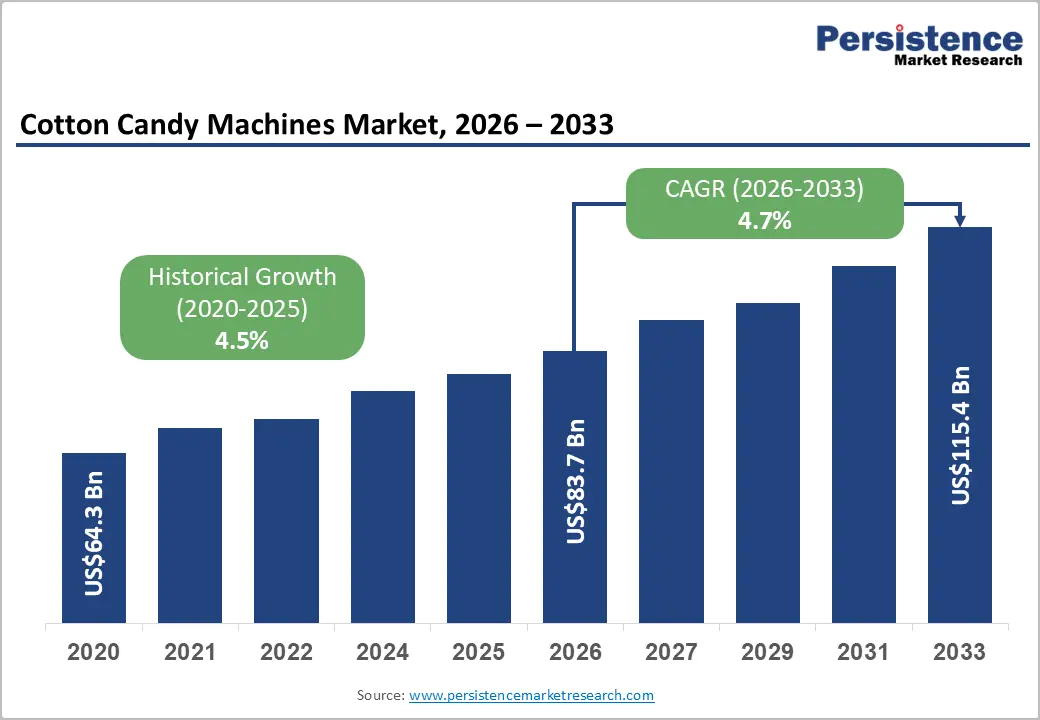
The global cotton candy machines market size is likely to be valued at US$83.7 billion in 2026 and is expected to reach US$115.4 billion by 2033, growing at a CAGR of 4.7% during the forecast period from 2026 to 2033, driven by increasing investments in amusement parks, festivals, cinemas, and event-based catering services. Rapid urbanization, rising disposable incomes, and evolving consumer preferences for experiential and nostalgic foods are accelerating adoption, particularly in emerging economies. The Asia Pacific region is witnessing robust momentum, fueled by strong growth in theme parks, shopping malls, and organized retail formats. Technological advancements, including energy-efficient heating elements, automated operation, and compact designs, are enhancing machine performance while lowering operational and maintenance costs, encouraging wider adoption among small vendors and commercial operators.
Key Industry Highlights:
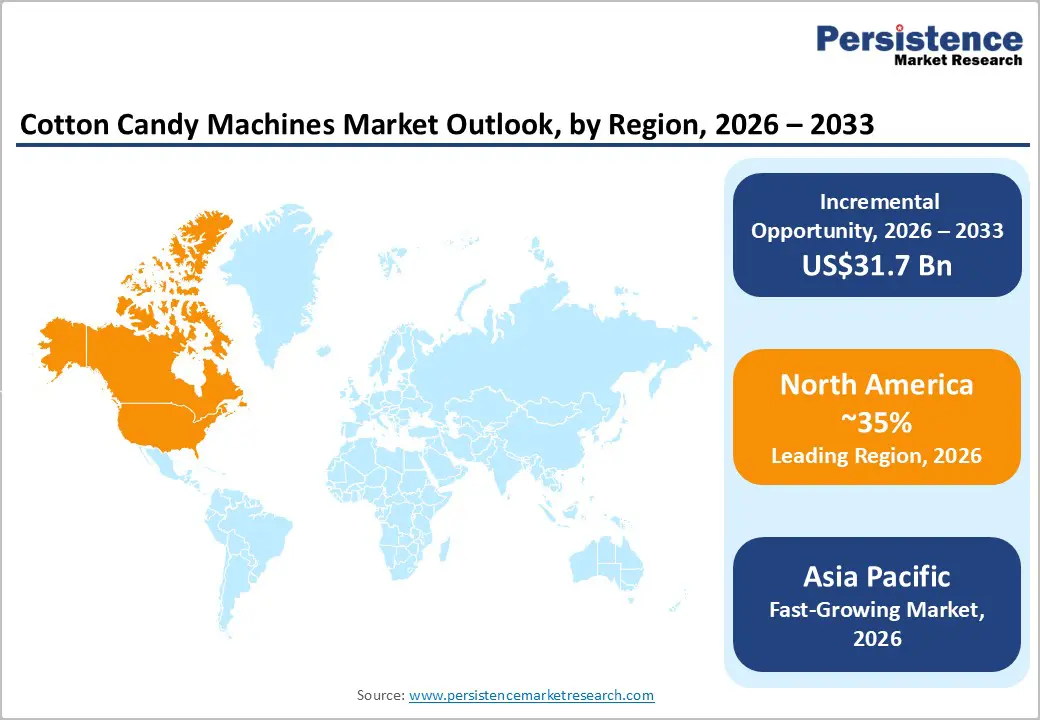
- Leading Region: North America is anticipated to be the leading region, accounting for a market share of 35% in 2026, driven by a mature amusement park ecosystem, high urbanization, strong consumer spending power, and rapid adoption of technologically advanced and energy-efficient equipment.
- Fastest-growing Region: Asia Pacific is likely to be the fastest-growing region in the cotton candy machines in 2026, supported by rapid urbanization, expanding tourism and entertainment infrastructure, cost-efficient manufacturing, and strong demand growth across China, India, Japan, and ASEAN economies.
- Leading Product Type: The commercial-grade segment is projected to represent the leading product type in 2026, accounting for 45% of the revenue share, driven by its optimal balance of output capacity, durability, and suitability for foodservice operations.
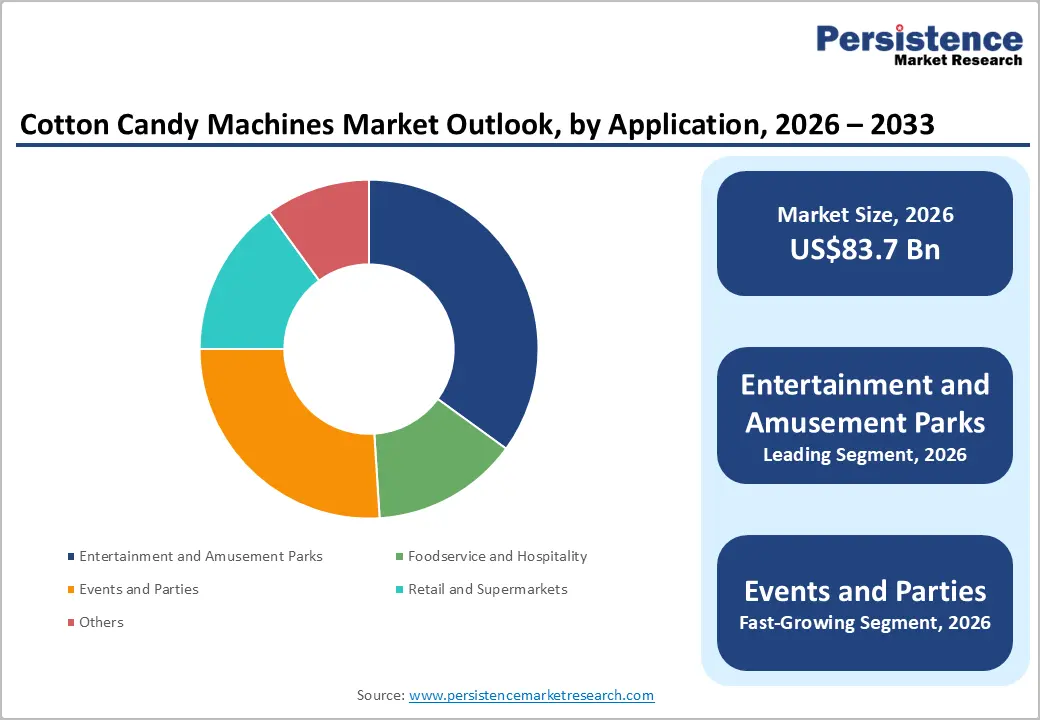
- Leading Application: Entertainment and amusement parks are anticipated to be the leading application type, accounting for over 38% of the revenue share in 2026, supported by expanding theme park infrastructure, rising tourism activities, and high consumer spending on on-site food and beverage experiences.
| Key Insights | Details |
|---|---|
| Cotton Candy Machines Market Size (2026E) | US$83.7 Bn |
| Market Value Forecast (2033F) | US$115.4 Bn |
| Projected Growth (CAGR 2026 to 2033) | 4.7% |
| Historical Market Growth (CAGR 2020 to 2025) | 4.5% |
Market Factors – Growth, Barriers, and Opportunity Analysis
Rising Demand in Entertainment and Foodservice Sectors
Cotton candy remains a staple impulse snack across amusement parks, theme parks, cinemas, fairs, festivals, and family entertainment centers. Increasing investments in leisure infrastructure, particularly in developing and urbanizing regions, have expanded the number of venues that rely on high-margin, visually appealing food offerings to enhance visitor experience. Cotton candy machines benefit from their ability to attract consumers through live preparation, vibrant colors, and nostalgic appeal, making them highly suitable for high-footfall environments. Seasonal events, carnivals, and traveling fairs amplify demand, as portable and commercial-grade machines are easy to deploy and operate. The recovery and expansion of tourism have increased visitor volumes at entertainment destinations, directly increasing concession sales.
Parallel growth in the foodservice sector significantly strengthens market expansion, driven by the diversification of menus and the growing emphasis on experiential and customizable food products. Restaurants, cafés, food trucks, shopping malls, and quick-service outlets are increasingly incorporating cotton candy machines to differentiate offerings and attract younger consumers and families. The rise of themed dining, pop-up food concepts, and social-media-driven food trends has elevated the importance of visually engaging desserts, where cotton candy plays a prominent role. Commercial-grade machines are particularly favored due to their balance of efficiency, hygiene compliance, and operational flexibility. Growth in organized retail and hospitality chains has led to standardized adoption of compact and energy-efficient equipment, lowering long-term operating costs.
Regulatory Hurdles on Food Safety Standards
Cotton candy machines used in commercial environments must comply with strict hygiene, material safety, and operational regulations imposed by food safety authorities across regions. Requirements related to food-contact materials, temperature control, electrical safety, and cleaning protocols increase product design complexity and certification timelines. Compliance with standards such as food-grade stainless steel usage, contamination prevention, and operator safety mechanisms often raises manufacturing and testing costs. For vendors operating across multiple regions, differing regulatory frameworks complicate market entry, as machines must be adapted to local compliance norms.
The impact of food safety regulations is particularly evident in cross-border trade and import-export activities within the cotton candy machines market. Imported machines often face additional certification requirements, labeling mandates, and customs inspections, which can extend delivery timelines and raise final prices for end users. In regions with stringent food safety enforcement, operators must also invest in regular maintenance, sanitization training, and compliance audits, adding to overall operating expenses. These factors discourage the adoption among small retailers, mobile vendors, and event-based businesses with limited budgets. Regulatory updates and revisions require manufacturers to continually redesign components or upgrade existing models, affecting product lifecycle stability.
Technological Convergence with Smart Automation
Manufacturers increasingly integrate advanced electronics, sensors, and automated controls into machine designs. Smart automation enables precise temperature regulation, automated sugar dispensing, and consistent spinning speeds, ensuring uniform product quality while reducing operator dependency. These features are particularly valuable in high-traffic environments such as amusement parks, malls, and cinemas, where speed, consistency, and hygiene are critical. Automated systems also minimize manual handling, lowering contamination risks and supporting compliance with food safety regulations. Touchscreen interfaces and preset operating modes simplify machine usage, allowing staff with minimal training to operate equipment efficiently.
The convergence of smart automation with digital connectivity enhances market potential by enabling data-driven operations and predictive maintenance. IoT-enabled cotton candy machines can monitor performance metrics such as usage frequency, energy consumption, and maintenance cycles in real-time, helping operators reduce downtime and extend equipment lifespan. Remote diagnostics and alerts allow proactive servicing, lowering repair costs and preventing unexpected failures during peak operating hours. Energy-efficient components combined with smart control systems reduce power consumption, making machines more sustainable and cost-effective over their lifespan. For manufacturers, automation creates opportunities for product differentiation and premium pricing, while also enabling advanced customization options such as variable portion sizes, colors, and flavors.
Category-wise Analysis
Product Type Insights
The commercial-grade segment is expected to lead the cotton candy machines market, accounting for approximately 45% of revenue in 2026, driven by its widespread use in foodservice and entertainment venues, where reliability, consistent output, and ease of operation meet high-volume demand efficiently. Commercial-grade machines are widely adopted in amusement parks, malls, and family entertainment centers due to their ability to produce large quantities of cotton candy quickly while adhering to hygiene standards such as the FDA and USDA protocols. For example, Gold Medal Products Co.’s commercial machines are extensively used in U.S. theme parks and fairs, demonstrating how their high reliability and ease of operation reinforce the dominance of this segment.
The industrial-grade segment is likely to represent the fastest-growing segment in 2026, supported by the increasing demand for high-capacity production in large-scale entertainment events and automated foodservice applications. These machines cater to venues such as major theme parks, stadiums, and large-scale festival organizers that require continuous production with minimal downtime. Industrial-grade machines incorporate advanced automation features, allowing for high-output performance and reduced labor dependency, which is particularly useful in high-traffic locations where rapid service is essential. For example, Cretors & Company’s industrial machines have been deployed in international amusement parks and large carnival circuits, providing large quantities of cotton candy efficiently while maintaining product consistency.
Application Insights
Entertainment and amusement parks are projected to lead the market, capturing around 38% of the revenue share in 2026, supported by high visitor footfall, on-site confectionery demand, and the popularity of visually engaging, experiential snacks such as cotton candy in theme parks and leisure destinations. High-volume demand and the requirement for on-site preparation make amusement parks, theme parks, and large entertainment venues major consumers of commercial-grade machines. Live cotton candy preparation enhances the visitor experience by adding visual appeal and evoking nostalgia, which in turn drives impulse purchases. For instance, at U.S. Disney Parks, cotton candy machines are strategically positioned near rides and entertainment areas, contributing significantly to overall food and beverage revenue.
Events and parties are likely to be the fastest-growing application in 2026, driven by a surge in social, corporate, and private gatherings post-2023. The increasing popularity of customized and themed celebrations has created demand for portable and flexible cotton candy machines that can be deployed easily across venues. For example, Nostalgia Products LLC offers compact, portable machines widely used by event planners and caterers for weddings, birthday parties, and corporate events, highlighting the growing adoption of cotton candy in non-traditional venues. This trend is reinforced by an increase in spending on events, experiential dining, and personalized party services, where visually appealing desserts such as cotton candy play a central role.
Regional Insights
North America Cotton Candy Machines Market Trends
North America is anticipated to be the leading region, accounting for a market share of 40% in 2026, driven by strong consumer demand within foodservice, entertainment, and retail sectors. Rising urbanization, high disposable incomes, and extensive leisure and amusement infrastructure in the U.S. and Canada foster widespread adoption of cotton candy machines across venues such as theme parks, movie theaters, malls, and event spaces. Operators are increasingly prioritizing products that combine efficiency, durability, and ease of use to meet the needs of high-traffic environments. Technological upgrades such as energy-efficient components, automated temperature controls, and user-friendly interfaces are accelerating machine replacement cycles and encouraging operators to upgrade older units.
The expanding food truck and mobile vending trends also contribute to market growth, where portable cotton candy machines are leveraged to attract customers at sports events, fairs, and festivals. For example, Paragon International Inc. strengthened its footprint in North America by offering a diversified range of cotton candy machines tailored to commercial and mobile foodservice needs. Paragon’s portfolio includes both high-capacity commercial units for amusement parks and compact, easy-to-transport models for concession stands and event vendors. By integrating features such as quick-start heating elements and simplified cleaning mechanisms, Paragon addresses operator demands for reliability and operational efficiency, making their machines popular choices among U.S. theme parks and entertainment complexes.
Europe Cotton Candy Machines Market Trends
Europe is likely to be a significant market for cotton candy machines in 2026, due to the growing consumer demand for experiential and nostalgic snacks, expanding amusement parks and entertainment venues, and strict adherence to food safety and hygiene standards that drive adoption of reliable and efficient machines. Regions such as Western Europe, with developed amusement parks and family entertainment centers, are embracing both traditional and automated cotton candy solutions that combine performance with compliance to stringent EU safety and hygiene standards. Manufacturers are focusing on energy efficient designs and ease of cleaning to align with regulatory expectations and operator preferences, encouraging adoption among small vendors and large operators alike.
As consumer interest in nostalgic and social-media-friendly foods continues to rise, suppliers are introducing machines that offer greater customization, multi-flavor capabilities, and compact designs suited to a wide range of European applications. One example is CandyCube, a European manufacturer and market leader in fully automated cotton candy machines designed to meet local requirements and regulatory standards. CandyCube’s machines feature remote control functionality, energy-efficient operation, and fast production speeds, making them popular in amusement parks, event venues, and family-oriented entertainment spaces across Europe. The company’s emphasis on durability, ease of use, and comprehensive after-sales support enables operators to improve guest experiences while optimizing operational efficiency.
Asia Pacific Cotton Candy Machines Market Trends
The Asia Pacific region is likely to be the fastest-growing region in the cotton candy machines market in 2026, driven by the increasing popularity of entertainment and leisure activities across major economies such as China, India, and Japan. The region accounts for a significant portion of demand, with strong growth driven by the growing middle class spending on family oriented attractions, outdoor festivals, themed dessert outlets, and food service establishments that increasingly include cotton candy as a novelty food option. Urban entertainment venues, including multiplexes, theme parks, and shopping malls, are adding cotton candy stations to enhance customer experiences and capture impulse sales.
The growing influence of Western food trends, combined with locally adapted flavors and a strong social-media-driven food culture, is driving increased consumer interest in cotton candy across the Asia Pacific region. For example, Guangzhou Red Rabbit Intelligent Technology Co., Ltd., a Guangzhou-based manufacturer, specializes in fully automated cotton candy vending machines. The company offers smart, IoT-enabled units designed for high-traffic environments such as shopping mall atriums, amusement parks, family entertainment centers, and transit hubs, locations that are becoming increasingly prominent across urban Asia Pacific markets. Red Rabbit’s machines incorporate features such as remote monitoring, automated diagnostics, and intuitive user interfaces, addressing the operational requirements of both independent vendors and large-scale entertainment operators.
Competitive Landscape
The global cotton candy machines market exhibits a moderately fragmented structure, driven by the coexistence of established manufacturers and numerous regional and niche players competing across commercial, retail, and residential segments. Established firms leverage strong brand recognition, extensive distribution networks, and deep product portfolios to serve large scale operators such as amusement parks, foodservice chains, and event organizers, while smaller and emerging companies focus on innovative designs, cost competitiveness, and home use models to capture niche demand.
With key leaders including Gold Medal Products Co., Paragon International, Cretors & Company, and Great Northern Popcorn Company, the market’s competitive landscape reflects both legacy strength and adaptive strategies in product development and market penetration. These players compete through targeted innovation, broad product portfolios, and enhanced after sales support, often emphasizing machine reliability, advanced features, and compliance with food safety standards to differentiate themselves. Other competitors focus on customization, cost effective units, or online retail expansion to attract varied customer segments.
Key Industry Developments:
- In December 2025, Paragon International unveiled the 7105200 Spin Magic 5 cotton candy machine, designed for high-volume and professional use. Capable of producing up to 200 cones per hour, the unit features a durable 5-inch all-metal spinning head, a stainless steel cabinet, and a 26-inch aluminum bowl, ensuring longevity and easy cleaning. Equipped with a professional control panel and voltage meter, operators can optimize sugar-to-floss yield under various conditions. The 1/12 hp motor delivers 3,450 RPMs, while full motor protection from sugar exposure extends operational life. Requiring a 120V, 1,636W electrical connection, the Spin Magic 5 combines efficiency, durability, and user-friendly features for commercial foodservice, amusement parks, and event applications.
- In April 2025, Gold Medal Products Co., a leading manufacturer of concession equipment, opened its 18th branch in Memphis, strengthening its presence in western Tennessee, northern Mississippi, eastern Arkansas, and southern Missouri. Formerly Concessionaire Rental & Supply, the new location provides local businesses and entrepreneurs with easy access to high-quality equipment, including popcorn machines, cotton candy makers, Sno-Kone® machines, and fryers. The expansion reflects Gold Medal’s commitment to growth, innovation, and enhanced customer service, ensuring operators have the tools and support needed to succeed in the entertainment and foodservice sectors.
Companies Covered in Cotton Candy Machines Market
- Cretors & Company
- Gold Medal Products Co.
- Paragon International Inc.
- Benchmark USA Inc.
- The Candery
- Nostalgia Products LLC
- Vivo (VIVOHOME)
- Great Northern Popcorn Company
- Olde Midway
- Funtime Popcorn Company
Frequently Asked Questions
The global cotton candy machines market is projected to reach US$83.7 billion in 2026.
Rising demand in entertainment, foodservice, and event sectors, where visually appealing, high-margin snacks enhance customer experiences.
The cotton candy machines market is expected to grow at a CAGR of 4.7% from 2026 to 2033.
Technological advancements with smart and automated machines, expansion in emerging markets, growth of mobile food vending and events, and increasing adoption in amusement parks, retail, and experiential foodservice sectors.
Cretors & Company, Gold Medal Products Co., Paragon International Inc., and Benchmark USA Inc. are the leading players.


