




- Communication Infrastructure & Services
- Industrial Ethernet Market
Industrial Ethernet Market Size, Share, and Growth Forecast, 2025 - 2032
Industrial Ethernet Market By Product Type (Hardware, Software, Services), Protocol (EtherCAT, EtherNet/IP, Others), End-use, and Regional Analysis for 2025 - 2032

Industrial Ethernet Market Size and Trends Analysis
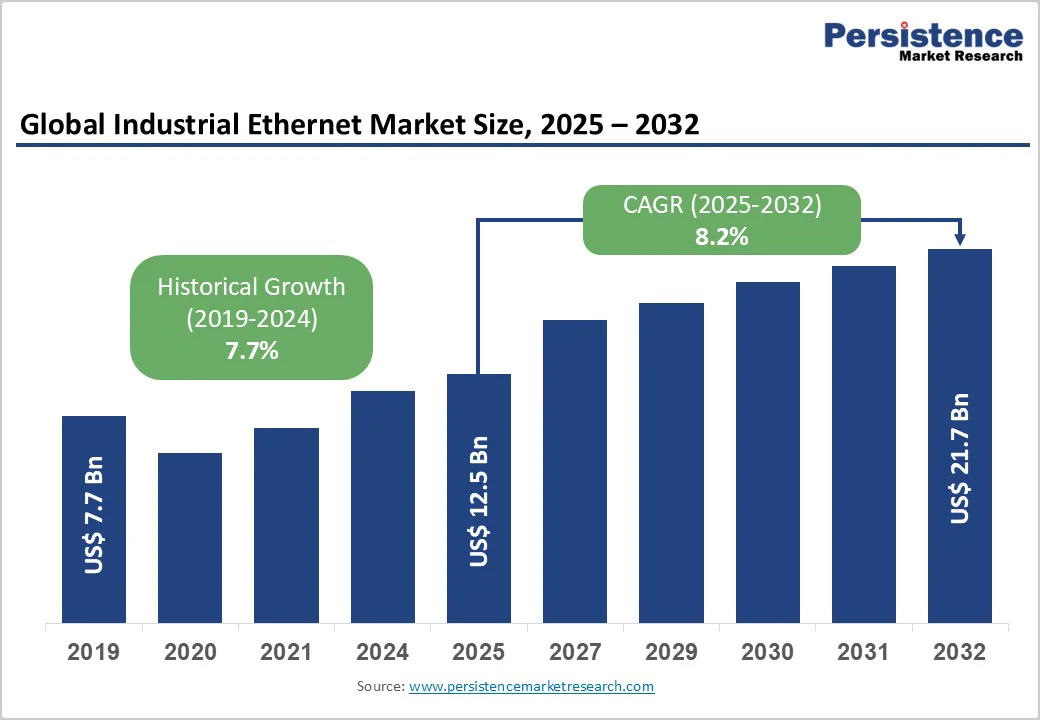
The global industrial ethernet market size is likely to be valued US$12.5 Billion in 2025, projected to US$21.7 Billion by 2032, growing at a CAGR of 8.2% during the forecast period from 2025 to 2032, driven by the increasing prevalence of Industry 4.0 adoption, rising demand for real-time data communication, and advancements in network technologies.
The need for seamless connectivity and automation, particularly in manufacturing, has significantly boosted the adoption of industrial ethernet across various industries. The market is further propelled by innovations in hardware and PROFINET protocols, catering to preferences for reliable and scalable options. The growing acceptance of industrial ethernet as essential for IoT integration, particularly in automotive, is a key growth factor.
Key Industry Highlights:
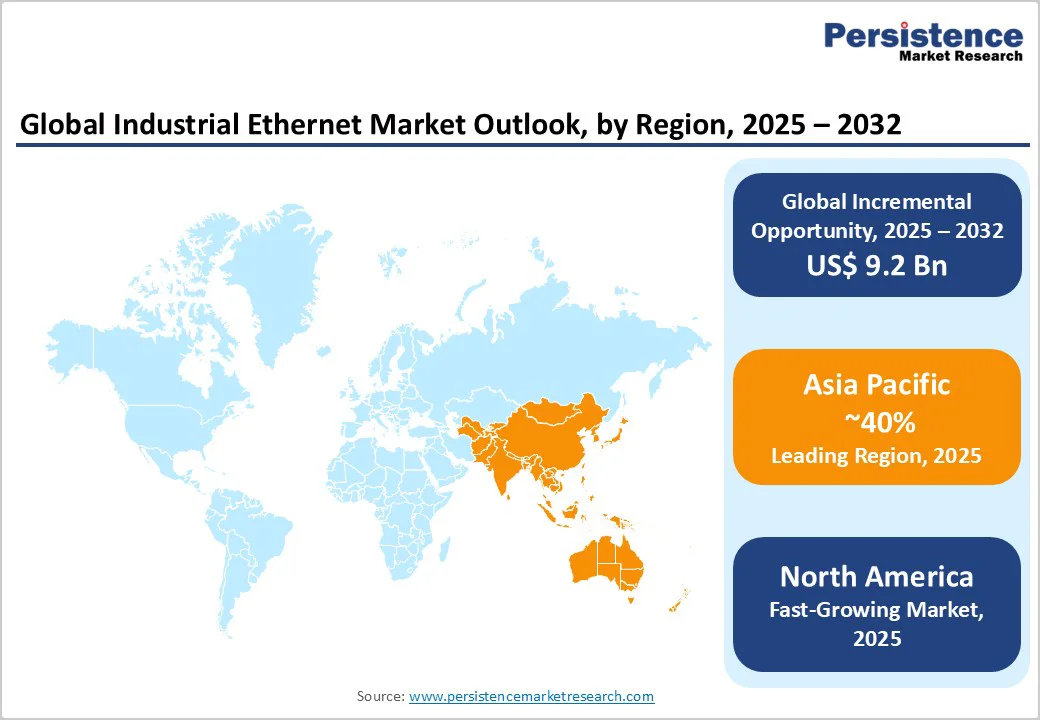
- Leading Region: Asia Pacific, commanding a 40% market share in 2025, driven by rapid industrialization, high prevalence of automation, and strong R&D activities in China.
- Fastest-growing Region: North America, fueled by increasing Industry 4.0 initiatives, rising awareness of smart factories, and growing investments in IIoT in the U.S.
- Dominant Product Type: Hardware, holding approximately 50% of the market share, due to essential networking components.
- Leading Protocol: PROFINET, accounting for over 30% of market revenue, driven by Siemens compatibility.
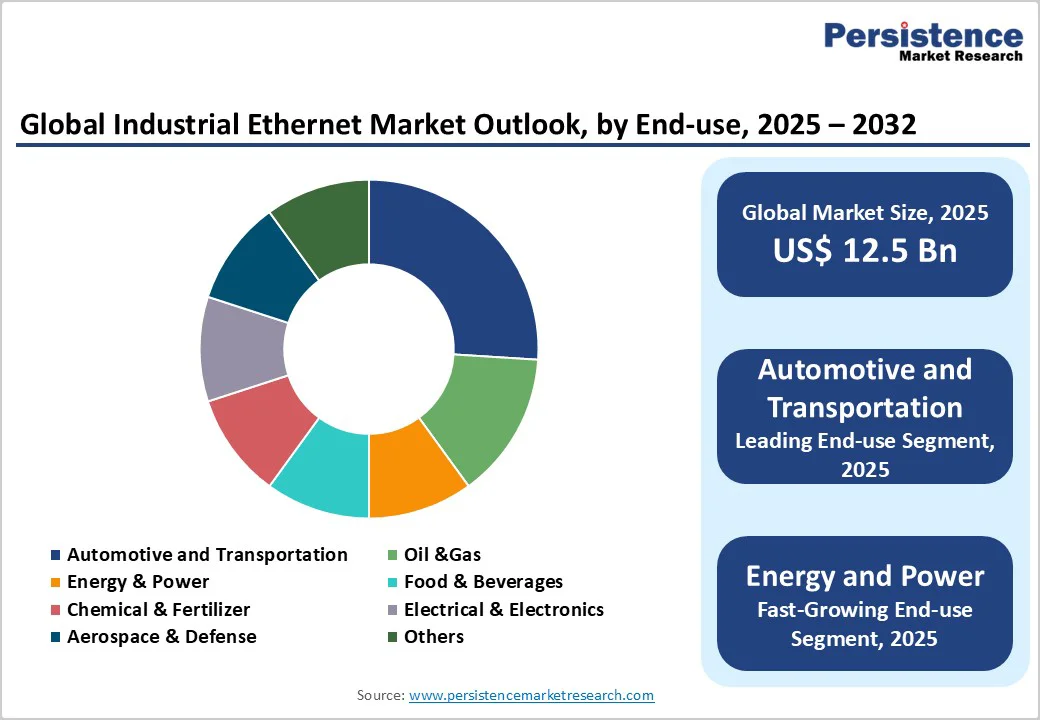
- Leading End-use: Automotive and Transportation, contributing nearly 25% of market revenue, due to assembly line needs.
- Key Market Driver: Growing adoption of Industry 4.0 and automation in manufacturing is driving demand for high-speed, reliable communication networks.
- Market Opportunity: The increasing adoption of IIoT and 5G-enabled industrial communication in emerging economies offers lucrative opportunities for market expansion.
| Key Insights | Details |
|---|---|
| Industrial Ethernet Market Size (2025E) | US$12.5 Bn |
| Market Value Forecast (2032F) | US$21.7 Bn |
| Projected Growth (CAGR 2025 to 2032) | 8.2% |
| Historical Market Growth (CAGR 2019 to 2024) | 7.7% |
Market Factors - Growth, Barriers, and Opportunity Analysis
Rising Prevalence of Industry 4.0 Adoption and Demand for Real-Time Communication
The increasing prevalence of Industry 4.0 adoption globally is a primary driver of the industrial ethernet market. As industries transition toward smart manufacturing, there is a growing need for seamless data exchange between machines, sensors, and control systems. Industrial Ethernet provides the high-speed, low-latency, and reliable connectivity required to support automation, robotics, and Industrial Internet of Things (IIoT) applications.
Industry 4.0 emphasizes digital integration, intelligent production, and data-driven decision-making, all of which depend on robust network infrastructure. Industrial Ethernet enables real-time monitoring, predictive maintenance, and adaptive production, helping manufacturers improve efficiency, safety, and flexibility.
Its ability to handle large data volumes and support deterministic communication makes it ideal for time-critical processes in industries such as automotive, energy, and pharmaceuticals. The convergence of IT and operational technology (OT) systems is accelerating Ethernet adoption, allowing unified control and analytics across factory floors.
High Implementation and Interoperability Costs
The high costs associated with implementing and interoperating with industrial Ethernet pose a significant restraint on market growth. Deploying Industrial Ethernet involves substantial investment in new cabling, switches, routers, and compatible devices that support high-speed, real-time communication.
Industries must integrate various Ethernet protocols such as PROFINET, EtherCAT, EtherNet/IP, and Modbus TCP, which often operate on different standards, increasing system complexity and compatibility issues.
Interoperability between old and new equipment demands customized interfaces and middleware solutions, further driving up costs. Skilled technicians and system integrators are required to ensure smooth configuration, synchronization, and network management, adding to labor expenses.
Maintenance and cybersecurity measures also increase operational expenditure, as Industrial Ethernet networks are highly data-intensive and vulnerable to potential breaches. Achieving seamless communication between multi-vendor equipment often requires additional software licensing and extensive testing.
Advancements in TSN and 5G-Integrated Ethernet Solutions
Advancements in Time-Sensitive Networking (TSN) and 5G-integrated Ethernet solutions present significant growth opportunities for the industrial Ethernet market.
TSN technology enhances traditional Ethernet by providing deterministic, low-latency data transmission essential for real-time applications such as robotics, motion control, and process automation. It enables seamless interoperability across devices and networks, reducing delays and ensuring precise coordination in time-critical industrial operations.
Meanwhile, the integration of 5G technology with Industrial Ethernet is accelerating digital transformation by offering ultra-high bandwidth and near-zero latency communication.
This combination supports the growing adoption of Industrial Internet of Things (IIoT) and smart factory ecosystems, where vast numbers of connected sensors, machines, and control systems require uninterrupted data flow. TSN and 5G enable remote monitoring, predictive maintenance, and adaptive production lines, enhancing flexibility and efficiency.
Category-wise Analysis
Product Type Insights
Hardware dominates the market, accounting for 50% of the share in 2025. Its dominance is driven by essential components, such as switches, that ensure connectivity. Hardware, such as that from Moxa Inc., provides robust ports, ensuring reliability. Its scalability and performance make it preferred for manufacturers.
Services are the fastest-growing segment, driven by consulting needs and increasing adoption in upgrades. Services offer customization, appealing to legacy. Focus on managed innovation accelerates adoption in North America and Europe.
Protocol Insights
PROFINET leads the market, holding 30% of the share in 2025. Dominance stems from strong integration within the Siemens automation ecosystem and broad accessibility across industries. Widely used for real-time control and seamless communication in industrial environments, PROFINET’s reliability, scalability, and interoperability continue to drive its growing global demand.
EtherCAT is the fastest-growing segment, driven by its exceptional motion control precision and widespread adoption in robotics and automation. Its deterministic communication ensures real-time synchronization and minimal latency, enabling seamless coordination of complex machinery. The combination of high speed, efficiency, and reliability makes EtherCAT ideal for advanced industrial applications.
End-use Insights
Automotive and Transportation dominate the market, contributing nearly 25% of revenue in 2025. Extensive use in automated assembly lines, robotics, and connected vehicle systems drives this dominance. Integration with Industrial IoT (IIoT) enables real-time data exchange, precision control, and smart manufacturing, making it the preferred choice for modern automotive production environments.
Energy and Power is the fastest-growing segment, driven by the rising need for real-time grid monitoring and integration of renewable energy sources. The technology enables seamless communication between substations, control centers, and field devices. Its versatility, scalability, and remote access capabilities enhance efficiency, reliability, and automation in modern power networks.
Regional Insights
Asia Pacific Industrial Ethernet Market Trends
Asia Pacific is largest and the fastest-growing market with a market share of 40%, driven by expanding manufacturing sectors, increasing automation, and government-led initiatives promoting smart industry transformation.
Countries such as China, Japan, South Korea, and India are leading regional adoption as part of their push toward Industry 4.0 and Industrial IoT (IIoT) integration. The rise of automotive, electronics, and energy industries has created strong demand for high-speed, reliable, and real-time communication networks within production environments.
Manufacturers are increasingly adopting Time-Sensitive Networking (TSN), EtherCAT, and PROFINET technologies to enhance synchronization and reduce latency in automated operations.
Local players, along with global giants such as OMRON Corporation, Siemens, and Mitsubishi Electric, are providing cost-effective and customized Ethernet solutions tailored to regional needs. The growing deployment of 5G-enabled industrial networks, combined with cloud connectivity and AI-driven analytics, is further improving data management and machine communication efficiency.
North America Industrial Ethernet Market Trends
North America accounts for a 35.3% share in 2025, driven by rapid industrial automation, digitalization, and the integration of advanced communication technologies.
The United States and Canada are leading the region’s adoption of Industry 4.0 and Industrial Internet of Things (IIoT) initiatives, emphasizing smart manufacturing, predictive maintenance, and connected operations. The presence of major automation companies such as Rockwell Automation, Cisco Systems, and Belden Inc. is strengthening technological advancement and innovation across industries.
Industrial Ethernet solutions are increasingly deployed in automotive, oil & gas, energy, and food & beverage sectors to enable real-time monitoring, data analytics, and seamless machine-to-machine communication.
The growing adoption of Time-Sensitive Networking (TSN), Ethernet/IP, and 5G-enabled networks enhances system reliability and low-latency communication across manufacturing environments. Furthermore, government incentives supporting smart infrastructure and digital transformation are accelerating implementation across industrial facilities.
Europe Industrial Ethernet Market Trends
Europe holds a 25% share in 2025, driven by the region’s strong focus on industrial automation, digital transformation, and sustainability. Countries such as Germany, the U.K., France, and Italy are leading adoption due to their advanced manufacturing sectors and early embrace of Industry 4.0 principles.
The region’s well-established industrial infrastructure and emphasis on precision engineering have made Industrial Ethernet the preferred choice for real-time communication and control across factories and process industries.
Leading players such as Siemens AG, Schneider Electric, and ABB Ltd. are at the forefront, investing heavily in Time-Sensitive Networking (TSN), PROFINET, and EtherNet/IP technologies to improve system interoperability and efficiency.
The integration of 5G, AI, and cloud-based monitoring systems is further enhancing machine-to-machine communication and data-driven decision-making. The European Union’s initiatives promoting smart manufacturing and digital sustainability, such as the “Made in Europe” strategy, are boosting market expansion.
Competitive Landscape
The global industrial ethernet market is highly competitive, In developed regions such as North America and Europe, major players such as Siemens AG and Rockwell Automation dominate the market through strong R&D capabilities, advanced networking solutions, and robust industrial partnerships. These companies focus on developing high-performance, secure, and scalable Ethernet solutions to support Industry 4.0 applications, automation, and smart manufacturing initiatives.
In the Asia Pacific region, companies such as OMRON Corporation are gaining traction by offering localized and cost-effective solutions tailored to regional industrial needs. The increasing adoption of Time-Sensitive Networking (TSN) technology is providing a competitive edge by enabling real-time communication and synchronization across industrial systems. Additionally, the integration of 5G connectivity, cloud computing, and IoT platforms is accelerating the shift toward fully connected, intelligent factories.
Key Developments
- In May 2025, Rockwell Automation launched its EtherNet/IP™ In-cabinet Solution, which leverages single-pair Ethernet/IP technology to streamline wiring, reduce installation time by up to ~80%, and enhance real-time data access in control panels.
- In April 2023, OMRON released its NX502 CPU Units along with the NX-EIP201 EtherNet/IP Units, offering high-speed (1 Gbps) communications and advanced information processing/safety control, supporting real-time data analytics and rising production demands for flexible manufacturing.
Companies Covered in Industrial Ethernet Market
- Cisco Systems, Inc.
- Siemens
- Rockwell Automation
- OMRON Corporation
- Moxa Inc.
- Phoenix Contact
- Belden Inc.
- ABB
- Schneider Electric
- Bosch Rexroth AG
Frequently Asked Questions
The global Industrial Ethernet Market is projected to reach US$12.5 Billion in 2025.
The rising prevalence of Industry 4.0 adoption and demand for real-time communication are key drivers.
The market is poised to witness a CAGR of 8.2% from 2025 to 2032.
Advancements in TSN and 5G-integrated ethernet solutions are key opportunities.
Cisco Systems, Inc., Siemens, Rockwell Automation, OMRON Corporation, and Moxa Inc. are key players.


