




- Medical Devices
- High Definition Laparoscopy Market
High Definition Laparoscopy Market Size, Share, Growth, and Regional Forecast, 2026 to 2033
High Definition Laparoscopy Market by Product (Laparoscopes, Energy Devices, Insufflators, Access Devices, Closure Devices, and Others), by Application (Bariatric Surgery, General Surgery, Gynecological Surgery, Urological Surgery, and Others), by End User (Hospitals, Specialty clinics, Ambulatory surgical centers, and Others), and Regional Analysis from 2026 to 2033

High Definition Laparoscopy Market Size and Trends Analysis
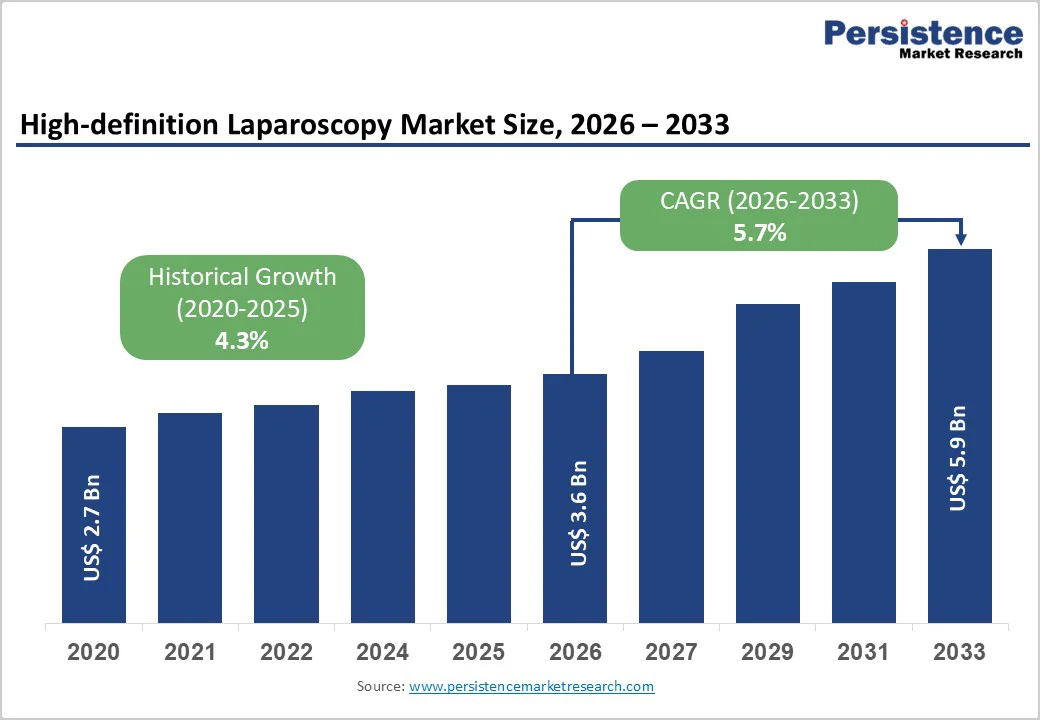
The global high definition laparoscopy market size is estimated to grow from US$ 3.6 Bn in 2026 to US$ 5.9 Bn by 2033. The market is projected to record a CAGR of 5.7% during the forecast period from 2026 to 2033.
Global demand for high-definition laparoscopy systems is rising steadily, driven by the increasing volume of minimally invasive surgical procedures across bariatric, general, gynecological, and urological surgeries. The growing prevalence of conditions such as obesity, gastrointestinal disorders, gynecological diseases, and urological complications is creating sustained demand for high-resolution imaging and precision surgical tools. Increasing emphasis on patient safety, surgical efficiency, and reduced intraoperative complications is accelerating adoption across hospitals, specialty clinics, and ambulatory surgical centers.
Rising procedural volumes, complex surgical requirements, and the need for improved visualization during surgeries further support market expansion. In parallel, the integration of robotic-assisted systems, energy devices, and advanced imaging platforms is increasing the need for precise and reliable high-definition laparoscopes. Expansion of tertiary care hospitals, surgical centers, and advanced operating theaters continues to reinforce long-term demand. Improving healthcare infrastructure, rising regulatory scrutiny, and standardization of surgical protocols across developed and emerging markets are collectively driving sustained global growth of the high-definition laparoscopy market.
Key Industry Highlights
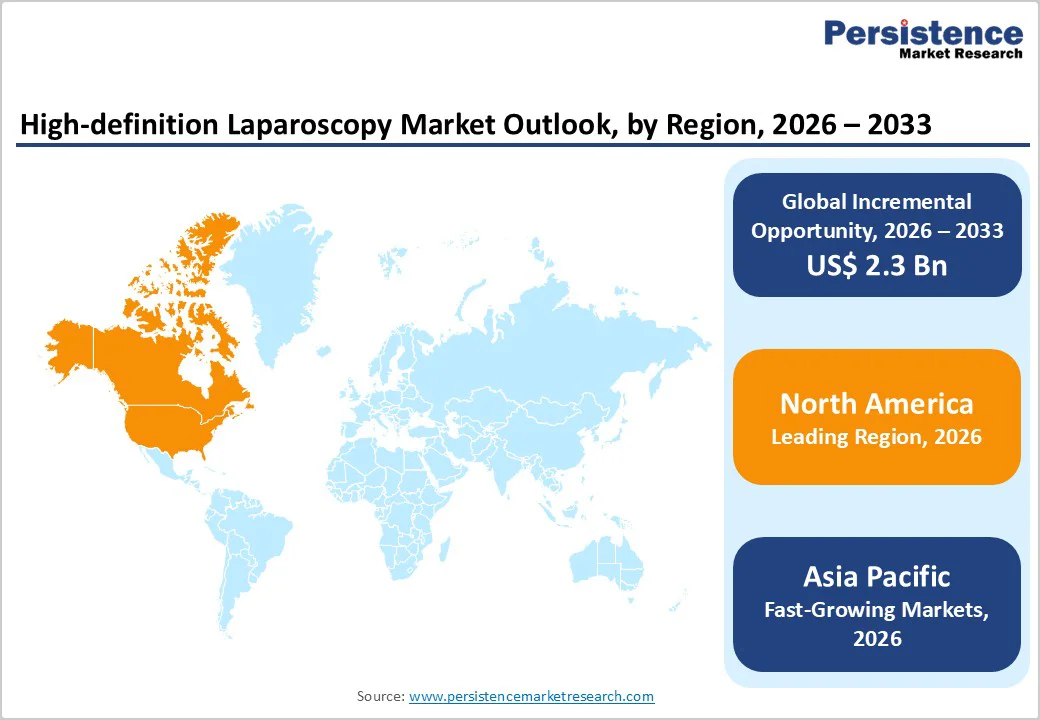
- Leading Region: North America holds the largest market share at 46.8%, supported by high surgical volumes, advanced healthcare infrastructure, strong safety regulations, and widespread adoption of minimally invasive procedures.
- Fastest-Growing Region: Asia Pacific is expanding at the fastest pace due to a large patient base, rapid healthcare infrastructure development, and rising adoption of laparoscopic surgeries.
- Leading Product Segment: Laparoscopes dominate the market due to proven operational performance, broad clinical use, and strong familiarity among surgeons.
- Fastest-Growing Product Segment: Energy devices are witnessing rapid growth as demand increases for compact, cost-effective, and workflow-efficient laparoscopic tools.
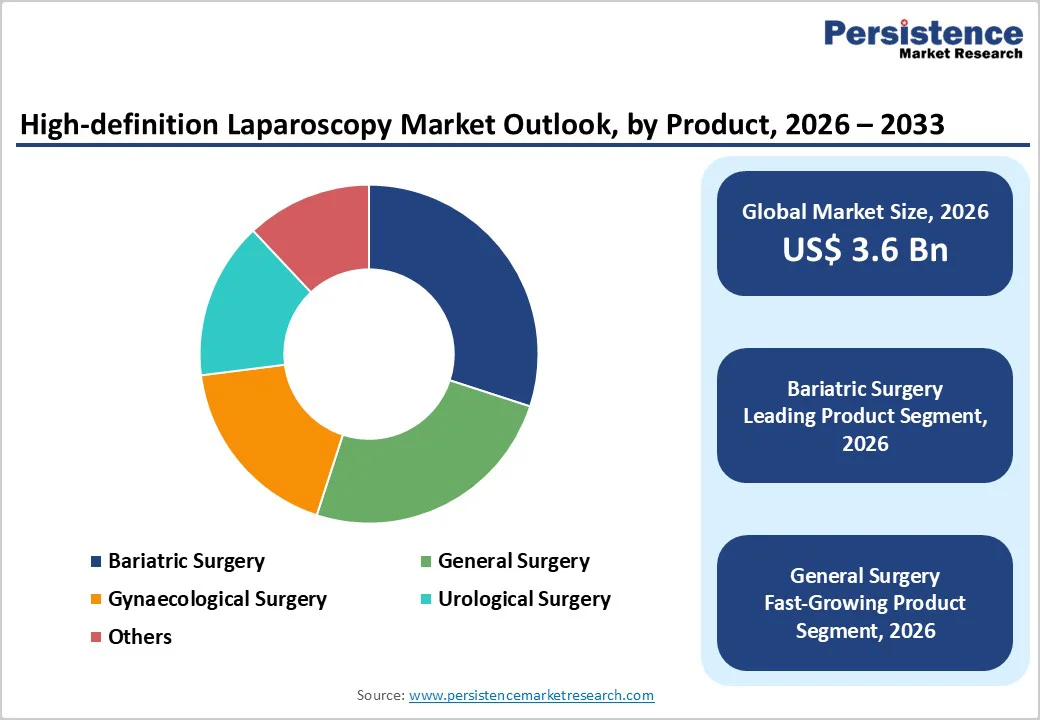
- Leading Application Segment: Bariatric surgery remains the largest application segment, driven by high procedure volumes and complex surgical interventions.
- Fastest-Growing Application Segment: General surgery is expanding rapidly due to growth in hospital surgical services, integration with energy devices, and centralized operating workflows.
| Global Market Attributes | Key Insights |
|---|---|
| High Definition Laparoscopy Market Size (2026E) | US$ 3.6 Bn |
| Market Value Forecast (2033F) | US$ 5.9 Bn |
| Projected Growth (CAGR 2026 to 2033) | 5.7% |
| Historical Market Growth (CAGR 2020 to 2025) | 4.3% |
Market Dynamics
Driver – Rising Adoption of Minimally Invasive Surgeries and Increasing Focus on Surgical Precision
The global high-definition laparoscopy market is primarily driven by the growing preference for minimally invasive surgical procedures across bariatric, general, gynecological, and urological surgeries. Rising prevalence of obesity, gastrointestinal disorders, gynecological conditions, and urological diseases has increased demand for procedures that reduce patient trauma, shorten recovery times, and improve clinical outcomes. High-definition laparoscopic systems provide superior imaging quality, enhanced tissue visualization, and precision guidance, enabling surgeons to perform complex interventions with reduced intraoperative complications. Healthcare providers are increasingly focused on improving procedural efficiency, reducing operating times, and minimizing postoperative morbidity, which has accelerated the adoption of advanced HD imaging platforms.
Continuous technological innovations, such as integration with energy devices, robotic-assisted systems, and real-time imaging analytics, further enhance surgical precision and workflow efficiency. Additionally, hospitals and ambulatory surgical centers are emphasizing patient safety, surgical ergonomics, and standardized operating protocols, reinforcing the adoption of HD laparoscopes across both developed and emerging healthcare markets. Strong clinical evidence supporting better outcomes and the growing demand for minimally invasive surgeries collectively underpin sustained market growth globally.
Restraints – High Costs and Variability in Adoption across Healthcare Systems
Despite robust demand, the high-definition laparoscopy market faces constraints related to high device costs and uneven adoption across healthcare settings. Advanced HD laparoscopic systems, including 4K and integrated imaging platforms, often require substantial capital investment in equipment, operating room upgrades, and surgeon training. In resource-constrained healthcare facilities, particularly in low- and middle-income countries, these high costs can limit widespread adoption, with hospitals prioritizing conventional laparoscopic equipment or lower-resolution systems. Variability in clinical standards, surgical expertise, and institutional infrastructure further contributes to fragmented adoption.
Additionally, reimbursement policies for minimally invasive procedures vary across regions, occasionally constraining procurement of advanced imaging systems. Compatibility challenges with existing surgical instruments, energy devices, or robotic platforms may create operational barriers, while lack of awareness among surgeons about the benefits of HD systems can slow market penetration. Collectively, pricing pressures, inconsistent infrastructure, and uneven regulatory support continue to restrain broader adoption of high-definition laparoscopy despite increasing recognition of its clinical advantages.
Opportunity – Expansion of Outpatient Surgeries and Integration with Advanced Imaging Technologies
Significant growth opportunities exist for the high-definition laparoscopy market as healthcare delivery shifts toward outpatient and ambulatory surgical centers. Rising demand for minimally invasive procedures in decentralized healthcare settings necessitates compact, efficient, and versatile HD laparoscopic systems that enhance surgical precision and workflow efficiency. Integration of advanced imaging technologies, including 4K resolution, fluorescence-guided surgery, and augmented reality overlays, offers improved tissue differentiation, real-time decision support, and enhanced visualization for complex procedures.
Furthermore, the expansion of robotic-assisted surgery and compatibility with energy devices creates new avenues for adoption in both elective and emergency surgeries. Emerging markets in Asia Pacific, Latin America, and the Middle East are witnessing rapid healthcare infrastructure development, increasing surgical volumes, and rising investments in hospital modernization, all of which are fueling demand for high-quality HD laparoscopic systems. Strategic initiatives such as localized manufacturing, cost-optimized solutions, and surgeon training programs can help manufacturers capitalize on these opportunities. Growing awareness of patient safety, enhanced clinical outcomes, and workflow optimization continues to drive long-term adoption of HD laparoscopy globally.
Category-wise Analysis
By Product, Laparoscopes Lead Due to Operational Efficiency and Broad Clinical Adoption
The laparoscopes segment is projected to dominate the global high-definition laparoscopy market in 2026, capturing a revenue share of 35.0%. This leadership is driven by well-established clinical performance, superior visualization capabilities, and enhanced operational efficiency in minimally invasive surgeries. Laparoscopes offer high-definition imaging that enables precise dissection, reduced tissue trauma, and improved patient outcomes. Their compatibility with multiple energy devices and integration with advanced camera systems further supports adoption across diverse surgical procedures. Widespread familiarity among surgeons, adherence to standardized surgical workflows, and alignment with hospital infection control protocols reinforce demand. While other product categories, such as energy devices and insufflators, are experiencing steady uptake, laparoscopes continue to benefit from reliability, procedural versatility, and broad regulatory acceptance in both developed and emerging markets, ensuring sustained market dominance.
By Application, Bariatric Surgery Emerges as the Largest Utilization Segment
The bariatric surgery segment is expected to dominate the global high-definition laparoscopy market in 2026, accounting for a revenue share of 30.0%. This prominence is largely attributed to the high frequency of minimally invasive procedures in obesity management and related gastrointestinal interventions. High-definition laparoscopic systems are critical in bariatric surgeries due to enhanced visualization, precise tissue handling, and reduced intraoperative complications. Rising patient volumes, increasing obesity prevalence, and adoption of complex metabolic procedures across hospitals, specialty clinics, and ambulatory surgical centers are driving demand. Additionally, the growing focus on enhanced recovery protocols, shorter hospital stays, and improved patient safety supports the adoption of HD laparoscopes. Advanced imaging compatibility with robotic and energy-assisted devices further strengthens the segment’s position. While general and gynecological surgeries contribute significantly to market demand, bariatric procedures are increasingly favored due to procedural complexity and clinical outcomes, reinforcing its market leadership.
By End User, Hospitals Maintain Dominance Owing to High Procedure Volumes
The hospitals segment is projected to dominate the global high-definition laparoscopy market in 2026, representing a revenue share of 50.0%. Hospitals remain the primary end users due to their role in performing high volumes of minimally invasive surgeries, including bariatric, urological, gynecological, and general surgical procedures. The availability of advanced surgical infrastructure, trained laparoscopic surgeons, and integrated operating theaters supports broad adoption of HD laparoscopic systems. Hospitals prioritize device safety, ergonomic design, and system compatibility with auxiliary technologies such as energy devices and robotics, ensuring procedural efficiency and patient safety. Moreover, investments in tertiary care centers, structured surgical workflows, and advanced imaging equipment reinforce hospitals’ central position. While ambulatory surgical centers and specialty clinics are increasingly adopting HD laparoscopes, hospitals continue to lead due to complex procedural requirements, high patient throughput, and commitment to clinical excellence.
Region-wise Insights
North America High Definition Laparoscopy Market Trends
The North America high-definition laparoscopy market is expected to dominate globally with a value share of 46.8% in 2026, primarily driven by the United States. The region benefits from a highly advanced healthcare infrastructure, widespread adoption of minimally invasive surgical procedures, and strong regulatory oversight from agencies such as the U.S. FDA. Hospitals and ambulatory surgical centers perform high volumes of laparoscopic surgeries, which consistently drive demand for HD visualization systems. Favorable reimbursement frameworks and broad insurance coverage enhance access to advanced surgical technologies.
North America’s leadership is further supported by the presence of major medical device manufacturers, well-established distribution networks, and continuous investment in surgical innovation. Additionally, ongoing initiatives in infection control, surgical safety protocols, and workforce training reinforce adoption. Hospitals’ focus on improving procedural efficiency, patient outcomes, and integration of robotic-assisted technologies ensures sustained utilization of high-definition laparoscopes across the region, solidifying North America as a mature and high-value market.
Europe High Definition Laparoscopy Market Trends
The Europe high-definition laparoscopy market is projected to grow steadily, supported by increasing healthcare utilization, rising surgical volumes, and strong emphasis on patient safety. Key contributors include Germany, the U.K., France, Italy, and Nordic countries, all of which have robust public healthcare systems and standardized clinical practices. European hospitals prioritize evidence-based procurement, adherence to stringent safety regulations, and integration of advanced imaging technologies, driving adoption of HD laparoscopic systems.
Expansion of outpatient surgical centers, increased use of complex procedures, and rising demand for minimally invasive surgeries further support market growth. Initiatives to reduce surgical complications, improve occupational safety, and standardize laparoscopic protocols enhance adoption. Harmonized regulatory frameworks across the EU and continuous investment in hospital infrastructure, surgical training programs, and technological upgrades position Europe as a stable, mature, and high-value market for high-definition laparoscopy over the forecast period.
Asia Pacific High Definition Laparoscopy Market Trends
The Asia Pacific high-definition laparoscopy market is expected to register a relatively higher CAGR of 7.7% between 2026 and 2033, driven by rapid expansion of healthcare infrastructure, growing adoption of minimally invasive surgeries, and rising awareness of patient safety standards. Countries such as China, India, Japan, South Korea, and Southeast Asian nations are witnessing increasing hospital admissions, expansion of surgical centers, and higher uptake of complex laparoscopic procedures. Government initiatives to strengthen healthcare delivery, improve hospital safety standards, and increase access to advanced medical technologies are further fueling market growth.
Expansion of specialty clinics, hospital networks, and centralized surgical services enhances the availability and utilization of HD laparoscopes. Additionally, rising investments by global medical device manufacturers, integration of energy-assisted and robotic technologies, and emphasis on standardized surgical protocols and infection prevention support sustained adoption. These factors collectively position Asia Pacific as a high-growth, strategically important market in the global high-definition laparoscopy landscape.
Market Competitive Landscape
The global high-definition laparoscopy market is highly competitive, with strong participation from Medtronic, B. Braun SE, Stryker, Ethicon Inc., and Smith + Nephew. These companies benefit from broad minimally invasive surgery portfolios, advanced imaging and visualization technologies, and well-established global manufacturing, service, and distribution networks. Competitive strategies focus on enhancing image resolution, improving ergonomics and device integration, and expanding compatibility with energy devices and robotic-assisted surgical platforms.
Investments in R&D, product portfolio expansion, and geographic penetration particularly across emerging healthcare markets are intensifying competition. Continuous innovation in HD and 4K visualization, camera systems, light sources, and integrated surgical ecosystems is expected to drive sustained market evolution over the forecast period.
Key Industry Developments:
- In July 2025, Arthrex received FDA clearance for its NanoScope operative arthroscopy system for pediatric orthopedics and laparoscopy. The compact, high-resolution system features the NanoNeedle Scope, a chip-on-tip HD camera designed for pediatric anatomy. It supports procedures such as knee and shoulder arthroscopy, ACL reconstruction, meniscal repairs, and diagnostic or hernia laparoscopy, minimizing the risk of injury to anatomical and neurovascular structures.
Companies Covered in High Definition Laparoscopy Market
- Medtronic
- B. Braun SE
- Stryker
- Ethicon Inc.
- Smith + Nephew
- LaproSurge
- Karl Storz GmbH & Co. KG
- ConMed Corporation
- Olympus Corporation
- Richard Wolf GmbH
- Others
Frequently Asked Questions
The global high definition laparoscopy market is projected to be valued at US$ 1.5 Bn in 2026.
Rising preference for minimally invasive surgeries, increasing prevalence of chronic diseases such as obesity, gastrointestinal and urological disorder, and continuous advancement in high definition imaging and visualization technologies that improve surgical precision and outcomes.
The global high definition laparoscopy market is poised to witness a CAGR of 6.3% between 2026 and 2033.
Significant growth potential exists in emerging markets and through integration of AI, robotics, and advanced visualization technologies in laparoscopic systems.
Medtronic, B. Braun SE, Stryker, Ethicon Inc., and Smith + Nephew are some of the key players in the high definition laparoscopy market.


