




- Healthcare Services
- Global Bunionectomy Market
Global Bunionectomy Market Size, Share, and Growth Forecast 2026 - 2033
Bunionectomy Market by Procedure Type (Osteotomy, Exostectomy, Arthrodesis), by Service Providers (Hospitals, Ambulatory Surgical Centers, Specialty Clinics, Others), by Regional Analysis, 2026-2033.

Bunionectomy Market Size and Trend Analysis
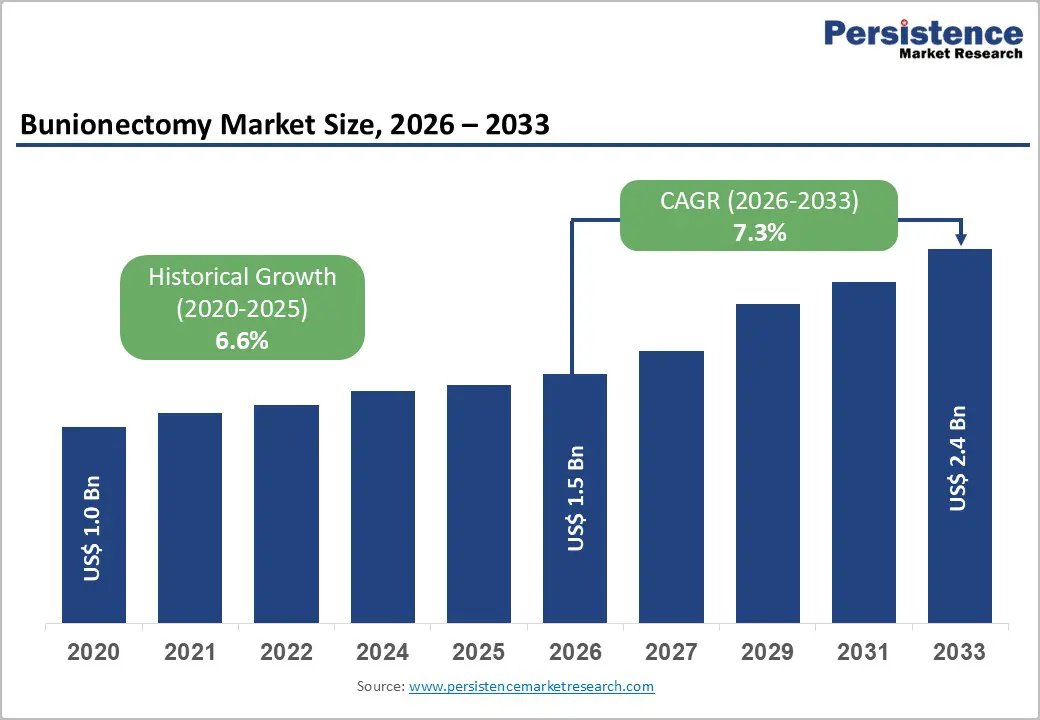
The global bunionectomy market size is expected to be valued at US$ 1.5 billion in 2026 and projected to reach US$ 2.4 billion by 2033, growing at a CAGR of 7.3% between 2026 and 2033.
Bunionectomy is a surgical procedure used to remove a bunion, a painful bony and soft-tissue enlargement at the base of the big toe that causes inflammation, walking difficulty, and shoe irritation. The procedure is recommended when conservative treatments such as anti-inflammatory drugs and orthotics fail, with typical recovery achieved within six to eight weeks using a surgical boot. Bunion development may be hereditary or due to congenital deformities, and according to the National Institutes of Health (NIH), bunions affect nearly 23% of adults globally. The global bunionectomy market is expected to grow steadily, driven by rising geriatric population, increasing diagnosis rates, expanding multi-specialty hospitals, and higher healthcare spending in developed economies. Technological advancements, particularly minimally invasive bunionectomy techniques, are further supporting market growth. However, procedure-related complications, COVID-19-related surgical delays, workforce shortages, and limited healthcare expenditure in regions such as the Middle East & Africa continue to restrain market expansion.
Key Industry Highlights
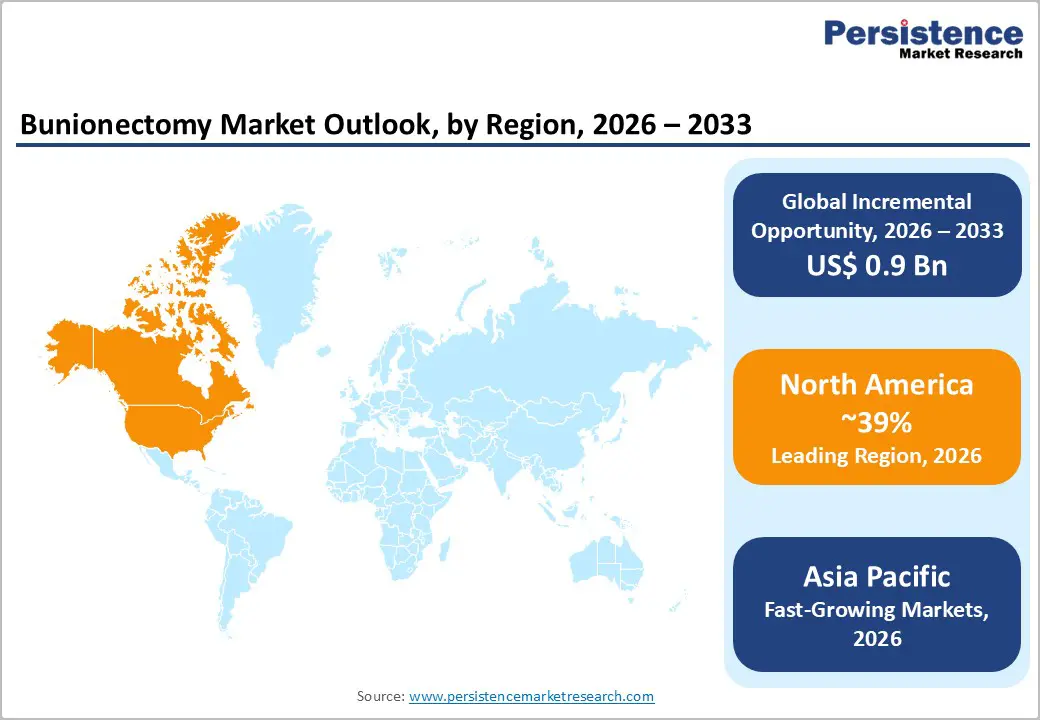
- Leading Region: North America leads the global bunionectomy market, supported by advanced orthopedic infrastructure, high procedure volumes, strong reimbursement frameworks, and widespread adoption of minimally invasive foot surgeries.
- Fastest Growing Region: Asia Pacific is the fastest-growing region, driven by rising hallux valgus prevalence, rapid population aging, expanding private healthcare infrastructure, and increasing awareness of surgical correction options.
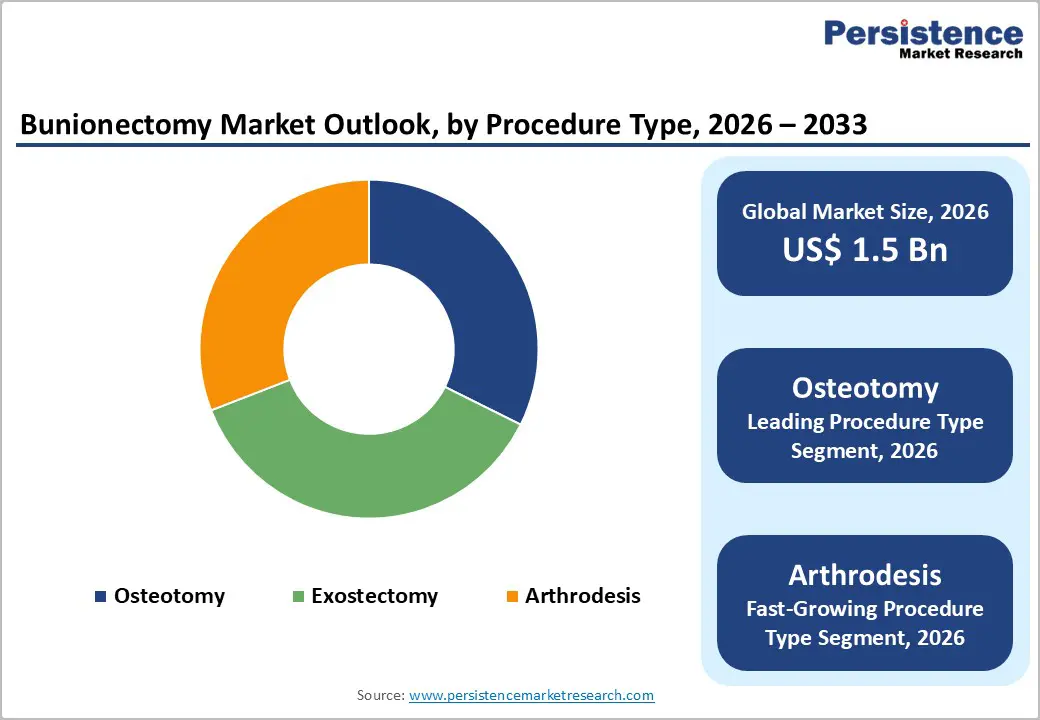
- Dominant Segment: Osteotomy is the dominant procedure segment, owing to its effectiveness in correcting mild to moderate deformities, joint-preserving approach, and compatibility with minimally invasive techniques.
- Fastest Growing Segment: Minimally invasive osteotomy procedures represent the fastest-growing segment, supported by faster recovery, reduced soft-tissue trauma, outpatient suitability, and growing patient and surgeon preference.
| Global Market Attributes | Key Insights |
|---|---|
| Bunionectomy Market Size (2026E) | US$ 1.5 Bn |
| Market Value Forecast (2033F) | US$ 2.4 Bn |
| Projected Growth (CAGR 2026 to 2033) | 7.3% |
| Historical Market Growth (CAGR 2020 to 2024) | 6.6% |
Market Dynamics
Driver – High prevalence of hallux valgus and aging population
A major driver of the global bunionectomy market is the high and rising prevalence of hallux valgus, particularly among older adults and women. Globally, nearly one-fifth of adults are affected, with prevalence increasing sharply beyond 60 years of age. Women show a higher disease burden due to long-term biomechanical stress from narrow footwear and hormonal influences, resulting in a large population experiencing pain, inflammation, and functional limitations. As symptoms progress and conservative measures such as orthotics and medications fail, demand for definitive surgical correction increases. Aging populations across North America, Europe, and Asia Pacific further amplify procedure volumes, as elderly patients prioritize mobility, independence, and pain relief.
Another important growth driver is the shift toward minimally invasive and outpatient bunion surgery. Advances in surgical instruments, fixation systems, and imaging have enabled smaller incisions, reduced soft-tissue damage, and faster postoperative recovery while maintaining effective deformity correction. These benefits have increased patient acceptance and surgeon adoption. Simultaneously, healthcare systems are encouraging procedures in ambulatory surgical centers to reduce costs and hospital stays. The combination of patient-friendly techniques, shorter rehabilitation periods, and efficient care delivery models is structurally expanding the overall bunionectomy market across developed and emerging healthcare systems.
Restraints – Postoperative complications and revision risk
Despite clinical advancements, postoperative complications remain a key restraint for the global bunionectomy market. Surgical risks such as infection, nerve injury, delayed union, nonunion, and deformity recurrence can discourage both patients and surgeons, particularly in mild or moderate cases where conservative treatment remains an option. Some patients require revision surgeries due to recurrence or implant-related issues, increasing overall treatment burden and cost. Concerns around prolonged recovery, stiffness, or need for fusion procedures may delay surgical decision-making, limiting procedure uptake.
Access and reimbursement constraints further restrict market growth. In many low- and middle-income regions, limited availability of trained foot and ankle surgeons and inadequate surgical infrastructure reduce access to advanced bunion correction procedures. Even in developed markets, bunionectomy may be classified as elective, resulting in strict reimbursement criteria and prior authorization requirements. Out-of-pocket expenses for minimally invasive implants, fixation devices, and postoperative care can deter patients from opting for surgery. These financial and structural barriers collectively constrain market expansion despite strong underlying clinical demand.
Opportunity – Expansion of arthrodesis and complex reconstruction in severe and arthritic bunions
Significant opportunity exists in the expansion of arthrodesis and complex reconstruction procedures for severe and arthritic bunions. As patient expectations shift toward durable pain relief and long-term functional outcomes, fusion-based procedures are increasingly favored in advanced deformities, rheumatoid arthritis, and revision cases. Improvements in fixation hardware, surgical planning, and perioperative protocols have enhanced fusion rates and clinical outcomes, making arthrodesis a reliable option for complex patients. With the global rise in degenerative joint disease and an expanding elderly population, demand for definitive corrective solutions is expected to grow, particularly in tertiary care hospitals and specialized foot and ankle centers.
Another major opportunity lies in scaling minimally invasive osteotomy techniques within ambulatory surgical center–based care models. Standardized protocols, surgeon training, and fluoroscopy-guided procedures allow high procedural efficiency, predictable outcomes, and reduced costs. Faster return to weight-bearing and improved cosmetic results increase patient satisfaction, supporting higher adoption rates. Providers that integrate digital follow-up, bundled payment models, and value-based care pathways can capture patients transitioning from prolonged conservative management to surgery, creating sustained growth opportunities across mature and emerging markets.
Category-wise Analysis
By Procedure Type Analysis
By procedure type, osteotomy remains the leading segment in the bunionectomy market, accounting for an 54% share by 2025. Its dominance is driven by broad clinical applicability in mild to moderate hallux valgus, where joint preservation is preferred. Osteotomy techniques such as chevron, scarf, and proximal metatarsal cuts enable precise correction of intermetatarsal and hallux valgus angles while maintaining metatarsophalangeal joint mobility. Surgeons favor these procedures due to their predictable alignment outcomes and adaptability across patient anatomies. Osteotomy is frequently combined with soft tissue balancing or exostectomy, allowing tailored correction without the need for joint fusion. The growing adoption of minimally invasive and percutaneous osteotomy methods further strengthens this segment, as they reduce soft-tissue disruption and support faster functional recovery. Strong procedural familiarity, established clinical guidelines, and favorable long-term outcomes continue to position osteotomy as the preferred bunionectomy technique across major healthcare markets.
By Service Providers Analysis
By service provider, hospitals are expected to remain the dominant setting for bunionectomy procedures in 2025, accounting for approximately 60% or more of total procedure volume. Hospitals are better equipped to manage complex hallux valgus cases, including severe deformities, arthritic involvement, and revision surgeries, particularly among elderly patients with multiple comorbidities. Multispecialty hospitals provide integrated access to orthopedic surgeons, anesthesiology teams, imaging facilities, and postoperative rehabilitation services, ensuring comprehensive perioperative care. Academic and tertiary care hospitals also serve as referral centers for complicated foot and ankle cases, supporting higher surgical volumes and consistent clinical outcomes. Their involvement in training, research, and adoption of advanced fixation systems further reinforces their leadership. Although ambulatory surgical centers are gaining traction for uncomplicated cases due to efficiency and cost advantages, hospitals continue to hold a strong position because of their ability to address higher-risk patients and deliver end-to-end surgical management.
Region-wise Insights
North America Bunionectomy Market Trends
North America leads the global bunionectomy market, holding an estimated 39% share in 2025, supported by advanced orthopedic infrastructure and high surgical volumes, particularly in the United States. The region shows a meaningful prevalence of hallux valgus, estimated at nearly 16%, combined with a steadily aging population that drives demand for corrective foot and ankle procedures. Large academic and specialty hospitals provide a wide spectrum of bunionectomy techniques, including minimally invasive osteotomy and arthrodesis for complex deformities. Clear reimbursement and clinical coverage criteria established by major payers influence treatment pathways, favoring evidence-based surgical selection after conservative therapy failure. These frameworks support standardized diagnostics and procedure planning, contributing to consistent surgical outcomes. Additionally, the rapid expansion of ambulatory surgical centers has shifted a growing share of uncomplicated bunion surgeries to outpatient settings, improving patient convenience while aligning with cost efficiency and value-based care models across the region.
Asia and Pacific Bunionectomy Market Trends
Asia Pacific is expected to be the fastest growing region in the bunionectomy market, driven by rising hallux valgus prevalence estimated at around 22% and accelerated population aging in countries such as China, Japan, and India. Historically limited access to specialized foot and ankle care restricted procedure volumes; however, expanding private healthcare networks and improved awareness are increasing surgical adoption. Developed markets such as Japan and China are investing in minimally invasive bunionectomy techniques, advanced imaging, and standardized orthopedic training. In parallel, India and Southeast Asian countries are witnessing growth in private specialty hospitals and ambulatory centers offering affordable bunion correction procedures. Local production of orthopedic implants and fixation devices has improved cost accessibility, supporting wider use of osteotomy and arthrodesis techniques. Changing lifestyle patterns, footwear preferences, and growing emphasis on mobility and quality of life are expected to sustain strong procedural growth across Asia Pacific, outpacing more mature healthcare markets.
Market Competitive Landscape
The global bunionectomy market is relatively fragmented on the provider side, with numerous hospitals, academic centers, and specialty clinics performing procedures, while a subset of high-volume orthopedic and foot-ankle institutes act as regional referral hubs. Competition centers on surgical expertise, minimally invasive capabilities, and perioperative outcomes, with leading institutions differentiating through subspecialized surgeons, advanced imaging, and enhanced recovery protocols. Many centers pursue growth via expansion of outpatient programs, digital patient engagement, and participation in clinical research on new osteotomy and arthrodesis techniques and fixation systems.
Key Industry Developments:
- In July 2025, Johnson & Johnson introduced the VIRTUGUIDE™ AI-powered Patient-Matched Lapidus System in the U.S., aiming to simplify bunion surgery for millions of patients.
Companies Covered in Global Bunionectomy Market
- Hoag Orthopedic Institute
- Johns Hopkins Medicine
- Winchester Hospital
- Mayo Clinic
- Rubin Institute for Advanced Orthopedics
- Marsh Field Clinic
- Duke Health
- KIMS Hospitals
- UChicago Medicine
- Blake Lands Hospital
- C. K. B. Hospitals
- Others
Frequently Asked Questions
The global market is projected to be valued at US$ 1.5 Bn in 2026.
Rising bunion prevalence, aging population, increased diagnosis rates, higher healthcare spending, technological advancements, and growing availability of specialized surgical facilities.
The global market is poised to witness a CAGR of 7.3% between 2026 and 2033.
Adoption of minimally invasive procedures, expanding ambulatory surgical centers, emerging market penetration, surgeon training programs, and innovation in bunion correction devices.
Key companies include Hoag Orthopedic Institute, Johns Hopkins Medicine, Winchester Hospital, Mayo Clinic, Rubin Institute for Advanced Orthopedics, and Marsh Field Clinic.


