




- Processed Food
- Global Vintage Cave-aged Cheddar Market
Global Vintage Cave-aged Cheddar Market Size, Share, and Growth Forecast 2026 - 2033
Vintage Cave-aged Cheddar Market by Nature (Traditional Rennet, Unpasteurized Milk), by Cheddar Type (Regular, Low-fat, Non-fat), by End-use (Food Processing Industry, Foodservice Industry, Retail/Household), by Regional Analysis, 2026-2033

Vintage Cave-aged Cheddar Market and Trends Analysis
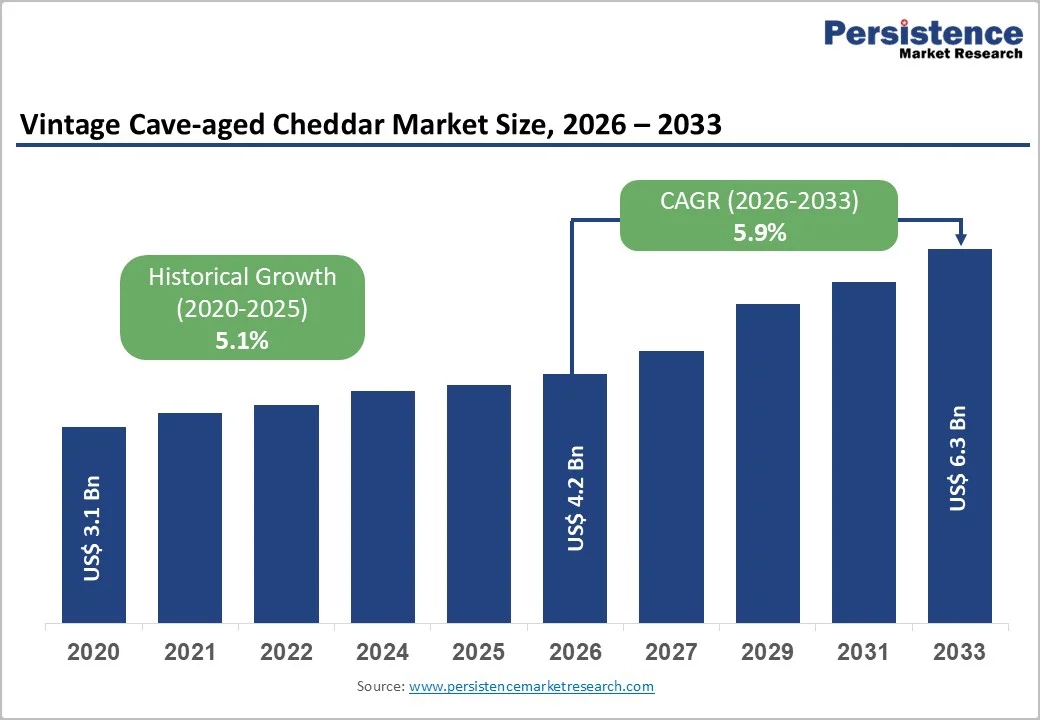
The global vintage cave-aged cheddar market size is expected to be valued at US$ 4.2 billion in 2026 and projected to reach US$ 6.3 billion by 2033, growing at a CAGR of 5.9% between 2026 and 2033.
Premiumization in dairy, surging demand for artisanal cheeses, and the rising popularity of long-matured, terroir-driven products are central to this market’s expansion. Specialty and artisanal cheeses are growing faster than mass-produced varieties as consumers seek authentic, story-rich products, with global natural cheese value estimated above US$ 150 billion in 2024, giving cave-aged cheddar a strong premium platform. Growth is further reinforced by robust specialty cheese sales in mature markets, evolving foodservice menus that showcase extra-aged cheddar, and digital retail channels that connect small affineurs with global consumers.
Key Industry Highlights
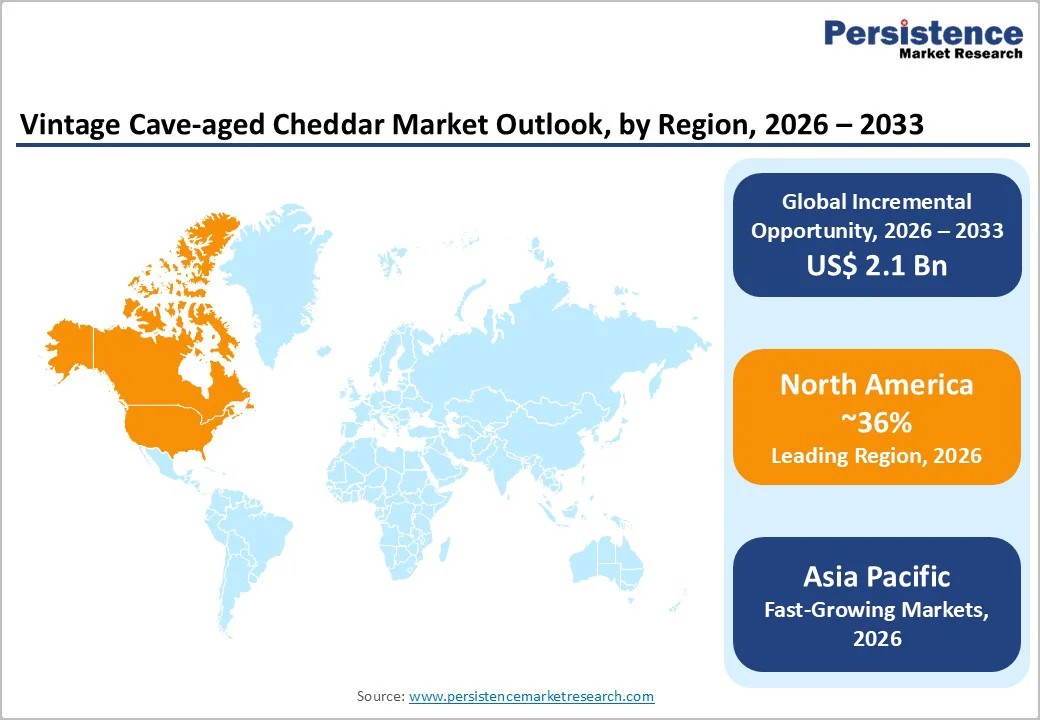
- Leading Region: North America leads the global market supported by strong cheddar traditions, robust specialty retail infrastructure, and stringent but well?defined food safety oversight.
- Fastest Growing Region: Asia Pacific is the fastest-growing region, fueled by urbanization, rising disposable incomes, expanding bakery and QSR chains, and growing consumer curiosity for artisanal and aged cheeses in China, Japan, India, and ASEAN.
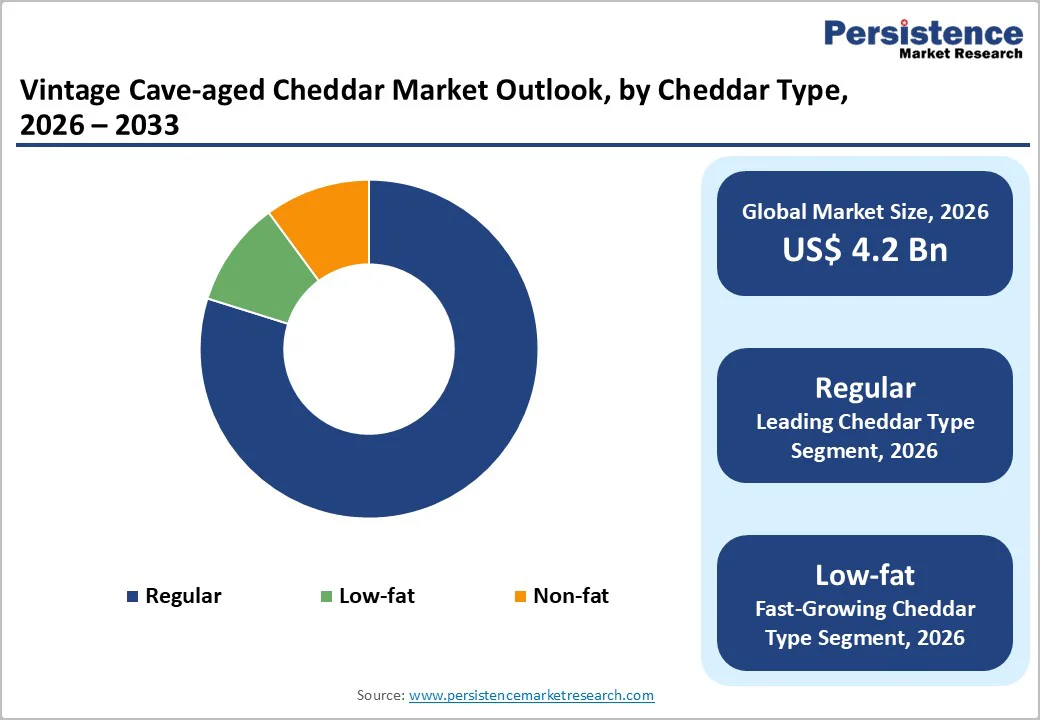
- Dominant Segment: Regular remains the dominant segment due to consumer preference for full?fat, intensely flavored cave-aged cheddar in cheese boards, cooking, and premium foodservice offerings.
- Fastest Growing Segment: Low-fat exhibits the highest growth, as health?conscious consumers seek lower?fat yet high?protein specialty cheeses and manufacturers refine formulations that retain flavor and texture after long aging.
| Global Market Attributes | Key Insights |
|---|---|
| Vintage Cave-aged Cheddar Market Size (2026E) | US$ 4.2 Bn |
| Market Value Forecast (2033F) | US$ 6.3 Bn |
| Projected Growth (CAGR 2026 to 2033) | 5.9% |
| Historical Market Growth (CAGR 2020 to 2024) | 5.1% |
Market Dynamics
Driver – Growing appetite for artisanal and specialty cheeses
Escalating consumer interest in artisanal, cave-aged, and small?batch cheeses is a primary driver of the vintage cave-aged cheddar market. Shoppers increasingly view cheese as a premium indulgence linked to craftsmanship, provenance, and clean-label production, favoring products made with traditional methods and longer maturation times. Specialty and artisanal cheese segments have posted growth rates exceeding mainstream cheese, supported by expanding farmers’ markets, specialty counters, and online subscription boxes. Within this broader wave, cave-aged cheddar stands out for its intense flavor, heritage appeal, and compatibility with gourmet boards, pairing menus, and home entertaining, which together anchor sustained demand across North America and Europe.
Rising demand from premium foodservice and modern retail
Vintage cave-aged cheddar is increasingly featured in high?end burgers, elevated mac?and?cheese, chef?led tasting menus, and artisanal snacks, boosting volumes through the Foodservice Industry. Restaurants and gastropubs use extra?aged cheddar to differentiate menus and justify premium price points, while specialty sandwich and burger chains leverage its complex flavor as a signature ingredient. Parallelly, supermarkets in regions such as the U.S., U.K., and Germany are enlarging specialty cheese sections and partnering with affineurs to showcase cave-aged lines, often supported by storytelling around caves, aging durations, and local dairy farms. This combination of out?of?home and retail exposure builds consumer familiarity and encourages trial, reinforcing growth across channels.
Restraints – Stringent safety regulations and surveillance for unpasteurized cheeses
Regulatory scrutiny of unpasteurized milk cheeses represents a key constraint for traditional cave-aged cheddar producers. In the U.S., the Food and Drug Administration (FDA) requires raw?milk cheeses to be aged at least 60 days at defined temperature conditions, and recent surveillance programs have highlighted that aging alone may not fully eliminate risks from pathogens such as H5N1. These findings have prompted discussions on updating rules and expanding microbiological testing, which can increase compliance costs, delay product releases, and create uncertainty for small dairies reliant on raw-milk cave aging.
High production, maturation, and logistics costs
Vintage cave-aged cheddar entails long maturation periods, controlled cave environments, and intensive quality management, all of which raise production costs relative to standard cheddar. Extended aging ties up capital and leads to weight loss through moisture evaporation, while rind care and regular turning add labor overhead. Maintaining strict cold-chain logistics especially for exports further elevates costs, resulting in retail prices that are often multiples of commodity cheddar and limiting access among highly price?sensitive consumers.
Opportunity – Emergence of low?fat cave-aged variants and health?aligned positioning
Growing health consciousness and the search for high?protein but lower?fat dairy offers strong opportunities in Low-fat cave-aged cheddar. Advances in cheesemaking allow producers to adjust fat and moisture while preserving flavor intensity and texture, enabling low?fat cheddar to benefit from the same extended affinage and terroir narratives as regular variants. As consumers increasingly look for nutrient-dense, clean-label snacks, positioning low?fat cave-aged cheddar as a premium yet “better?for?you” option can unlock new demand in retail snacking, ready?to?eat meals, and foodservice offerings focused on healthier indulgence.
Premiumization and emerging-market expansion in Asia Pacific
Asia Pacific’s rising middle class, rapid urbanization, and growing acceptance of Western?style foods create a substantial opportunity for vintage cave-aged cheddar. Countries such as China, Japan, and India are experiencing strong growth in cheese consumption, propelled by the proliferation of bakeries, pizzerias, and burger chains that increasingly experiment with bold, aged flavors. Local artisan cheese movements in markets like India show that consumers are receptive to terroir storytelling and handcrafted products, suggesting that imported or locally produced cave-aged cheddar can occupy a premium niche, especially when paired with fusion cuisine and wine or craft?beer cultures. Strategic partnerships with foodservice operators and specialty retailers can position Asia Pacific as the fastest?growing region for the market through 2032.
Category-wise Analysis
By Nature Analysis
Within the Nature category, Traditional Rennet is assessed as the leading segment, capturing roughly 60% of the vintage cave-aged cheddar market in 2025. Traditional animal rennet is favored for its ability to drive complex proteolysis and flavor development over extended maturation, a critical attribute for cave-aged styles that may age for 12–24 months or longer. Many heritage cheddar producers highlight traditional rennet on labels to signal authenticity and adherence to time?honored methods, appealing to connoisseurs and specialty cheese buyers. Regulatory recognition of traditional cheesemaking practices in Europe and North America also supports this segment, as appellation schemes and quality standards frequently reference rennet type and aging protocols, reinforcing its leadership.
By Cheddar Type Analysis
By Cheddar Type, Regular cave-aged cheddar dominates with about 75% market share in 2025, reflecting consumer preference for full?fat, intensely flavored cheese. Regular-fat cave-aged cheddar delivers superior mouthfeel, melting behavior, and flavor complexity, making it the default choice for cheese boards, cooking, and foodservice menus. Food service operators and specialty retailers often lead with regular variants while positioning Low-fat and Non-fat options as complementary, contributing to the latter’s smaller but faster?growing base. As premiumization continues and consumers prioritize taste in indulgent occasions, the regular segment is expected to retain its dominance even as innovation in healthier formulations accelerates.
Region-wise Insights
North America Vintage Cave-aged Cheddar Market Trends
North America is the leading regional market, capturing about 36% share of global vintage cave-aged cheddar consumption in 2025, driven largely by the U.S. and Canada. High per?capita cheese intake, a strong culture of cheddar consumption, and a well-developed specialty retail network underpin this leadership. States such as Wisconsin and California host robust artisan cheese sectors, with numerous producers offering cloth?bound and cave-aged cheddars showcased at festivals, specialty shops, and farmers’ markets.
Regulation also shapes the landscape: the FDA requires raw?milk cheese sold in interstate commerce to be aged at least 60 days, and ongoing microbiological surveillance of raw?milk cheeses aims to mitigate pathogen risks, including recent concerns regarding H5N1 in aged raw cow’s milk cheese. These safety efforts encourage investments in quality assurance, testing, and in some cases heat treatment or pasteurized alternatives, but they also raise operating costs for traditional affineurs. Innovation in North America includes experiments with cave simulation technologies, collaborations between dairies and breweries for co?aging, and digital storytelling to connect consumers with farm?to?cave supply chains, reinforcing the region’s premium positioning.
Europe Vintage Cave-aged Cheddar Market Trends
Europe offers a deeply entrenched cheese culture and remains a key demand and production hub for cave-aged cheddar and other aged cheeses. In the U.K., historic farmhouse cheddar producers with clothbound, cave-aged traditions supply both domestic retailers and export markets, often under protected?designation frameworks that emphasize geography, milk source, and aging methods. Consumers across Germany, France, and Spain increasingly seek premium and artisanal cheeses, with rising interest in matured cheddar alongside regional specialties such as Comté and Manchego.
Regulatory harmonization via the EU’s food safety framework provides structured rules for raw?milk and aged cheeses while allowing member states to maintain robust artisanal production. European dairies are integrating artisanal production and organic certification, focusing on sustainable sourcing, animal welfare, and transparent supply chains, which strongly resonate with premium buyers. Culinary sophistication and gastronomy?oriented tourism across Western Europe further amplify opportunities for cave-aged cheddar to feature in cheese boards, bistro menus, and wine?pairing experiences.
Asia and Pacific Vintage Cave-aged Cheddar Market Trends
Asia Pacific is the fastest?growing regional market for vintage cave-aged cheddar, supported by rapid urbanization, rising incomes, and shifting dietary patterns toward Western?style foods. Markets such as China, Japan, and India have seen robust growth in cheese consumption, particularly in bakery, pizza, and burger formats, with cheddar as a preferred ingredient. As consumers move up the value chain, specialty retailers and high?end supermarkets are adding aged and artisanal cheeses, including cave-aged cheddar, to curated imported assortments.
Emerging artisan cheese movements in India and parts of ASEAN showcase the potential for locally produced cave-aged styles tailored to regional palates and climates. Government initiatives promoting dairy sector modernization and cold?chain investment, along with incentives for domestic cheese manufacturing, further support supply growth. Medical and leisure tourism hubs in countries like Thailand and Singapore also foster demand in premium hospitality and fine dining, reinforcing Asia Pacific’s role as a high?growth destination for vintage cave-aged cheddar brands.
Market Competitive Landscape
The vintage cave-aged cheddar market is moderately fragmented, combining long-established cooperatives with a broad base of artisanal dairies and specialty affineurs. Large players such as Kraft Heinz Company and Bel Group leverage extensive distribution, branding muscle, and investments in aging facilities to market premium cheddar lines through supermarkets and foodservice networks. In contrast, smaller producers like farmstead creameries emphasize limited-batch cave-aged cheddars, regional milk sourcing, and authentic aging environments, often reaching consumers via specialty shops and direct?to?consumer subscriptions. Emerging business models include collaborative aging facilities, cheese clubs, and storytelling?driven e?commerce, while innovation efforts focus on flavor infusions, organic certification, and sustainable packaging.
Key Industry Developments:
- In March 2025, Kraft Heinz Company revealed a significant strategic partnership with Bel Group to jointly develop premium cheddar products for the North American market, featuring vintage cave-aged cheddar variants.
- In September 2024, Dairy Farmers of America announced the acquisition of a regional cheddar producer to broaden its cheddar portfolio, including vintage-aged varieties.
Companies Covered in Global Vintage Cave-aged Cheddar Market
- Cabot Creamery
- Tillamook County Creamery Association
- Yancey's Fancy
- Murray's Cheese
- Bel Group
- Eden Valley Swiss Cheese
- Nantucket Cheese
- Kraft Heinz Company
- H Dairy
- Dairy Farmers of America
- Tillamook Cheese
- Sargento Foods
- Others
Frequently Asked Questions
The global market is projected to be valued at US$ 4.2 Bn in 2026.
Demand is driven by rising consumer interest in artisanal and specialty cheeses, premium foodservice applications, and clean‑label, terroir‑focused products that showcase traditional cave aging and deliver complex flavors.
The global market is poised to witness a CAGR of 5.9 between 2026 and 2033.
Key opportunities include expanding low‑fat and health‑aligned cave-aged cheddar ranges and leveraging foodservice and e‑commerce platforms in fast‑growing Asia Pacific markets to introduce premium, story‑rich offerings to new consumer segments.
Key companies include Cabot Creamery, Tillamook County Creamery Association, Yancey’s Fancy, Murray’s Cheese, Bel Group, Eden Valley Swiss Cheese.


