




- Beauty & Personal Care
- Electric Shavers Market
Electric Shavers Market Size, Share, and Growth Forecast for 2026-2033
Electric Shavers Market by Product Type (Foil Shavers, Rotary Shavers, Compact Shavers), Power Source (Corded Electric Shavers, Rechargeable Battery Shavers, Dual Power Shavers), End-User (Men, Women, Unisex, Professional Stylists), and Regional Analysis for 2026-2033

Electric Shavers Market Share and Trends Analysis
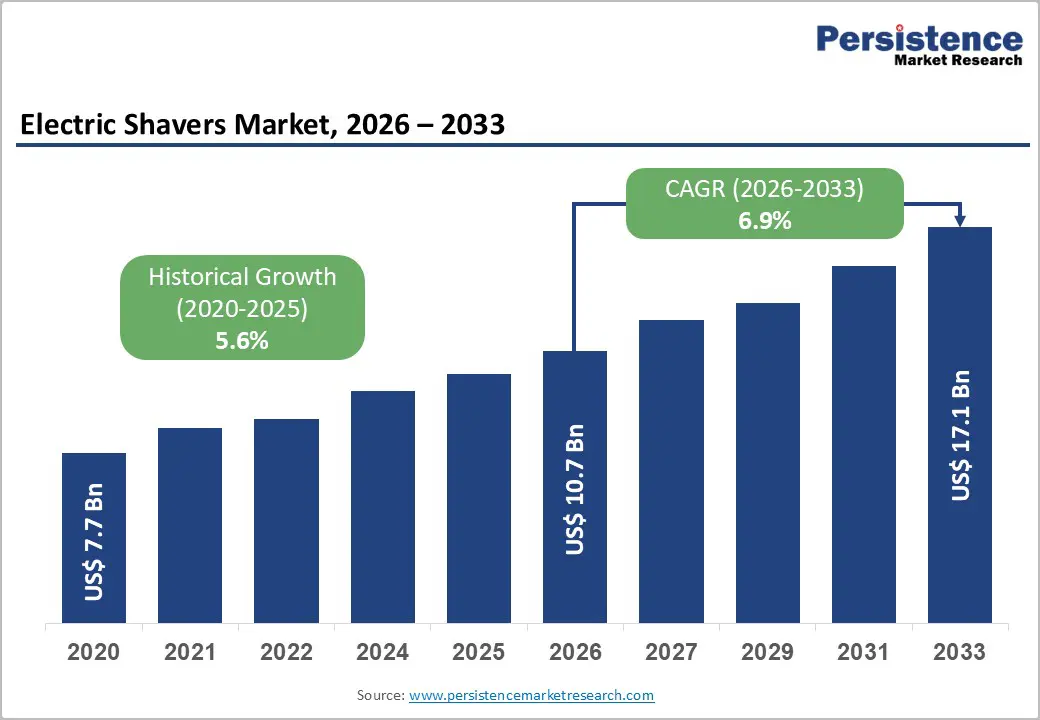
The global electric shavers market size is likely to be valued at US$ 10.7 billion in 2026, and is projected to reach US$ 17.1 billion by 2033, growing at a CAGR of 6.9% during the forecast period 2026–2033. Growth is being supported by increasing consumer expenditure on personal grooming and the rising adoption of electric grooming devices among younger demographics.
Consumers are shifting from manual razors to rechargeable and multifunctional devices that are offering convenience, speed, and improved hygiene. Manufacturers are continuously enhancing blade precision, skin protection mechanisms, and battery efficiency, which is strengthening product replacement cycles and encouraging premium upgrades. Urbanization is continuing to influence grooming habits as working professionals are prioritizing time-efficient personal care routines. Rising disposable incomes are enabling consumers to invest in higher-quality grooming appliances across both developed and emerging economies. Professional grooming standards are becoming normalized across genders, which is broadening the addressable customer base beyond traditional male segments. Retail expansion through e-commerce platforms is improving product accessibility and price transparency. As technological innovation is advancing and consumer awareness is increasing, the electric shavers market is maintaining a stable and predictable growth trajectory supported by recurring product demand and gradual premiumization.
Key Industry Highlights
- Dominant Power Source: Rechargeable shavers are expected to account for about 58% of the revenue in 2026, while dual power shavers are projected to be the fastest-growing at a CAGR of 7.6% through 2033, driven by demand for cordless flexibility.
- Leading Product Type: Foil shavers are projected to hold roughly 44% market share in 2026, whereas rotary shavers are anticipated to grow the fastest at a CAGR of 7.8% through 2033, owing to their ergonomic design.
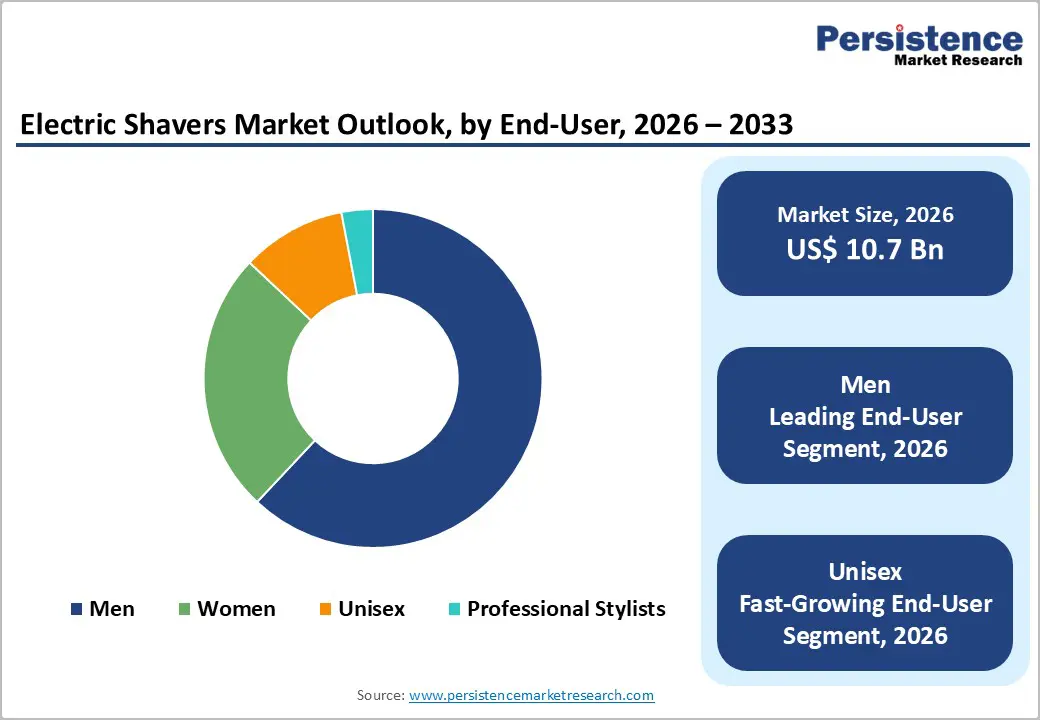
- Dominant End-User Group: Men are expected to be 62% of end-users in 2026, while the unisex segment is forecast to expand at the fastest rate of about 9.1% through 2033, reflecting evolving grooming patterns.
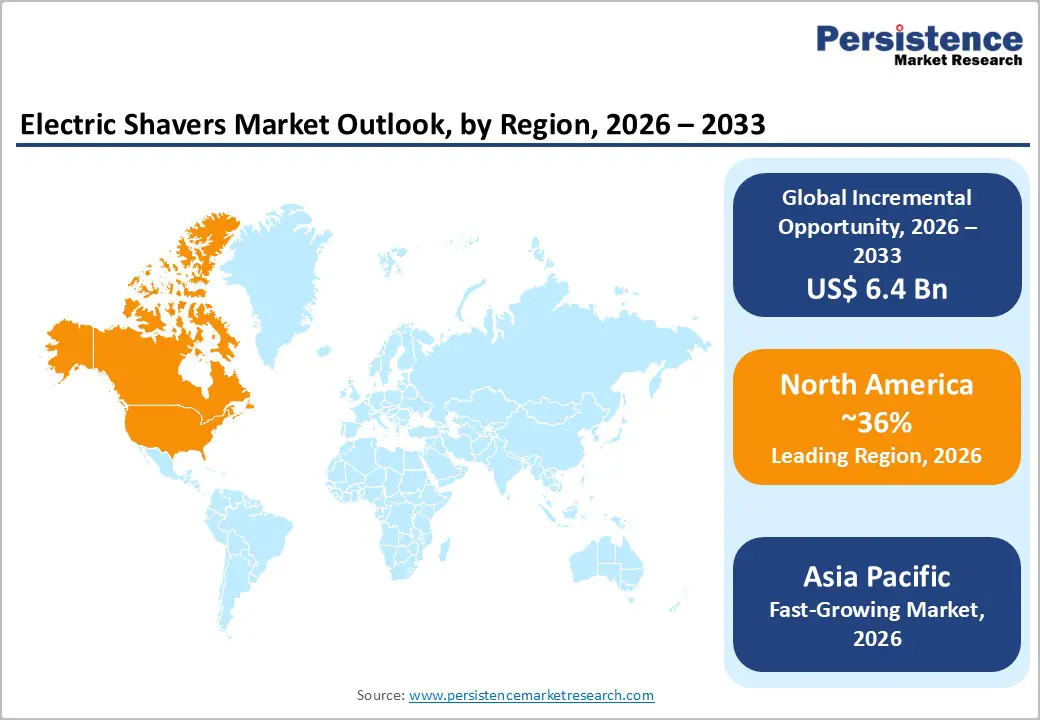
- Regional Growth Leadership: North America is expected to lead with around 36% share in 2026, while Asia Pacific is projected to be the fastest-growing market at a CAGR of 8.3% through 2033, fueled by rising disposable incomes and expanding manufacturing capacity.
- Premiumization Trend: Mass-market electric shavers continue to dominate sales volumes, while premium and sustainable electric shavers are expected to display exponential growth, as professional grooming and eco-compliance gain importance.
- October 2025: TIME Magazine named the Philips Norelco i9000 Prestige Ultra the Best Invention of 2025, recognizing its AI-powered SkinIQ Pro technology, root-level cutting precision, and UV-cleaning charging pouch.
| Key Insights | Details |
|---|---|
| Electric Shavers Market Size (2026E) | US$ 10.7 Bn |
| Market Value Forecast (2033F) | US$ 17.1 Bn |
| Projected Growth (CAGR 2026 to 2033) | 6.9% |
| Historical Market Growth (CAGR 2020 to 2025) | 5.6% |
Market Factors – Growth, Barriers, and Opportunity Analysis
Urban Lifestyle Transformation Driving Technology-Enabled Grooming Adoption
The electric shavers market is experiencing robust growth as urbanization reshapes consumer lifestyles and grooming habits. According to World Bank urbanization indicators, over 56% of the global population now resides in urban areas, and this proportion is expected to rise in the coming decade, creating a larger pool of time-conscious consumers. Busy professionals increasingly prefer electric shavers over manual razors, saving 10–15 minutes daily on grooming routines. Longer working hours, higher workforce participation, and the influence of social media on appearance standards are driving adoption. This trend spans both developed and emerging markets, with urban consumers prioritizing efficiency, comfort, and convenience in their grooming choices. The result is a steadily expanding market for technology-enabled personal care solutions.
From a business perspective, this urban lifestyle shift strengthens revenue potential through repeat purchases of replacement heads, premium models, and accessories. Continuous innovation in multi-directional blades, skin-sensing technology, and lithium-ion batteries enhances user experience, reduces irritation, and extends product lifespan. Compliance with international electrical safety standards boosts consumer confidence and allows manufacturers to command higher price points. Regions such as Asia Pacific, with rapid urbanization and rising disposable incomes, are expected to drive some of the fastest market growth. As grooming norms normalize across genders and professional contexts, manufacturers benefit from a broader addressable market, improved brand loyalty, and long-term revenue visibility.
Cost Competition and Supply Chain Challenges Limiting Market Growth
Adoption of electric shavers in emerging and price-sensitive markets is constrained by high upfront costs and strong competition from traditional manual razors. In countries developing countries, lower-income consumers continue to prefer low-cost disposable shaving alternatives, limiting electric shaver penetration. Even entry-level models struggle to convert trial users, placing margin pressure on manufacturers. These challenges restrict growth in rural and semi-urban regions despite favorable urban demographics. Coupled with replacement cycles exceeding five years in developed markets, the market experiences slower revenue expansion from repeat purchases. As a result, cost and competitive pressures remain major barriers to global market acceleration.
Operational and technological factors are also weighing in on the electric shavers market growth. These devices rely on precision blades, high-quality motors, lithium-ion batteries, and electronic sensors, making manufacturers vulnerable to component shortages or rising material costs. Rapid product innovation shortens the appeal of older models, increasing inventory and obsolescence risks. Compliance with electrical safety and environmental standards further raises production complexity and cost. These conditions necessitate a stronger focus on aftermarket strategies, bundled offerings, and premium upgrades to sustain revenue. Effectively addressing affordability, competition, and supply chain resilience is essential for long-term market success.
Expanding Consumer Base and Premiumization through Sustainability and Professional Grooming
The market for electric shavers presents significant growth potential in emerging markets across Asia Pacific and Africa, driven by rising middle-class populations, increasing disposable incomes, and expanding retail infrastructure. United Nations population and income trend data indicate that Asia Pacific will contribute the largest incremental consumer base through 2033, creating a substantial addressable market. For instance, Procter & Gamble’s Grooming segment reported US$?6.66?billion in net sales in FY2025, reflecting strong underlying demand. Manufacturers investing in localized pricing strategies, region-specific designs, and domestic assembly operations can capture untapped demand efficiently. Urbanization, shifting lifestyle patterns, and broader adoption of rechargeable and energy-efficient devices further accelerate growth.
The premiumization and professional grooming trends are creating higher-margin opportunities. Professional stylists increasingly adopt electric shavers for precise grooming, beard styling, and hygiene compliance, driving institutional sales channels. Sustainability also drives purchasing decisions, with EU and North American regulations encouraging eco-friendly, rechargeable devices. Manufacturers can capitalize on this by offering products with advanced features, commercial-grade quality, and eco-conscious branding, enhancing differentiation in competitive markets. Combined, emerging market expansion, professional grooming adoption, and sustainability trends position electric shavers for sustained revenue growth and long-term market resilience.
Category-wise Analysis
Product Type Insights
Foil shavers are expected to remain the leading product type, likely capturing around 44% of the global market revenues in 2026, due to their precision shaving and skin-friendly performance in North America and Europe. The Braun Series 9 Pro+ foil shaver, with ProComfort blade technology and SmartCare cleaning system, is projected to reinforce leadership by supporting both daily users and professional grooming adoption. Urban male consumers and premium buyers are likely to favor foil shavers for consistent, irritation-free grooming. Repeat purchases of replacement heads and accessories are expected to contribute recurring revenue for manufacturers. Product innovation in multi-directional blades and ergonomic designs is likely to further strengthen market share.
Rotary shavers are projected to be the fastest-growing segment, with an estimated CAGR of 7.8% from 2026 to 2033, driven by rising demand in Asia Pacific and other emerging markets. The launch of Philips Series 7000, i9000, and i9000 Prestige Ultra featuring AI-powered SkinIQ technology is likely to accelerate adoption by providing adaptive shaving performance across diverse facial contours. These models are expected to appeal to younger and comfort-oriented users. Marketing campaigns emphasizing flexibility and efficiency are likely to further support growth. Affordable mid-tier rotary options are projected to attract first-time electric shaver buyers.
Power Source
Rechargeable battery shavers are likely to dominate with an estimated 58% of the electric shavers market revenue share in 2026, due to strong consumer preference for cordless convenience and portability. The introduction of Philips Norelco Head Shaver Pro Series with 360° flexing heads and up to 90 minutes of cordless runtime is expected to reinforce adoption among urban and travel-oriented consumers. Rechargeable models are likely to benefit from lithium-ion battery efficiency, faster charging, and compatibility with both facial and head shaving. Repeat purchase cycles of premium rechargeable units and accessories are projected to support revenue growth. The convenience and eco-friendly aspects of rechargeable models are likely to maintain leadership in sales and user satisfaction globally.
Dual power shavers are projected to be the fastest-growing segment, with an estimated CAGR of 7.6% from 2026 to 2033, due to their flexibility in regions with inconsistent electricity supply. Devices capable of operating in both corded and cordless modes are likely to attract urban and semi-urban consumers in emerging markets. The dual-power model launches are expected to support adoption in professional salons and households requiring uninterrupted performance. These products are likely to enhance usability, reliability, and overall market resilience. Dual power shavers are projected to expand geographic penetration and strengthen manufacturers’ ability to capture new consumer segments.
End-User Insights
Men are expected to remain the dominant end-user group, projected to hold around 62% of the electric shavers market share in 2026, driven by routine facial grooming and established usage patterns. Products such as the Braun Series 9 Pro+ and Prestige Ultra, are likely to maintain strong male consumer preference due to their precision, ergonomic comfort, and performance across beard lengths. Repeat purchases of replacement heads and accessories are projected to sustain recurring revenue. Professional salons and grooming outlets are also likely to continue using men’s electric shavers for precision services. This demographic is expected to maintain steady demand while supporting premium model sales.
Unisex and women end-users are projected to grow the fastest, forecasted to register a 2026-2033 CAGR of 9.1%, owing to their multifunctional grooming needs and evolving norms. The launch of Remington Hypoallergenic Foil Shaver for Women and unisex ergonomic models is likely to expand market penetration across households and e-commerce channels. Devices designed for sensitive skin, face, and body grooming are expected to accelerate adoption. Unisex models are likely to gain traction for shared household use and professional styling. The segment is projected to drive portfolio diversification, expand the addressable market, and contribute significantly to unit sales growth.
Regional Insights
North America Electric Shavers Market Trends
At approximately 36%, North America is expected to remain the leading regional market for electric shavers in 2026, reflecting strong consumer demand and high grooming penetration. Urban professionals and dual?income households increasingly view electric shavers as daily grooming essentials, with rechargeable and cordless models especially popular. E?commerce platforms and omnichannel retail are catalyzing purchase convenience and price competition. Premium segment strategies in North America emphasize advanced comfort features and skin protection, aligning with consumer willingness to pay for performance. Rising grooming awareness among younger demographics also fuels expansion beyond traditional male users.
Despite its leadership position, the focus of market stakeholders in North America is shifting toward value enhancement, driven more by innovation and premium feature adoption than pure unit volume increases. The U.S. electric shaver market is projected to grow further, with evolving consumer preferences toward cordless, rechargeable, and eco?friendly designs playing a key role. Sustainability considerations, such as recyclable components and energy?efficient battery technologies, are increasingly influencing buying decisions in developed markets. Seasonal promotions and bundled offerings further stimulate demand, especially during holiday and major retail events throughout the past years. As technology adoption increases, North America’s market position benefits from early uptake of customization and digital loyalty programs that reinforce brand loyalty and differentiation in a mature environment.
Europe Electric Shavers Market Trends
Europe is projected to hold a stable and substantial share of the electric shavers market in 2026, anchored by high disposable income and established grooming habits across Germany, the U.K., France, and Spain. Regional sales data indicate a strong preference for multifunctional and wet/dry electric shavers, especially as waterproof and ergonomic designs gain traction among urban consumers seeking convenience during daily routines. German and U.K. retail outlets continue to push seasonal electric shaver promotions aimed at holiday shoppers and professional users. Regulatory initiatives on energy efficiency and reusable components also contributed to eco?friendly product development and compliance design frameworks that favor rechargeable over disposable alternatives. Growing interest among younger European consumers in multifunction grooming tools supports product diversification.
In Europe, market growth remains measured, emphasizing innovation and sustainability, as mature consumer markets show stable demand for high?performance electric shavers. Retail dynamics show that wet/dry shavers accounted for a significant niche share, particularly in Japan, China, and South Korea, but in Europe, this trend is also reflected in the rising visibility of similar hybrid devices in specialty stores and department chains. Sustainability preferences are particularly strong in Scandinavian and Western European markets, where energy?efficient and recyclable grooming products are part of broader consumer lifestyle trends. Premium and professional segment players tailor product messaging around comfort, durability, and skin protection, sustaining demand in competitive regions.
Asia Pacific Electric Shavers Market Trends
Asia Pacific is projected to be the fastest?growing regional market for electric shavers, at a CAGR of 8.3% during the 2026-2033 forecast period. Large population bases in China, India, Japan, and ASEAN countries, combined with rising disposable income and expanding middle?class spending power, are driving increased adoption of personal grooming devices. E?commerce penetration in Asia Pacific continues to rise, with online purchasing becoming an increasingly important driver of electric shaver sales in urban and semi?urban markets. Rapid urbanization and the rise of lifestyle and self?care awareness among younger consumers are expanding the addressable market beyond traditional gender lines.
The growth momentum of the Asia Pacific electric shavers market is underpinned by diverse regional adoption patterns and localized innovations, with mid?tier electric shaver models gaining strong traction in India and Southeast Asia. Local manufacturing advantages and cost?competitive product portfolios allow domestic and regional players to penetrate price?sensitive segments effectively. Government initiatives supporting electronics and consumer goods manufacturing further strengthen supply chains and export capacities in China and ASEAN economies. In Japan and South Korea, premium product adoption is rising among professional and urban users. E?commerce campaigns and digital marketing, often coupled with social media influencer partnerships and online grooming tutorials, have amplified product awareness, particularly for ergonomic and easy?to?use electric shavers designed for both facial and body grooming.
Competitive Landscape
The global electric shavers market structure is moderately consolidated, with a small group of established brands accounting for a significant share of global revenue. Market leadership is anchored by companies such as Philips, Braun, and Panasonic, which together are estimated to control over half of total market sales, supported by strong brand equity, wide product portfolios, and global distribution reach. Their competitive advantage is reinforced by sustained investment in R&D, particularly in blade engineering, battery efficiency, and skin-protection technologies. High customer retention and premium positioning further strengthen entry barriers for new participants.
Market competition remains dynamic across mid-tier and professional segments. Brands such as Wahl, Remington, and regional manufacturers in Asia compete through targeted pricing, professional grooming penetration, and faster product refresh cycles. Market entry is constrained by brand loyalty, safety certifications, and scale-driven cost efficiencies, though e-commerce and contract manufacturing have lowered some barriers. Looking ahead, competitive intensity is expected to increase through incremental consolidation, portfolio expansion into women and unisex grooming, and deeper focus on rechargeable, sustainable, and professional-grade electric shavers.
Key Industry Developments
- In January 2026, RCPL acquired the global rights to heritage grooming and personal care brands including Brylcreem and Toni & Guy, marking a major strategic expansion into men’s grooming and styling. The move strengthens Reliance’s grooming portfolio and creates cross-category synergies that can complement electric grooming appliances.
- In December 2025, Honasa Consumer acquired a 95% stake in Reginald Men for INR 195 crore, formally entering the high-growth men’s personal care segment. Reginald Men’s strong profitability (nearly 25% EBITDA margin) and INR 70+ crore revenue base enhance Honasa’s diversification beyond women and baby care.
- In May 2025, Mercurius Media Capital announced a US$ 2 million media-for-equity investment in Groomie to scale its BaldiePro electric shaver business. The partnership targeted national TV and streaming campaigns to accelerate DTC growth and expand subscriptions to 80,000 by end-2025.
Companies Covered in Electric Shavers Market
- Philips
- Panasonic Corporation
- Procter & Gamble
- Xiaomi
- Remington
- Wahl Clipper Corporation
- Conair Corporation
- Andis Company
- Havells India Ltd.
- Flyco
- Syska
Frequently Asked Questions
he global electric shavers market is projected to reach US$ 10.7 billion in 2026.
Rising grooming expenditure, urban lifestyle adoption, technological advancements in rechargeable devices, and expanding grooming usage across genders are key growth drivers.
The market is poised to witness a CAGR of 6.9% from 2026 to 2033.
Professional grooming adoption and sustainability-driven product innovation represent major growth opportunities.


