




- Beauty & Personal Care
- Dry Wash Spray Market
Dry Wash Spray Market Size, Share, and Growth Forecast 2026 – 2033
Dry Wash Spray Market Size, Share, and Growth Forecast 2026 – 2033 by Application (Personal Care, Skin Care, Hair Care, Laundry Care, Surface Care), by Nature (Natural/Organic, Conventional), by Form (Foam, Liquid, Powder), by Packaging (Trigger Spray, Pressing Spray), by Sales Channel, by Regional Analysis, 2026–2033

Dry Wash Spray Market Size and Trend Analysis
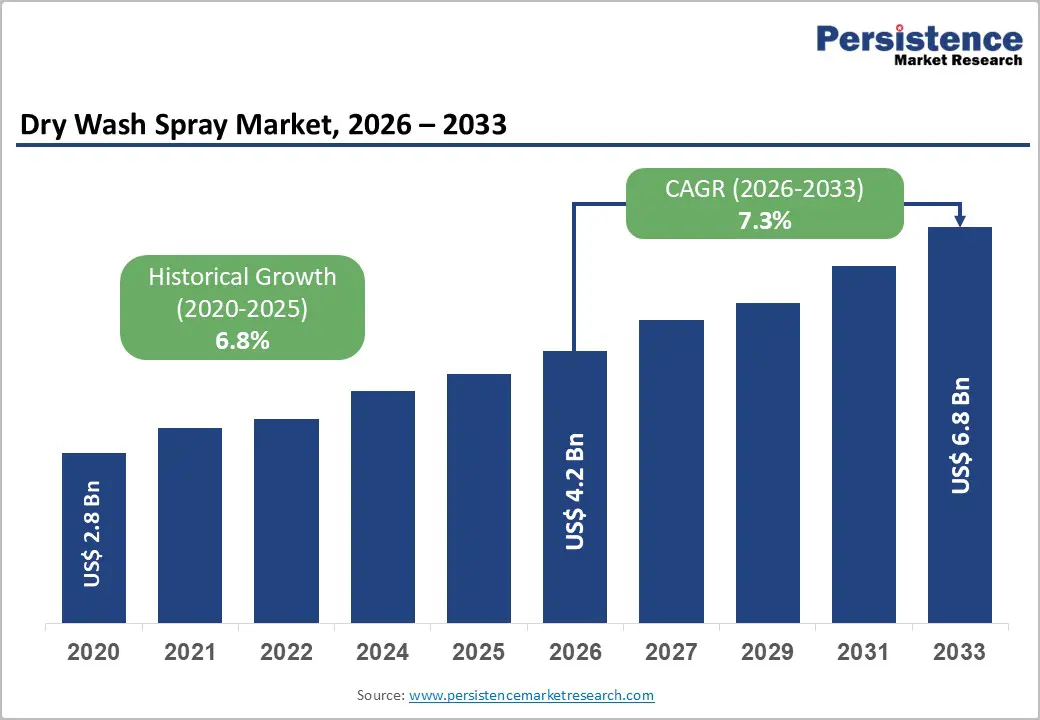
The global Dry Wash Spray Market size is likely to be valued at US$4.2 billion in 2026 and is expected to reach US$6.9 billion by 2033, growing at a CAGR of 7.3% during the forecast period from 2026 to 2033. This expansion is underpinned by rising urbanization, time-constrained lifestyles, and growing consumer preference for quick, water-efficient cleaning and grooming solutions across personal care, laundry, and surface care applications.
Key Market Highlights
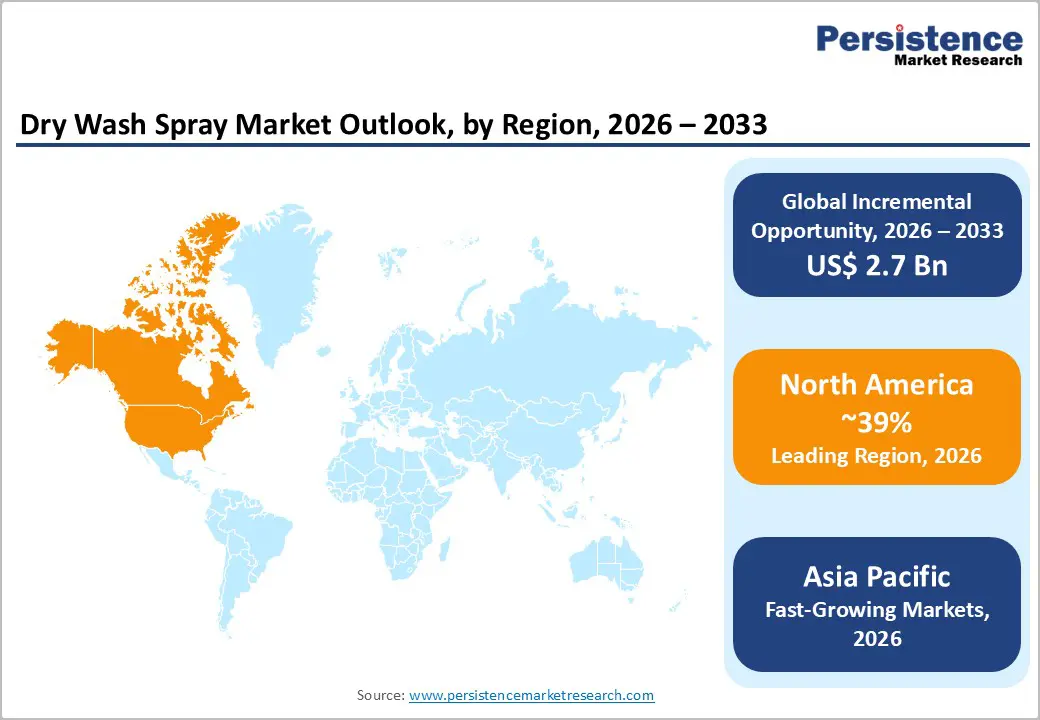
- Leading region: North America dominates the Dry Wash Spray Market holding 39% share, due to high consumer awareness, strong retail and e-commerce infrastructure, and early adoption of premium personal-care and surface-care sprays.
- Fastest-growing region: Asia Pacific is the fastest-growing region with rising CAGR of 8.9%, driven by rising urbanization, expanding middle-class populations, and growing e-commerce penetration in countries such as India, China, and Indonesia.
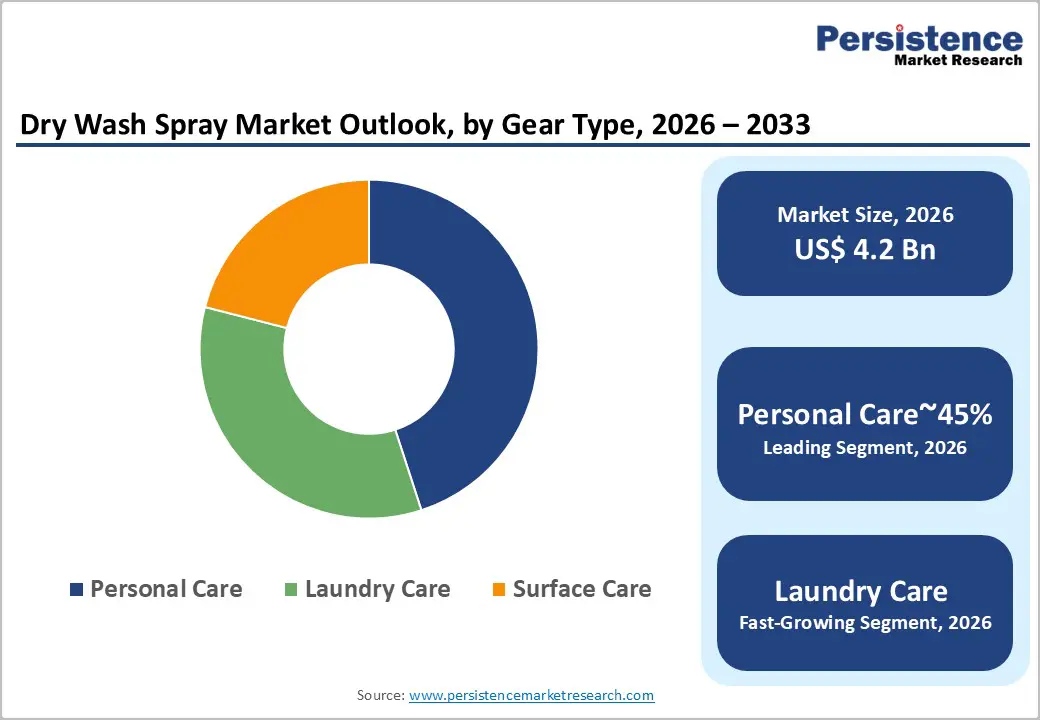
- Dominant segment from any category: The personal care application segment is the dominant category, led by dry shampoos and body-refresh sprays that benefit from frequent usage and strong brand loyalty in hair care and skin care.
- Fastest-growing segment from any category: The natural/organic nature segment is the fastest-growing, supported by stricter cosmetic regulations, clean-beauty trends, and increasing demand for organic rice starch and plant-based formulations in Europe and North America.
- Key market opportunity: The integration of e-commerce and direct-to-consumer models in emerging markets presents a major opportunity, enabling brands to scale rapidly in Asia Pacific, Latin America, and Africa through online retail stores and social-commerce platforms.
| Key Insights | Details |
|---|---|
| Dry Wash Spray Market Size (2026E) | US$ 4.2 Bn |
| Market Value Forecast (2033F) | US$ 4.9 Bn |
| Projected Growth (CAGR 2026 to 2033) | 7.3% |
| Historical Market Growth (CAGR 2020 to 2025) | 6.8% |
Market Dynamics
Market Growth Drivers
Rising demand for convenient, on-the-go personal and household care solutions
Consumers in urban centers across North America, Europe, and Asia Pacific increasingly favor time-saving products that fit fast-paced lifestyles, driving adoption of dry wash sprays in personal care and surface-care segments. For instance, the personal care application segment—encompassing dry shampoos and body-refresh sprays—has seen strong traction, supported by busy work routines, frequent travel, and post-pandemic hygiene consciousness.
The segments such as hair care and skin care are among the fastest-growing within the broader dry-ormat cleansing category, reinforcing the structural shift toward spray-based, waterless routines. This behavioral change is further amplified by the proliferation of online retail platforms, which simplify access to niche and premium dry wash spray formulations.
Growing focus on water conservation and sustainable cleaning
Global water-stress conditions, with over 2 billion people living in regions facing high water scarcity according to UN Water, are prompting both consumers and regulators to favor low-water alternatives in laundry and surface cleaning. Dry wash sprays for garments and vehicles reduce the frequency of traditional water-intensive washing cycles, thereby lowering water consumption and associated energy use.
In Europe, directives such as the EU Ecodesign for Energy-Related Products (ErP) framework and national water-efficiency programs encourage water-saving products, thereby indirectly boosting demand for apparel dry-wash sprays and automotive dry-wash formulations. Industry-led initiatives by companies such as Procter & Gamble, Unilever, and L’Oréal to reduce water footprints across their product portfolios have also spurred R&D into low-water, high-efficacy dry-wash sprays, aligning with broader ESG and circular-economy goals.
Market Restraints
Regulatory scrutiny on aerosol propellants and volatile organic compounds (VOCs)
Many dry wash sprays are packaged as aerosol cans or pressurized trigger sprays, which are subject to tightening regulations on VOC emissions and propellant use in markets such as the United States (under the U.S. Environmental Protection Agency guidelines) and the European Union (under the EU VOC Solvents Directive).
Compliance with these rules often necessitates reformulation with alternative propellants or aerosol packaging, which can increase R&D costs and delay product launches. For example, the EU has progressively reduced VOC limits for consumer products, pushing manufacturers to invest in low-VOC or water-based formulations that may initially exhibit lower cleaning performance or higher production costs, thereby constraining margin expansion.
Consumer skepticism about efficacy versus traditional washing methods
Despite technological advances, a segment of consumers remains skeptical about the cleaning efficacy of dry wash sprays compared with conventional water-based washing, particularly for heavily soiled garments, vehicles, or hard surfaces. Surveys conducted by independent consumer-insight platforms indicate that perceived ineffectiveness and residue buildup are among the top concerns cited by non-adopters.
This perception gap requires sustained marketing, education, and product trial campaigns, which increase customer acquisition costs. In emerging markets such as India and Brazil, where price sensitivity is high, the premium pricing of many branded dry wash sprays further limits penetration, especially when competing against low-cost detergents and manual cleaning methods.
Market Opportunities
Expansion of natural and organic formulations in personal care and skin-care applications
The global trend toward clean beauty and natural personal-care products creates a significant opportunity for natural/organic dry-wash sprays across hair care, skin care, and body-refresh segments. Regulatory bodies such as COSMOS in Europe and USDA Organic in the United States have established certification standards that help brands differentiate “clean” formulations, attracting eco-conscious millennials and Gen Z consumers.
Brands such as Unilever, L’Oréal, and niche players are already launching organic dry shampoos based on starches like rice and tapioca, free from parabens, sulfates, and silicones, as highlighted in dermatology-oriented publications. With Healthline and similar platforms frequently featuring “best natural and organic dry shampoos,” this sub-segment is poised to grow faster than conventional offerings, especially in premium retail and e-commerce channels.
Growth of e-commerce and direct-to-consumer (DTC) models in emerging economies
The rapid expansion of online retail and mobile-first shopping in Asia Pacific, Latin America, and parts of Africa presents a major growth lever for dry wash spray brands. According to World Bank and UNCTAD data, e-commerce penetration in countries such as India, Indonesia, and Brazil has accelerated post-pandemic, supported by rising smartphone adoption and digital-payment infrastructure.
This shift enables niche and regional brands to reach geographically dispersed consumers without heavy investments in brick-and-mortar networks. For instance, online retail stores and marketplaces now account for a growing share of sales for personal-care dry wash sprays, while drug and pharmacy stores increasingly stock multi-use surface-care sprays. By leveraging AI-driven personalization, subscription models, and social-commerce campaigns, manufacturers can tap into underpenetrated urban and semi-urban markets, particularly for travel-size and on-the-go formats.
Category-wise Insights
Application-wise Analysis
The personal care application segment dominates the Dry Wash Spray Market, capturing approximately 45% of total category share in 2026. Is this leadership driven by the widespread adoption of dry shampoos and body-refresh sprays in hair care and skin care, especially among working professionals and frequent travelers in North America and Europe.
The personal care-focused dry wash sprays benefit from higher willingness to pay, strong brand loyalty, and frequent repurchase cycles. The integration of fragrance-enhancing and oil-absorbing ingredients, such as rice starch and tapioca starch, further differentiates these products from traditional wash routines, reinforcing their position as the leading application segment.
Nature-wise Analysis
Within the Nature category, conventional dry wash sprays continue to hold around 60% of the market share, primarily due to broader availability, lower production costs, and established distribution networks. However, the natural/organic sub-segment is expanding at a faster pace, supported by stricter cosmetic regulations in the EU and growing consumer demand for clean-label ingredients.
Certifications such as COSMOS and USDA Organic have enabled brands like Unilever and L’Oréal to position premium natural formulations in hair care and skin care, particularly in Europe and North America. Independent dermatology and beauty-care publications frequently highlight the benefits of organic rice starch, colloidal oatmeal, and plant-based oils, which enhance credibility and drive trial among health-conscious consumers.
Form-wise Analysis
The liquid form segment leads the Form category with roughly 55% market share, owing to its versatility across personal care, laundry care, and surface care applications. Liquid dry-wash sprays are compatible with both trigger-spray and pressurized-spray packaging, enabling precise application and facilitating integration into existing household-cleaning and automotive product lines.
Industry-specific analyses indicate that liquid formulations are preferred for garment refresh. interior cleaning, and multi-surface sprays because they balance cleaning efficacy with residue control. Foam and powder variants, while smaller in share, are gaining traction in niche segments such as carpet and upholstery cleaning and travel-size dry shampoos, where texture and portability are critical.
Packaging-wise Analysis
Trigger spray packaging accounts for approximately 50% of the Packaging segment, driven by its ergonomic design, adjustable nozzle settings, and compatibility with a wide range of liquid and foam formulations. Trigger sprayers are widely used in household cleaning, automotive, and personal care products, supported by a mature supply chain for HDPE bottles and chemically resistant pumps in regions such as India and China.
Pressurized spray (aerosol) cans, despite regulatory constraints on VOCs, remain popular for dry shampoos and fabric-refresh sprays due to their fine mist and ease of application. Ongoing innovations in low-VOC propellants and refillable systems are expected to sustain demand for pressing-spray formats in premium and travel-oriented segments.
Sales Channel-wise Analysis
Online retail stores are the fastest-growing Sales Channel segment, with an estimated share of approximately 25% and rising, particularly for personal care and travel-size dry wash sprays. Platforms such as Amazon, Flipkart, and regional e-marketplaces have become primary channels for brand discovery, reviews, and repeat purchases, supported by targeted social-media and influencer campaigns.
Supermarkets/hypermarkets and drug and pharmacy stores remain critical for surface-care and laundry-care sprays, where in-store visibility and promotional displays drive impulse buys. Multi-brand stores and specialty stores cater to premium and niche formulations, while wholesalers/distributors facilitate penetration into B2B segments such as hospitality and automotive service centers.
Regional Insights
North America Dry Wash Spray Trends
North America leads the Dry Wash Spray Market in terms of innovation, brand penetration, and regulatory maturity, with the United States accounting for the largest national share. The region benefits from a highly developed retail infrastructure, strong e-commerce adoption, and a culture of on-the-go personal care, which supports premium pricing for dry shampoos and fabric-refresh sprays.
Regulatory frameworks such as the U.S. EPA guidelines on VOCs and California’s Air Resources Board (CARB) standards are pushing manufacturers to adopt low-emission propellants and water-based formulations, aligning with broader sustainability goals. In parallel, partnerships between major brands and hospitality chains or airline operators are expanding the usage of dry wash sprays in travel and in-flight environments, reinforcing North America’s role as a trendsetter in product development.
Europe Dry Wash Spray Trends
Europe exhibits strong demand for eco-friendly and regulation-compliant dry wash sprays, particularly in Germany, the United Kingdom, France, and Spain. Harmonized frameworks such as the EU VOC Solvents Directive and REACH regulations shape formulation strategies, encouraging the use of biodegradable solvents and low-VOC systems. Germany and the UK are notable for early adoption of natural/organic personal-care sprays, while France and Spain show robust growth in surface-care and automotive applications.
Industry reports and EU-funded innovation programs highlight investments in green chemistry and circular packaging solutions, positioning European brands at the forefront of sustainable dry wash spray development. Cross-border e-commerce platforms further amplify reach, enabling regional players to compete with global giants.
Asia Pacific Dry Wash Spray Trends
Asia-Pacific is the fastest-growing region for the Dry Wash Spray Market, driven by large populations, rapid urbanization, and rising disposable incomes in China, Japan, India, and the ASEAN countries. In China and Japan, premium personal-care and automotive sprays benefit from advanced manufacturing ecosystems and strong retail and e-commerce networks.
India and Indonesia are emerging as key hubs for cost-efficient production and local formulation, supported by government initiatives to boost chemical manufacturing and export capacity. Local brands are increasingly partnering with global players to access technology and distribution, while online marketplaces such as Lazada, Shopee, and Flipkart facilitate rapid scaling. The combination of manufacturing advantages, digital adoption, and urban lifestyle shifts positions Asia Pacific as a primary growth engine for the global dry wash spray industry.
Competitive Landscape
Market Structure Analysis
The Dry Wash Spray Market is moderately consolidated, with a mix of global consumer-goods giants and regional specialty players. Major corporations such as Prestige Consumer Healthcare Inc., Combe Incorporated, L’Oréal S.A., Unilever PLC, Procter & Gamble Company, Henkel Corporation, and Church & Dwight Co. hold significant shares in personal care and surface care, leveraging strong brand equity, R&D capabilities, and global distribution.
Smaller and regional brands compete on niches such as natural/organic formulations, automotive detailing, and B2B solutions, often using innovative packaging and localized marketing. Strategic trends include M&A activity, product line extensions into multi-use sprays, and sustainability-driven innovation, such as refillable systems and low-VOC propellants, which are reshaping competitive dynamics across regions.
Key Market Developments
- In January 2025: L’Oréal S.A. launched a new line of organic dry shampoos under its Kérastase brand, featuring rice starch and plant-based fragrances, targeting eco-conscious consumers in Europe and North America. The launch is part of L’Oréal’s broader sustainability roadmap, aiming to reduce water usage and carbon footprint across its hair-care portfolio.
- In September 2024: Unilever PLC introduced a multi-surface dry wash spray in India, designed for quick cleaning of kitchen surfaces, appliances, and automotive interiors, leveraging the company’s Sunsilk and Surf Excel brand equity to cross-sell into household-care segments.
- In March 2024, Procter & Gamble Company expanded its Febreze Fabric Fresh line with a travel-size dry wash spray optimized for air travel and hotel stays, supported by partnerships with major airline operators and hospitality chains to promote in-cabin usage and reduce laundry frequency.
Companies Covered in Dry Wash Spray Market
- Prestige Consumer Healthcare Inc.
- Combe Incorporated
- L’Oréal S.A.
- Unilever PLC
- ITW Global Brands
- High Ridge Brands
- Henkel Corporation
- Church & Dwight Co.
- Faultless Brands
- Procter & Gamble Company
- Turtle Wax, Inc.
- Gold Eagle Company
- Estée Lauder Companies
- Unicharm Corporation
- 3M Company
- Newell Brands
Frequently Asked Questions
The Dry Wash Spray Market is projected to reach US$ 6.9 Billion by 2033, growing at a CAGR of 7.3% from 2026, driven by rising demand for convenient, water‑saving personal‑care and surface‑care solutions.
Key demand drivers include busy urban lifestyles, water‑conservation awareness, post‑pandemic hygiene concerns, and expanding e‑commerce, which collectively boost adoption of personal‑care, laundry‑care, and surface‑care sprays.
The personal care application segment dominates, capturing around 45% of the market, led by dr shampoos and body‑refresh sprays in hair care and skin care.
North America leads the global Dry Wash Spray Market, supported by strong brand presence, advanced retail and e‑commerce infrastructure, and early adoption of premium personal‑care and surface‑care sprays.
A key opportunity lies in natural/organic formulations and e‑commerce‑driven expansion in emerging markets, where clean‑beauty trends and digital‑shopping adoption are accelerating demand for eco‑friendly and on‑the‑go dry wash sprays.
Major players include Prestige Consumer Healthcare Inc., Combe Incorporated, L’Oréal S.A., Unilever PLC, Procter & Gamble Company, Henkel Corporation, Church & Dwight Co., Turtle Wax, Inc., Gold Eagle Company, Estée Lauder Companies, Unicharm Corporation, and 3M Company, among others.


