




- Home Care & Utilities
- Laundry Detergent Sheets Market
Laundry Detergent Sheets Market Size, Share, and Growth Forecast, 2026 – 2033
Laundry Detergent Sheets Market by Product Type (Biodegradable, Non-Biodegradable), Application (Household, Commercial, Industrial, Laundromats), and Regional Analysis for 2026 – 2033

Laundry Detergent Sheets Market Size and Trends Analysis
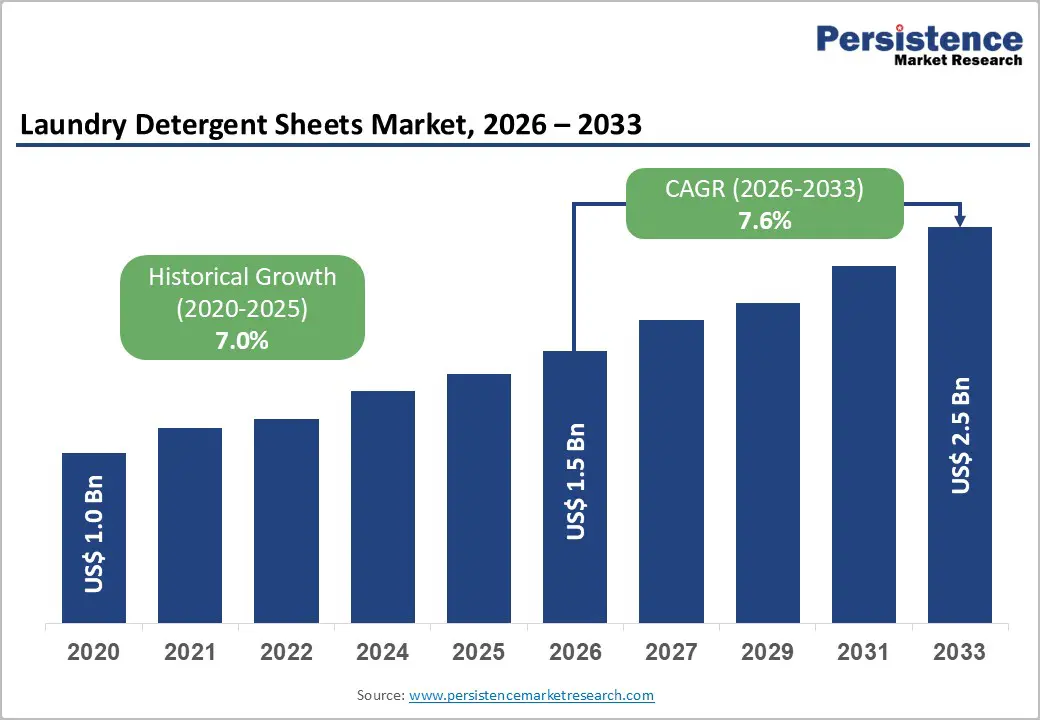
The global laundry detergent sheets market size is likely to be valued at US$1.5 billion in 2026 and is expected to reach US$2.5 billion by 2033, growing at a CAGR of 7.6% during the forecast period from 2026 to 2033, driven by regulatory pressure on single-use plastics, corporate sustainability commitments, and the rapid penetration of eco-friendly household products.
Detergent sheets benefit from reduced packaging, lower transportation emissions, and simplified dosing, making them attractive alternatives to traditional liquid and powder detergents. Growing e-commerce adoption, subscription-based sales models, and product innovations, such as enzyme-based and biodegradable formulations, are enhancing market visibility and accessibility. Emerging economies are experiencing increased uptake of compact housing and smaller washing machines, which favor concentrated detergent formats.
Key Industry Highlights:
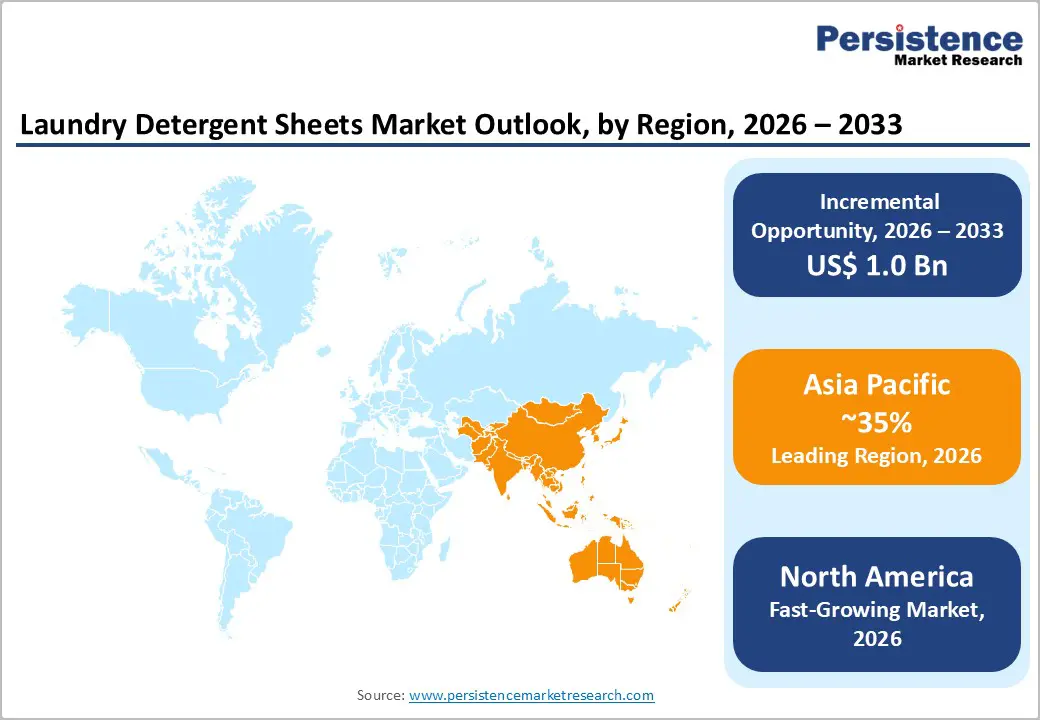
- Leading Region: Asia Pacific is anticipated to be the leading region, accounting for a market share of 35% in 2026, driven by rapid urbanization, rising middle-class income levels, expanding e-commerce penetration, and strong manufacturing capabilities supporting cost-efficient and sustainable detergent sheet production.
- Fastest-growing Region: North America is likely to be the fastest-growing region for laundry detergent sheets in 2026, supported by strong environmental regulations, high consumer awareness of sustainable products, advanced product innovation, and a consolidated presence of leading detergent manufacturers.
- Leading Product Type: The biodegradable segment is projected to represent the leading product type in 2026, accounting for 62% of the revenue share, supported by strong consumer preference for sustainable and regulation-compliant detergent solutions.
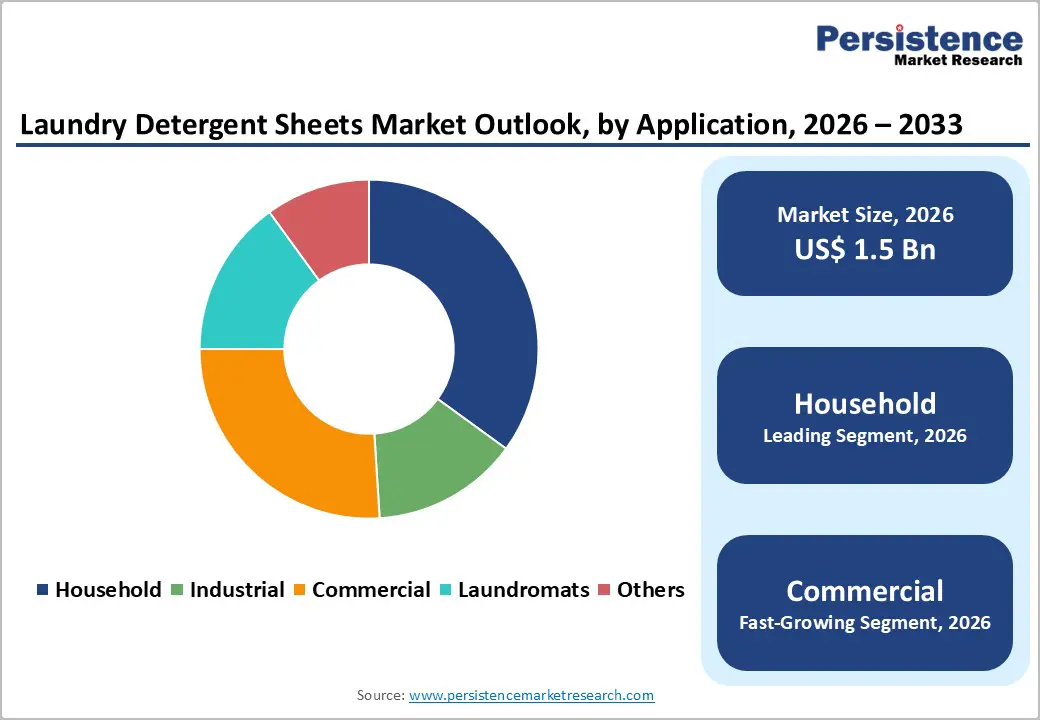
- Leading Application: The household segment is projected to be the leading application type, accounting for over 55% of revenue in 2026, supported by convenience, portability, and strong e-commerce penetration.
| Report Attribute | Details |
|---|---|
|
Laundry Detergent Sheets Market Size (2026E) |
US$1.5 Bn |
|
Market Value Forecast (2033F) |
US$2.5 Bn |
|
Projected Growth (CAGR 2026 to 2033) |
7.6% |
|
Historical Market Growth (CAGR 2020 to 2025) |
7.0% |
Market Factors – Growth, Barriers, and Opportunity Analysis
Urbanization and Changing Consumer Lifestyles
Urban households, particularly in densely populated cities, often face limited storage space and prefer compact, lightweight alternatives to bulky liquid or powder detergents. Laundry detergent sheets address these constraints by offering ultra-thin, pre-measured formats that are easy to store, transport, and use. The rise of apartment living, shared housing, and smaller home layouts has reinforced the demand for such minimalist solutions. Urban consumers are more exposed to sustainability messaging and regulatory initiatives promoting waste reduction, which aligns well with the plastic-free packaging of detergent sheets. Cities continue to expand in emerging economies across Asia Pacific, Latin America, and parts of Africa. Detergent sheets are increasingly viewed as modern, practical products that fit seamlessly into fast-paced urban lifestyles, supporting consistent market adoption and long-term growth.
Changing consumer lifestyles strengthen demand, as modern consumers seek products that save time, reduce effort, and align with environmentally responsible values. Busy work schedules, dual-income households, and the growing influence of younger, sustainability-conscious demographics have reshaped purchasing behavior in favor of convenient, mess-free laundry solutions. Laundry detergent sheets eliminate the need for measuring, reduce spillage, and perform efficiently in both standard and compact washing machines, making them ideal for time-constrained urban users. The rise of e-commerce and direct-to-consumer models has improved product accessibility, particularly among digitally engaged consumers who value subscription-based and doorstep delivery options.
Regulatory Compliance Hurdles in Diverse Markets
Manufacturers expand across diverse geographic regions with varying environmental and chemical regulations. Governments worldwide are tightening policies related to packaging waste, biodegradability, chemical safety, and labeling transparency, directly influencing product formulation and market entry strategies. While such regulations encourage sustainable innovation, they also create hurdles for producers, as compliance requirements differ markedly between regions. Restrictions on phosphates, surfactants, and microplastics vary across North America, Europe, and Asia Pacific, requiring companies to customize formulations for each market.
Inconsistent enforcement and evolving regulatory frameworks amplify uncertainty for manufacturers operating in multiple jurisdictions. Frequent policy updates related to sustainability targets, carbon emissions, and consumer safety demand continuous reformulation and packaging redesign, increasing R&D investment requirements. Emerging markets may lack standardized guidelines, creating ambiguity in compliance interpretation and elevating legal risks for international brands. Conversely, highly regulated markets demand rigorous compliance audits and certifications, which can slow down innovation cycles. Trade regulations and import standards complicate cross-border expansion, particularly for eco-focused detergent sheets that rely on novel materials.
Integration of Smart Technology and Customization
Consumers increasingly seek intelligent, personalized, and connected home care solutions. Smart washing machines with automated detergent dosing and app-based controls are becoming more common in urban households, creating opportunities for detergent sheet manufacturers to develop compatible, performance-optimized products. QR-enabled packaging, smart labels, and digital usage guides can help consumers select the right number of sheets based on load size, fabric type, or water hardness, improving washing efficiency and reducing waste. Data-driven insights gathered through digital platforms and e-commerce channels enable brands to understand usage patterns and optimize formulations accordingly.
Customization strengthens this opportunity by addressing diverse consumer preferences and washing conditions across regions. Personalized detergent sheets tailored to fragrance sensitivity, skin type, fabric care needs, and regional water quality allow brands to differentiate in a competitive market. Customization also supports sustainability goals by enabling consumers to choose formulations optimized for cold-water washing or low-energy cycles, reducing environmental impact. Developments in modular formulation and plant-based chemistry make it easier to offer customizable variants without significantly increasing production complexity. E-commerce platforms and direct-to-consumer channels play a crucial role in delivering personalized options efficiently, supported by data analytics and customer feedback loops.
Category-wise Analysis
Product Type Insights
The biodegradable segment is expected to lead the laundry detergent sheets market, accounting for approximately 62% of revenue in 2026, driven by strong alignment with global sustainability goals and shifting consumer values toward environmentally responsible products. Consumers increasingly prefer detergent solutions that minimize ecological impact, especially in urban households where awareness of waste reduction and chemical safety is high. For example, the growing preference for plant-based detergent sheets among eco-focused households, where consumers deliberately replace traditional detergents with biodegradable sheets to align daily routines with sustainable living practices, reinforces the segment’s leadership across major markets.
The non-biodegradable segment is likely to represent the fastest-growing segment in 2026, supported by its cost competitiveness, strong cleaning performance, and established consumer trust in conventional detergent formulations. This segment continues to appeal to price-sensitive consumers and commercial users who prioritize stain-removal efficiency and consistency over sustainability attributes. For example, the continued adoption of non-biodegradable detergent sheets by value-focused consumers in regions with less stringent sustainability regulations, where established brands leverage mass retail channels, strong brand trust, and proven cleaning performance to ease the transition from traditional liquid and powder detergents.
Application Insights
The household segment is projected to lead the market, capturing around 55% of the revenue share in 2026, supported by everyday consumer demand for convenience, ease of storage, and mess-free usage. Modern households, especially in urban settings, increasingly favor compact and lightweight laundry solutions that simplify routine chores while fitting into limited living spaces. This segment enjoys strong brand loyalty, as consumers who start using detergent sheets at home are unlikely to return to traditional formats. For instance, many households have widely adopted detergent sheets via online grocery platforms, drawn by their convenience, space-saving design, and alignment with sustainable home-care practices.
The commercial segment is expected to be the fastest-growing application in 2026, driven by increasing adoption across hospitality, institutional laundry services, and shared living facilities. Commercial users value efficiency, standardized dosing, and reduced storage requirements, all benefits offered by detergent sheets. For example, hotels are increasingly using detergent sheets to streamline operations while demonstrating environmentally responsible practices to guests. Serviced apartments and professional laundry providers also benefit from simplified inventory management and consistent wash quality, making sheets a compelling alternative to liquid detergents. Sustainability commitments within the service sector further boost adoption, as detergent sheets help achieve waste reduction goals and strengthen eco-friendly brand positioning.
Regional Insights
North America Laundry Detergent Sheets Market Trends
North America is expected to be the fastest-growing region for laundry detergent sheets in 2026, driven by strong consumer demand for eco-friendly, convenient, and space-saving laundry solutions. A large share of consumers in the U.S. and Canada now prioritize sustainability, with many actively seeking plastic-free and biodegradable detergent formats, thereby boosting sheet adoption across household segments. High washing machine penetration, coupled with widespread awareness about reducing packaging waste and carbon footprint, has shifted buying behavior toward sheet-based detergents that align with modern lifestyle preferences. The growth of e-commerce and direct-to-consumer subscription models has expanded market reach, enabling brands to target digitally engaged shoppers effectively.
North America’s trend toward sustainability, convenience, and digital purchasing behavior is solidifying detergent sheets as a mainstream alternative to traditional liquids and powders. For example, Earth Breeze, a U.S.-based eco-focused brand, has gained notable market presence by offering plant-based, phosphate-free laundry detergent sheets that appeal to environmentally minded consumers and households seeking a practical, low-waste laundry option. With its emphasis on vegan, hypoallergenic, and lower-Impact formulations, Earth Breeze reflects the broader North American consumer shift toward sustainability without compromising performance.
Europe Laundry Detergent Sheets Market Trends
Europe is likely to be a significant market for laundry detergent sheets in 2026, driven by stringent environmental regulations and high consumer awareness of sustainability. Western and Northern European countries are particularly influential, with consumers increasingly choosing eco-friendly and biodegradable detergent formats in response to stringent EU directives limiting harmful chemicals and plastic packaging. This regulatory framework, combined with growing environmental consciousness, has encouraged manufacturers to reformulate products with plant-based surfactants and low-phosphate ingredients, aligning with regional green consumption patterns.
Urbanization and smaller living spaces are driving demand for compact, mess-free laundry solutions suited to modern routines. In Europe, rising expectations for transparency in sustainability and cleaner supply chains are driving manufacturers to enhance both formulations and packaging, supporting long-term segment growth. For example, Alunara, a Lithuanian brand offering biodegradable, plant-based detergent sheets certified free of plastic waste and harmful chemicals, has gained traction across the Baltic region and wider European markets by aligning its product design with regional sustainability priorities and consumers’ demand for environmentally responsible laundry solutions.
Asia Pacific Laundry Detergent Sheets Market Trends
The Asia Pacific region is expected to be the leading market, accounting for a 35% share in 2026, driven by rising urbanization, growing disposable incomes, and an increasing focus on sustainable living. Consumers in key APAC countries are becoming more environmentally conscious, with many prioritizing eco-friendly and recyclable packaging when selecting laundry care products. This shift is boosting demand for detergent sheets that meet these sustainability preferences. Expanding online retail and e-commerce platforms are enhancing product accessibility in both urban and semi-urban areas, making detergent sheets a convenient choice for busy households and digitally active consumers.
The widespread availability of automatic washing machines in rapidly urbanizing markets further supports the adoption of pre-measured sheet formats, which offer ease of use and minimal mess, reinforcing long-term growth prospects. For example, MR.SHEET, an Indian brand, offers eco-conscious, plant-based laundry detergent sheets that dissolve quickly and deliver effective cleaning in cold water. By emphasizing cold-water performance and plastic-free packaging, MR.SHEET caters to consumers in the Asia Pacific seeking sustainable, convenient, and high-performing laundry solutions.
Competitive Landscape
The global laundry detergent sheets market is moderately fragmented, driven by the coexistence of specialized, eco-focused startups and established cleaning product manufacturers adapting to shifting consumer preferences toward sustainable and convenient laundry solutions. Emerging brands emphasize biodegradable formulations, compact formats, and direct-to-consumer subscription models to attract environmentally conscious households, while traditional firms leverage broader distribution networks and brand recognition to sustain relevance in this evolving segment. This dynamic creates a competitive environment in which no single company dominates, and market share is distributed among multiple players striving to differentiate through product innovation and sustainability credentials.
With key leaders including Tru Earth, Earth Breeze, Henkel, LG Household & Health Care, Kind Laundry, WashEZE, and Dizolve Group, the competitive landscape reflects a blend of pure-play detergent sheet specialists and larger consumer goods firms integrating sheet formats into broader cleaning portfolios. These players compete through continuous product innovation, sustainability initiatives, strategic retail partnerships, and enhanced e-commerce presence, while also expanding into commercial and international markets to capture broader demand.
Key Industry Developments:
- In May 2025, Soane Materials launched SoaneClean™ Laundry Detergent Sheet technology, a patented, PVA-free, and biodegradable solution designed to significantly improve cleaning performance while eliminating plastic waste and reducing carbon emissions. The new technology enables manufacturers to produce high-efficiency detergent sheets using existing production infrastructure, allowing faster commercialization without major capital investment. SoaneClean delivers up to 50% higher cleaning active concentration than conventional detergent sheets and offers improved stain removal across all water temperatures. Its lightweight, water-free format reduces transportation emissions and supply-chain costs, positioning the technology as a scalable and cost-effective alternative to liquid detergents and pods.
- In May 2025, Earth Breeze inaugurated its first U.S. manufacturing facility in Harrodsburg, Kentucky, following an investment of nearly US$6 million, marking a major expansion milestone for the eco-friendly laundry detergent sheets market. The new facility supports large-scale production of detergent sheets and creates 226 full-time jobs, strengthening domestic manufacturing capabilities. The plant integrates formulation blending, drying, cutting, packaging, quality control, and R&D, reinforcing Earth Breeze’s commitment to sustainable production, innovation, and local economic development while supporting the growing demand for plastic-free laundry solutions in North America.
Companies Covered in Laundry Detergent Sheets Market
- Cleanfinity Brands
- Dizolve Group
- Earth Breeze
- ECOS
- Eco-Sal
- Fresh Fiji (LG H&H)
- Homevative
- Kind laundry
- LLC (Dash)
- MaddieBrit Products
- Purecise Clean
- TruEarth
- WashEZE
Frequently Asked Questions
The global laundry detergent sheets market is projected to reach US$1.5 billion in 2026.
Rising consumer demand for eco-friendly, plastic-free, and convenient laundry solutions is supported by urbanization, sustainability regulations, and e-commerce growth.
The laundry detergent sheets market is expected to grow at a CAGR of 7.6% from 2026 to 2033.
Expanding adoption of biodegradable and plant-based formulations, integration with e-commerce and subscription models, growing demand from commercial and hospitality sectors, and product innovation focused on smart compatibility, customization, and sustainable packaging.
Cleanfinity Brands, Dizolve Group, Earth Breeze, ECOS, and Eco-Sal are the leading players.


