




- Hardware & Software IT Services
- Digital Experience Platform Market
Digital Experience Platform Market Size, Share, and Growth Forecast, 2026 - 2033
Digital Experience Platform Market by Solution (Platform, Services), Deployment (On-Premises, Cloud-Based, Hybrid), Application (Customer Experience Management, Content Management & Delivery, Omnichannel Experience Integration, Marketing Automation & Campaign Management, Customer Data & Personalization, Customer Support & Chatbot Integration, Analytics & Insights, Others), Industry and Regional Analysis for 2026 - 2033

Digital Experience Platform Market Size and Trends Analysis
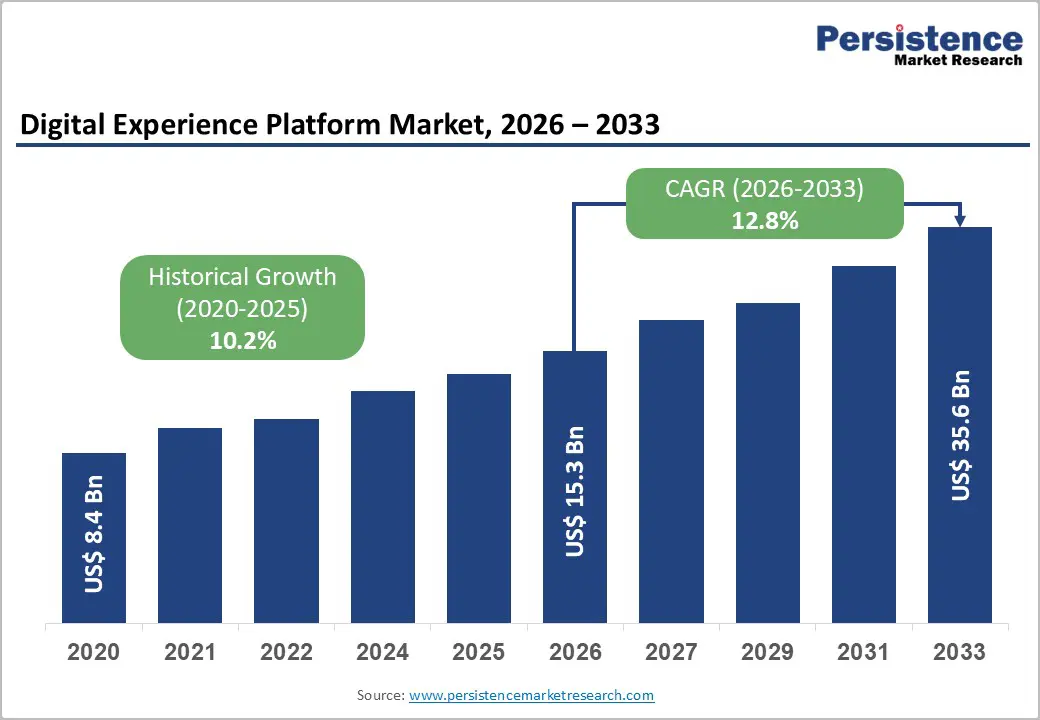
The global digital experience platform market size is likely to be valued at US$15.3 billion in 2026 to US$35.6 billion by 2033, growing at a CAGR of 12.8% during the forecast period from 2026 to 2033.
This substantial growth trajectory is driven by accelerating cloud-first enterprise IT adoption, omnichannel demand for personalized customer experiences, and AI-powered real-time data analytics. Organizations are increasingly prioritizing DXP investments to enhance customer retention, operational efficiency, and seamless ecosystem integration across digital touchpoints, establishing DXPs as a cornerstone of modern enterprise technology infrastructure.
Key Industry Highlights:
- Leading Solution: Platform dominates with over 66% market share in 2026, valued above US$ 10.1 Bn, driven by demand for integrated, end-to-end solutions enabling AI-driven personalization, seamless CRM/ERP/commerce integration, and centralized governance. Services, supporting implementation, customization, and integration, are the fastest-growing, with a 17.4% CAGR, projected to exceed US$ 13.5 Bn by 2033.
- Leading Deployment: On-premises holds over 32% market share in 2026, valued at above US$ 4.9 Bn, favored by large enterprises for data sovereignty, regulatory compliance, and tight integration with legacy systems. Cloud-based DXPs are the fastest-growing, at 16.9% CAGR, driven by flexibility, scalability, rapid innovation, and remote collaboration needs.
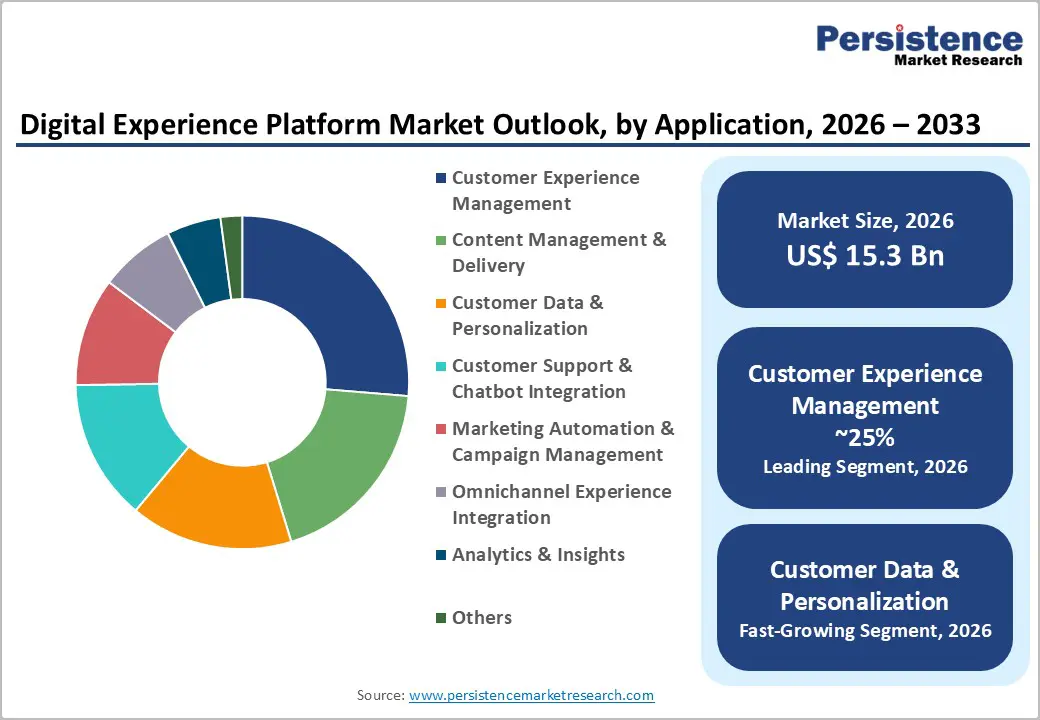
- Leading Application: Customer experience management commands the largest share at over 25% in 2026, valued above US$ 3.8 Bn, as enterprises prioritize real-time personalization, omnichannel consistency, and churn reduction. Customer data and personalization applications are growing at 16.4% CAGR due to the rising need for hyper-personalized experiences leveraging AI and analytics.
- Leading Industry: Retail and eCommerce lead with over 26% market share in 2026, valued above US$ 4.0 Bn, driven by personalized, omnichannel engagement to enhance sales and loyalty. Healthcare is the fastest-growing industry, supported by patient-centric services, telehealth adoption, regulatory compliance, and demand for unified digital experiences.
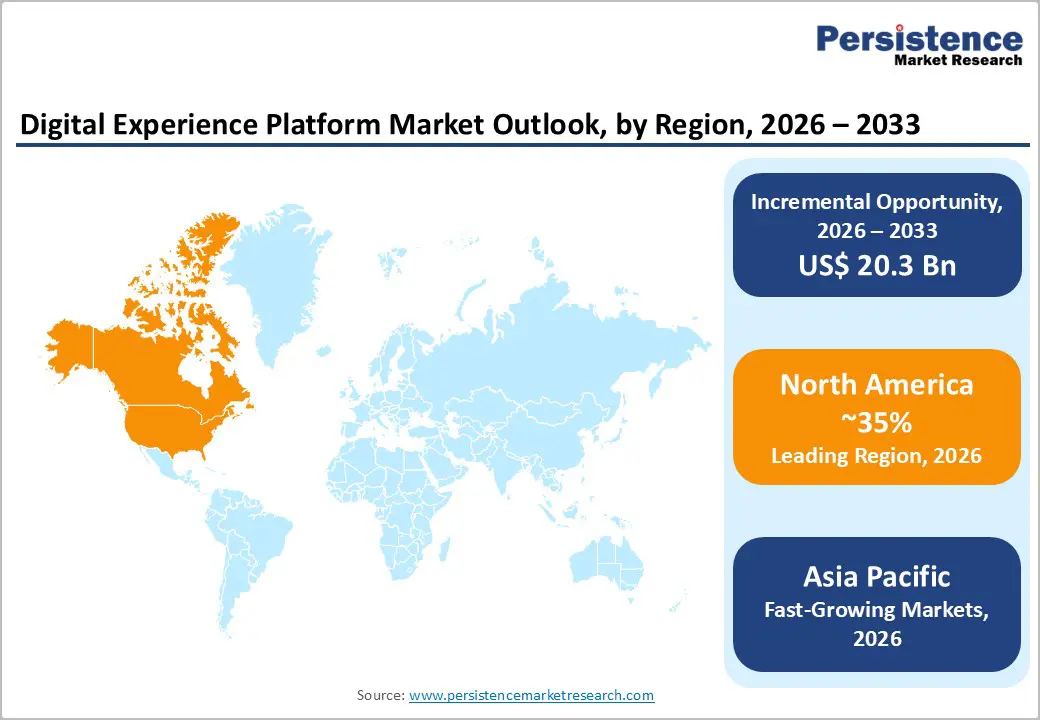
- Leading Region: North America maintains leadership with an over 35% share in 2026, valued at US$ 5.4 Bn, led by the U.S., accounting for over ~US$ 4.1 Bn, due to mature IT infrastructure, early AI adoption, and regulatory clarity that enable enterprise DXP planning. Asia Pacific is the highest-growth region, with a 18.6% CAGR through 2033. Europe holds more than 24% share by 2033, valued at above US$ 3.7 Bn, supported by GDPR compliance, privacy-focused architectures, and national digital infrastructure investments.
| Key Insights | Details |
|---|---|
| Digital Experience Platform Market Size (2026E) | US$15.3 Bn |
| Market Value Forecast (2033F) | US$35.6 Bn |
| Projected Growth (CAGR 2026 to 2033) | 12.8% |
| Historical Market Growth (CAGR 2020 to 2025) | 10.2% |
Market Dynamics
Driver - Generative AI Integration and Hyper-Personalization Capabilities
Generative AI and hyper-personalization have become core growth factors for digital experience platforms as enterprises increasingly embed AI across customer touchpoints. By 2025, over 70-80% of customer service organizations are expected to integrate generative AI to improve agent productivity and customer engagement. AI-driven predictive analytics enables DXPs to deliver real-time, hyper-personalized experiences that reduce churn and increase customer lifetime value. More than 55% of CX trendsetter companies prioritize AI-based personalization and are 120% more likely to report high ROI from AI initiatives. Capabilities such as real-time sentiment analysis and natural language processing allow DXPs to shift from reactive support to proactive, intelligence-led customer engagement.
Omnichannel Customer Journey Integration and Regulatory Compliance Requirements
Enterprises increasingly need to deliver consistent omnichannel experiences across web, mobile, social, physical stores, and contact centers, as customers now routinely interact through multiple touchpoints before conversion. Fragmented channel systems create data silos, preventing unified customer profiles and limiting real-time personalization. DXPs resolve this by centralizing and synchronizing first-party customer data across channels. At the same time, regulatory requirements such as GDPR, CCPA, and HIPAA mandate strict consent management, data lineage, and auditability, which are natively supported by enterprise DXPs. For example, European banks and healthcare providers use DXPs to manage customer consent centrally while delivering compliant, personalized digital services across apps, portals, and in-branch or patient-facing systems.
Restraint - Data Integration Complexity and Legacy System Incompatibility
Enterprises with heterogeneous stacks often hit steep integration barriers when adopting DXPs because legacy systems frequently lack modern, API-first interfaces, forcing costly custom connectors and middleware. Those integration projects tie up IT teams and lengthen rollouts, delaying business value and increasing total implementation cost. Adopting MACH patterns (Microservices, API-first, Cloud-native, Headless) eases future extensibility but requires specialized skills and orchestration that many mid-market firms don’t have in-house. The result is slower adoption cycles and higher upfront effort, for example, a bank integrating a mainframe CRM with a headless DXP needs months of bespoke development and significant consultancy support before launch.
Return on Investment (ROI) Uncertainty and Hidden Total Cost of Ownership
ROI from digital experience platforms is difficult to quantify because key benefits such as customer satisfaction, loyalty, and lifetime value are largely intangible and not fully reflected in traditional financial models. While firms observe higher engagement or lower churn, converting these outcomes into clear balance-sheet metrics remains complex. Implementation challenges, customization, legacy system integration, and change management often inflate the total cost of ownership beyond initial estimates. This cost uncertainty slows procurement decisions, particularly in highly regulated sectors such as banking and government, which demand rigorous cost-benefit justification.
Opportunity- Composable Architecture and Low-Code/No-Code Development Platforms
The shift toward composable DXP architectures and low-code/no-code development platforms creates opportunities for vendors offering flexible, modular solutions that reduce implementation complexity and lower adoption barriers. Enterprises increasingly prefer a composable architecture that enables rapid feature deployment and technology stack customization without extensive custom development, improving time-to-value and reducing total cost of ownership. This architectural shift favors vendors investing in developer experience, comprehensive API ecosystems, and pre-built integration components that accelerate implementation and enable business users to participate in experience creation without technical dependencies.
Healthcare Sector Digital Transformation and Patient Experience Enhancement
Healthcare is a high-growth DXP vertical as patients increasingly expect consumer-grade digital services such as online appointments, patient portals, and real-time communication with care teams. DXPs enable unified digital front doors that integrate electronic health records, telehealth, billing, and patient engagement tools into a seamless experience. Built-in security, consent management, and governance features align well with strict healthcare regulations such as HIPAA, creating a structural advantage for enterprise-grade platforms. For example, hospital networks deploying DXP-based patient portals have improved appointment management, reduced administrative burden, and enhanced patient satisfaction through consistent omnichannel engagement.
Category-wise Analysis
Solution Insights
Platform dominates the global market, capturing more than 66% market share in 2026 with a value exceeding US$ 10.1 Bn as enterprises need integrated, end-to-end solutions rather than fragmented point tools. Growing demand for real-time personalization at scale makes platform-based architectures essential, as they support AI-driven insights and seamless integration with CRM, ERP, and commerce systems. Platforms reduce operational complexity and long-term costs by enabling centralized governance, scalability, and faster time-to-market across digital touchpoints.
Services demonstrate the highest growth rate at 17.4% CAGR, with value projected to exceed US$ 13.5 Bn by 2033 as organizations increasingly require expert support for implementation, customization, and integration with existing systems. Businesses need guidance in optimizing user experience, managing AI-driven personalization, and ensuring seamless multi-channel delivery. Ongoing maintenance, training, and consulting services are critical to maximize platform ROI and adapt to evolving customer expectations. This growing reliance on specialized expertise drives the rapid expansion of DXP services.
Deployment Insights
On-premises hold over 32% market share in 2026, as large enterprises prioritize data sovereignty, security, and regulatory compliance, especially in BFSI, government, and healthcare. Organizations need deep customization and tight integration with legacy IT systems that are difficult to migrate to cloud environments. On-premises also meet the need for greater control over performance, latency, and uptime in mission-critical customer journeys. Enterprises with long-term IT investments and predictable workloads prefer on-premises models to maximize asset utilization and avoid recurring cloud costs.
Cloud-based deployments are expected to grow at the highest rate, with a CAGR of 16.9%, driven by organizations’ need for flexibility, scalability, and rapid innovation. Businesses increasingly demand seamless multi-channel experiences and real-time analytics, which cloud platforms deliver efficiently. It also reduces IT infrastructure costs and simplifies integration with existing systems, enabling faster time-to-market. Remote work and global customer engagement trends drive the preference for accessible, cloud-hosted DXPs that support collaboration and continuous updates.
Application Insights
Customer experience management commands the largest market share, over 25%, in 2026, due to organizations’ need for a unified way to manage customer interactions across websites, mobile apps, social media, and physical touchpoints. Businesses prioritize real-time personalization, consistent omnichannel journeys, and faster response to changing customer expectations. CX management tools address the need to reduce customer churn, improve loyalty, and increase lifetime value in highly competitive digital markets.
Customer data and personalization are expected to grow at a positive CAGR as businesses increasingly need to deliver highly relevant, individualized experiences to retain and engage customers. Companies are leveraging real-time data, AI, and analytics to understand customer behavior, preferences, and intent, enabling hyper-personalized interactions across channels. Rising consumer expectations for tailored content, offers, and seamless experiences are driving this demand.
Industry Insights
Retail and eCommerce maintain a dominant market position with over 26% market share in 2026, driven by their heavy reliance on personalized, seamless, and omnichannel customer experiences to drive sales and loyalty. With raising online shopping, consumers expect real-time product recommendations, smooth checkout processes, and consistent interactions across platforms. It helps retailers integrate data from multiple touchpoints, enabling targeted marketing, dynamic content delivery, and enhanced customer engagement.
Healthcare is expected to grow at a significant rate, driven by rising demand for patient-centric services and seamless digital interactions. Hospitals, clinics, and telemedicine providers need platforms that integrate patient records, enable personalized communication, and streamline appointment scheduling. Rising adoption of telehealth, wearable devices, and mobile health apps drives the need for unified digital experiences. Regulatory pressure for data security and compliance encourages healthcare organizations to invest in robust, customizable DXPs.
Regional Insights
North America Digital Experience Platform Market Trends
North America maintains market leadership with over 35% share in 2026, reaching US$ 5.4 Bn value, with the U.S. market alone crossing US$ 4.1 Bn by 2026. The region’s dominance stems from early enterprise technology adoption, substantial IT budgets, and a concentrated presence of major DXP vendors. Clear regulatory frameworks and sophisticated data privacy policies enable enterprises to plan governance strategies with confidence. With mature IT infrastructure and high cloud adoption, enterprises prioritize customer experience as a competitive differentiator, leveraging AI-powered personalization, predictive analytics, and operational efficiency within DXPs.
Asia Pacific Digital Experience Platform Market Trends
Asia-Pacific emerges as the highest-growth region with 18.6% projected CAGR through 2033, driven by accelerated digitalization, e-commerce expansion, and mobile-first customer engagement strategies. Rising populations of digital-native consumers in China, India, and Southeast Asia, coupled with government-driven digital transformation initiatives, are creating enormous addressable markets for DXP vendors. China alone has ~1.12-billion internet users as of June 2025, ~79.7% penetration, reflecting its mature digital ecosystem. India represents the highest-CAGR country opportunity, with rapidly growing enterprise IT spending and a thriving digital technology sector. Organizations are increasingly adopting cloud-native, headless DXP architectures to enable rapid deployment and localized, multi-lingual experience customization tailored to regional preferences.
Europe Digital Experience Platform Market Trends
Europe is expected to hold more than 24% share by 2033, with a value exceeding US$ 3.7 Bn, driven by established digital infrastructure, high enterprise technology adoption, and complex multi-country regulations such as GDPR and emerging ePrivacy rules. Germany, the UK, France, and Spain lead DXP adoption, supported by cloud-native platforms and privacy-by-design architectures. The region exhibits competitive fragmentation, with specialized mid-market vendors addressing country-specific or vertical needs. Widespread digitalisation of public services, with 70% of EU citizens using online services in 2024, and national strategies investing EUR288.6 billion in digital infrastructure and skills, will further accelerate demand for integrated, secure DXP solutions.
Competitive Landscape
The digital experience platform (DXP) market is moderately fragmented, with a mix of large global providers and niche specialized players competing for enterprise clients. Companies differentiate through integrated offerings that combine content management, analytics, AI-driven personalization, and omnichannel capabilities, etc. Strategic partnerships and ecosystem integrations are commonly leveraged to expand reach and enhance platform value. Continuous innovation in AI, customer data platforms, and low-code/no-code capabilities remains central to staying competitive.
Key Industry Developments:
- In March 2025, Adobe introduced agentic AI capabilities within Adobe Experience Platform, enabling marketers to automate content production, optimize websites, refine audiences, and scale digital media. The company also launched Brand Concierge, a brand-centric AI app that delivers personalized customer experiences by leveraging brand attributes and customer data.
- In February 2025, Sitecore unveiled over 250 innovations for its DXP and CMS, highlighting advances in its Stream AI capabilities. The platform now offers brand-aware AI, AI copilots and agents, and agentic workflows, enabling marketers to deliver personalized, scalable, and balanced digital experiences.
Companies Covered in Digital Experience Platform Market
- Adobe
- Oracle Corporation
- SAP SE
- IBM Corporation
- Microsoft Corporation
- Salesforce Inc.
- OpenText Corporation
- Sitecore Holding II A/S
- Acquia Inc.
- Optimizely Inc.
- Liferay Inc.
- Kentico
- Others
Frequently Asked Questions
The global digital experience platform market is projected to be valued at US$15.3 Bn in 2026.
The need for organizations to deliver seamless, personalized, and consistent customer experiences across multiple digital channels is a key driver of the market.
The market is expected to witness a CAGR of 12.8% from 2026 to 2033.
Growing demand for AI-driven personalization, omnichannel engagement, and integrated analytics is creating strong growth opportunities.
Adobe, Oracle Corporation, SAP SE, IBM Corporation, Microsoft Corporation, Salesforce Inc., OpenText Corporation are among the leading key players.


