




- Home Appliances
- Air Fryer Market
Air Fryer Market Size, Share, and Growth Forecast, 2026 – 2033
Air Fryer Market by Product Type (Manual, Digital), Model (Countertop Models, Toaster Oven Models, Basket Style Models, Multi-cooker Models), Capacity (Up to 3 Liters, 3–5 Liters, 5–6 Liters, Above 6 Liters), and Regional Analysis for 2026 – 2033

Air Fryer Market Size and Trends Analysis
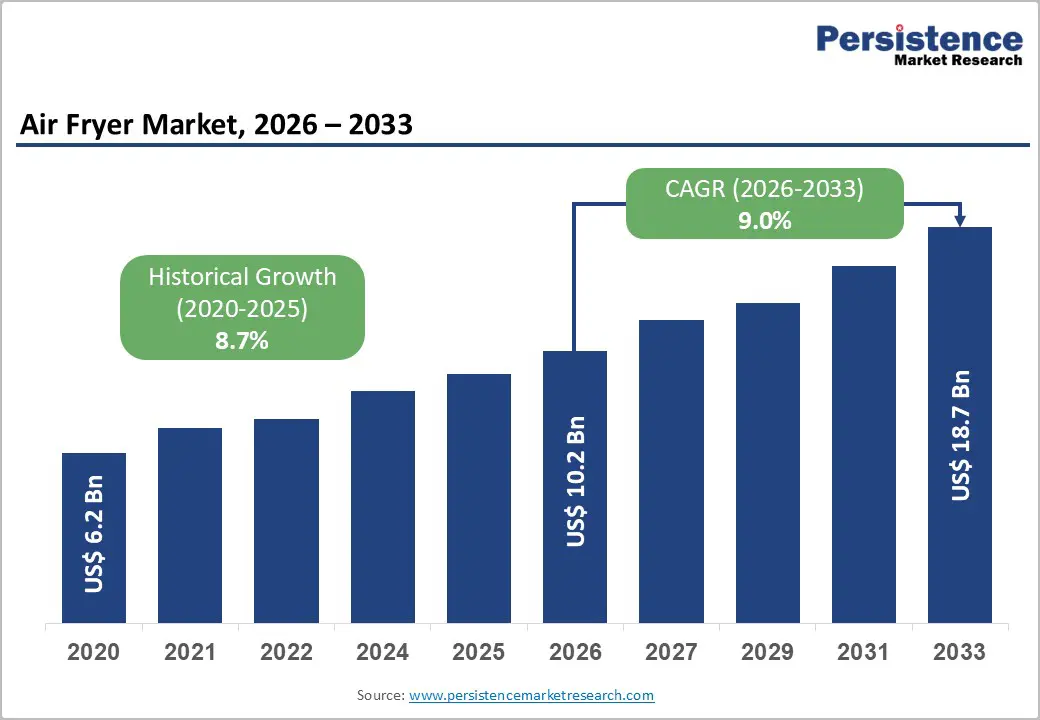
The global air fryer market size is likely to be valued at US$10.2 billion in 2026 and is expected to reach US$18.7 billion by 2033, growing at a CAGR of 9.0% during the forecast period from 2026 to 2033, driven by rising consumer preference for healthier, low-oil cooking alternatives amid increasing awareness of lifestyle-related health issues, along with the growing demand for convenient, time-saving kitchen appliances suited to busy urban lifestyles. Continuous innovation in smart, energy-efficient, and multifunctional air fryers is boosting adoption, supported by strong residential demand, growing e-commerce penetration, and affordable entry-level models, despite moderate challenges from raw material price volatility and supply-chain pressures.
Key Industry Highlights:
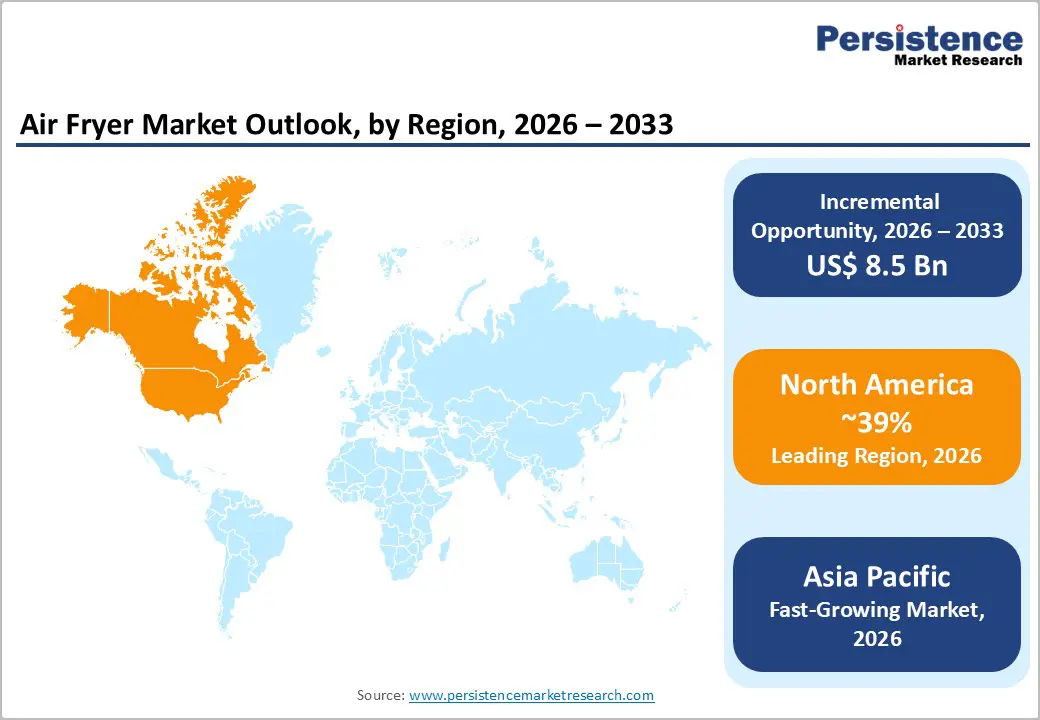
- Leading Region: North America is anticipated to be the leading region, accounting for a market share of 39% in 2026, driven by health-conscious consumers, premium appliance adoption, and demand for convenient, multifunctional air fryers.
- Fastest-growing Region: Asia Pacific is likely to be the fastest-growing region in the air fryer in 2026, supported by rising disposable incomes, rapid urbanization, increasing health awareness, and strong adoption in China, India, Japan, and Southeast Asian countries.
- Leading Product Type: The digital segment is projected to represent the leading product type in 2026, accounting for 62% of the revenue share, driven by smart features, touchscreen interfaces, preset cooking modes, and growing consumer preference for convenience and automation in kitchens.
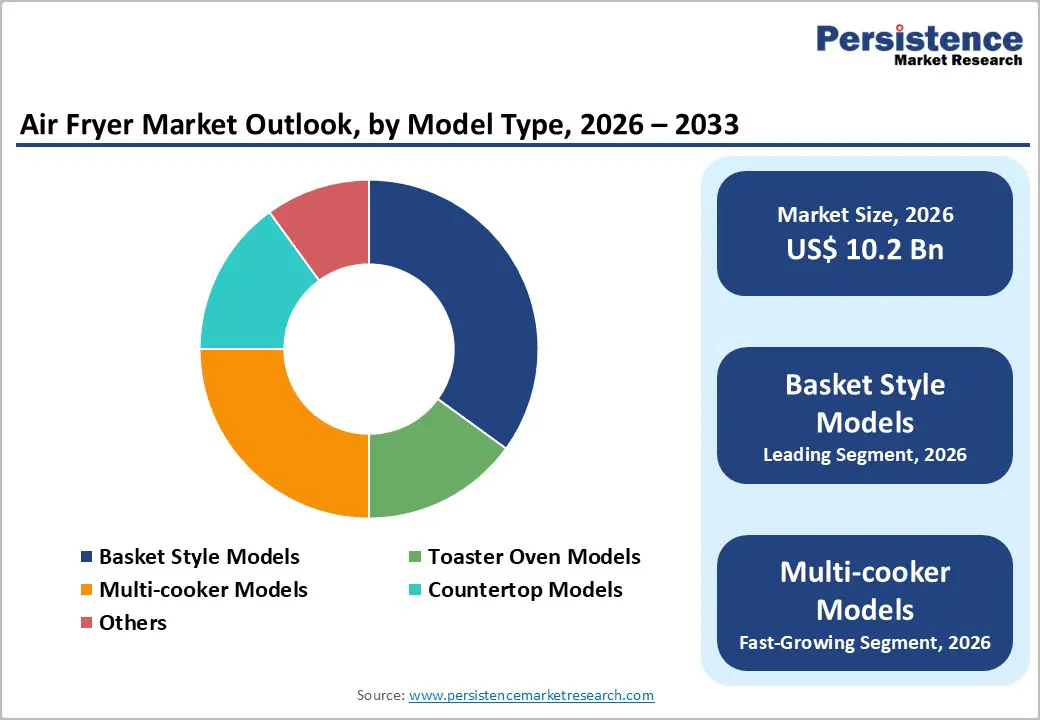
- Leading Model Type: Basket style models are anticipated to be the leading model type, accounting for over 54% of the revenue share in 2026, supported by affordability, compact design, ease of use, and consistent performance for traditional air frying in household kitchens.
| Key Insights | Details |
|---|---|
| Air Fryer Market Size (2026E) | US$10.2 Bn |
| Market Value Forecast (2033F) | US$18.7 Bn |
| Projected Growth (CAGR 2026 to 2033) | 9.0% |
| Historical Market Growth (CAGR 2020 to 2025) | 8.7% |
Market Factors – Growth, Barriers, and Opportunity Analysis
Health Consciousness and Demand for Low-Oil Cooking
Rising awareness of lifestyle-related diseases such as obesity, diabetes, and cardiovascular conditions has encouraged individuals to seek healthier cooking alternatives. Traditional frying methods rely heavily on oil, which contributes to higher fat intake and associated health risks. Air fryers, by contrast, use rapid air circulation technology to cook food with little or no oil, enabling the preparation of crispy, fried-style meals while significantly reducing calorie content. This aligns with the increasing adoption of low-fat, heart-healthy diets and clean-eating lifestyles across both developed and emerging markets. Millennial and urban consumers, in particular, are actively seeking appliances that support wellness without compromising convenience or taste. The trend is amplified by social media and wellness influencers promoting air fryer recipes as part of healthy meal planning.
The demand for low-oil cooking is fueled by modern lifestyles that prioritize quick, convenient, and efficient meal preparation. Air fryers cater to busy households by significantly reducing cooking times compared to conventional ovens or stovetop frying, making them a practical solution for urban consumers managing tight schedules. The technology also allows precise temperature control, ensuring evenly cooked meals with minimal nutrient loss, which resonates with health-conscious families aiming to retain vitamins and minerals in their food. The versatility of air fryers, capable of frying, baking, grilling, and roasting, enables consumers to prepare a wide variety of dishes with reduced fat content, encouraging regular use. This has encouraged manufacturers to innovate and introduce digital, multi-functional, and smart air fryers that enhance convenience and nutritional outcomes.
Competition from Multi-Functional Appliances and Supply Constraints
Consumers are increasingly seeking devices that offer versatility, combining multiple cooking functions such as air frying, baking, grilling, roasting, steaming, and even pressure cooking in a single unit. Products such as multi-cookers, toaster ovens, and convection ovens with integrated air frying capabilities are gaining traction, as they allow households to reduce clutter, save counter space, and manage cooking more efficiently. This competitive environment exerts pressure on traditional and single-function air fryers, particularly manual or entry-level models, which may be perceived as less valuable or limited in functionality. Leading brands, including Instant Pot, Ninja Foodi, and Breville, are actively promoting hybrid appliances, creating a perception that one device can replace multiple kitchen tools.
Air fryers rely on precise components such as heating elements, motors, non-stick baskets, and digital control panels. Fluctuations in raw material availability, particularly metals and electronic components, can delay production and increase costs, impacting pricing strategies. Supply chain disruptions, whether due to geopolitical tensions, shipping bottlenecks, or semiconductor shortages, pose a challenge, especially for manufacturers scaling operations to meet demand. Smaller brands and regional players may face higher vulnerability to such constraints, limiting their ability to expand or compete effectively. Logistics costs and lead times influence inventory management for retailers, particularly during peak seasons such as festive sales in India or Black Friday in North America.
Technological Convergence with Smart Homes
As consumers increasingly adopt connected devices, the demand for kitchen appliances that integrate with smartphones, tablets, and voice assistants has risen sharply. Smart air fryers enable remote monitoring, automated cooking programs, and real-time notifications, providing convenience and precision for users. IoT-enabled air fryers can preheat, adjust cooking times, and even suggest recipes based on user preferences, aligning with modern lifestyles that prioritize efficiency and customization. Integration with smart home ecosystems such as Amazon Alexa, Google Home, and Apple HomeKit enhances user experience, allowing voice-controlled operation and seamless synchronization with other connected kitchen devices.
Technological convergence expands opportunities for differentiated product offerings and market penetration, especially in regions with high digital adoption, such as North America, Europe, and Asia Pacific. Companies are leveraging software updates, app-based controls, and AI-powered cooking recommendations to create unique value propositions. Integration of smart air fryers with meal-planning apps or nutrition trackers enables consumers to maintain healthier diets while optimizing cooking times, appealing to health-conscious users. Connected appliances provide manufacturers with valuable data on usage patterns, enabling predictive maintenance, personalized marketing, and continuous product improvement.
Category-wise Analysis
Product Type Insights
The digital segment is expected to lead the air fryer market, accounting for approximately 62% of revenue in 2026, driven by its convenience, advanced features, and higher perceived value among consumers. Digital air fryers offer touchscreens, multiple cooking presets, timers, and connectivity options that appeal to busy households seeking quick, precise, and effortless meal preparation. For example, Philips Digital Air Fryer XXL has captured a significant portion of the North American and European markets due to its preset menu options, large cooking capacity, and ease of cleaning. The segment’s dominance is reinforced by increasing consumer willingness to pay a premium for smart features that enhance the cooking experience. As more households replace traditional frying methods with healthier alternatives, digital air fryers have become the preferred choice for convenience-oriented consumers, especially in urban areas.
The digital segment is also likely to represent the fastest-growing segment in 2026, supported by the rising trend of smart homes and IoT integration. Manufacturers are introducing Wi-Fi-enabled air fryers with smartphone apps, remote monitoring, voice commands, and automated cooking adjustments. For example, Ninja Smart XL Air Fryer has seen rapid adoption in North America and Asia Pacific due to its app integration and multiple cooking functions, enabling precise control over temperature and timing. Growth is supported by health-conscious and tech-savvy consumers seeking appliances that combine convenience, efficiency, and automation. As kitchens evolve into connected spaces, digital air fryers increasingly serve as entry-point smart devices, aligning with smart home ecosystems such as Amazon Alexa and Google Home.
Model Insights
Basket style models are projected to lead the market, capturing around 54% of the revenue share in 2026, supported by their affordability, compactness, and traditional air frying performance. These models are ideal for household kitchens, especially nuclear families, as they offer simplicity while delivering consistent fried textures without excess oil. For example, the COSORI Air Fryer Max XL is a basket-style unit that has gained significant popularity in the U.S. and Europe for its user-friendly design, large capacity, and multiple presets. Retailers report that basket-style models dominate both offline and e-commerce channels due to their reliability and cost-effectiveness. Consumers prefer these models for daily frying, roasting, and baking tasks without the complexity of multi-function appliances.
Multi-cooker models are likely to be the fastest-growing model, driven by versatility and family-oriented cooking needs. These appliances combine air frying with baking, roasting, grilling, and steaming, making them suitable for households seeking multiple functionalities in a single device. For example, the Instant Pot Duo Crisp + Air Fryer has witnessed rapid adoption in North America and Europe, as it enables batch cooking, meal prep, and diverse recipes while saving kitchen space. The growth of multi-cooker models is accelerated by rising disposable incomes, health awareness, and the demand for appliances that reduce the need for multiple kitchen devices. Consumers increasingly view multi-cooker air fryers as cost-effective solutions that enhance cooking flexibility, particularly for larger families.
Regional Insights
North America Air Fryer Market Trends
North America is anticipated to be the leading region, accounting for a market share of 39% in 2026, driven by strong consumer demand for healthier cooking alternatives and rising interest in convenient, time-saving kitchen solutions. High disposable incomes, well-established retail networks, and widespread adoption of modern kitchen technologies. Health-conscious consumers in the U.S. and Canada increasingly seek low-oil cooking methods to counter lifestyle-related health issues, which has boosted air fryer adoption across households. Digital and feature-rich models with multiple presets, intuitive controls, and energy-efficient performance are particularly popular, as they address the desires of consumers who want both healthier meals and seamless cooking experiences.
North America is a continuous innovation by key appliance manufacturers, which is reshaping consumer expectations and product offerings. Companies are launching new designs that integrate smart features, expanded capacities, and multifunctional capabilities, allowing air fryers to serve more roles in everyday cooking. For example, the COSORI Iconic Air Fryer introduced in the U.S. features a stainless-steel and glass build with multiple cooking functions, smart home compatibility via the VeSync app, and non-toxic materials reflecting how brands are responding to consumer preferences for durability, health-centric design, and connected experiences. These advancements appeal particularly to tech-savvy and health-oriented buyers who value appliances that can be controlled remotely or integrated into a smart home ecosystem, enhancing convenience and lifestyle fit.
Europe Air Fryer Market Trends
Europe is likely to be a significant market for air fryers in 2026, due to consumers increasingly prioritizing healthier cooking methods and energy-efficient appliances, reflecting broader lifestyle shifts across major economies such as Germany, France, the U.K., and the Netherlands. Rising health awareness and strong demand for low-oil cooking options have boosted air fryer adoption among households seeking alternatives to traditional frying and ovens, particularly in urban areas. Consumers value compact designs suited to modern kitchen spaces and versatile functionality that supports everyday cooking needs. Retail and online channels play a key role in expanding product reach, while promotional activities by retailers help educate consumers about air fryer benefits, supporting adoption across diverse demographic segments.
Innovation and localized strategies are driving the European air fryer market, as manufacturers tailor products to consumer preferences for efficiency, smart features, and multifunctionality. For instance, Xiaomi’s Smart Double Stack Air Fryer, launched in select European markets, offers a 12-liter capacity, app control, multiple preset modes, and dual-basket functionality, appealing to families and tech-savvy users seeking versatile cooking solutions. This reflects a broader trend of connected air fryers that integrate with mobile apps or smart home systems, providing guided recipes, remote monitoring, and programmable cooking schedules to enhance the user experience.
Asia Pacific Air Fryer Market Trends
The Asia Pacific region is likely to be the fastest-growing region, driven by rising urbanization, increasing disposable incomes, and growing health awareness, which will reshape consumer lifestyles across key countries such as China, India, Japan, and South Korea. Urban households are increasingly adopting air fryers as a healthier alternative to traditional frying methods due to their ability to reduce oil usage while delivering similar textures and flavors, an important factor given growing concerns around diet-related health issues such as cardiovascular disease. Wider availability of both affordable basic models and feature-rich digital units has broadened the consumer base, enabling families of all sizes to consider air fryers for everyday meal preparation. E-commerce channels and aggressive promotional strategies by retailers have facilitated market penetration, with consumers drawn to convenient online shopping and doorstep delivery.
Broad adoption in residential kitchens, innovation, and targeted product launches are shaping competitive dynamics and encouraging greater purchase intent across the region. For example, Midea Group has strengthened its presence by offering a range of air fryers that balance advanced features with affordability, helping the brand appeal to both value-focused and feature-driven consumers in markets such as China and Southeast Asia. Complementing this, companies such as Panasonic and TTK Prestige have introduced models with enhanced cooking capabilities, energy-efficient performance, and ergonomic designs that resonate with family-oriented buyers looking for versatile appliances.
Competitive Landscape
The global air fryer market exhibits a moderately fragmented structure, driven by the presence of both well-established appliance manufacturers and a growing number of regional and niche players competing for market share through innovation, distribution strength, and product diversification. Leading companies maintain strong positions by consistently investing in new technologies, expanding digital and smart features, and broadening product portfolios to meet diverse consumer needs.
With key leaders including Koninklijke Philips N.V., SharkNinja Operating LLC (Ninja), Cosori, Tefal (Groupe SEB), and Instant Brands driving innovation and market reach, competitive emphasis centers on feature enhancements, expanded capacity offerings, and connectivity integration. These players compete through frequent new product launches, strategic partnerships with retailers and e-commerce platforms, and targeted marketing campaigns that highlight convenience, health benefits, and smart kitchen integration.
Key Industry Developments:
- In October 2025, Cuisinart® launched two next-generation air fryers—the 11-Quart Dual Basket Air Fryer Pro (ADZ-112) and the 15-in-1 Extra-Large Digital Air Fryer Oven (TOA-112)—expanding its multifunctional kitchen appliance portfolio. Features include Dual Zone technology, Sync Finish/Settings, large capacities, multiple presets, and intuitive digital controls. The dual-basket model allows cooking two dishes simultaneously, while the oven combines air frying with versatile oven-level precision.
- In November 2025, Crompton Greaves Consumer Electricals introduced the Ameo Air Fryer Series in India, targeting health-conscious urban households. The range emphasizes oil-free cooking, faster heating, and low-noise operation, with features such as Nutriguard Technology for nutrient retention, Quick Fry Technology for even cooking, and SilentPro Technology for quieter performance.
Companies Covered in Air Fryer Market
- Koninklijke Philips N.V.
- SharkNinja Operating LLC
- Cuisinart.
- the BLACK + DECKER
- Dash
- Breville Site.
- Havells India Ltd.
- TTK Prestige Ltd.
- Corelle Brands LLC
- Tefal
Frequently Asked Questions
The global air fryer market is projected to reach US$10.2 billion in 2026.
Rising health consciousness, growing demand for low-oil cooking, busy lifestyles favoring quick meal preparation, and continuous innovation in smart and multifunctional kitchen appliances.
The air fryer market is expected to grow at a CAGR of 9.0% from 2026 to 2033.
Key market opportunities lie in smart and connected air fryers, expansion in emerging markets, growing demand for large-capacity and multifunctional models, and rising adoption of health-focused cooking appliances.
Koninklijke Philips N.V., SharkNinja Operating LLC, Cuisinart, BLACK+DECKER, Dash, and Breville are the leading players.


