




- Off-Road Equipment & Machinery
- Road Marking Equipment Market
Road Marking Equipment Market Size, Share, and Growth Forecast 2025 - 2032
Road Marking Equipment Market By Equipment Type (Manual, Semi-automatic, Automatic), Coating (Thermoplastic, Solvent-based, Water-based, Cold Plastic), Application (Road Marking, Car Park Marking, Anti-Skid Marking, Other), and Regional Analysis for 2025 - 2032

Road Marking Equipment Market Size and Trend Analysis
The global road marking equipment market size is supposed to be valued at US$3.2 Billion in 2025 and is projected to reach US$4.6 Billion by 2032, growing at a CAGR of 5.5% between 2025 and 2032, driven by escalating government investments in road infrastructure development and stringent safety regulations mandating clear, visible road markings across transportation networks.
According to the Federal Highway Administration (FHWA), a new minimum retroreflectivity standard passed in August 2022 requires longitudinal pavement markings on roads with speed limits of 35 miles per hour or greater to meet a minimum retroreflectivity of 50 millicandelas per square meter per lux, creating substantial demand for advanced marking equipment.
Key Market Highlights
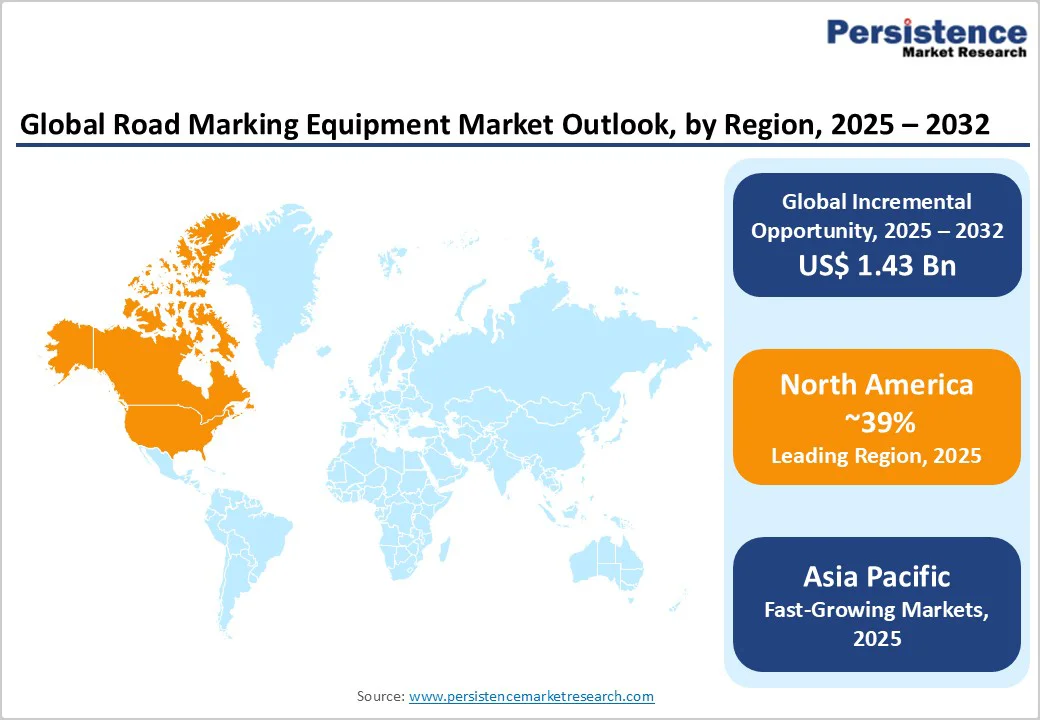
- Regional Leader: North America dominates as the leading region, with 39% of the market share, due to advanced infrastructure and strict FHWA regulations enhancing road safety through widespread equipment adoption.
- Fastest Growing Region: Asia Pacific emerges as the fastest-growing region, propelled by massive investments in China and India for highway expansions and urban mobility.
- Leading Segment: Automatic equipment type leads segments with 48% share, driven by efficiency in large-scale projects amid labor shortages.
- Fastest Growing Segment: Thermoplastic coatings grow fastest in the category, due to their longevity and reflectivity in high-traffic zones per IRF standards.
- Growth Opportunity: Adoption of AI-integrated smart technologies offers key opportunities for precision in smart city developments.
| Key Insights | Details |
|---|---|
|
Road Marking Equipment Market Size (2025E) |
US$3.2 Bn |
|
Market Value Forecast (2032F) |
US$4.6 Bn |
|
Projected Growth CAGR (2025-2032) |
5.5% |
|
Historical Market Growth (2019-2024) |
3.2% |
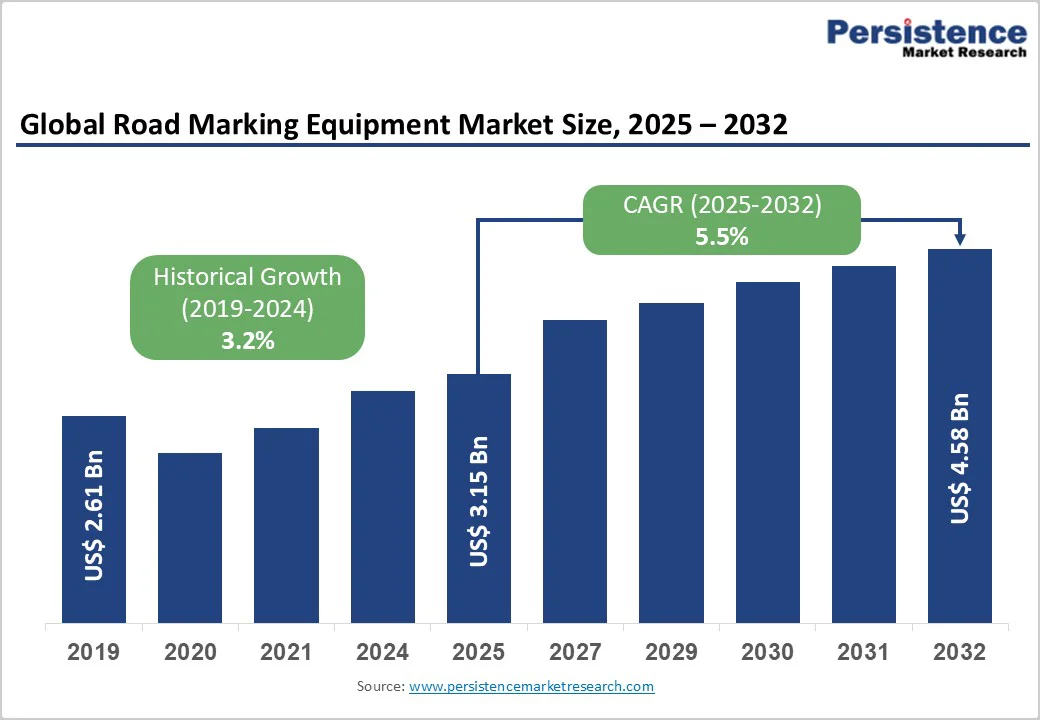
Market Size, Share, and Growth Forecast, 2025 - 2032
Growth Analysis - Increasing Government Infrastructure Spending and Road Safety Regulations
Government investments in road infrastructure are driving global demand for advanced road marking equipment. In India, the budget allocation for roads and highways development reached approximately INR 2.8 Trillion (US$33.7 billion) during the financial year 2024, with similar increases estimated for 2025. The Ministry of Road Transport and Highways increased capital expenditure on National Highways from about INR 51,000 Crore (US$6.1 Billion) in 2013-14 to INR 3.01 Lakh Crore (US$36.3 Billion) in 2023-24, representing a six-fold increase. These investments directly correlate with equipment procurement for marking new roads and maintaining existing networks.
Furthermore, regulatory mandates from authorities such as the FHWA requiring compliance with MUTCD (Manual on Uniform Traffic Control Devices) standards by September 2026 are compelling road authorities to upgrade their marking equipment fleets, driving consistent market growth across developed and developing economies.
Technological Advancements in Automated and Precision Marking Systems
The integration of advanced technologies, such as GPS, laser-guided systems, and automated guidance mechanisms, into road marking equipment is revolutionizing application efficiency and precision. Automated road marking machines equipped with sensor-based control systems ensure perfectly aligned, consistent markings while reducing lane-closure windows and labor costs. Hofmann's BetLine Technology, introduced in 2024, utilizes advanced sensors and control systems to deliver crisp, durable markings with superior precision.
Graco Inc.'s strategic acquisition of Corob S.p.A. for €230 million (US$266.1 million) in November 2024 demonstrates industry consolidation focused on integrating high-tech dispensing and mixing solutions into road marking applications. These technological innovations align with the growing demand for smart transportation infrastructure and machine-readable markings compatible with Autonomous Driver Assisted Systems (ADAS), creating sustained demand for next-generation marking equipment.
Barrier Analysis - High Initial Capital Investment and Equipment Maintenance Costs
The substantial capital expenditure required for purchasing advanced automated road marking equipment poses a significant barrier, particularly for small-scale contractors and municipalities in developing regions. High-performance machines equipped with GPS-controlled systems, thermoplastic application capabilities, and automated guidance technologies command premium pricing. Sophisticated automatic machines can cost upwards of US$50,000 per unit, as noted in FHWA procurement guidelines, deterring adoption in budget-constrained projects where manual alternatives suffice for basic needs. This financial hurdle limits market penetration, with IRF reports indicating that 30% of global road projects still rely on outdated tools due to capital shortages.
Environmental Compliance and VOC Emission Restrictions
Stringent environmental regulations targeting Volatile Organic Compound (VOC) emissions from road marking coatings are creating operational challenges for equipment manufacturers and contractors. In Canada, the Volatile Organic Compound Concentration Limits for Architectural Coatings Regulations limit traffic marking coatings to a maximum VOC content of 450 g/L.
Furthermore, agencies such as the U.S. Environmental Protection Agency (EPA) enforce low-VOC standards for coatings, requiring specialized applicators that add 10-15% to equipment costs, according to European Environment Agency assessments. These regulations necessitate modifications to equipment to handle low-VOC thermoplastic and water-based formulations, requiring additional investment in specialized heating and application systems.
Opportunity Analysis - Expansion in Emerging Smart City and Autonomous Vehicle Infrastructure Projects
The shift toward automated road marking equipment presents lucrative opportunities, driven by integration with intelligent transportation systems in smart cities. China's extensive Belt and Road Initiative and Smart City Program, coupled with its expressway system exceeding 160,000 kilometers, exemplify the need for advanced marking solutions in infrastructure development.
Recent FHWA pilots in the U.S. demonstrate that automatic systems reduce application time by 40%, enhancing efficiency for high-volume highways and airports. Companies can capitalize by developing AI-enabled tools compatible with IoT for real-time monitoring, tapping into government grants such as the EU's Horizon Europe program, which allocates €95 billion (US$109.8 billion) for sustainable mobility. This technology not only boosts accuracy but also aligns with the paints and coatings market's push toward eco-friendly formulations, promising revenue growth through premium offerings.
Sustainable and Eco-Friendly Solutions
The rising emphasis on green infrastructure is opening avenues for equipment compatible with biodegradable and low-emission materials, driven by global sustainability goals. The Paris Agreement influences policies, with over 50 countries incentivizing eco-markings, potentially boosting demand by 25% in Europe by 2030.
Innovations in water-based applicators, as seen in recent Chinese highway projects, extend marking lifespan while minimizing environmental impact. This opportunity is particularly promising in the powder coating pretreatment market crossover, where pre-treatment tech enhances sustainable coating adhesion. Firms focusing on these can lead in policy-driven markets, ensuring long-term revenue growth.
Category-wise Analysis
Equipment Type Insights
The automatic equipment segment commands approximately 48% market share in the road marking equipment market, establishing dominance through superior operational efficiency and precision capabilities. Automatic machines equipped with laser guidance and self-propulsion reduce application time by up to 50% compared to manual options, according to International Road Federation data on highway projects.
Government mandates for high-precision markings that meet FHWA's minimum retroreflectivity standards of 50 to 100 millicandelas per square meter per lux require automated equipment capable of maintaining uniform coating thickness and glass bead distribution. The Asia Pacific region, where rapid infrastructure development spans diverse terrain from urban expressways to rural highways, demonstrates particularly strong adoption of automated equipment.
Coating Insights
Thermoplastic dominates the coating category with a 47% market share, owing to its exceptional durability and reflectivity in demanding conditions. Thermoplastic coatings last three to five years under heavy traffic and outperform solvent-based alternatives by 30% in wear resistance, according to the American Society of Civil Engineers standards. Their heat-applied nature ensures strong adhesion to asphalt, reducing maintenance frequency on major roadways. This leadership is supported by growing preferences for long-lasting solutions in safety-critical environments.
The European standard EN 1436 specifications for road marking performance emphasize retroreflection, daytime visibility, and wet-night visibility characteristics —parameters where thermoplastic markings excel —driving equipment demand across Germany, the U.K., France, and Spain as authorities prioritize regulatory compliance and long-term performance optimization.
Application Insights
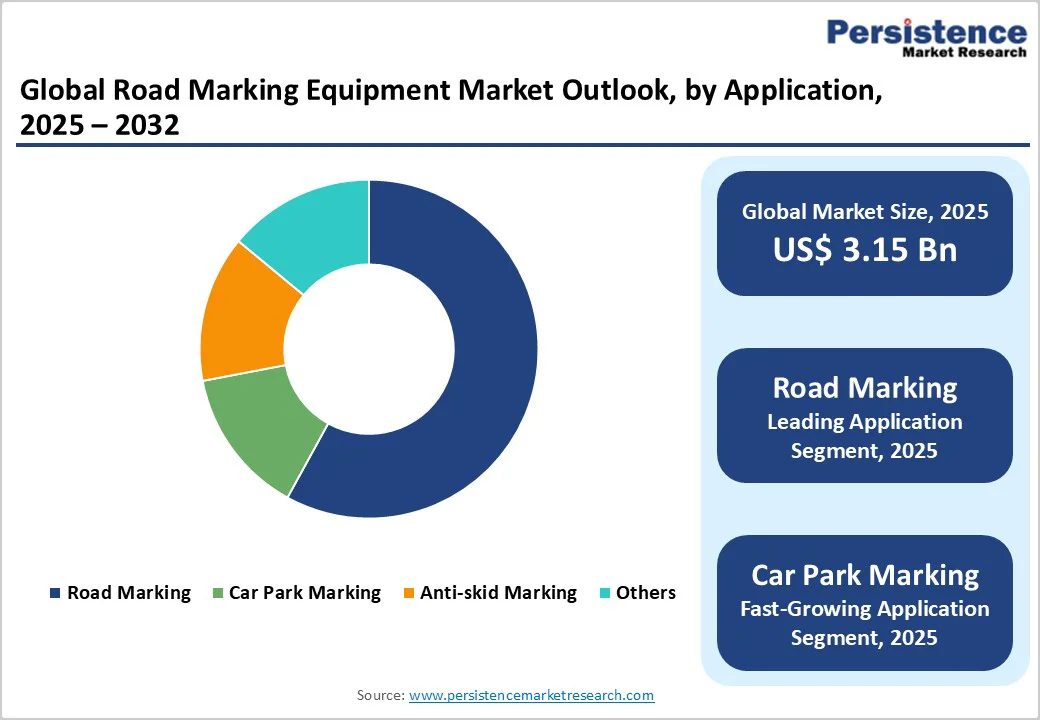
Road marking applications account for approximately 59% of the road marking equipment market, driven by primary demand from highway construction, maintenance programs, and urban road network expansion projects. Government investments in National Highway development, exemplified by India's expansion from 91,287 km in March 2014 to 1,46,204 km currently, necessitate continuous deployment of equipment for longitudinal lane markings, edge lines, and centerline striping across multi-lane highways and expressways.
The proliferation of high-speed corridors and expressways spanning 2,474 km in India and extensive networks across North America and Europe sustains robust equipment demand for initial marking applications and scheduled maintenance programs, ensuring regulatory compliance and optimal road safety performance.
Regional Insights
North America Road Marking Equipment Market Trends
North America maintains a mature, technology-driven road marking equipment market characterized by stringent regulatory frameworks and advanced innovation ecosystems. The Federal Highway Administration allocated US$52 billion for road improvements in 2025, prioritizing automated equipment for efficient marking on interstate systems. Innovations such as IoT-integrated machines from local firms enhance maintenance tracking, reducing downtime by 20% in urban areas.
Regulatory frameworks, including MUTCD standards, mandate high-retroreflective markings, driving upgrades in equipment precision. Recent developments, such as California's smart highway pilots, integrate vehicle-to-infrastructure technology to improve traffic management.
Europe Road Marking Equipment Market Trends
Europe exhibits strong performance in road marking equipment, with Germany, the U.K., France, and Spain leading through harmonized regulations and infrastructure renewal. The EU Green Deal promotes eco-friendly equipment, with Germany's autobahn maintenance using thermoplastic applicators to cut emissions by 15%. Cross-border standards under EN 1436 ensure uniform visibility, boosting demand for versatile machines. France and Spain focus on urban retrofits, where semi-automatic tools streamline pedestrian zone markings.
Harmonization efforts, such as the Trans-European Transport Network, integrate advanced technologies to enable seamless connectivity. Recent news highlights the U.K.'s HS2 rail-adjacent road projects employing GPS-guided systems for precision. These dynamics position Europe as a hub for sustainable and regulated growth.
Asia Pacific Road Marking Equipment Market Trends
Asia Pacific is witnessing a rapid growth in road marking equipment, driven by manufacturing advantages and infrastructure booms in China, Japan, India, and ASEAN nations. China dominates regional equipment consumption through its extensive expressway system, which exceeds 160,000 kilometers, and continues to invest in the Belt and Road Initiative and the National Trunk Highway System.
India's Bharatmala program emphasizes anti-skid markings, with local production lowering costs by 25%. India's road infrastructure budget allocation, approaching INR 2.8 Trillion (US$33.7 billion) for FY 2025, sustains robust equipment demand as the country expands its National Highway network and upgrades existing corridors to multi-lane configurations. The increase in the 4-lane and above NH network from 18,371 km in 2014 to 48,430 km currently necessitates substantial deployment of marking equipment.
Competitive Landscape
The global road marking equipment market displays a moderately consolidated structure, with key players such as Graco Inc. and Hofmann leading through innovation and global distribution. Companies pursue expansion through strategic partnerships and R&D in automation, differentiating themselves with eco-friendly features such as low-VOC applicators. Emerging models emphasize subscription-based maintenance, shifting from one-time sales to recurring revenue. This landscape encourages collaboration on sustainable tech amid fragmented regional suppliers.
Key Industry Developments
- November 2024: Graco Inc. completed the acquisition of Corob S.p.A. for €230 million (US$266.1 million) with up to €30 million (US$34.7 million) in additional contingent consideration, bolstering its position in the paint and coating machinery manufacturing category and expanding its global manufacturing footprint across Italy, India, and Canada.
- September 2024: Hofmann showcased its advanced BetLine Technology, featuring cutting-edge sensors and control systems that ensure precision alignment and durability, addressing contractor demands for efficient, high-quality road marking solutions compatible with smart transportation infrastructure requirements.
- November 2024: HOFMANN Road Marking Technology hosted the 25th HOFMANN Expo in Rellingen, Germany, convening international specialists and demonstrating the latest marking technologies through expert presentations and live demonstrations, cementing its position as the industry's innovation center and premier trade fair for road marking technology.
Companies Covered in Road Marking Equipment Market
- Vogel Traffic Services (DBA EZ-Liner)
- Hofmann GmbH
- Graco Inc.
- MRL Equipment Co.
- M-B Companies
- BORUM A/S
- The Weir Group plc
- STiM Group
- CMC s.r.l.
- Winter Markiertechnik GmbH
- Toyo Nainenki Kogyosha Co., Ltd.
- Automark Industries
- RME Road Marking Equipment
- TATU Traffic Group
- Titan Tool Inc.
Frequently Asked Questions
The road marking equipment market is valued at US$3.2 Billion in 2025 and expected to reach US$4.6 Billion by 2032, reflecting steady growth.
Key drivers include global infrastructure investments and road safety regulations, boosting equipment needs for visibility and efficiency.
Automatic equipment leads with a 48% share, due to its precision and time-saving benefits in large projects.
North America leads, supported by strong U.S. investments and regulatory focus on safety infrastructure.
The integration of AI and GPS technologies in smart cities offers growth potential for automated, efficient marking solutions.
Leading players include Graco Inc., Hofmann, and BORUM A/S, known for innovative and sustainable equipment portfolios.


