




- Off-Road Equipment & Machinery
- Road Sweeping Machine Market
Road Sweeping Machine Market Size, Share, and Growth Forecast, 2026 – 2033
Road Sweeping Machine Market by Product Type (Self-Propelled Sweepers, Truck-Mounted Sweepers, Ride-On Sweepers, Tow-Behind Sweepers), Technology (Mechanical Broom Sweepers, Vacuum Sweepers, Combination Sweepers, Regenerative Air Sweepers), Application (Paved Surfaces, Unpaved Surfaces), and Regional Analysis for 2026–2033

Road Sweeping Machine Market Share and Trends Analysis
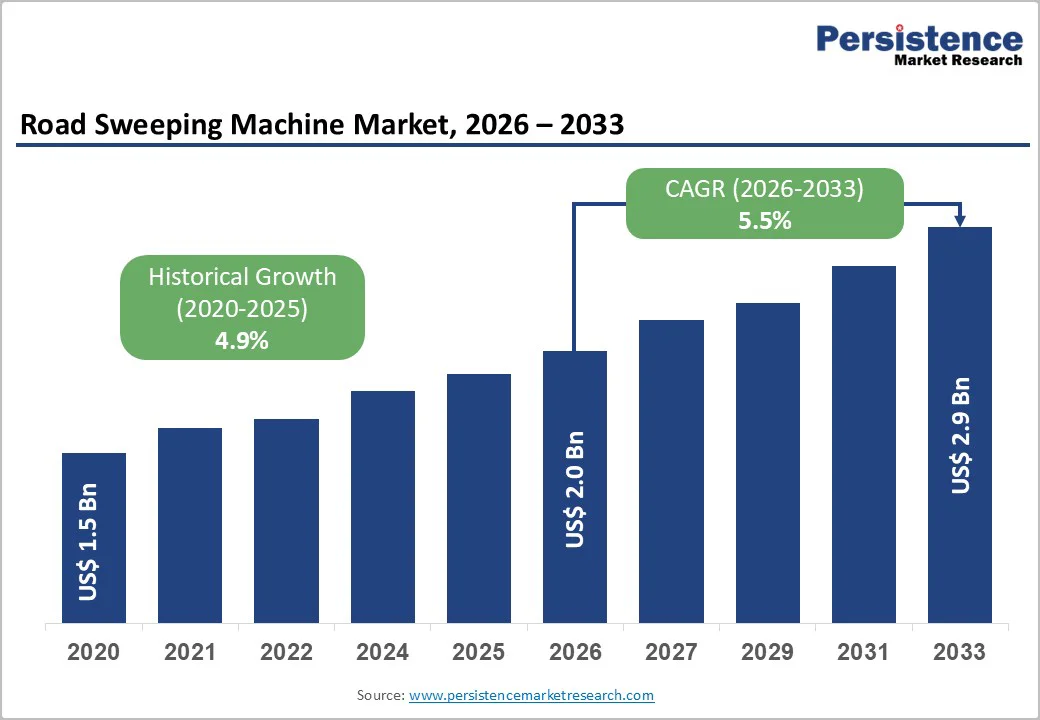
The global road sweeping machine market size is likely to be valued at US$ 2.0 billion in 2026, and is projected to reach US$ 2.9 billion by 2033, growing at a CAGR of 5.5% during the forecast period 2026-2033. The growth of this market is primarily supported by rising urban expansion, increasing municipal spending on public infrastructure, and tightening environmental mandates for dust and particulate control. Higher adoption of mechanized cleaning solutions by city administrations and industrial operators continues to accelerate equipment modernization. The shift toward automated road maintenance technologies also strengthens long-term demand for road cleaning solutions.
Key Industry Highlights
- Leading Product Type: Self-propelled sweepers are projected to dominate with an estimated 45% share in 2026, driven by their widespread adoption for municipal use.
- Fastest-Growing Product Type: Truck-mounted sweepers are expected to grow the fastest at around 6.5% CAGR through 2033, supported by highway and industrial cleaning demand.
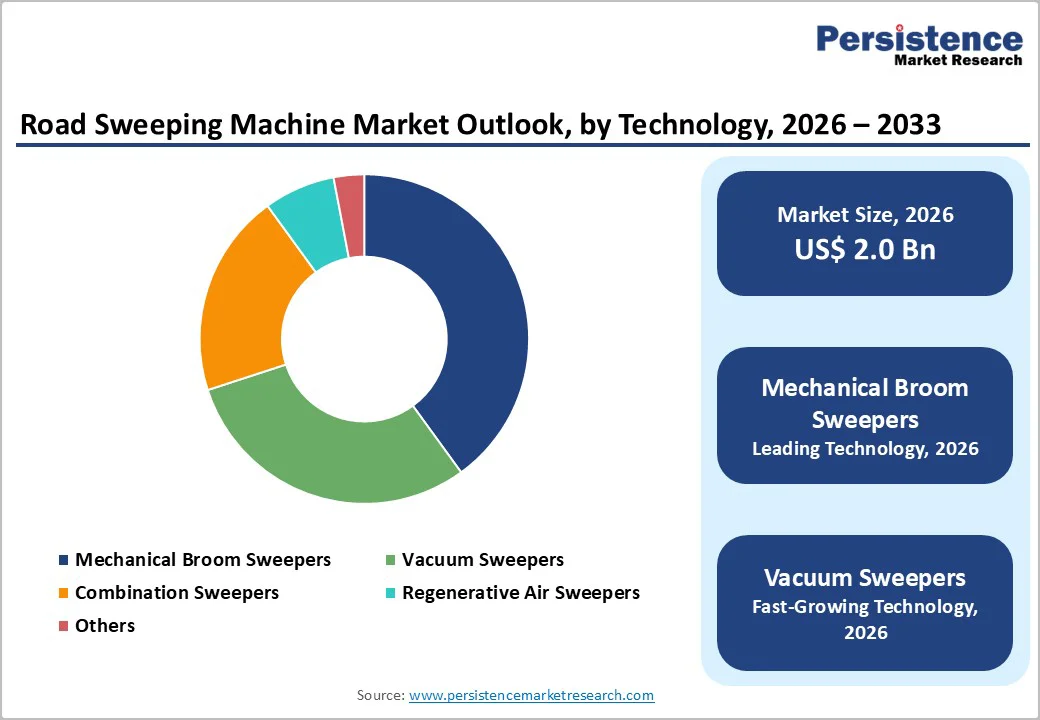
- Dominant Technology: Mechanical broom sweepers are expected to lead with about 40% revenue share in 2026, due to their cost efficiency and broad deployment.
- Fastest-Growing Technology: Vacuum sweepers are likely to expand the fastest at an estimated 7.2% CAGR from 2026 to 2033, driven by strengthening dust-control regulations.
- Leading Application: Paved surface applications are projected to dominate at roughly 70% in 2026, reflecting the proliferation of urban road networks.
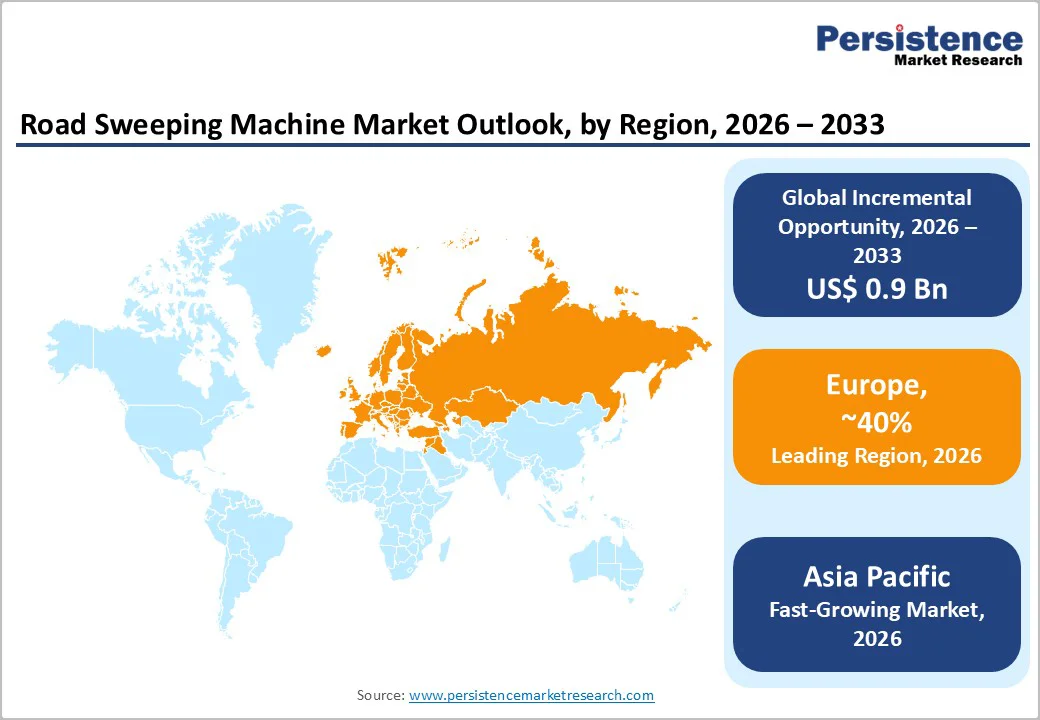
- Dominant Region: Europe is expected to hold approximately 40% of the market share in 2026, backed by strict environmental norms of the European Union (EU).
| Key Insights | Details |
|---|---|
|
Road Sweeping Machine Market Size (2026E) |
US$ 2.0 Bn |
|
Market Value Forecast (2033F) |
US$ 2.9 Bn |
|
Projected Growth (CAGR 2026 to 2033) |
5.5 % |
|
Historical Market Growth (CAGR 2020 to 2025) |
4.5 % |
Market Factors – Growth, Barriers, and Opportunity Analysis
Urbanization and Regulatory Drivers Accelerate Road Sweeping Mechanization
Growing rate of urbanization is significantly increasing the need for efficient road maintenance, prompting municipalities to modernize sanitation fleets and deploy mechanized sweeping systems. Urban populations are projected to reach 68% of the global total by 2050, as per UN projections, compelling authorities to expand budgets for addressing rising particulate pollution, construction debris, and traffic-generated dust. Government-led sanitation programs reinforce this shift by prioritizing cleaner transport corridors and enabling rapid response to urban environmental pressures, which generates consistent demand for advanced road sweeping machinery. Cities and regional administrations view fleet modernization as a critical investment in public health and air quality management.
Stricter dust and particulate emission standards across North America, Europe, and Asia are accelerating the transition from manual to mechanized sweeping operations. Regulatory bodies mandate compliance with particulate matter (PM) 2.5 and PM10 thresholds, compelling operators to adopt higher-efficiency vacuum and regenerative-air technologies that meet these requirements. Technological advancements such as enhanced suction performance, improved filtration systems, global positioning system (GPS)-enabled fleet management, and low-noise operation strengthen adoption as municipalities pursue smart-infrastructure objectives. Regulatory pressure and continuous product innovation converge to reshape procurement decisions and drive sustained expansion, positioning mechanized sweeping as the standard practice rather than an optional upgrade in urban environments.
High Total Cost of Ownership Slows Mechanization
High upfront prices and recurring operating burdens limit adoption of modern road sweeping equipment, especially for smaller municipalities and private contractors with constrained capital expenditure (CAPEX). Limited budgets force many buyers to delay fleet renewal, which extends replacement cycles and reduces penetration of advanced solutions across developing regions. To unlock projects, suppliers and city managers can lower barriers through total cost of ownership (TCO) business cases, financing options, and right-sized specifications that match duty cycles rather than defaulting to premium configurations.
Performance hurdles in challenging settings also restrict market expansion, because equipment can lose effectiveness on uneven surfaces, narrow urban lanes, and areas with weak supporting infrastructure such as poor curb definition. Gaps in operator training and inconsistent preventive maintenance reduce productivity, increase downtime, and weaken confidence in mechanized cleaning compared with manual methods. Buyers can reduce this risk by selecting application-fit platforms, investing in structured operator enablement, and using routine inspection protocols supported by telematics for proactive servicing and route optimization.
Emerging Markets and Sustainable Technologies Fuel Long-Term Growth
The road sweeping machine market stands to gain significantly from accelerating urbanization and infrastructure investment across emerging regions, particularly in Asia Pacific, the Middle East, and Africa. Expanding secondary cities paired with rising municipal budgets for sanitation are driving mechanized sweeping adoption at unprecedented rates. Delhi's June 2025 Air Pollution Mitigation Plan exemplifies this trajectory, deploying 70 mechanical road sweeping machines, 460 integrated water-sprinkler units, and 70 litter pickers supported by more than INR 2,000 crore investment across 1,400 kilometers of major roads under Public Works Department (PWD) leadership. Such large-scale, government-sponsored programs demonstrate how urban administrations in developing economies are rapidly embracing mechanized cleaning to reduce dust and achieve air-quality targets.
Simultaneously, industrial expansion, warehouse development, and the rise of airports, ports, and logistics facilities generate substantial demand for reliable road-maintenance equipment to manage dust, debris, and regulatory requirements. The shift toward low-emission and electric municipal fleets strengthens this momentum further, as policy incentives encourage investment in electric and hybrid sweepers that cut operating costs while advancing sustainability objectives. Equipment operators prioritizing efficiency, compliance, and reduced carbon footprint increasingly select environmentally friendly mid-sized, truck-mounted, and tow-behind configurations. This convergence of industrial growth, regulatory support for green technology, and operator commitment to lower emissions creates favorable conditions for sustained market expansion and accelerated innovation in cleaner sweeping solutions.
Category-wise Analysis
Product Type Insights
Self-propelled sweepers are set to lead the market with an estimated 45% share in 2026, as municipalities widely adopt them for large-scale urban and industrial cleaning. Their independent operation, capacity to handle medium to heavy debris, and efficient fleet utilization make them well-suited for city centers and industrial zones. Ongoing municipal procurement programs and fleet modernization efforts continue to strengthen their dominance in both developed and emerging regions. The segment is further boosted by the rollout of electric self-propelled models, such as Aebi Schmidt’s eSwingo 200+ and eCleango 550, which deliver zero-emission, low-noise, and high-performance sweeping ideal for dense urban environments and extended cleaning routes.
Truck-mounted sweepers are projected to register the fastest growth, at an estimated CAGR of 6.5% from 2026 to 2033. This expansion is driven by the development of highway networks, industrial corridors, and the need for high-capacity cleaning in demanding environments. Their robust construction, long-distance operation, and large debris-holding capacity make them essential for expressways, logistics hubs, and large industrial estates. Infrastructure expansion projects and new road constructions are major growth catalysts, supporting increased adoption in emerging and industrial regions. The rising demand for heavy-duty sweeping solutions is further elevating the appeal of high-capacity truck-mounted units in global markets.
Technology Insights
Mechanical broom sweepers are anticipated command an estimated 40% market revenue share in 2026 due to their affordability, straightforward design, and minimal upkeep needs. Operators value their robust performance in handling coarse debris during routine municipal tasks, making them a practical choice for cost-conscious regions. Municipalities in urban and industrial settings continue to favor these units for reliable cleaning without requiring advanced features. Steady procurement in developing markets further solidifies their position, as authorities prioritize functional equipment to expand fleets economically.
Vacuum sweepers are forecasted to achieve the highest growth rate from 2026 to 2033, fueled by the urgent need for fine-dust and particulate capture. Superior filtration capabilities help cities comply with stringent PM2.5 and PM10 limits in populated and industrial districts. Regulatory mandates on air quality intensify this shift toward efficient vacuum systems. Regions undergoing major road projects, such as the United Arab Emirates (UAE), Qatar, and Saudi Arabia, are increasingly specifying truck-mounted combination units for expressway maintenance, which aligns with ambitious infrastructure agendas and boosts demand for advanced vacuum solutions.
Application Insights
Paved surface applications will likely control 70% of the road sweeping machine market revenue share in 2026, driven by extensive urban road networks, highways, and industrial campuses around the globe. Municipalities continue to invest heavily in road cleanliness, while ongoing global paving projects further cement this segment’s primary position. Operators prefer sweepers designed for paved environments because they offer high efficiency, reduced maintenance needs, and proven durability in high-traffic zones. City planners and highway authorities consistently prioritize these units to maintain service levels across expanding infrastructure grids.
Unpaved surface applications are set to expand most rapidly, with an estimated CAGR of 7.8% through 2033, as mechanization spreads to construction sites, rural infrastructure developments, and mining operations. Stricter safety regulations and dust-control mandates encourage the use of equipment capable of managing uneven terrain effectively. The rise of new industrial estates, remote logistics hubs, and major infrastructure initiatives also accelerates demand, prompting original equipment manufacturers (OEMs) and local governments to focus resources on robust sweepers built for challenging, unpaved conditions.
Regional Insights
North America Road Sweeping Machine Market Trends
North America is poised to command approximately 30% of the road sweeping machine market share in 2026, with the United States generating the bulk of regional revenue. Robust municipal budgets fuel widespread procurement of mechanized sweepers for urban and industrial cleaning programs. Regulators emphasize particulate reduction and road safety, which propels demand for vacuum and regenerative air systems in cities and along transport corridors. California’s 2025 Hybrid and Zero-Emission Truck and Bus Voucher Incentive Project (HVIP) scheme exemplifies this push, offering vouchers up to US$ 160,000 for eligible Class 7 electric chassis in sweepers, which directly cuts acquisition costs and accelerates cleaner fleet transitions. ?
Heavy investments in automation, low-emission powertrains, and telematics systems further solidify the region’s leadership position. Municipal and state agencies prioritize reliable, eco-friendly equipment to achieve environmental goals and enhance operations. HVIP’s 2025 funding rounds deliver point-of-sale discounts for zero-emission vocational vehicles, reinforcing electrification trends. Municipal fleet managers can maximize these opportunities by aligning procurement with voucher timelines, integrating telematics for route optimization, and piloting hybrid models to demonstrate return on investment before full-scale adoption.
Europe Road Sweeping Machine Market Trends
Europe is likely to capture approximately 40% of the road sweeping equipment market in 2026. High urban density, extensive paved road networks, and harmonized environmental regulations across the EU create a strong foundation for this leadership. Germany, France, the United Kingdom, and Spain serve as key contributors, prioritizing sustainable mobility and improved air quality through mechanized sweeping adoption. Ongoing EU urban cleanliness and zero-emission programs accelerate deployment of advanced equipment. Cities such as Amsterdam and Barcelona are already deploying AI-equipped and low-emission sweepers. Municipal investment in electric and hybrid sweeping fleets reinforces Europe’s position in environmentally compliant road-cleaning systems.
The Europe road sweeping equipment market growth is projected to register an estimated CAGR of 5.8% from 2026 to 2033. Urban renewal projects, smart-city modernization, and carbon-reduction policies drive this expansion. Increasing adoption of battery-electric drives and low-noise technologies aligns with EU mobility mandates and city-level sustainability goals. The region’s strong technological maturity, established distribution networks, and strict environmental standards ensure continuous growth across urban, industrial, and transport-corridor maintenance applications. Equipment suppliers should align product development with these regulatory and technological trends to capture value in this mature, high-standard market.
Asia Pacific Road Sweeping Machine Market Trends
The Asia Pacific market is expected to achieve the highest CAGR of approximately 7.5% from 2026 to 2033, driven by swift urbanization, substantial infrastructure investments, and expanding industrial activity. Major cities such as Beijing, Tokyo, and Mumbai face mounting pressure to manage air quality, which accelerates adoption of vacuum and combination sweepers designed to capture fine particulates effectively. Abu Dhabi's 2025 initiative to deploy over 500 automated sweepers equipped with IoT connectivity and AI-enabled waste detection exemplifies the broader Asia-Middle East push toward technology-driven municipal cleaning systems. These programs demonstrate how regional authorities are moving beyond basic mechanization to embrace intelligent fleet management and real-time operational insights.
Cost-competitive manufacturing and the rise of domestic OEMs strengthen the region's ability to meet diverse operational requirements while keeping total ownership costs manageable. Smart-city programs and large-scale infrastructure expansion continue to accelerate mechanized sweeping adoption, including autonomous and semi-automated units now under pilot testing in Gulf and Asia Pacific metros. Mid-range and tow-behind sweepers gain traction as cities balance performance needs across both dense urban centers and developing rural corridors. Municipal buyers can capture maximum value by selecting platforms with scalable automation features, partnering with regional OEMs for responsive service networks, and phasing deployment to align with infrastructure readiness and operator training capacity.
Competitive Landscape
The global road sweeping machine market structure is moderately consolidated, led by key players such as Tennant Company, Bucher Municipal, Dulevo International, Schwarze Industries, Hako GmbH, and Fayat Group. These companies produce self-propelled, truck-mounted, and vacuum/regenerative air sweepers for municipal, industrial, and commercial applications. Strong capabilities in innovation, efficiency, and regulatory compliance ensure reliable performance. Investments in low-emission, electric, and IoT-enabled sweepers enhance sustainability and market differentiation. Extensive distribution networks and service infrastructure strengthen their global presence.
Emerging regional manufacturers, particularly in the Asia Pacific, Latin America, and Eastern Europe, are gaining traction with cost-effective mid-range and tow-behind sweepers. Local production, flexible customization, and competitive pricing help penetrate urbanizing and industrializing markets. Focused innovation in energy-efficient and connected sweepers meets evolving operational standards. Targeted deployment in construction, mining, and industrial zones drives adoption. These strategies allow regional players to capture high-growth opportunities.
Key Industry Developments
- In June 2025, Tennant Company launched the Z50 Citadel™ Outdoor Sweeper, combining mechanical broom and vacuum technologies with the TwinLift Debris Management System (DMS) to capture fine dust, light litter, and heavy debris effectively across industrial sites and municipal areas. Operator-friendly features include a 10-inch touchscreen with 1-Step™ controls, real-time diagnostics, adjustable brushes, PerformanceView™ cameras, and EUnited PM 2.5/PM10-certified air filtration for safety and reduced downtime.
- In June 2025, Elgin Sweeper introduced the DualEyes camera system for RegenX mid-dump regenerative air sweepers, providing operators with enhanced visibility of the front right tire, corner, right-side broom, and curbline using Starlight Technology for clear color imaging in daylight and darkness. The waterproof, dustproof system integrates rear-view and pickup head cameras onto a single 10-inch dash-mounted screen, enabling safer operation and more effective street cleaning from left-hand steering positions when right-hand steering is unavailable.
- In January 2025, Boschung introduced the Urban-Sweeper S2.0 MAX featuring one-click sweeping functionality and upgraded second-generation batteries, drives, motors, and controllers. The autonomous variant, S2.0 Autonomous, integrates lidars, cameras, mm-wave radars, and GNSS antennas for 360-degree environmental awareness, enabling safe operation on public streets with Level 5 certification.
Companies Covered in Road Sweeping Machine Market
• Tennant Company
• Bucher Municipal
• Dulevo International
• Schwarze Industries
• Hako GmbH
• Fayat Group (Ravo, Scarab)
• Boschung Group
• Aebi Schmidt Group
• TYMCO
• Zoomlion
Frequently Asked Questions
The global road sweeping machine market is projected to reach US$ 2.0 billion in 2026.
Rapid urbanization, increasing environmental regulations on dust and PM emissions, expansion of industrial corridors and highways, adoption of low-emission and electric sweepers, and technological advancements in automated and connected road cleaning equipment are driving the market.
The market is poised to witness a CAGR of 5.5% from 2026 to 2033.
Growing adoption of electric and hybrid sweepers, mechanization of unpaved and industrial areas, expansion in emerging economies, fleet modernization programs, and investment in smart and connected sweeping technologies are key market opportunities.
Tennant Company, Bucher Municipal, Dulevo International, Schwarze Industries, Hako GmbH, and Fayat Group are some of the key players in the market.


