




- Electric Mobility
- Off Road All Terrain e-Scooter Market
Off Road All Terrain e-Scooter Market Size, Share, and Growth Forecast, 2026 - 2033
Off Road All Terrain e-Scooter Market by Tire Type (Pneumatic Tires, Solid Tires), Frame Material (Aluminum, Steel, Carbon Fiber), Speed Range (Low Speed (15-25km/h), Others), and Regional Analysis for 2026 - 2033

Off Road All Terrain e-Scooter Market Size and Trends Analysis
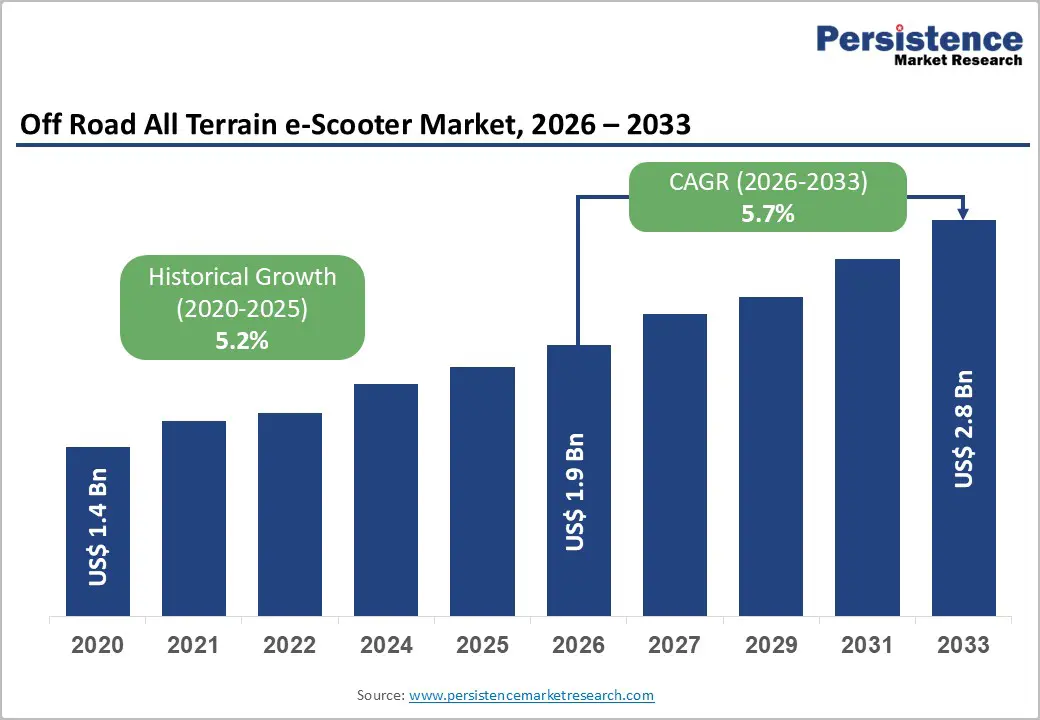
The global off road all terrain e-scooter market size is likely to be valued at US$1.9 billion in 2026, and is expected to reach US$2.8 billion by 2033, growing at a CAGR of 5.7% during the forecast period from 2026 to 2033, driven by the increasing prevalence of outdoor recreational mobility, rising demand for durable, high-torque electric scooters in rugged environments, and advancements in dual-motor and long-range battery systems.
Growing demand for high-performance off-road, all-terrain e-scooters, particularly pneumatic-tire models with aluminum frames for adventure and urban-to-trail use, is accelerating adoption among consumers. Advances in carbon fiber frames and premium speed ranges (above 80 km/h) are further boosting uptake by offering lighter weight and higher adrenaline appeal. Increasing recognition of off-road all-terrain e-scooters as critical for last-mile adventure, fitness, and eco-friendly exploration in emerging recreational markets remains a major driver of market growth.
Key Industry Highlights:
- Leading Region: North America, anticipated to account for a 39% market share in 2026, driven by strong adventure culture, high disposable income, and premium demand in the U.S.
- Fastest-growing Region: Asia Pacific, fueled by rising youth interest in electric mobility, expanding urban trail networks, and growing investments in e-scooter manufacturing in China.
- Dominant Tire Type: Pneumatic tires, to hold approximately 68% of the market share, as they provide superior shock absorption and traction on rough surfaces.
- Leading Frame Material: Aluminum, to account for over 55% of the market revenue, due to its optimal strength-to-weight ratio.
- Leading Speed Range: The mid speed (25-50 km/h) segment, to contribute nearly 45% of the market revenue, due to balanced performance and regulatory acceptance.
| Key Insights | Details |
|---|---|
| Off-Road All-Terrain e-Scooter Market Size (2026E) | US$1.9 Bn |
| Market Value Forecast (2033F) | US$2.8 Bn |
| Projected Growth (CAGR 2026 to 2033) | 5.7% |
| Historical Market Growth (CAGR 2020 to 2025) | 5.2% |
Market Factors - Growth, Barriers, and Opportunity Analysis
Demand Outdoor Recreational Mobility and High-Torque Rugged e-Scooters
Demand for outdoor recreational mobility is rising as consumers increasingly seek electric alternatives that perform well on rougher roads. High-torque, rugged e-scooters are gaining traction among adventure-oriented users seeking reliable mobility on trails, uneven terrain, campuses, large industrial sites, and semi-urban environments. Unlike conventional commuter scooters, these models feature powerful motors, reinforced frames, higher ground clearance, and advanced automotive suspension systems, enabling them to handle steep inclines, gravel paths, and variable weather conditions with ease.
This trend is strongly supported by lifestyle shifts toward outdoor leisure, eco-friendly recreation, and short-distance exploration. Users view rugged e-scooters not just as transport devices but as recreational equipment that combines convenience with performance. High torque output is a key differentiator, delivering faster acceleration, improved hill-climbing capability, and better load handling, making these scooters suitable for heavier riders and gear-carrying applications. Demand is being fueled by commercial and institutional use cases. Resorts, adventure parks, warehouses, and security services are adopting rugged e-scooters for efficient on-site mobility where traditional scooters or bicycles fall short.
Regulatory Restrictions and Safety Concerns
Regulatory restrictions and safety concerns remain significant barriers to the adoption and expansion of electric scooters in many regions. As e-scooters increasingly share public spaces with pedestrians, cyclists, and motor vehicles, authorities face mounting pressure to control their use to prevent accidents and infrastructure strain. In response, governments have introduced varying rules related to speed limits, rider age, helmet mandates, vehicle weight, and permitted riding zones. These regulations often differ widely between cities and countries, creating uncertainty for manufacturers, operators, and consumers.
Safety concerns are a central driver behind these restrictions. High acceleration and torque, particularly in performance-oriented or rugged e-scooters, increase the risk of loss of control for inexperienced riders. Accidents caused by sudden braking, uneven surfaces, or poor visibility have led regulators to impose stricter operational limits. Battery safety has also come under scrutiny, with concerns around overheating, improper charging, and fire hazards prompting tighter compliance requirements. From a market perspective, regulatory complexity increases product development costs and slows market entry, as manufacturers must customize designs to meet local standards.
Innovations in Carbon Fiber Frames and Dual-Motor High-Torque Platforms
Innovations in carbon fiber frames and dual-motor high-torque platforms are reshaping the performance and capability of modern electric scooters. Carbon fiber, known for its exceptional strength-to-weight ratio, enables manufacturers to produce frames that are simultaneously lighter and more robust than traditional aluminum or steel counterparts. This results in e-scooters that accelerate faster, handle more responsively, and offer longer range due to reduced overall weight. The inherent vibration-damping properties of carbon fiber also enhance rider comfort on rough terrain, making these scooters more appealing for recreational and mixed-use applications.
Parallel advances in dual-motor high-torque platforms further elevate performance by delivering balanced power distribution to both wheels. This configuration significantly improves traction control and stability, especially when navigating hills, loose surfaces, or wet conditions. By leveraging regenerative braking across both motors, these systems also enhance energy efficiency and extend battery life. The integration of on-the-fly power management allows riders to switch between performance profiles such as economy, sport, or off-road, tailoring torque output to specific conditions without sacrificing control.
Category-wise Analysis
Tire Type Insights
Pneumatic tires are expected to lead the market, accounting for 68% of the market in 2026, due to their superior shock absorption and ability to adapt to uneven surfaces. Air-filled construction provides better traction, stability, and ride comfort than solid alternatives, making it highly suitable for urban roads, rough pathways, and outdoor conditions. These tires reduce vibration transfer to the frame, improving rider safety and component durability. Their enhanced grip during braking and cornering also boosts user confidence.
The Xiaomi M365 electric scooter, manufactured by Xiaomi’s Mijia brand, features 8.5-inch inflatable pneumatic tires that absorb shocks and smooth out bumps on uneven surfaces. These pneumatic tires improve comfort, traction, and overall ride quality compared with solid tires, making the M365 popular among urban commuters and in shared mobility fleets.
Solid tires are expected to be the fastest-growing tire type, as they offer unmatched durability and minimal maintenance compared to pneumatic tires. As they contain no air, solid tires eliminate the risk of flats and punctures, making them ideal for heavy daily use, last-mile delivery fleets, and rugged industrial environments. This reliability reduces downtime and operating costs for both individual riders and commercial operators.
Solid tires deliver consistent performance across terrain and withstand wear from frequent braking and sharp debris. Models such as the Hiboy S2 and Hiboy S2 Pro feature 8.5-inch or 10-inch solid rubber tires that are air-free and puncture-proof. These solid tires eliminate the risk of flats and significantly reduce maintenance needs for riders who commute daily or use scooters in urban settings.
Frame Material Insights
The aluminum segment is leading the market, holding approximately 55% of the share in 2026, driven by an optimal balance of strength, light weight, and affordability for electric scooters and personal mobility devices. Its high strength-to-weight ratio helps keep vehicles lightweight, improving acceleration and range while maintaining structural durability.
Aluminum also resists corrosion, which extends product lifespan across varying weather conditions. Manufacturing processes for aluminum, such as casting and extrusion, are well established and cost-effective, enabling scalable production without significant price premiums. The Urban Foldable Electric Scooter features an aluminum alloy frame, which keeps the scooter lightweight for easier carrying and longer range while maintaining structural durability, a key reason aluminum dominates frame materials in many models.
Carbon fiber is expected to be the fastest-growing frame material, delivering exceptional strength with minimal weight, unlocking performance improvements that aluminum and steel cannot match. Its lightweight design boosts acceleration, increases range, and makes handling more responsive, making it especially valuable for premium and performance-oriented electric scooters. Carbon fiber naturally dampens vibrations, improving ride comfort on uneven terrain.
Advances in manufacturing and lowering production costs have made carbon fiber more accessible, encouraging adoption beyond niche products. NIU Technologies’ KQi Air X and KQi Air scooters, an established electric two-wheeler maker, introduced these models with full or major carbon fiber frame construction, making them significantly lighter (around ~25-26 lbs) compared to traditional aluminum-framed scooters.
Speed Range Insights
The mid-speed (25-50 km/h) segment is projected to lead the market, accounting for nearly 45% of revenue in 2026, as it strikes a practical balance for daily riders. This speed range strikes a balance, providing speeds fast enough for efficient commuting in urban and suburban areas while reducing travel time compared to low-speed models. It is manageable and safe for most riders on city streets.
Scooters in this category are ideal for last-mile transport, quick errands, and mixed-use trips, meeting regulatory standards and rider needs without requiring high-performance components. The Yakuza Neu Electric Scooter, with a top speed of approximately 25 km/h, falls squarely within the mid-speed range, making it ideal for daily commutes and errands. It is designed to be user-friendly in urban and suburban environments, serving students, regular commuters, and short-distance travelers without requiring high-end performance components.
The high-speed (50-80 km/h) segment is anticipated to be the fastest-growing, driven by its appeal to riders seeking both thrilling performance and practical utility, particularly for travel beyond crowded urban areas. This range bridges the gap between commuter scooters and light motorcycles, offering faster travel over longer distances while maintaining the compactness and ease of an e-scooter.
Riders seeking more acceleration, versatility across different terrains, and improved energy efficiency at higher speeds are increasingly opting for these models. The 5600W 38.4Ah Electric Scooter for adults, with a top speed of around 80 km/h (50 mph), is a prime example. Powered by a dual-drive 5600 W motor and a sturdy build, this scooter is ideal for longer commutes or recreational rides where speed is a priority.
Regional Insights
North America Off-Road All-Terrain e-Scooter Market Trends
North America is projected to lead, accounting for nearly 39% of the market in 2026, driven by the region’s strong outdoor recreational culture, high disposable incomes for premium mobility, and high public awareness of the benefits of electric adventure. Distribution systems in the U.S. and Canada provide extensive support for e-scooter programs, ensuring wide accessibility across pneumatic tires, aluminum frames, and mid-speed populations. Increasing demand for high-torque, convenient, and easy-to-customize forms is further accelerating adoption, as these formats improve trail capability and reduce barriers associated with conventional scooters.
Innovation in off-road all-terrain e-scooter technology, including stable dual-motor systems, improved carbon-fiber construction, and targeted high-speed enhancements, is attracting significant investment from both the public and private sectors. Government initiatives and consumer campaigns continue to promote use against a range of risks, durability concerns, and emerging adventure threats, creating sustained market demand. The growing focus on high-speed grades and specialty uses, particularly for trails and others, is expanding the target applications for off-road all-terrain e-scooters.
Europe Off-Road All-Terrain e-Scooter Market Trends
Market growth in Europe is supported by rising awareness of the benefits of electric mobility, robust urban-to-rural trail systems, and government-led sustainable transport programs. Countries such as Germany, France, and the Netherlands have well-established recreational frameworks that support routine off-road e-scooter use and encourage the adoption of innovative scooter delivery methods, including off-road all-terrain e-scooters. These high-performance formulations are particularly appealing for mid-speed populations, regulation-conscious riders, and high-speed users, improving capability and coverage rates.
Technological advancements in off-road all-terrain e-scooter development, including enhanced suspension, application-specific delivery, and improved carbon fiber grades, are further boosting market potential. European authorities are increasingly supporting research and trials on scooters for both routine and specialized use, strengthening market confidence. The growing emphasis on convenient, zero-emission options is aligned with the region’s focus on preventive green mobility and reducing fossil-fuel use. Public awareness campaigns and promotional drives are expanding reach in both urban and rural areas, while brands are investing in motors and new variants to improve performance.
Asia Pacific Off Road All Terrain e-Scooter Market Trends
Asia Pacific is likely to be the fastest-growing market for off road all terrain e-scooters in 2026, driven by rising adventure awareness, increasing government initiatives, and expanding application programs across the region. Countries, such as China, India, Indonesia, and Thailand, are actively promoting scooter campaigns to address recreational growth and emerging urban-trail needs. Off road all terrain e-scooters are particularly attractive in these regions due to their scalable administration, ease of customization, and suitability for large-scale adventure drives in both urban and rural populations.
Technological advancements are supporting the development of stable, effective, and easy-to-own off-road all-terrain e-scooters, which can withstand challenging terrain conditions and minimize range dependence. These innovations are critical for reaching remote trails and improving overall mobility coverage. Growing demand for pneumatic tires, aluminum frames, and mid-speed applications is contributing to market expansion. Public-private partnerships, increased recreational expenditure, and rising investment in scooter research and manufacturing capacity are further accelerating growth. The convenience of scooter delivery, combined with improved torque and reduced risk of failure, positions off-road all-terrain e-scooters as a preferred choice.

Competitive Landscape
The global off-road all-terrain e-scooter market is highly competitive, with several key players driving innovation and shaping industry trends. Leading companies are focusing on technological advancements, such as enhanced battery life, improved motor efficiency, and integrated smart features, to differentiate their offerings. Major manufacturers such as Varla Scooter, Kaabo, Wolf Warrior, Inokim, Zero Electric Scooters, EMOVE, and Kugoo are well-established in the market, leveraging their brand reputation and distribution networks to capture significant market share. Newer entrants such as Apollo Scooters are emphasizing niche segments, offering unique features tailored to specific consumer needs, such as eco-friendly materials, customizable designs, and rugged durability for extreme terrains.
Competition is also intensified by the growing number of startups that are bringing innovative designs and advanced technologies to market. For instance, Apollo Scooters has introduced a dual-motor e-scooter with an advanced suspension system for rough terrains. Pricing strategies, product quality, and customer service are crucial factors influencing market share, as consumers increasingly demand value for money, performance, and safety. Strategic partnerships, mergers, and acquisitions are also common as companies seek to expand their product portfolios and enhance their market presence.
Key Industry Developments:
- In October 2025, NAVEE, a leading innovator in smart mobility, unveiled the XT5 Pro All-Terrain Electric Scooter, designed for riders seeking both performance and sustainability. The XT5 Pro was built for exploration and was equipped with a 2,200 W high-torque rear motor, delivering 30% more climbing power and a top speed of 31 mph (50 km/h). An automotive-grade regenerative braking system was integrated to recover energy during rides, extending the range up to 46 miles (75 km). Supporting a maximum load capacity of 331 lbs (150 kg), the scooter was fitted with front and rear dual-side arm damping spring suspension, 12-inch all-terrain tubeless tires, and 163 mm of ground clearance for stability on gravel, mud, and steep terrain.
- In July 2025, Teewing, the high-performance electric mobility brand, unveiled the Mars XTR-its most powerful and extreme electric scooter to date. The Mars XTR was equipped with a 10,000 W dual motor output and rugged 11-inch hybrid off-road tires, and was designed to conquer any terrain with unmatched torque, stability, and style.
Companies Covered in Off Road All Terrain e-Scooter Market
- Segway-Ninebot
- Apollo Scooters
- Varla Scooter
- Kaabo
- Dualtron
- Wolf Warrior
- Inokim
- Zero Electric Scooters
- EMOVE
- Kugoo
Frequently Asked Questions
The global off road all terrain e-scooter market is projected to reach US$1.9 billion in 2026.
Rising outdoor recreational mobility and demand for high-torque rugged e-scooters are key drivers.
The off road all terrain e-scooter market is poised to witness a CAGR of 5.7% from 2026 to 2033.
Carbon fiber frames and dual-motor high-torque platforms are key opportunities.
Segway-Ninebot, Kaabo, Dualtron, Apollo Scooters, and Varla Scooter are the key players.


