




- Food Ingredients & Additives
- Wheat Syrup Market
Wheat Syrup Market Size, Share, and Growth Forecast, 2026 - 2033
Wheat Syrup Market by Nature (Organic, Conventional), Functionality (Thickener, Sweetener, Moisture-retaining Agent), End-User (Bakery & Confectionery, Dairy & Ice Cream, Beverages, Animal Feed, Others), and Regional Analysis for 2026 - 2033

Wheat Syrup Market Share and Trends Analysis
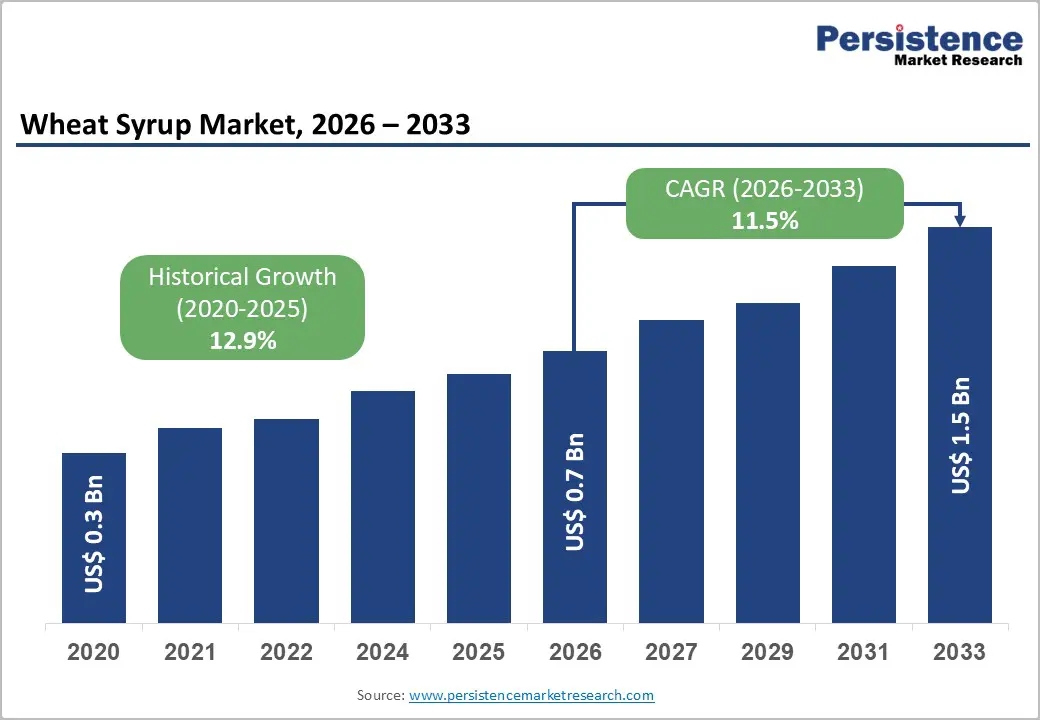
The global wheat syrup market size is likely to be valued at US$ 0.7 billion in 2026, and is projected to reach US$ 1.5 billion by 2033, growing at a CAGR of 11.5% during the forecast period 2026−2033. Rising adoption of natural and functional sweeteners in food and beverage formulations is driving demand for wheat syrup. Increasing awareness of the health benefits of plant-based sugar alternatives encourages their use in the bakery, confectionery, and beverage industries.
Technological advancements in extraction and processing enhance quality and consistency, facilitating broader integration across industrial and retail applications. Demographic trends, such as urbanization and rising disposable income, expand the addressable consumer base. Digital commerce and modern retail penetration support accessibility and distribution efficiency. Evolving food regulations promoting safe, natural ingredients increase acceptance among manufacturers and end-users.
Key Industry Highlights
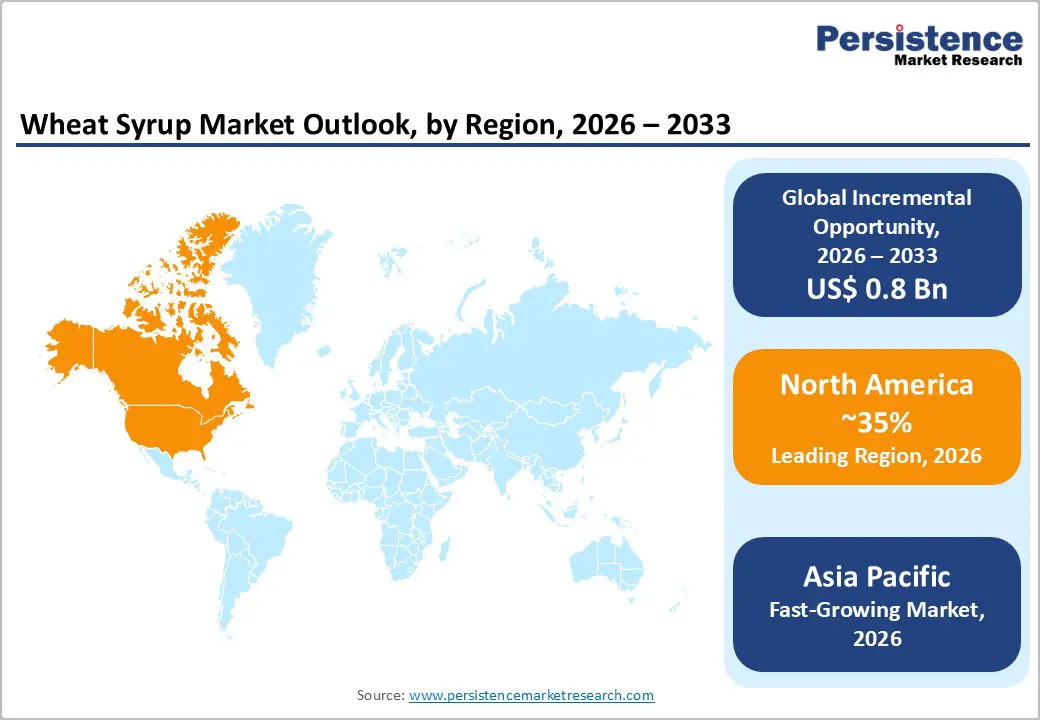
- Dominant Region: North America is projected to hold 35% of the wheat syrup market share in 2026, driven by adoption in bakery, confectionery, and beverages.
- Fastest-growing Regional Market: The Asia Pacific market is expected to grow the fastest between 2026 and 2033, fueled by rising income and demand for natural sweeteners.
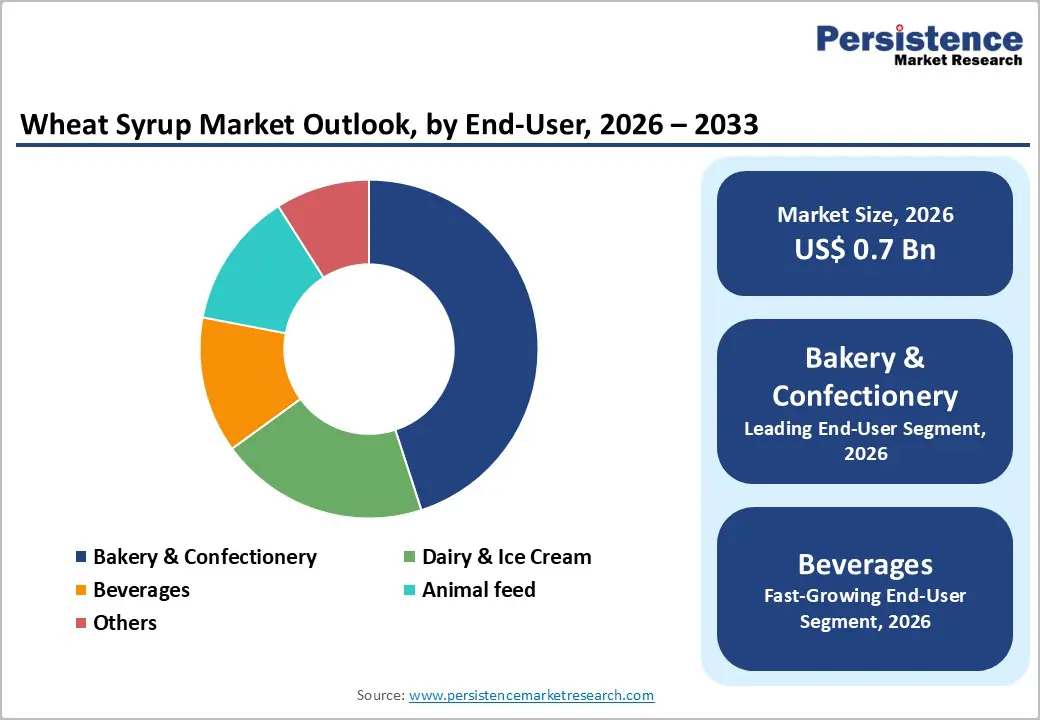
- Leading End-User: The bakery & confectionery segment is set to hold 45% of the wheat syrup market in 2026, supported by moisture retention, sweetness balancing, and texture enhancement.
- Fastest-growing End-User: The beverages segment is forecasted to record the fastest growth between 2026 and 2033, driven by demand for natural, clean-label sweeteners.
| Key Insights | Details |
|---|---|
|
Wheat Syrup Market Size (2026E) |
US$ 0.7 Bn |
|
Market Value Forecast (2033F) |
US$ 1.5 Bn |
|
Projected Growth (CAGR 2026 to 2033) |
11.5% |
|
Historical Market Growth (CAGR 2020 to 2025) |
12.9% |
Market Factors - Growth, Barriers, and Opportunity Analysis
Growing Demand for Natural Sweeteners
Consumer preference for healthier dietary patterns is a primary factor driving increased adoption of natural sweeteners in product formulations. Health data from the U.S. Centers for Disease Control and Prevention (CDC) indicate that about 12% of the U.S. population lives with diabetes, a condition influenced by excessive sugar intake, with well over 40 million people affected as of recent estimates, prompting public health initiatives focused on reducing added sugars in diets. Regulatory emphasis from government agencies such as the CDC and Dietary Guidelines for Americans encourages limiting added sugar consumption, which in turn drives food and beverage producers to integrate alternatives derived from natural sources, including plant-based extracts that deliver sweetness without contributing to glycemic load.
Food manufacturers are reallocating product development investments to address consumer demand for cleaner ingredient lists and options perceived as more wholesome. Natural sweeteners are increasingly positioned as compatible with strategies to reduce caloric density and appeal to consumers seeking options aligned with wellness goals, including weight management and metabolic health objectives. Producers leveraging plant-derived alternatives can differentiate offerings in competitive channels where clean-label positioning and transparent ingredient sourcing are valued by target demographics.
Integration of Technological Processing and Product Innovation
Advancements in processing technologies enhance operational efficiency and product consistency across production lines. Automated systems, precision sensors, and digital monitoring tools allow manufacturers to control quality parameters, reduce waste, and optimize resource utilization. Incorporating innovative formulations and novel extraction methods enables the development of differentiated products with improved taste, texture, and nutritional profile, responding to shifting consumer preferences. Process modernization supports faster production cycles and strengthens supply chain resilience, which improves overall competitiveness. Collaboration between research institutions and private enterprises accelerates the adoption of new methods, fostering a culture of continuous improvement and efficiency in production processes.
Government investment demonstrates recognition of technological and innovative impact on industry growth. In 2025, the National Institute of Food and Agriculture allocated US$ 6.8 million to projects advancing novel food processing and product development. Funding stimulates experimentation with high-yield processing techniques, alternative ingredient utilization, and value-added product creation. Companies that adopt these innovations benefit from cost reductions through resource efficiency and gain opportunities for product differentiation that attract premium pricing.
Competitive Pressure from Alternative Sweeteners
Market participants face substantial strain from the rising adoption of high-intensity and non-calorie sweeteners that replace traditional caloric sweetening agents. Regulatory guidance from the U.S. Food and Drug Administration (FDA) establishes clear acceptable daily intake limits for numerous non-sugar sweeteners (including acesulfame potassium, aspartame, sucralose, and certain steviol glycosides), facilitating their broader use across food and beverage applications. These alternatives often deliver equivalent sweetness at significantly lower caloric impact than sugar derivatives, enabling product reformulation to meet evolving dietary preferences and public health directives.
Commercial strategies of major packaged food corporations have evolved around this nutritional and regulatory landscape, prioritizing clean-label, low-sugar offerings that leverage alternative sweetening technologies to differentiate products and capture health-oriented market segments. Consumer demand dynamics further amplify this effect, with a growing share of end markets seeking low-calorie or sugar-free formulations supported by scientific evidence and government labeling standards.
Supply Chain Complexity and Raw Material Dependency
Complex sourcing networks for agricultural commodity-based ingredients create systemic operational challenges that extend beyond simple procurement tasks. Crops such as wheat are subject to climatic variability, trade policy shifts, and logistics constraints that interact to form an intricate web of upstream dependencies. For example, official projections for global wheat supply show sensitivity to weather variability, with production forecasts adjusting across major producers in 2025/26 in response to climatic and market conditions, indicating underlying volatility in raw material availability. These conditions necessitate layered supply arrangements, from farm output forecasts and storage capacities to international freight coordination and tariff compliance, which complicate planning for processors of crop-derived sweetening agents.
Dependency on agricultural production exposes manufacturing value chains to inherent price and yield fluctuations originating at the farm gate. Wheat commodity markets are prone to short-term price swings driven by crop conditions and policy shifts, which directly influence input costs for food ingredient processors. These swings can erode margin predictability and force buyers into expensive spot purchases or forward contract commitments that inflate cost structures. Government commodity outlooks underscore how crop supply forecasts and ending stock projections shift across marketing years, reflecting the fluid nature of raw material supply fundamentals and the difficulty of securing long-term, cost-stable contracts for agricultural inputs.
Technological Convergence with Health-Focused Formulation
Investing in advanced processing technologies, paired with health-oriented product design, presents a major value-creation pathway for sweetener producers. Enhanced extraction and formulation platforms enable precise control over syrup composition, sensory quality, and nutritional attributes, enabling integration into low-glycemic or functional food applications that align with evolving dietary guidelines. Process innovation, including enzymatic hydrolysis and membrane filtration, supports production efficiency and product differentiation in sectors such as beverages and nutraceuticals, reducing operational costs and improving product quality consistency.
A stronger focus on health in formulations enhances competitive positioning with health-conscious end users. Consumer preferences are shifting toward natural, minimally processed ingredients perceived as better for metabolic health and long-term wellness. Research and industry analysis show rising demand for alternatives to traditional sweeteners that contribute to excessive calorie intake and elevated blood glucose levels, prompting innovation in product portfolios. Manufacturers that integrate health-driven components into their offerings can expand into premium segments and specialty applications such as functional foods and clean-label beverages, creating pricing power and brand differentiation.
Expansion into Emerging Functional Food Markets
Rising consumer awareness regarding health and wellness is driving demand for functional food products enriched with natural ingredients. Wheat syrup offers natural sweetness and nutritional benefits, including dietary fiber, antioxidants, and essential micronutrients, aligning with clean-label and plant-based trends. Markets across Asia-Pacific, Latin America, and the Middle East are witnessing rapid adoption of fortified foods and beverages, creating opportunities for integrating wheat syrup into products such as protein bars, breakfast cereals, and functional beverages. Manufacturers can capitalize on this trend by developing innovative formulations that cater to regional taste preferences while meeting global regulatory standards for functional claims.
Consumer inclination toward preventive nutrition and immunity support fuels interest in functional sweeteners derived from grains. Retailers and foodservice providers are increasingly incorporating nutrient-dense alternatives into mainstream offerings, enabling higher visibility and adoption of wheat syrup-based solutions. Strategic collaborations between ingredient suppliers and food manufacturers facilitate product diversification and access to niche health-focused segments.
Category-wise Analysis
Nature Insights
The organic segment is poised to lead with a forecasted 55% of the wheat syrup market revenue share in 2026, owing to rising demand for clean-label and natural ingredients across bakery, confectionery, and beverage industries. Consumers increasingly associate organic products with higher safety and nutritional quality. Food manufacturers prefer organic sources to align with sustainability initiatives and certification requirements. Organic certification enhances retail trust, facilitating adoption in modern trade and e-commerce platforms. The segment benefits from strong technological integration in cultivation and extraction, improving yield and flavor consistency.
Conventional wheat syrup is anticipated to be the fastest-growing segment between 2026 and 2033, fueled by scalability of production and cost-efficient sourcing. Technological improvements in refining and processing allow consistent quality at industrial volumes. Manufacturers targeting emerging markets leverage conventional wheat syrup due to accessibility and shorter supply chains. Its versatility across bakery, dairy, beverage, and animal feed applications supports broad industrial adoption. Integration with digital logistics platforms enhances distribution efficiency.
End-User Insights
Bakery & confectionery is expected to hold a dominant position, accounting for an anticipated 45% of the wheat syrup market share in 2026, driven by its functional properties in moisture retention, sweetness balancing, and textural enhancement. Its natural humectant properties prevent staling and extend shelf life, making it particularly valuable in cakes, pastries, and cookies. Flavor modulation capabilities allow bakers to reduce refined sugar content while maintaining sensory appeal. Manufacturers in this segment prioritize ingredient quality and consistency to maintain product performance. Widespread integration into bakery and confectionery formulations ensures reliability and repeat usage, supporting brand loyalty and operational efficiency across industrial and artisanal production lines.
The beverages segment is forecast to be the fastest-growing end-user segment between 2026 and 2033, driven by rising demand for natural sweeteners in functional drinks, plant-based beverages, and ready-to-drink formulations. Wheat syrup contributes clean-label sweetness while complementing nutrient fortification in protein shakes, oat-based drinks, and herbal infusions. Consumer awareness of sugar reduction and health optimization stimulates adoption in beverage formulations. Manufacturers leverage wheat syrup to enhance taste while maintaining clean-label positioning. Technological integration in beverage processing and flavor optimization enables large-scale industrial applications.
Regional Insights
North America Wheat Syrup Market Trends
North America is expected to dominate with an estimated 35% of the wheat syrup market value in 2026, reflecting strong integration of natural sweeteners across bakery, confectionery, and beverage applications. High adoption in the United States and Canada stems from established food manufacturing infrastructure and stringent regulatory frameworks that favor clean-label and functional ingredients. The presence of leading ingredient suppliers and multinational food manufacturers enables rapid product development and consistent supply of high-quality wheat syrup. Rising consumer preference for plant-based diets and sugar-reduced formulations supports incorporation into protein bars, granola, and functional beverages. Advanced research in formulation optimization allows manufacturers to balance sweetness, viscosity, and moisture retention, enhancing product performance across industrial and artisanal production.
Strong distribution networks across the United States and Canada enhance accessibility for both retail and foodservice segments, supporting consistent market penetration. E-commerce adoption facilitates rapid delivery to urban and suburban consumers, creating new consumption opportunities in ready-to-drink beverages and fortified snacks. Collaborative initiatives between ingredient developers and food manufacturers drive innovation in functional applications, including nutrient-enriched bakery products and low-glycemic beverages. Consumer education campaigns highlighting natural, plant-derived sweeteners reinforce perceptions of these products as healthier alternatives to refined sugar, driving brand preference and market loyalty.
Europe Wheat Syrup Market Trends
Europe is positioned as a significant market for wheat syrup, supported by established food processing infrastructure and high consumer demand for natural and functional ingredients in countries such as Germany, France, Italy, and the United Kingdom. Strong presence of multinational bakery and beverage manufacturers drives consistent integration of wheat syrup into industrial and artisanal production lines. Regulatory frameworks encouraging clean-label and plant-based formulations promote adoption in baked goods, confectionery, and ready-to-drink beverages. Consumers increasingly seek products that combine taste with functional benefits, such as fiber enrichment and sugar reduction, prompting manufacturers to leverage wheat syrup for texture enhancement, sweetness modulation, and moisture retention.
Innovation in product development supports expansion into specialty and functional segments, including protein-enriched bakery products, low-glycemic snacks, and fortified beverages. Countries such as Germany and the United Kingdom emphasize nutrient-rich, clean-label alternatives, enabling wheat syrup adoption in premium and mainstream product lines. Retail modernization and online grocery penetration enhance accessibility, allowing consumers to explore functional products with greater convenience. Collaboration between ingredient suppliers and manufacturers facilitates formulation optimization, supporting compatibility with various flavor profiles and processing conditions.
Asia Pacific Wheat Syrup Market Trends
Asia Pacific is expected to be the fastest-growing market for wheat syrup over the 2026-2033 forecast period, driven by accelerating urbanization, rising disposable incomes, and evolving dietary preferences in China and India. The rapid expansion of modern retail formats and online grocery platforms enables widespread availability of functional ingredients, facilitating their adoption in bakery, confectionery, and beverage applications. Consumers increasingly prioritize natural, nutrient-rich alternatives to refined sugar, creating demand for wheat syrup in protein bars, ready-to-drink beverages, and fortified snacks. Manufacturers capitalize on this trend by customizing formulations to suit regional taste profiles, balancing sweetness intensity, viscosity, and texture for local product lines.
Rising investment in food technology and processing infrastructure strengthens the capacity for industrial-scale application of wheat syrup in functional products. Countries such as China and Japan benefit from advanced formulation expertise, enabling manufacturers to optimize moisture retention, flavor compatibility, and nutritional content in baked goods and beverages. Growing awareness of health optimization and sugar reduction accelerates integration into plant-based and functional drink formulations. E-commerce platforms and the expansion of modern trade further facilitate access in tier-1 and tier-2 cities, enabling manufacturers to test innovative offerings and capture niche segments.
Competitive Landscape
The global wheat syrup market structure is moderately fragmented, with leading players collectively holding an estimated 40% market share. Companies such as Cargill, Incorporated., ADM, Ingredion, Bunge, Tate & Lyle, and Roquette Frères focus on differentiation through product innovation, ensuring functional properties such as moisture retention, sweetness balancing, and texture enhancement meet industrial standards. Emphasis on quality consistency allows manufacturers to secure contracts with large-scale bakery, confectionery, and beverage producers. Distribution networks spanning retail, foodservice, and e-commerce channels support broad market reach, while investments in research and development facilitate formulation improvements, clean-label positioning, and compliance with regulatory standards.
Smaller regional producers maintain local presence, offering flexibility in catering to niche and regional preferences. These players often explore specialty applications, including nutrient-enriched bakery products and functional beverages, leveraging localized insights to meet emerging consumer trends. The market structure allows new entrants to capitalize on digital commerce platforms, creating direct-to-consumer channels and niche product visibility. Operational efficiency, functional property optimization, and brand credibility remain core drivers for competitive advantage. Investment in production technology ensures consistency, flavor stability, and large-scale applicability, supporting repeat usage in commercial formulations.
Key Industry Developments
- In October 2025, Brause’s Malt Soda, a German-inspired craft soft drink made with organic apples and Bavarian wheat malt, earned NEXTY recognition as it expanded across more than 150 U.S. retailers by offering a healthier, natural-ingredient alternative to traditional sodas and pushing craft soft drinks into the mainstream.
Companies Covered in Wheat Syrup Market
- Cargill, Incorporated.
- ADM
- Ingredion.
- Bunge.
- Tate & Lyle
- Roquette Frères.
- SAPPORO HOLDINGS LTD.
- Wilmar Distribution Pte. Ltd.
- Meelunie B.V.
Frequently Asked Questions
The global wheat syrup market is projected to reach US$ 0.7 billion in 2026.
Rising demand for natural, functional sweeteners in bakery, confectionery, and beverage applications is driving the market.
The market is poised to witness a CAGR of 11.5% from 2026 to 2033.
Integration into functional foods, plant-based beverages, and clean-label formulations presents key market opportunities.
Some of the key market players include Cargill, ADM, Ingredion, Bunge, Tate & Lyle, and Roquette Frères.


