




- Food Ingredients & Additives
- Hydrolyzed Wheat Gluten Market
Hydrolyzed Wheat Gluten Market Size, Share, Growth, and Regional Forecast, 2026 - 2033
Hydrolyzed Wheat Gluten Market by Product (Conventional and Organic), by Form (Powder and Liquid), by Application (Bakery & Confectionery, Plant-Based Meat & Seafood Analogues, Dairy Alternatives, Functional beverages, Animal Feed & Pet Nutrition, and Others) by End User (Food Manufacturers, Ingredient Processors, Cosmetic Manufacturers, Pharmaceutical Companies, and Others), and Regional Analysis from 2026 - 2033

Hydrolyzed Wheat Gluten Market Share and Trend Analysis
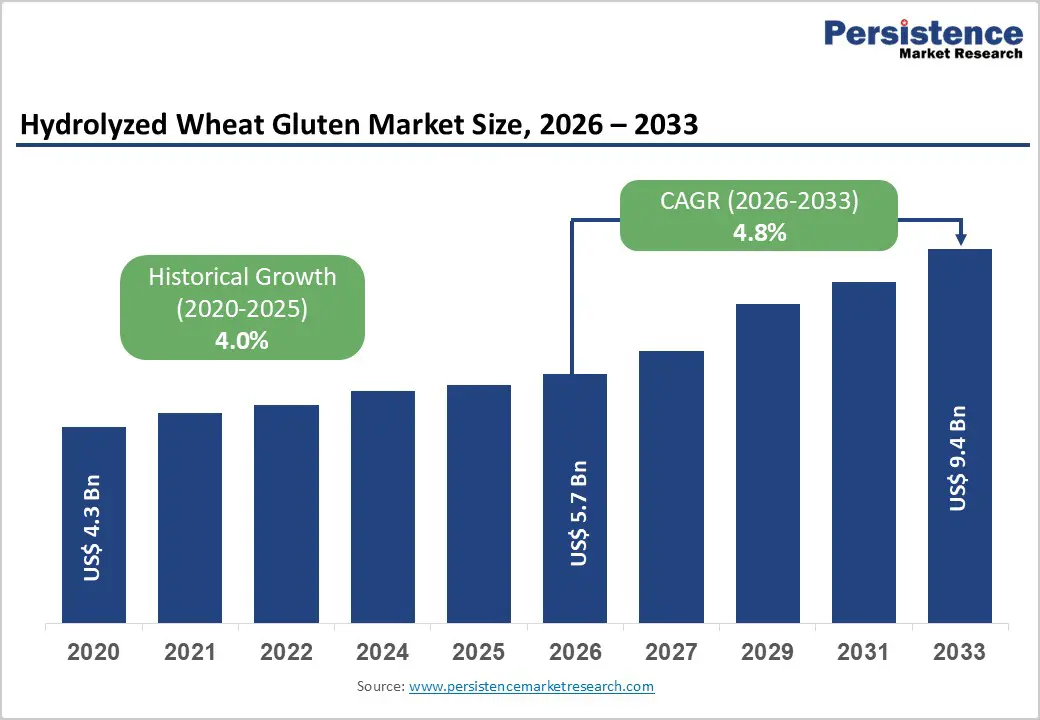
The global hydrolyzed wheat gluten market size is likely to be valued at US$ 5.7 billion in 2026 to US$ 9.4 billion by 2033, growing at a CAGR of 4.8% during the forecast period from 2026 to 2033. The global use of hydrolyzed wheat gluten is steadily increasing as food producers intensify the use of functional plant proteins across processed foods, bakery formulations, and protein-enriched product lines. Manufacturers value hydrolyzed wheat gluten for its ability to improve texture stability, emulsification, and moisture retention while supporting clean-label formulation goals.
The consumer inclination toward high-protein diets and plant-forward eating habits has widened its application scope in meat alternatives, ready meals, and fortified snacks. Expansion of organized food retail, cross-border ingredient trade, and digital procurement platforms has strengthened accessibility for industrial buyers worldwide. Urban consumption patterns and rising demand for convenience foods continue to drive large-scale ingredient sourcing. Additionally, innovation in enzymatic hydrolysis, improved solubility performance, and standardized quality specifications are enhancing product consistency. Increasing investment in specialty grades and value-added protein solutions is further reinforcing long-term adoption across food, nutrition, and personal care industries.
Key Industry Highlights
- Leading Region: North America holds the largest share at 46.7%, supported by advanced food processing capabilities, strong adoption of protein-fortified products, high penetration of plant-based foods, and established ingredient supply networks.
- Fastest-Growing Region: Asia Pacific is expanding most rapidly, driven by urbanization, rising disposable incomes, growth of processed food manufacturing, and increasing demand for functional protein ingredients.
- Leading Product Segment: Conventional accounts for the dominant position due to cost efficiency, consistent functional performance, and wide compatibility across industrial food applications.
- Fastest-Growing Product Segment: Organic variants are gaining momentum as manufacturers respond to clean-label expectations and premium natural ingredient positioning.
- Leading Form Segment: Powder remains the preferred format owing to longer shelf stability, ease of storage, and suitability for dry blending in large-scale food processing.
- Fastest-Growing Form Segment: Liquid formats are witnessing faster uptake as formulators seek improved dispersion and faster incorporation in beverages, sauces, and personal care applications.
| Key Insights | Details |
|---|---|
|
Hydrolyzed Wheat Gluten Market Size (2026E) |
US$ 5.7 Bn |
|
Market Value Forecast (2033F) |
US$ 9.4 Bn |
|
Projected Growth (CAGR 2026 to 2033) |
4.8 % |
|
Historical Market Growth (CAGR 2020 to 2025) |
4.0 % |
Market Dynamics
Driver - Rising Adoption of Functional Plant Proteins Across Processed and Reformulated Foods
Growing consumer preference for protein-enriched and ingredient-transparent food products is accelerating demand for wheat-derived protein hydrolysates across global food manufacturing. Food producers increasingly seek multifunctional ingredients capable of improving texture, emulsification, and moisture retention while supporting clean-label positioning. Hydrolyzed wheat gluten fulfills these requirements by offering enhanced solubility and digestibility compared with native gluten, enabling smoother incorporation into bakery goods, sauces, ready meals, and plant-based formulations. Rapid expansion of convenience foods driven by urban lifestyles and time-constrained consumers has significantly increased reliance on performance ingredients that ensure consistent quality during large-scale processing and extended storage.
Additionally, plant-forward dietary trends are encouraging manufacturers to diversify protein sources beyond soy and dairy, creating new application scope in meat alternatives, high-protein snacks, and fortified baked products. Improvements in enzymatic hydrolysis technologies have also enhanced functional performance, allowing formulators to achieve better mouthfeel and stability without artificial additives. Foodservice expansion, private-label innovation, and continuous product reformulation initiatives among multinational brands further strengthen procurement volumes. As global processors prioritize efficiency and nutritional enhancement simultaneously, functional wheat protein hydrolysates are increasingly positioned as essential components within modern food production systems.
Restraints - Allergen Concerns, Regulatory Labeling Requirements, and Raw Material Sensitivity
Despite expanding adoption, market growth encounters limitations related to gluten allergen perception and strict regulatory frameworks governing labeling and food safety. Increasing consumer awareness surrounding gluten intolerance and celiac disease has encouraged some manufacturers to shift toward gluten-free alternatives, restricting usage in certain product categories. Mandatory allergen declarations across North America and Europe require transparent labeling, which can influence purchasing decisions among health-conscious consumers and limit inclusion in products targeting sensitive populations.
Raw material dependence on wheat supply also introduces volatility linked to agricultural yields, geopolitical trade disruptions, and fluctuating commodity prices. Variations in protein content and crop quality can affect hydrolysis efficiency, requiring additional processing adjustments and quality control measures. Maintaining consistent peptide profiles demands advanced manufacturing expertise and investment in controlled enzymatic processes, raising operational costs for smaller producers. Furthermore, international trade regulations, certification requirements, and evolving food standards increase compliance complexity for exporters. Competition from alternative plant proteins such as pea, rice, and fava bean further intensifies pressure, particularly in markets emphasizing allergen-free positioning. These combined technical, regulatory, and perception-related challenges create constraints on rapid adoption despite strong functional advantages.
Opportunity - Expansion into High-Value Applications and Development of Specialty Protein Solutions
Emerging innovation trends are opening significant opportunities through diversification into premium and specialized application areas. Manufacturers are increasingly exploring hydrolyzed wheat gluten for advanced uses beyond traditional bakery processing, including sports nutrition, clinical nutrition, and fortified convenience foods. The ingredient’s rapid absorption characteristics and amino acid availability make it attractive for recovery beverages, protein blends, and functional dietary products targeting active and aging populations. In parallel, the personal care industry is creating new demand as hydrolyzed wheat peptides gain recognition for film-forming and conditioning properties in hair and skin formulations.
Technological advancements in controlled hydrolysis allow producers to tailor molecular weight distribution and functionality, enabling customized solutions for specific industrial requirements. Growth in plant-based meat innovation also presents long-term potential, as formulators seek proteins capable of enhancing texture and juiciness without compromising stability. Expanding food processing sectors in emerging economies are encouraging ingredient localization and partnerships between suppliers and regional manufacturers. Additionally, sustainability considerations favor plant-derived proteins with relatively efficient resource utilization compared with animal sources. As companies invest in specialty grades, organic certifications, and application-focused innovation, value creation is expected to shift toward differentiated, high-performance protein solutions rather than commodity supply.
Category-wise Analysis
By Product, Conventional Hydrolyzed Wheat Gluten Leads Due to Cost Efficiency and Broad Industrial Usability
Conventional hydrolyzed wheat gluten is projected to remain the dominant product category in 2026, contributing 84.1% of global revenue. Its leadership is primarily linked to large-scale industrial adoption where processors require consistent protein functionality, reliable solubility, and stable performance across diverse formulations. Manufacturers favor conventional variants because controlled hydrolysis enables predictable emulsification, binding, and moisture retention during processing. These characteristics are particularly important in bakery fillings, sauces, protein-fortified foods, and processed meal applications where formulation stability directly affects product quality and shelf life. Additionally, conventional products offer cost advantages compared with organic alternatives, making them suitable for high-volume commercial production. Established wheat supply chains and scalable processing infrastructure further strengthen availability. Food companies also rely on standardized specifications to maintain uniform output across multiple production facilities, reinforcing long-term procurement contracts. Continuous demand from mainstream food processing and ingredient manufacturing ensures sustained category dominance globally.
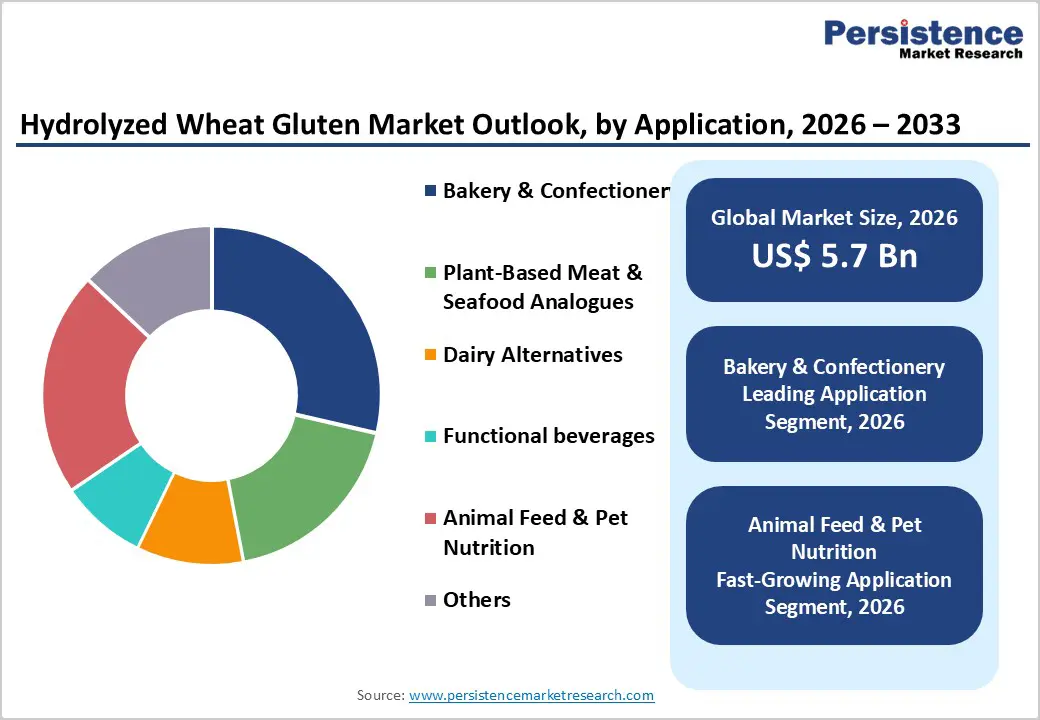
By Application, Bakery & Confectionery Application Dominates Supported by Texture Enhancement and Processing Stability
The bakery and confectionery segment is expected to account for 28.6% of total hydrolyzed wheat gluten consumption in 2026, maintaining its position as the largest application area. Hydrolyzed wheat gluten improves dough elasticity, enhances crumb softness, and supports moisture retention, making it highly valuable in cakes, biscuits, pastries, and filled desserts. Its ability to enhance mouthfeel while maintaining structural integrity during baking allows manufacturers to achieve consistent product quality at scale. Rising consumption of packaged baked goods, snack bars, and indulgent confectionery products across urban markets continues to sustain ingredient demand. In addition, manufacturers increasingly incorporate functional proteins into bakery products to align with evolving consumer interest in protein-enriched foods. Industrial bakeries benefit from improved processing tolerance and extended shelf stability, reducing waste and operational inefficiencies. Expansion of café chains, quick-service bakeries, and private-label dessert brands globally further accelerates procurement volumes, strengthening this segment’s leadership.
By End User, Food Manufacturers Hold the Largest Share Owing to Bulk Procurement and Continuous Production Demand
Food manufacturers are anticipated to represent 46.8% of total market demand in 2026, making them the primary end-use buyers of hydrolyzed wheat gluten. Large food processing companies rely on functional protein ingredients to optimize texture, emulsification, and nutritional positioning across multiple product categories. Hydrolyzed wheat gluten is widely utilized in processed foods, ready meals, sauces, snacks, and plant-based formulations, supporting steady high-volume purchasing cycles. Centralized procurement systems and long-term supplier agreements enable manufacturers to secure consistent quality and pricing stability. The shift toward protein enrichment and clean-label reformulation has further encouraged integration of wheat protein hydrolysates into new product development pipelines. Additionally, automation and scale efficiencies within industrial food production increase reliance on standardized ingredients capable of delivering reproducible performance. As global demand for convenience foods continues expanding, food manufacturers remain the most influential demand center within the market ecosystem.
Region-wise Insights
North America Hydrolyzed Wheat Gluten Market Trends
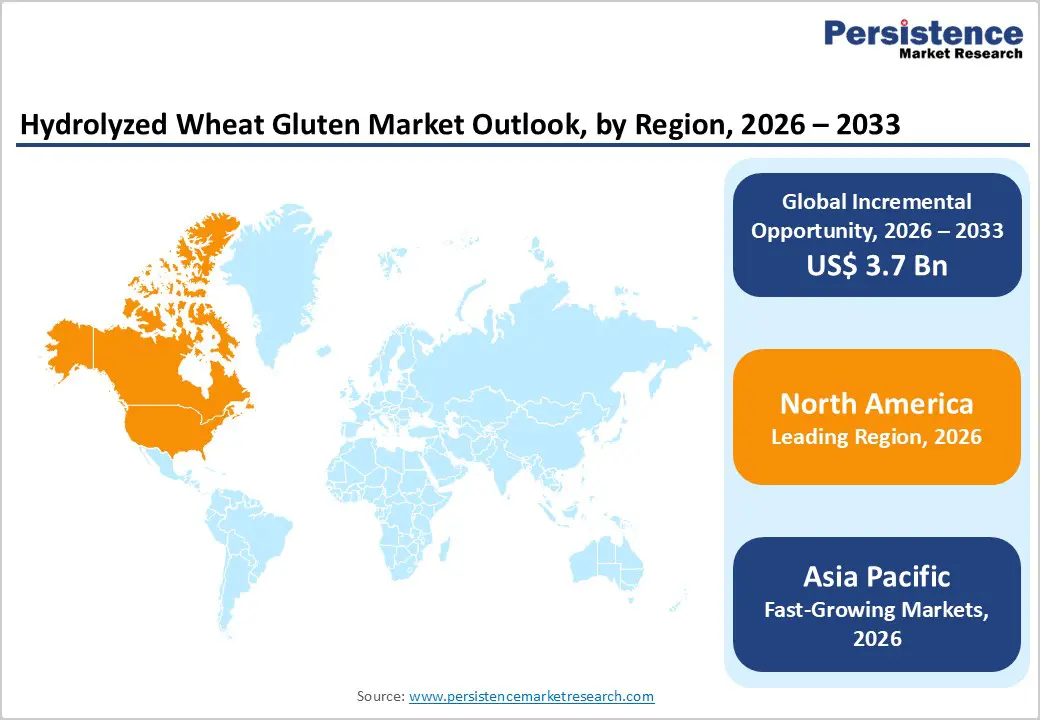
North America is forecast to command 46.7% of global market value in 2026, led by strong consumption across the United States and Canada. The region benefits from a highly developed processed food sector where functional protein ingredients are routinely incorporated to improve texture, stability, and nutritional value. Growth in plant-based eating patterns has significantly accelerated adoption, particularly in meat alternatives, high-protein bakery products, and ready-to-eat meals. Consumers increasingly prefer recognizable and naturally derived ingredients, encouraging manufacturers to reformulate products using wheat-based protein hydrolysates. Advanced food technology infrastructure allows precise ingredient integration, supporting large-scale commercial production.
Additionally, innovation pipelines among food brands focus on protein fortification and clean-label positioning, creating consistent demand for specialty wheat proteins. Well-established distribution systems and strong collaboration between ingredient suppliers and food processors further stabilize supply chains. Premium product launches and expanding functional food categories continue to reinforce North America’s dominant market position.
Europe Hydrolyzed Wheat Gluten Market Trends
Europe is expected to experience steady expansion in 2026, supported by strong regulatory emphasis on ingredient transparency and product quality. Countries including Germany, the United Kingdom, France, Italy, and the Nordic region demonstrate consistent utilization of hydrolyzed wheat gluten across bakery, savory snacks, and plant-based formulations. European consumers increasingly prioritize sustainable sourcing and minimally processed ingredients, encouraging manufacturers to incorporate plant-derived functional proteins into reformulated offerings. Strict labeling regulations enhance consumer confidence while supporting premium positioning for high-quality ingredients.
Growth in vegan and flexitarian dietary patterns has also accelerated innovation in alternative protein applications, particularly in meat substitutes and dairy-free products. Retail and specialty food channels actively promote high-protein and clean-label product ranges, strengthening ingredient demand. Additionally, ongoing investments in sustainable production technologies and environmentally responsible packaging align with regional policy priorities, ensuring continued adoption of hydrolyzed wheat gluten across evolving food categories.
Asia Pacific Hydrolyzed Wheat Gluten Market Trends
The Asia Pacific market is projected to grow at a CAGR of approximately 6.6% between 2026 and 2033, reflecting rapid transformation in regional food consumption patterns. Urbanization, expanding middle-income populations, and increasing exposure to Western dietary habits are driving higher demand for bakery products, processed foods, and convenience meals that utilize functional protein ingredients. Countries such as China, India, Japan, and South Korea are witnessing significant expansion in food processing industries, creating new opportunities for ingredient suppliers.
The region benefits from strong wheat processing capabilities and competitive manufacturing costs, enabling both domestic consumption and export growth. Rising awareness of protein-enriched diets and plant-based alternatives further supports adoption across modern food applications. Expansion of organized retail and e-commerce grocery platforms improves accessibility to packaged foods, indirectly boosting ingredient demand. Investments in processing modernization and government support for food manufacturing continue positioning Asia Pacific as the fastest-growing regional market globally.
Market Competitive Landscape
The global hydrolyzed wheat gluten market is highly competitive, with strong participation from Sihauli Chemicals Private Limited., aseschem, BRM HERBALS, Cargill, Incorporated, and Purenso Select. These companies leverage established export networks, B2B ingredient distribution, and strong raw material sourcing capabilities while focusing on consistent protein quality, controlled hydrolysis processes, solubility optimization, and advanced drying technologies to meet evolving food and personal care industry requirements.
Rising demand for plant-based proteins and clean-label ingredients is driving innovation, prompting manufacturers to expand specialty and organic offerings, enhance processing efficiency, strengthen global supply chains, and increase penetration across bakery, functional food, and cosmetic applications.
Companies Covered in Hydrolyzed Wheat Gluten Market
- Sihauli Chemicals Private Limited
- aseschem
- BRM HERBALS
- Cargill, Incorporated
- Purenso Select
- Farmoganic
- Chaitanya Agro Biotech Pvt. Ltd.
- Crespel & Deiters Group
- Roquette Frères.
- Innovative healthcare India Pvt Ltd
- Trulux
- Unilong Industry Co., Ltd.
- ADM
- Swasthum Wellness pvt ltd
- Others
Frequently Asked Questions
The global hydrolyzed wheat gluten market is projected to be valued at US$ 5.7 Bn in 2026.
Rising global adoption of plant-based diets, increasing demand for functional and clean-label ingredients, and expanding use in food processing and personal care formulations are primarily driving the hydrolyzed wheat gluten market growth.
The global hydrolyzed wheat gluten market is poised to witness a CAGR of 4.8% between 2026 and 2033.
Growth opportunities lie in plant-based meat innovation, functional nutrition products, aquaculture feed expansion, and premium natural cosmetics leveraging hydrolyzed wheat protein’s functional and sustainability advantages.


