




- Beverages
- Flavored Dairy Market
Flavored Dairy Market Size, Share, and Growth Forecast, 2026 - 2033
Flavored Dairy Market by Product Type (Flavored Yogurt, Flavored Milk, Others), Flavor (Chocolate, Fruit Flavors, Others), Product Format, Distribution Channel, and Regional Analysis for 2026 - 2033

Flavored Dairy Market Size and Trends Analysis
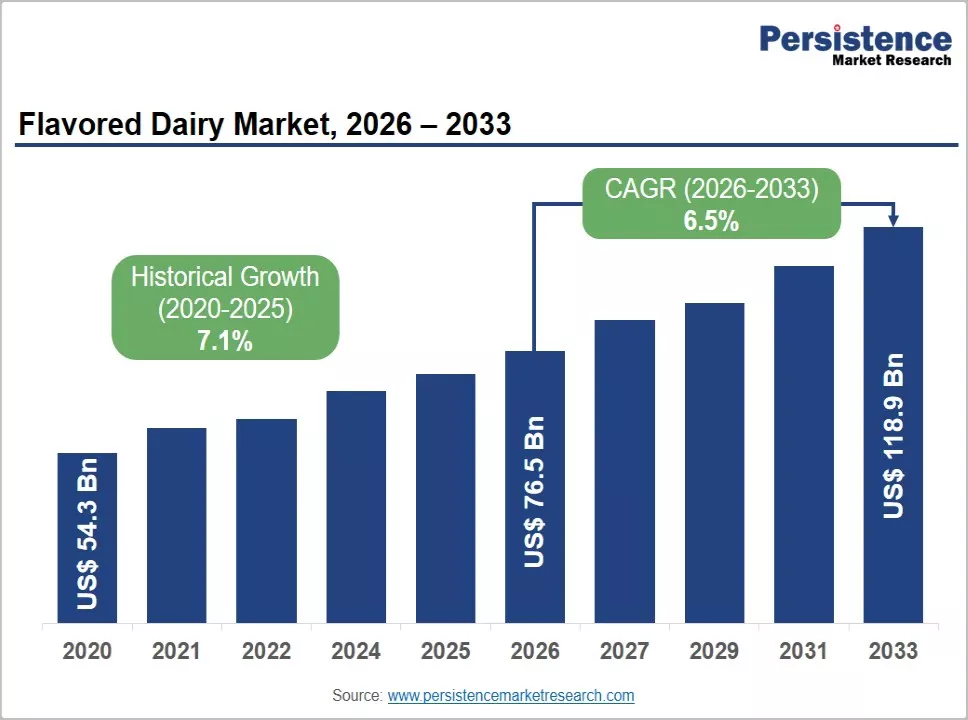
The global flavored dairy market size is likely to be valued at US$76.5 billion in 2026 and is expected to reach US$118.9 billion by 2033, growing at a CAGR of 6.5% between 2026 and 2033, driven by increasing consumption of convenient dairy products, greater demand for functional nutrition, broader flavor innovation, and the continued development of ready-to-drink dairy formats.
The market is moving beyond conventional sweetened dairy toward products that combine taste, convenience, protein, probiotics, fortification, lactose-free formulations, and reduced sugar. This shift is broadening consumption across age groups and usage occasions, including breakfast, snacking, post-exercise nutrition, and on-the-go consumption. Manufacturers are increasing investments in high-protein yogurt, drinkable yogurt, flavored milk, lassi-style beverages, functional dairy, and localized flavor systems.
Key Industry Highlights
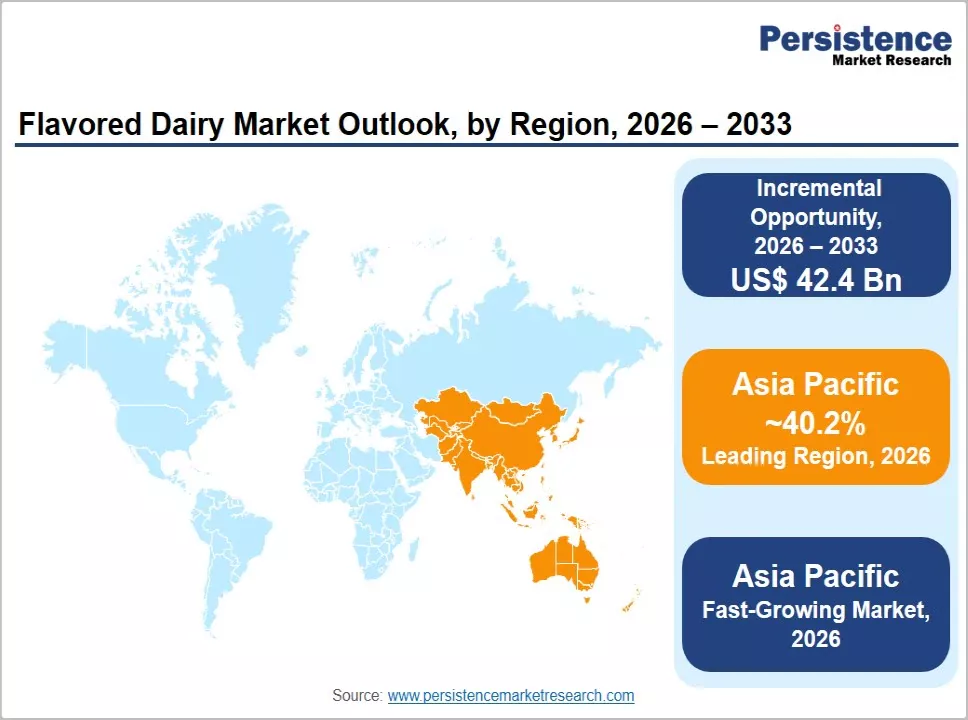
- Leading Region: Asia Pacific is projected to account for 40.2% of the market share, supported by expanding dairy consumption, urbanization, processing investments, and demand for convenient and functional products.
- Fastest-growing Region: Asia Pacific, driven by rising disposable incomes, expanding cold-chain infrastructure, increasing consumption of RTD dairy beverages, and product localization across China, India, and Southeast Asia.
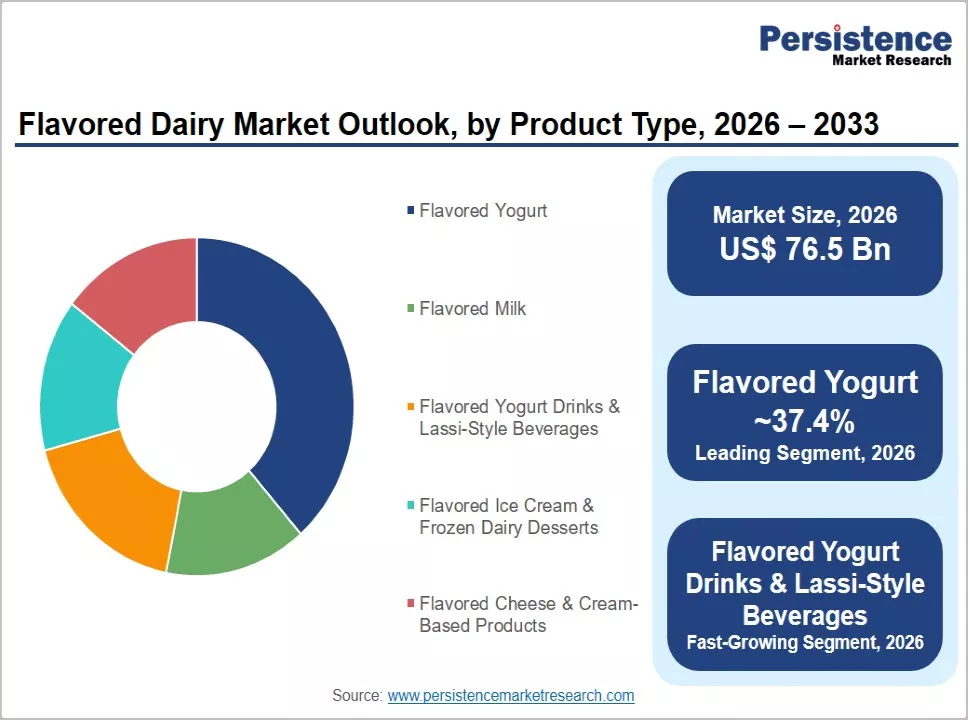
- Dominant Product Type: Flavored yogurt, anticipated to account for 37.4% of the market, due to its broad consumption base and compatibility with probiotics, protein, fruit flavors, and reduced-sugar positioning.
- Leading Flavor: Chocolate, anticipated to represent approximately 34.9% of the market share, remains the leading flavor due to its broad consumer appeal across children, teenagers, and adults.
DRO Analysis
Drivers - Rising Global Milk Availability and Expansion of Value-Added Dairy Processing
The expanding global dairy supply base provides an important structural foundation for flavored dairy products because yogurt, flavored milk, dairy beverages, frozen desserts, and cream-based products depend on consistent milk availability. The Food and Agriculture Organization reported global milk production of approximately 985 million tonnes in 2024, including about 797 million tonnes of cattle milk. The OECD-FAO Agricultural Outlook 2026-2035 projects global milk production to increase at approximately 2% annually, with productivity improvements accounting for much of the expansion. India is expected to contribute a significant portion of additional global production.
Increasing milk availability supports greater processing into higher-value dairy categories and allows manufacturers to expand flavored product portfolios without relying exclusively on imported raw materials. India is particularly significant, with milk production reaching 247.87 million tonnes in 2024-25, representing a 3.58% year-over-year increase, while per-capita milk availability reached 485 grams per day, according to India's Department of Animal Husbandry and Dairying. This combination of raw-material availability and rising domestic consumption supports growth in flavored milk, yogurt drinks, lassi, and fortified dairy.
Growing Consumer Demand for Convenient and Functional Nutrition
Consumers are increasingly seeking foods and beverages that provide nutritional value while fitting into faster-paced consumption patterns. The OECD-FAO Agricultural Outlook identifies population growth, rising incomes, and changing dietary patterns as important contributors to increasing dairy consumption, particularly in developing Asian markets. Manufacturers are responding by developing high-protein yogurt, probiotic drinks, fortified flavored milk, reduced-sugar products, and single-serve dairy beverages. Product development is increasingly focused on combining familiar flavors with nutritional attributes rather than positioning flavor alone as the primary purchase incentive.
Functional positioning expands the addressable consumer base for flavored dairy. High-protein products can appeal to active consumers and adults seeking convenient nutrition, while probiotic and fermented products can address digestive-health preferences. FrieslandCampina's 2025 product activity illustrates this transition through products such as Optimel Protein Extra, Campina Greek-style yogurt, and protein-oriented Chocomel, alongside sugar-reduction initiatives in Asian markets. These developments indicate that future competitive differentiation will increasingly depend on nutritional functionality, formulation quality, and convenience in addition to flavor.
Restraint - Sugar Reduction Requirements and Raw-Material Cost Volatility
Sugar reduction represents a structural challenge for flavored dairy, particularly chocolate milk, sweetened dairy beverages, flavored yogurt, and drinkable dairy products. In the United Kingdom, policy changes announced in 2026 are scheduled to lower the Soft Drinks Industry Levy threshold from 5 grams to 4.5 grams of added sugar per 100 milliliters and remove the exemption for milk-based drinks from January 1, 2028. In the U.S., the Food and Drug Administration requires added sugars to be separately disclosed on Nutrition Facts labels. These developments increase pressure on manufacturers to reformulate products while maintaining consumer acceptance.
Reformulation can increase formulation, ingredient, testing, and packaging costs. Sugar reduction can also affect texture, sweetness perception, mouthfeel, and flavor balance, making it particularly challenging in chocolate, caramel, and fruit-flavored products. Manufacturers must therefore invest in alternative sweetening systems and formulation technologies while controlling dairy, packaging, energy, and logistics costs. Smaller processors may face proportionally greater development costs, while large companies with established R&D capabilities can spread reformulation expenses across larger production volumes.
Opportunities - Expansion of High-Protein and Functional Flavored Dairy
The integration of dairy protein, probiotics, vitamins, minerals, and other functional attributes presents a significant opportunity for manufacturers to increase the value of flavored dairy products. Protein-focused dairy products are gaining importance as consumers seek convenient nutrition without moving entirely into specialized sports-nutrition categories. Fermented dairy also provides an established platform for probiotic positioning, while fortified flavored milk can combine familiar taste with nutritional benefits.
Manufacturers can develop high-protein Greek-style yogurt, probiotic yogurt drinks, fortified flavored milk, lactose-free beverages, and reduced-sugar products targeting specific consumption occasions. Products that combine familiar flavors with functional benefits can compete more effectively with protein beverages, smoothies, nutrition bars, and other convenience-oriented snacks. The opportunity is particularly relevant for single-serve products designed for breakfast, work, travel, and post-exercise consumption. Portfolio segmentation around protein content, sugar level, lactose status, and functional ingredients can also enable manufacturers to address multiple price points.
Localized Flavors and Asia Pacific Expansion
Asia Pacific provides significant opportunities because the region combines large dairy markets, expanding processing infrastructure, increasing urbanization, and changing consumer preferences. The OECD-FAO Agricultural Outlook expects Asia, particularly India and Pakistan, to record strong growth in fresh dairy consumption. India produced 247.87 million tonnes of milk in 2024-25, while China continues to operate one of the world's largest dairy-processing industries.
Companies can combine established dairy-processing technologies with regionally relevant flavors such as mango, strawberry, saffron, rose, caramel, coffee, and tropical fruits. Yili's CAOYUAN Yogurt portfolio demonstrates this approach by combining regional ingredients and cultural positioning with reduced-sucrose formulations. Its Dandong Strawberry Yogurt, for example, is positioned with 50% less sucrose. Similar strategies can be applied across India and Southeast Asia by combining local flavor preferences with high-protein, probiotic, fortified, or reduced-sugar formulations.
Category-wise Analysis
Product Type Insights
Flavored yogurt is anticipated to account for 37.4% of market share. Its strong position reflects yogurt's broad consumer base and flexibility across flavor and nutritional propositions. Products can combine fruit, chocolate, vanilla, coffee, or caramel flavors with probiotics, protein, reduced sugar, low-fat, or fortified formulations. Examples include fruit-flavored Greek yogurts, high-protein flavored yogurts, and probiotic varieties. Established refrigerated distribution through supermarkets, convenience stores, and foodservice further supports demand, while spoonable and drinkable formats serve breakfast, snacking, dessert, and on-the-go occasions. Manufacturers are increasingly using flavored yogurt as a platform for functional nutrition and premiumization.
Flavored yogurt drinks and lassi-style beverages are anticipated to be the fastest-growing product segment, supported by portability, digestive-health positioning, and rising demand across Asia Pacific. Products such as probiotic yogurt drinks, fruit-flavored lassi, protein-enriched dairy beverages, and RTD yogurt drinks are expanding consumption beyond traditional meal occasions. In India, established familiarity with lassi provides a strong foundation for packaged products featuring longer shelf life, standardized quality, and functional ingredients. Manufacturers across China and Southeast Asia are also developing RTD dairy beverages incorporating fruit flavors, probiotics, and protein. The segment increasingly competes with smoothies and other portable functional beverages.
Flavor Insights
Chocolate is anticipated to account for approximately 34.9% of the market share. Its strength is supported by broad consumer recognition, cross-generational appeal, and extensive use across flavored milk, yogurt, ice cream, and dairy beverages. Chocolate milk products such as Chocomel and other ready-to-drink chocolate milk beverages demonstrate the flavor's established position. Demand remains particularly strong among children and teenagers while adult consumption is supported by breakfast drinks, indulgence products, and coffee-based dairy beverages. However, sugar reduction is encouraging manufacturers to preserve chocolate intensity and texture while developing lower-sugar formulations.
Strawberry is anticipated to be the fastest-growing mainstream flavor. Its growth is supported by broad consumer acceptance and compatibility with yogurt cultures, fruit preparations, protein, vitamins, and functional ingredients. Strawberry is used across flavored milk, yogurt, yogurt drinks, frozen desserts, and cream-based products. Yili's Dandong Strawberry Yogurt, positioned with 50% less sucrose, illustrates how strawberry flavor can be combined with reduced-sugar positioning. Future innovation is expected to increasingly pair strawberry with protein, probiotics, vitamin C, and lower-sugar formulations, strengthening its appeal across health-oriented and mainstream dairy products.
Regional Insights
North America Flavored Dairy Market Trends
North America represents a mature flavored dairy market supported by high branded-product penetration, advanced refrigerated distribution, sophisticated food processing, and strong product innovation. The U.S. accounts for approximately 75.2% of North American flavored-milk revenue. U.S. milk production reached approximately 232 billion pounds in 2025, supported by an average dairy-cow inventory of 9.50 million head, providing a substantial domestic supply base for value-added dairy.
U.S. Flavored Dairy Market Trends
The U.S. market is increasingly shaped by high-protein, Greek-style, reduced-sugar, lactose-free, and probiotic dairy products. Brands such as Chobani, Oikos, Yoplait, and Fairlife have helped expand consumer familiarity with protein-rich and functional dairy formats. Competitive consolidation is also reshaping the category. In June 2025, Lactalis completed its acquisition of General Mills' U.S. yogurt business, including Yoplait, Go-Gurt, Oui, and Mountain High, adding approximately US$1.2 billion in annual sales and two manufacturing facilities. The transaction strengthens Lactalis' yogurt portfolio and manufacturing reach, increasing its ability to compete across mainstream, children's, premium, and functional segments.
Canada Flavored Dairy Market Trends
Canada provides a complementary mature market supported by established dairy consumption and strong domestic processing. Companies such as Saputo maintain broad dairy portfolios spanning milk, yogurt, cheese, and cultured products. Growing interest in protein, lower-sugar formulations, and convenient single-serve dairy is encouraging manufacturers to diversify beyond conventional products. North American innovation is therefore increasingly centered on nutritional reformulation, premiumization, and convenient formats rather than simply increasing traditional dairy volumes.
Europe Flavored Dairy Market Trends
Europe remains a mature flavored dairy market characterized by established yogurt consumption, extensive processing infrastructure, modern retail, and stringent nutrition and health-claim requirements. Germany, the United Kingdom, France, and Spain are important markets, while sustainability, ingredient transparency, sugar reduction, and functional nutrition increasingly influence product development.
Germany Flavored Dairy Market Trends
Germany has a large food-processing industry and sophisticated retail network supporting flavored yogurt, dairy beverages, and functional products. Arla Foods and Müller are prominent dairy brands, while private-label products provide substantial shelf presence. Manufacturers are increasingly emphasizing protein, reduced sugar, and convenient formats as consumers seek greater nutritional value from everyday dairy products.
U.K. Flavored Dairy Market Trends
The U.K. market is being strongly influenced by sugar-reduction policy. The planned expansion of the Soft Drinks Industry Levy to milk-based drinks from January 2028 is particularly relevant to flavored milk, milkshakes, and sweetened yogurt beverages. This is encouraging manufacturers to reformulate recipes ahead of implementation. The shift benefits brands capable of maintaining taste while lowering added sugar and strengthens demand for functional and nutritionally differentiated dairy products.
Asia Pacific Flavored Dairy Market Trends
Asia Pacific is projected to account for 40.2% market share and is also the fastest-growing region. China contributes around 63.8% of Asia Pacific flavored-milk revenue, while India provides major structural growth through rising milk production, processing investment, urbanization, and expanding consumption of value-added dairy.
China Flavored Dairy Market Trends
China combines a huge consumer base with sophisticated dairy manufacturers such as Yili and China Mengniu Dairy. Product innovation increasingly combines local flavors, fermentation, protein, and reduced sugar. Yili's CAOYUAN Yogurt portfolio, including its Dandong Strawberry Yogurt with 50% less sucrose, illustrates the regional movement toward localized flavors and healthier formulations. Such launches are shifting competition toward differentiated, functional dairy rather than basic flavored milk.
India Flavored Dairy Market Trends
India offers strong long-term growth potential. Milk production reached 247.87 million tonnes in 2024-25, while per-capita availability reached 485 grams per day. Companies such as Amul, Mother Dairy, and Milky Mist are expanding value-added categories including flavored milk, yogurt, lassi, and other dairy beverages. Government-backed dairy infrastructure investment is also increasing processing capacity, supporting greater commercialization of packaged products. The combination of traditional familiarity with lassi and yogurt and modern retail expansion creates strong potential for RTD, probiotic, protein-enriched, and reduced-sugar dairy formats across urban and emerging markets.
Competitive Landscape
The global flavored dairy market has a mixed competitive structure, comprising large multinational dairy companies, regional processors, dairy cooperatives, specialist yogurt companies, and private-label manufacturers. Competition varies considerably by product and geography. Competitive positioning centers on brand strength, product innovation, cold-chain coverage, manufacturing scale, flavor localization, and functional nutrition.
Leading companies are emphasizing product innovation, functional nutrition, sugar reduction, localized flavors, manufacturing efficiency, portfolio expansion, and strategic acquisitions. Differentiation increasingly depends on protein content, probiotic positioning, reduced sugar, lactose-free formulations, brand recognition, cold-chain reach, and flexible product development. Companies are also expanding through digital retail, convenience channels, quick commerce, and targeted premium products.
Key Industry Developments
- In June 2026, Danone announced an agreement to acquire MADE Group, an Australian healthy food and beverage company with a portfolio spanning high-protein ready-to-drink products, gut-health offerings, and other nutrition-focused products.
Companies Covered in Flavored Dairy Market
- Danone S.A.
- Lactalis Group
- Nestlé S.A.
- China Mengniu Dairy Company Limited
- Inner Mongolia Yili Industrial Group Co., Ltd.
- FrieslandCampina N.V.
- Arla Foods amba
- Fonterra Co-operative Group Limited
- Saputo Inc.
- Chobani LLC
- Meiji Holdings Co., Ltd.
- Morinaga Milk Industry Co., Ltd.
- Gujarat Co-operative Milk Marketing Federation Ltd. (Amul)
- Grupo Lala, S.A.B. de C.V.
- FAGE International S.A.
- The Hershey Company
Frequently Asked Questions
The global flavored dairy market is expected to be valued at US$76.5 billion in 2026.
The flavored dairy market is expected to reach US$118.9 billion by 2033.
Key trends include high-protein and probiotic formulations, reduced-sugar products, lactose-free dairy, RTD yogurt and lassi-style beverages, localized flavors, and functional fortification. Manufacturers are increasingly combining familiar flavors such as chocolate and strawberry with nutritional benefits and convenient formats.
Flavored yogurt is the leading product type, anticipated to account for approximately 37.4% of the market.
The flavored dairy market is projected to grow at a 6.5% CAGR from 2026 to 2033.
Major players include Danone, Lactalis Group, Nestlé, Yili, and China Mengniu Dairy.


