
U.S. IoT Market Size, Share, Trends, Growth, and Regional Forecasts 2025 - 2032

U.S. IoT Market Size, Share and Growth Forecast by Solution (Hardware, IoT Platforms/Software, Services), by Organization Size (Small- & Mid-sized Organizations, Large Organizations), by Industry (Industrial Automation, Connected Healthcare, Smart Transportation, Smart Retail, Smart Building Automation & Security), and Regional Analysis

ID: PMRREP33472
Calendar

July 2025

135 Pages

Author : Sayali Mali

U.S. IoT Market Size and Share Analysis

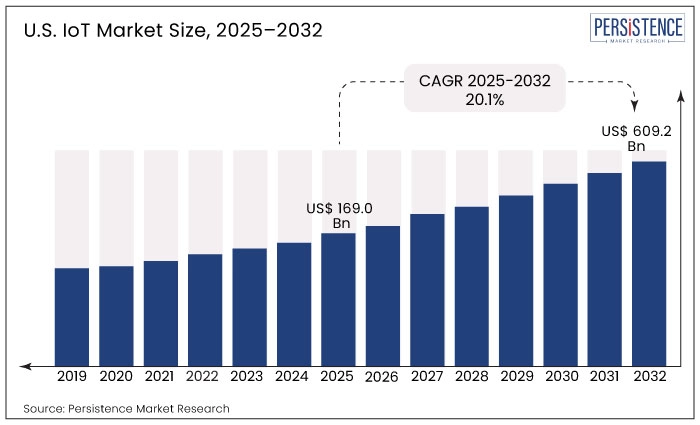
The U.S. internet of things (IoT) market was valued at US$ 142.2 billion in 2024 and is expected to reach US$ 169.0 billion in 2025. During the assessment period (2025 to 2032), the market is projected to expand rapidly at a CAGR of 20.1% to climb to US$ 609.2 billion by the end of 2032.

The Internet of Things (IoT) is a network of mobile devices, computing devices, and other physical objects that are integrated with software, sensors, and network connectivity, enabling data collection and sharing between them and other systems over the Internet.

IoT pertains to the capability of everyday objects to establish internet connectivity and interact with other devices or systems. This connectivity empowers enhanced automation, data gathering, and decision-making processes. IoT gadgets include smart household appliances, wearable fitness trackers, industrial sensors, and self-driving automobiles.

In the United States, IoT is being utilized to increase efficiency, reduce costs, and improve customer experience in a variety of industries, including healthcare, agriculture, transportation, energy, and manufacturing. IoT is also driving smart cities, which use linked devices and sensors to improve urban infrastructure and services such as traffic control, trash management, and public safety.

  • The United States accounts for nearly 20% share of the global IoT market in 2024
  • In April 2021, Apple announced its new Air Tag product, which uses Bluetooth connectivity to enable users to track and locate items such as keys and wallets. This product represents Apple's entry into the IoT tracking market.
  • In January 2021, the United States government announced the launch of the National Artificial Intelligence Initiative Office, which will coordinate federal investments in AI research and development, including in the IoT space.
us iot market 2025–2032

Attribute Key Insights

U.S. IoT Market Size (2025)

US$ 169.0 billion

Projected Market Value (2032)

US$ 609.2 billion

U.S. Market Growth Rate (2025 to 2032)

20.1% CAGR

Market Share of IoT Sensors (2025)

11.7%

Historical Market Growth (CAGR 2019 to 2024)

18.9% CAGR

What’s Influencing the Demand for IoT Systems and Services in the U.S.?

“Increasing Focus of Businesses on Automation and Improved Process Efficiency”

IoT technology provides several advantages to businesses, including enhanced efficiency, automation, and improved decision-making capabilities. Businesses in the United States obtain important data and insights by connecting multiple devices, sensors, and equipment to optimize their operations and boost their bottom line.

As businesses attempt to automate their processes and lessen their reliance on human labor. The COVID-19 pandemic pushed many companies to incorporate IoT technologies into their systems. Demand for IoT devices and services is thus expected to grow further in the future.

Acceptance and implementation of IoT technologies by businesses in the United States are projected to increase demand for the country's IoT market. This trend is anticipated to continue in the coming years as businesses attempt to optimize their operations and boost their bottom line by leveraging the benefits of Internet of Things technology.

How is U.S. IoT Market Growth Being Hindered to Some Extent?

“High Security Risks Associated with IoT Solutions”

The IoT is a fast-expanding market in which numerous gadgets are linked to the internet to facilitate communication and exchange of data between them. The Internet of Things has several benefits, such as increased efficiency and convenience, but it also poses significant security risks.

A security breach in the IoT can have serious implications, ranging from data theft and privacy violations to physical damage and even death. Both consumers and organizations are becoming more conscious of the significance of IoT security.

To address these security problems, the IoT industry must prioritize security by developing comprehensive security mechanisms and standards across all devices and networks. Manufacturers must incorporate security features such as encryption, authentication, and secure communication protocols into IoT devices from the start.

  • In February 2024, IBM announced a collaboration with AT&T to develop new edge computing and 5G solutions for enterprise customers.
  • In December 2023, Amazon Web Services (AWS) launched AWS IoT SiteWise Edge, a new feature that enables industrial customers to collect and analyze data at the edge of their network.
us iot market by region 2025–2032

Category-wise Insights

Why Do IoT Sensors Occupy a Leading Share of the U.S. Market?

“Rising Adoption of Cloud Computing Technology and Need for Efficient Data Processing Systems”

Wide adoption of linked devices across a range of industries, including healthcare, retail, manufacturing, and transportation, has significantly increased the adoption of IoT in recent years.

IoT sensors are essential to the operation of IoT systems because they gather, store, and process the data produced by connected devices. Demand for high-performance IoT sensors is rising along with the number of connected devices.

It is anticipated that the use of cloud computing is anticipated to increase demand for IoT sensors in the United States. Businesses may scale their IoT systems in accordance with changing needs without having to make substantial financial investments thanks to cloud-based IoT solutions.

Requirement for quicker and more effective processing of IoT data as well as the adoption of cloud computing technology is likely to be the main drivers of the rising demand for IoT sensors in the U.S.

IoT sensors accounted for 11.7% of the U.S. market in 2025.

What is the Demand Outlook for IoT Solutions from Small- & Mid-sized Organizations?

“Wide Availability of Cost-effective IoT Solutions Boosting Their Demand from Small- and Mid-sized Businesses”

Affordability and cost-effectiveness are significant drivers for the rising demand for IoT solutions in small- and mid-sized businesses. In comparison to larger corporations, these organizations often operate with limited budgets and resources. They are aware of the costs associated with implementing new technologies. IoT suppliers who provide affordable solutions and show a positive return on investment are more likely to catch the attention of these organizations.

Small and mid-sized businesses can reap the benefits of linked devices and data analytics without straining their financial resources by delivering cost-effective IoT solutions. Through IoT adoption, they may optimize their operations, automate processes, increase efficiency, and minimize human labor. This cost-effectiveness translates into practical benefits like greater productivity, simpler workflows, lower operational expenses, and increased competitiveness. The U.S. IoT market is poised for growth as more small and mid-sized organizations recognize the value and affordability of adopting IoT solutions.

Demand for IoT solutions from small- & mid-sized organizations is anticipated to swell at a CAGR of 17.4% during the forecasted period.

Competitive Landscape

To enhance their product portfolios and deliver more customized and advanced U.S. IoT  Market services in the United States, companies are increasingly prioritizing acquisitions and partnerships with their competitors

  • In June 2020, Microsoft acquired the IoT security company CyberX to enhance the security of its Azure IoT platform.
  • In October 2020, Intel acquired SigOpt, an AI optimization platform provider, to enhance its AI and ML capabilities for IoT applications.

Recent developments related to key players providing IoT market solutions in the U.S. have been tracked by analysts at Persistence Market Research, which will be accessible in the full report.

Companies Covered in U.S. IoT Market

  • IBM
  • Amazon Web Services, Inc.
  • Microsoft Azure
  • Google Cloud
  • Cisco
  • Intel
  • Qualcomm
  • Siemens
  • Verizon
  • Dell
Frequently Asked Questions

The United States IoT market was valued at US$ 169.0 billion in 2025.

The IoT market in the U.S. is predicted to swell at a 20.1% CAGR through 2032.

Revenue from IoT solutions in the U.S. is forecasted to climb to US$ 609.2 billion by 2032 end.

The IoT platforms/software segment is set to account for 52.6% share in 2025.

Industrial automation is expected to account for 29.1% market share in 2025.

U.S. IoT Market Industry Report Scope
Attributes Details

Forecast Period

2025 to 2032

Historical Data Available for

2019 to 2024

Market Analysis Units Value: US$ Bn/Mn, Volume: As applicable

Key Market Segments

  • Solution
  • Organization Size
  • Industry

Key Companies Profiled

  • IBM
  • Amazon Web Services, Inc.
  • Microsoft Azure
  • Google Cloud
  • Cisco
  • Intel
  • Qualcomm
  • Siemens
  • Verizon
  • Dell
Customization and Pricing

Available upon Request

Key Segments of U.S. IoT Market Industry

By Solution:

  • Hardware
    • IoT Sensors
    • IoT Gateways
    • IoT Controllers
    • Others
  • IoT Platforms/Software
    • Cloud-based
    • On-Premise
  • Services
    • Professional Services
    • Technology Consulting
    • Integration & Deployment
    • Support & Maintenance

By Organization Size:

  • Small- & Mid-sized Organizations
  • Large Organizations

By Industry:

  • Industrial Automation
  • Connected Healthcare
  • Smart Transportation
  • Smart Retail
  • Smart Building Automation & Security
  • Others

Related Reports

  1. Executive Summary
    1. Global U.S. IoT Market Snapshot 2025 and 2032
    2. Market Opportunity Assessment, 2025-2032, US$ Bn
    3. Key Market Trends
    4. Industry Developments and Key Market Events
    5. Demand Side and Supply Side Analysis
    6. PMR Analysis and Recommendations
  2. Market Overview
    1. Market Scope and Definitions
    2. Value Chain Analysis
    3. Macro-Economic Factors
      1. Global GDP Outlook
      2. Global GDP Outlook
      3. Global economic Growth Forecast
      4. Global Urbanization Growth
      5. Other Macro-economic Factors
    4. Forecast Factors – Relevance and Impact
    5. COVID-19 Impact Assessment
    6. PESTLE Analysis
    7. Porter's Five Forces Analysis
    8. Geopolitical Tensions: Market Impact
    9. Regulatory and Technology Landscape
  3. Market Dynamics
    1. Drivers
    2. Restraints
    3. Opportunities
    4. Trends
  4. Price Trend Analysis, 2019 – 2032
    1. Region-wise Price Analysis
    2. Price by Segments
    3. Price Impact Factors
  5. Global U.S. IoT Market Outlook: Historical (2019 – 2024) and Forecast (2025 – 2032)
    1. Key Highlights
    2. Global U.S. IoT Market Outlook: Solution
      1. Introduction/Key Findings
      2. Historical Market Size (US$ Bn) Analysis by Solution, 2019-2024
      3. Current Market Size (US$ Bn) Forecast, by Solution, 2025-2032
        1. Hardware
        2. IoT Platforms/Software
        3. Services
      4. Market Attractiveness Analysis: Solution
    3. Global U.S. IoT Market Outlook: Organization Size
      1. Introduction/Key Findings
      2. Historical Market Size (US$ Bn) Analysis by Organization Size, 2019-2024
      3. Current Market Size (US$ Bn) Forecast, by Organization Size, 2025-2032
        1. Small- & Mid-sized Organizations
        2. Large Organizations
      4. Market Attractiveness Analysis: Organization Size
    4. Global U.S. IoT Market Outlook: Industry
      1. Introduction/Key Findings
      2. Historical Market Size (US$ Bn) Analysis by Industry, 2019-2024
      3. Current Market Size (US$ Bn) Forecast, by Industry, 2025-2032
        1. Industrial Automation
        2. Connected Healthcare
        3. Smart Transportation
        4. Smart Retail
        5. Smart Building Automation & Security
        6. Others
      4. Market Attractiveness Analysis: Industry
  6. Global U.S. IoT Market Outlook: Region
    1. Key Highlights
    2. Historical Market Size (US$ Bn) Analysis by Region, 2019-2024
    3. Current Market Size (US$ Bn) Forecast, by Region, 2025-2032
      1. North America
      2. Europe
      3. East Asia
      4. South Asia & Oceania
      5. Latin America
      6. Middle East & Africa
    4. Market Attractiveness Analysis: Region
  7. North America U.S. IoT Market Outlook: Historical (2019 – 2024) and Forecast (2025 – 2032)
    1. Key Highlights
    2. Pricing Analysis
    3. North America Market Size (US$ Bn) Forecast, by Country, 2025-2032
      1. U.S.
      2. Canada
    4. North America Market Size (US$ Bn) Forecast, by Solution, 2025-2032
      1. Hardware
      2. IoT Platforms/Software
      3. Services
    5. North America Market Size (US$ Bn) Forecast, by Organization Size, 2025-2032
      1. Small- & Mid-sized Organizations
      2. Large Organizations
    6. North America Market Size (US$ Bn) Forecast, by Industry, 2025-2032
      1. Industrial Automation
      2. Connected Healthcare
      3. Smart Transportation
      4. Smart Retail
      5. Smart Building Automation & Security
      6. Others
  8. Europe U.S. IoT Market Outlook: Historical (2019 – 2024) and Forecast (2025 – 2032)
    1. Key Highlights
    2. Pricing Analysis
    3. Europe Market Size (US$ Bn) Forecast, by Country, 2025-2032
      1. Germany
      2. Italy
      3. France
      4. U.K.
      5. Spain
      6. Russia
      7. Rest of Europe
    4. Europe Market Size (US$ Bn) Forecast, by Solution, 2025-2032
      1. Hardware
      2. IoT Platforms/Software
      3. Services
    5. Europe Market Size (US$ Bn) Forecast, by Organization Size, 2025-2032
      1. Small- & Mid-sized Organizations
      2. Large Organizations
    6. Europe Market Size (US$ Bn) Forecast, by Industry, 2025-2032
      1. Industrial Automation
      2. Connected Healthcare
      3. Smart Transportation
      4. Smart Retail
      5. Smart Building Automation & Security
      6. Others
  9. East Asia U.S. IoT Market Outlook: Historical (2019 – 2024) and Forecast (2025 – 2032)
    1. Key Highlights
    2. Pricing Analysis
    3. East Asia Market Size (US$ Bn) Forecast, by Country, 2025-2032
      1. China
      2. Japan
      3. South Korea
    4. East Asia Market Size (US$ Bn) Forecast, by Solution, 2025-2032
      1. Hardware
      2. IoT Platforms/Software
      3. Services
    5. East Asia Market Size (US$ Bn) Forecast, by Organization Size, 2025-2032
      1. Small- & Mid-sized Organizations
      2. Large Organizations
    6. East Asia Market Size (US$ Bn) Forecast, by Industry, 2025-2032
      1. Industrial Automation
      2. Connected Healthcare
      3. Smart Transportation
      4. Smart Retail
      5. Smart Building Automation & Security
      6. Others
  10. South Asia & Oceania U.S. IoT Market Outlook: Historical (2019 – 2024) and Forecast (2025 – 2032)
    1. Key Highlights
    2. Pricing Analysis
    3. South Asia & Oceania Market Size (US$ Bn) Forecast, by Country, 2025-2032
      1. India
      2. Southeast Asia
      3. ANZ
      4. Rest of SAO
    4. South Asia & Oceania Market Size (US$ Bn) Forecast, by Solution, 2025-2032
      1. Hardware
      2. IoT Platforms/Software
      3. Services
    5. South Asia & Oceania Market Size (US$ Bn) Forecast, by Organization Size, 2025-2032
      1. Small- & Mid-sized Organizations
      2. Large Organizations
    6. South Asia & Oceania Market Size (US$ Bn) Forecast, by Industry, 2025-2032
      1. Industrial Automation
      2. Connected Healthcare
      3. Smart Transportation
      4. Smart Retail
      5. Smart Building Automation & Security
      6. Others
  11. Latin America U.S. IoT Market Outlook: Historical (2019 – 2024) and Forecast (2025 – 2032)
    1. Key Highlights
    2. Pricing Analysis
    3. Latin America Market Size (US$ Bn) Forecast, by Country, 2025-2032
      1. Brazil
      2. Mexico
      3. Rest of LATAM
    4. Latin America Market Size (US$ Bn) Forecast, by Solution, 2025-2032
      1. Hardware
      2. IoT Platforms/Software
      3. Services
    5. Latin America Market Size (US$ Bn) Forecast, by Organization Size, 2025-2032
      1. Small- & Mid-sized Organizations
      2. Large Organizations
    6. Latin America Market Size (US$ Bn) Forecast, by Industry, 2025-2032
      1. Industrial Automation
      2. Connected Healthcare
      3. Smart Transportation
      4. Smart Retail
      5. Smart Building Automation & Security
      6. Others
  12. Middle East & Africa U.S. IoT Market Outlook: Historical (2019 – 2024) and Forecast (2025 – 2032)
    1. Key Highlights
    2. Pricing Analysis
    3. Middle East & Africa Market Size (US$ Bn) Forecast, by Country, 2025-2032
      1. GCC Countries
      2. South Africa
      3. Northern Africa
      4. Rest of MEA
    4. Middle East & Africa Market Size (US$ Bn) Forecast, by Solution, 2025-2032
      1. Hardware
      2. IoT Platforms/Software
      3. Services
    5. Middle East & Africa Market Size (US$ Bn) Forecast, by Organization Size, 2025-2032
      1. Small- & Mid-sized Organizations
      2. Large Organizations
    6. Middle East & Africa Market Size (US$ Bn) Forecast, by Industry, 2025-2032
      1. Industrial Automation
      2. Connected Healthcare
      3. Smart Transportation
      4. Smart Retail
      5. Smart Building Automation & Security
      6. Others
  13. Competition Landscape
    1. Market Share Analysis, 2024
    2. Market Structure
      1. Competition Intensity Mapping
      2. Competition Dashboard
    3. Company Profiles
      1. IBM
        1. Company Overview
        2. Product Portfolio/Offerings
        3. Key Financials
        4. SWOT Analysis
        5. Company Strategy and Key Developments
      2. Amazon Web Services, Inc.
      3. Microsoft Azure
      4. Google Cloud
      5. Cisco
      6. Intel
      7. Qualcomm
      8. Siemens
      9. Verizon
      10. Dell
  14. Appendix
    1. Research Methodology
    2. Research Assumptions
    3. Acronyms and Abbreviations

Research Methodology Framework for Market Research Excellence

At Persistence Market Research, we implement a comprehensive, validated, and multi-dimensional approachto market analysis that delivers actionable insights across complex market landscapes. Our methodology combines the analytical rigor of leading consulting firms with innovative research techniques, ensuring robust market assessments that guide strategic decision-making with confidence.

Core Research Philosophy

Our methodology is built on four foundational pillars:

Research Philosophy Image

At Persistence Market Research, our methodology is designed to transcend conventional market studies by combining analytical rigor, multi-source validation, and future-focused insights.

We integrate advanced research frameworks, robust data collection strategies, cutting-edge analytics, and innovative technologies to deliver a 360-degree view of complex markets.

We integrate advanced research frameworks, robust data collection strategies, cutting-edge analytics, and innovative technologies to deliver a 360-degree view of complex markets.

Each stage spanning from strategic scoping and hypothesis-building to competitive intelligence, quality validation, and actionable recommendations is engineered to provide clients with unmatched clarity, precision, and confidence in decision-making.

By embedding innovation and technology at the core, our approach ensures that insights are not only comprehensive but also predictive, empowering businesses to seize opportunities, mitigate risks, and achieve sustainable growth

Research Philosophy Image

Capturing Key Information and Events

During this phase, key research objectives focus on essential information and data points for assessing the market, including:

Research Philosophy Image

TAM-SAM-SOM Framework Implementation

We employ both top-down and bottom-up approaches to ensure accurate market sizing.

Top-Down Market SizingBottom-Up Market Sizing
Universe Definition: Total global/regional market identificationUnit Economics: Average transaction values, purchase frequencies, customer lifecycle
Segmentation Filters: Geographic, demographic, and behavioral constraintsCustomer Segmentation: Detailed buyer persona development and sizing
Market Share Analysis: Competitive landscape assessment and share allocationPenetration Analysis: Market penetration rates by segment and geography
Growth Rate Application: Historical trends and forward-looking growth assumptionsScaling Methodology: Extrapolation techniques with confidence intervals

Validation & Cross-Verification

  • Triangulation: Comparing top-down and bottom-up results for consistency
  • Sensitivity Analysis: Testing key assumptions and parameter variations
  • Peer Benchmarking: Comparison with analogous markets and industry benchmarks
  • Expert Review: External validation through industry specialist consultation

Research Philosophy Image

Forecasting & Projection Modeling

Our proprietary forecasting models incorporate multiple variables and scenarios.

Forecasting Components

  • Historical Trend Analysis: 10-year historical growth patterns and cyclical variations
  • Driver-Based Modeling: Economic indicators, demographic shifts, technology adoption
  • Scenario Planning: Base case, optimistic, and conservative projections
  • Monte Carlo Simulations: Probability-weighted outcomes and risk assessments

Model Validation

  • Back-Testing: Historical accuracy assessment over 3–5-year periods
  • Cross-Validation: Multiple modeling approaches for result comparison
  • External Benchmarking: Comparison with established market forecasts
  • Continuous Calibration: Quarterly model updates based on new data

Comprehensive Data Collection Strategy

Our secondary research phase establishes a robust knowledge base utilizing diverse, credible sources.

Secondary Data Sourcess

  • Industry Publications & Reports
  • Government & Regulatory Data
  • Financial Intelligence (filings & reports)
  • Academic Research & Digital Intelligence

Quality Assurance Protocol

  • Source credibility assessment and publication date validation
  • Data consistency checks across multiple sources
  • Bias identification and neutralization techniques
  • Information gap tracking for primary research prioritization

Research Philosophy Image

Primary Research Excellence

Our primary research methodology employs best-in-class techniques to capture unique market insights.

Quantitative Research Methods

  • Large-Scale Surveys: Statistically representative samples with 95% confidence intervals
  • Survey Methodology: Multi-channel deployment (online, telephone, in-person)
  • Question Architecture and Response Optimization

Qualitative Research Methods

  • Executive Interviews
  • Focus Groups
  • Expert Consultations

Quality Assurance & Validation Framework

Multi-Stage Validation Process

  • Source Verification and Consistency Testing
  • Outlier Detection and Bias Assessment
  • Peer Review Process and External Validation
  • Sensitivity Analysis and Confidence Intervals

Research Philosophy Image

Methodology Validation & Credibility

Our research methodology has been extensively validated through:

  • Academic Partnerships: Collaborations with top-tier business schools and research institutions
  • Client Success Stories: Documented case studies demonstrating research impact and ROI
  • Continuous Benchmarking: Performance comparison with leading global research firms

This comprehensive methodology framework positions Persistence Market Research at the forefront of market intelligence, combining the analytical sophistication of top-tier consulting firms with innovative research techniques. Our approach ensures that every market assessment delivers precise, actionable, and strategically valuable insights that drive business success in competitive market environments.

Ready to unlock your market potential? Contact our research experts to discuss how our validated methodology can transform your strategic decision-making with data-driven market intelligence.

Copyright © 2026 Persistence Market Research. All Rights Reserved

Connect With Us -
U.S. IoT Market Share, Trends & Competitive Outlook, 2032