




- Medical Devices
- Surgical Microscope Market
Surgical Microscope Market Size, Share, and Growth Forecast, 2026-2033
Surgical Microscope Market by Technology (Conventional Optical Microscopes, Digital Microscopes, 3D Visualization Microscopes, Fluorescence-Assisted Microscopes, Robot-Assisted Microscopes), Application (Brain & Spine Surgery, Eye Surgery, ENT Surgery, Dental Procedures, Plastic & Reconstructive Surgery, Others), End-User (Hospitals, ASCs, Specialty Clinics, Dental Clinics, Medical Teaching & Research Centers), and Regional Analysis for 2026-2033

Surgical Microscope Market Share and Trends Analysis
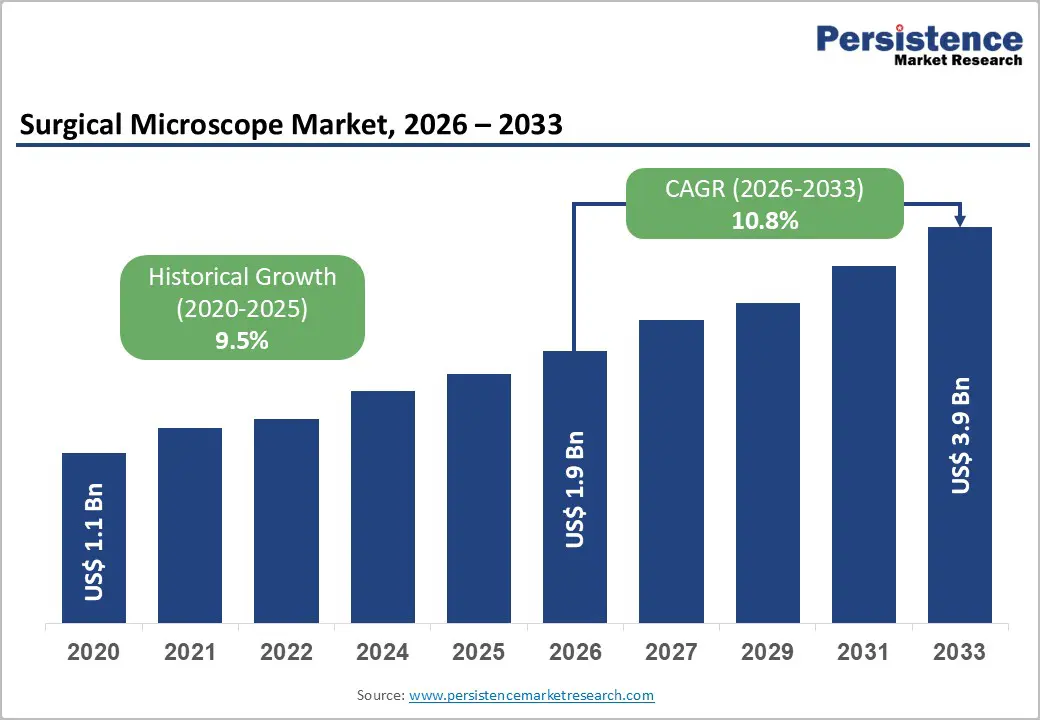
The global surgical microscope market size is likely to be valued at US$ 1.9 billion in 2026, and is projected to reach US$ 3.9 billion by 2033, growing at a CAGR of 10.8% during the forecast period 2026–2033. Procedure volumes are increasing across specialties as surgeons are relying on high-precision optical systems to perform complex interventions. Hospitals are upgrading operating theaters with advanced surgical visualization technologies to improve accuracy, depth perception, and intraoperative control. Capital investments in infrastructure modernization are strengthening procurement activity and are supporting long-term equipment adoption strategies.
Manufacturers are integrating digital imaging modules and 3D visualization capabilities to enhance workflow efficiency and surgical ergonomics. The rising prevalence of neurological and ophthalmic disorders is expanding the clinical base for microscope-assisted procedures. Regulatory authorities are encouraging minimally invasive surgery by streamlining evaluation pathways and reinforcing quality standards. Replacement demand sustains recurring revenue as installed systems enter upgrade cycles, while clinical applications are extending into reconstructive, dental, and spinal procedures.
Key Industry Highlights
- Technology Landscape: Digital surgical microscopes are expected to account for approximately 41% of the market in 2026, whereas 3D visualization microscopes are projected to grow the fastest through 2033, driven by their ergonomic advantages.
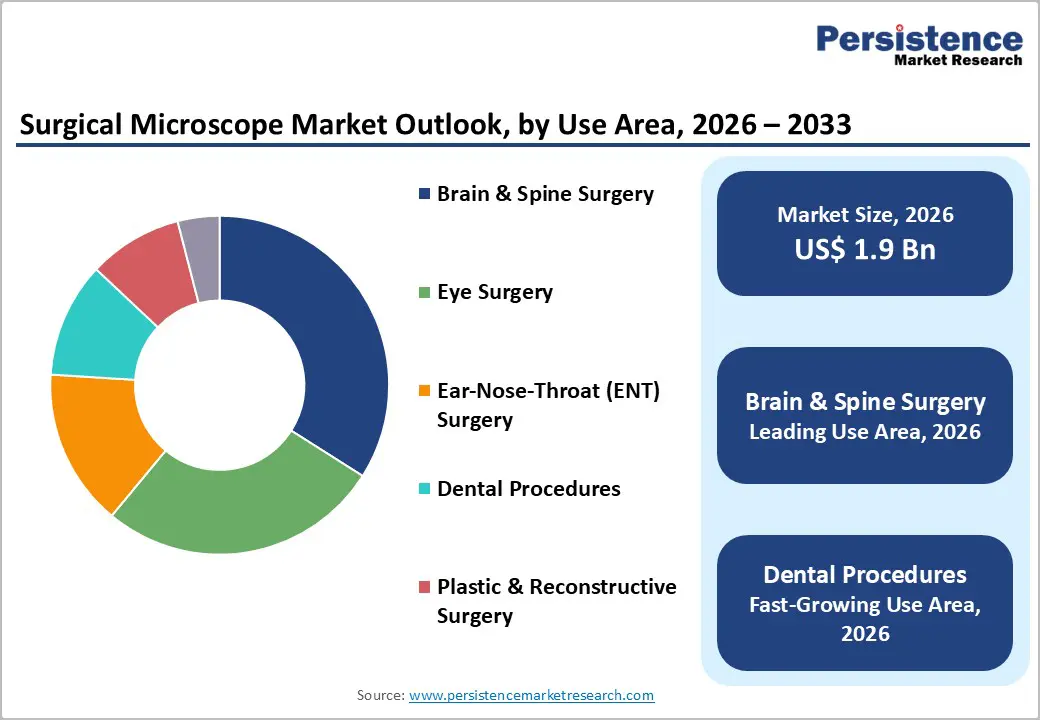
- Application Dynamics: Brain and spine surgeries are set to account for nearly 34% of demand in 2026, while dental procedures are likely to register a 2026-2033 CAGR of 13.1%, supported by the rising adoption of magnification-assisted techniques.
- End-Use Trends: Hospitals are anticipated to dominate, with approximately 52% revenue share in 2026, whereas ambulatory surgery centers (ASCs) are expected to expand at the fastest pace through 2033 as outpatient surgical volumes increase.
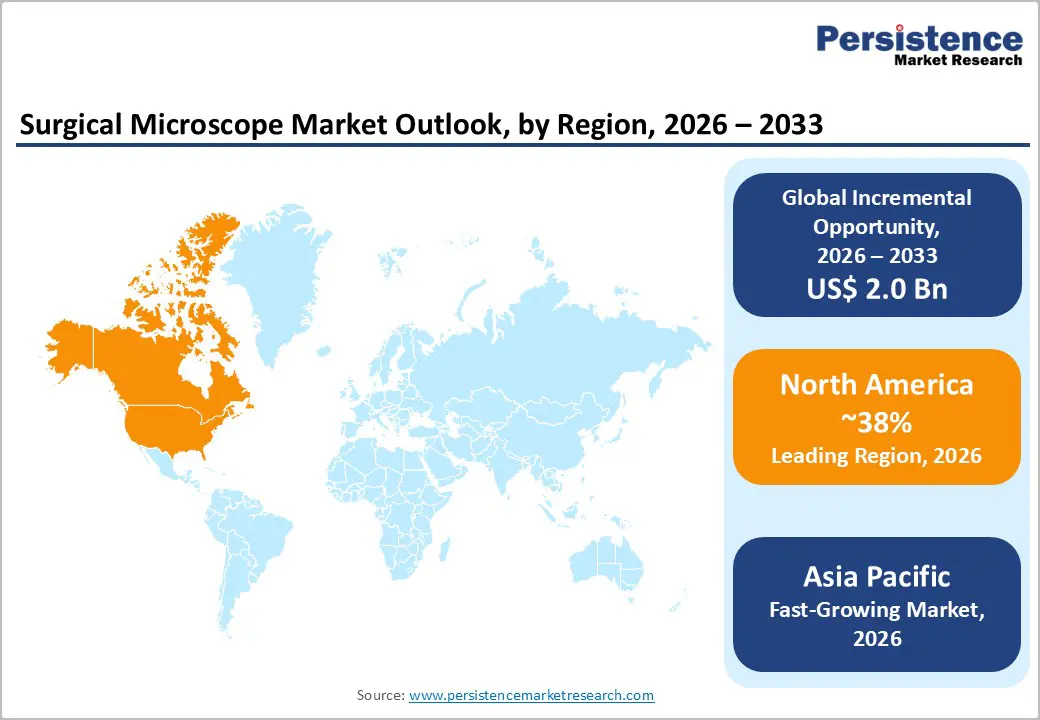
- Regional Performance: North America is projected to command around 38% market share in 2026, while Asia Pacific is slated to be the fastest-growing market about 13.5% CAGR through 2033, owing to hospital infrastructure expansion in China, India, and ASEAN markets.
| Global Market Attributes | Key Insights |
|---|---|
| Surgical Microscope Market Size (2026E) | US$ 1.9 Bn |
| Market Value Forecast (2033F) | US$ 3.9 Bn |
| Projected Growth (CAGR 2026 to 2033) | 10.8% |
| Historical Market Growth (CAGR 2020 to 2025) | 9.5% |
Market Factors – Growth, Barriers, and Opportunity Analysis
Expansion of Precision-Driven Surgical Procedures Enabled by Advanced Visualization
The steady increase in complex and minimally invasive surgical procedures is a primary driver of surgical microscope market growth. According to the World Health Organization (WHO), more than 310 million major surgeries are performed each year worldwide, with neurosurgery, ophthalmology, ear-nose-throat (ENT), and spinal procedures showing the highest dependence on surgical microscopes for accuracy and safety. Aging populations in North America, Europe, Japan, and China are driving higher incidence of neurological, ocular, and degenerative disorders, which require enhanced visual precision during surgery. Clinical findings published by the U.S. National Institutes of Health (NIH) consistently show that microscope-assisted procedures reduce complication rates and improve surgical outcomes. These measurable benefits strongly support hospital purchasing decisions and justify continued investment in advanced visualization systems.
The sustained investment in healthcare infrastructure is accelerating the adoption of surgical microscopes across both mature and developing healthcare systems. Healthcare spending in advanced economies regularly exceeds 9–11% of GDP, with a growing portion directed toward high-performance medical equipment that improves operating room efficiency and patient outcomes. In emerging markets, national health programs in India, China, and ASEAN countries are expanding tertiary hospitals and specialty surgical centers, increasing overall surgical capacity. The incorporation of digital imaging, fluorescence-assisted visualization, and 3D depth perception into modern microscopes further improves surgeon efficiency, reduces physical strain, and shortens procedure duration. Higher surgical volumes and infrastructure expansion are collectively creating a durable and sustained demand environment for operating room microscopes across multiple clinical specialties.
Financial, Regulatory, and Operational Barriers to Adoption
The high cost of surgical microscopes remains a major barrier to wider adoption in healthcare settings. Advanced digital and robot-assisted systems often cost several hundred thousand U.S. dollars per unit, making procurement difficult for smaller hospitals, specialty clinics, and publicly funded facilities with limited budgets. According to the WHO, health expenditure per capita varies widely: low- and middle-income countries spend under US$100 per person annually, whereas high-income countries spend over US$10,000 per person annually, reflecting disparities in access to health care. High acquisition costs lead many institutions to delay purchases or extend the use of older equipment. Limited reimbursement for procedures using advanced microscopes also reduces financial incentives for upgrades, slowing overall adoption.
Regulatory requirements and workforce readiness add further challenges. Approval processes for sophisticated microscopes require detailed clinical validation and can take extended periods through agencies such as the U.S. Food and Drug Administration (FDA) and European authorities. Advanced systems also require specialized surgeon training, yet many surgical programs lack dedicated modules for digital and 3D visualization tools, creating a skills gap. Maintenance, calibration, and limited service infrastructure in certain regions can further restrict adoption. Operational complexity, combined with financial and regulatory barriers, slows the uptake of advanced surgical microscopes despite increasing clinical demand for precise surgical guidance.
Technological Integration Advancing Precision and Clinical Success
A major opportunity in the surgical microscope market lies in integrating advanced technologies to enhance surgical precision, workflow efficiency, and patient outcomes. Modern systems increasingly combine robotic assistance, artificial intelligence, augmented reality, intraoperative imaging, and 3D digital visualization. Newer innovations, such as microscopes with 48 tiny cameras for ultra-precise 3D imaging, improve depth perception and spatial awareness during complex procedures. These technologies allow surgeons to focus on critical tasks, reduce cognitive load, and perform procedures with greater accuracy and efficiency.
Real-world applications demonstrate the clinical impact of these advances. Fluorescence imaging supports real-time tissue differentiation and blood flow assessment, reducing postoperative complications and improving tumor margin identification. Integration with robotics and advanced imaging, including MRI or 3D tractography, has enhanced targeting accuracy and shortened operative times in neurosurgical procedures. These innovations demonstrate that advanced surgical microscopes not only improve visualization but also yield measurable improvements in outcomes in precision-dependent specialties such as neurosurgery, ophthalmology, and reconstructive surgery.
Category-wise Analysis
Technology Insights
Conventional optical microscopes are projected to remain the largest installed segment, accounting for approximately 38% of total installations in 2026. These systems are widely considered reliable, cost-effective, and familiar to surgical teams in routine neurosurgical, ophthalmic, and ENT procedures. Their deployment is estimated to continue in public and secondary care centers with tighter budgets and established workflows. For instance, it has been reported that the Carl Zeiss OPMI Vario S8 surgical microscope was installed at Sir Sayajirao Gaekwad Hospital in India, likely enhancing precision in minimally invasive spine and orthopaedic surgeries. This suggests sustained confidence in optical platforms where advanced digital features may be less critical. Adoption is estimated to persist where training resources and capital budgets remain limited.
3D visualization microscopes are projected to be the fastest-growing technology segment, with an approximate 12.6% CAGR through 2033. These platforms are expected to enhance depth perception and operator comfort, improving outcomes in complex procedures. A notable innovation is the FiLM-Scope, developed by researchers at Duke University, which reportedly uses 48 tiny cameras to provide ultra-precise, real-time 3D imaging for operating room use, enabling detailed surface mapping and adjustable perspectives. These enhancements are expected to support both manual and robot-assisted procedures, making digital and 3D systems attractive to advanced surgical centers seeking improved precision and visualization.
Application Insights
Brain and spine surgeries are expected to dominate in 2026, accounting for approximately 34% of the surgical microscope market revenue, owing to the critical need for precise visualization in neurological procedures. Surgical microscopes are essential for navigating deep operative fields with high optical clarity and control. Townsville University Hospital in Queensland, Australia, reported the use of an advanced neurological microscope in more than 100 brain and spine surgeries, improving tumour boundary delineation and surgical accuracy. This example highlights the importance of high-end visualization in complex neurosurgical workflows. Sustained reliance in this segment reflects entrenched clinical practices and the direct link between optical precision and patient outcomes. Growth is supported by rising surgical volumes and the adoption of minimally invasive techniques. Advanced microscopes also enable training and workflow standardization in tertiary care centers.
Dental procedures are likely to be the fastest-growing application area, with a projected 13.1% CAGR through 2033, driven by magnification-assisted and minimally invasive techniques. Outpatient dental and specialty clinics increasingly adopt microscopes to improve procedural accuracy in endodontic, periodontal, and implant workflows. Studies from the United States and the United Kingdom have reported that dental operating microscopes enhance ergonomics and visualization, thereby improving treatment outcomes in precision dentistry. Adoption is strongest in outpatient and specialty clinics, where efficiency and patient satisfaction influence investment decisions. The trend reflects broader acceptance of advanced imaging tools outside traditional hospitals. Use of the microscope in dental microsurgery is expected to continue to grow alongside technological integration. Advanced visualization supports both procedural quality and clinical training.
End-User Insights
Hospitals are expected to remain the largest end-users with around 52% of the surgical microscope market share in 2026, driven by high surgical volumes, advanced infrastructure, and capital availability for both conventional and advanced surgical microscopes. These systems are used across neurosurgery, ophthalmology, ENT, and reconstructive procedures where precision visualization is critical. St. David’s Georgetown Hospital in Texas completed an operating room expansion, enhancing capabilities for minimally invasive surgery and supporting advanced imaging integration. This demonstrates hospitals’ role as anchor adopters of cutting-edge surgical technologies. Investments also facilitate training and workflow standardization. Adoption is strongest in tertiary care centers performing complex surgeries. Multimodal imaging integration further enhances surgical precision and outcomes.
Ambulatory surgery centers and specialty clinics are projected to be the fastest-growing end users, with a 2026-2033 CAGR of 12.4%, attributable to rising outpatient surgical volumes and the availability of compact, high-performance microscopes. The Innovations Surgery Center in Maryland became the first ambulatory center in its region to offer robotic-assisted gynecologic surgery, demonstrating integration of advanced visualization in outpatient settings. These centers benefit from minimally invasive workflows, improved ergonomics, and shorter procedure times. Adoption is increasing as reimbursement reforms expand outpatient care. Investment in surgical imaging and navigation complements the use of microscopes. The trend reflects broader adoption of technology beyond traditional hospitals. Outpatient and specialty clinics are becoming key growth drivers in the microscope market.
Regional Insights
North America Surgical Microscope Market Trends
North America is poised to hold the largest market share at around 41% in 2026, supported by high surgical volumes, advanced infrastructure, and early adoption of precision technologies. Hospitals and surgical centers are integrating robotics, real-time imaging, and digital workflows to enhance procedural accuracy. Dell Children’s Medical Center in Texas installed an intraoperative MRI suite, allowing real-time imaging in pediatric neurosurgery and reducing complication rates. These investments improve surgeon efficiency, facilitate minimally invasive procedures, and support high-acuity specialties such as neurosurgery and ophthalmology. Reimbursement frameworks and regulatory clarity encourage the adoption of advanced visualization tools. Teaching hospitals emphasize resident training in new technologies. Hospitals also invest in hybrid ORs combining robotics and imaging.
Healthcare providers are also prioritizing training and collaborative programs that accelerate technology adoption. IRCAD North America opened a surgical training institute in Charlotte, focusing on robotic and minimally invasive procedures for hundreds of surgeons. This prepares surgeons for advanced OR workflows and enhances the adoption of microscopes with integrated imaging. Hospitals are upgrading surgical suites with cloud-enabled and AI-assisted tools to improve patient outcomes and OR efficiency. Investments extend beyond tertiary hospitals into specialty centers and outpatient departments. Advanced visualization supports precise navigation in complex surgeries, with digital integration and surgeon training together ensuring North America's dominant position in this market.
Europe Surgical Microscope Market Trends
In Europe, the market for surgical microscopes is driven by technologically advanced hospitals and public healthcare systems in Germany, the U.K., France, and Spain, with OR modernization incorporating imaging, navigation, and digital tools to enhance precision in complex surgeries. Surgeons at a Swedish hospital completed neurosurgical procedures using AR-enhanced digital visualization, improving tissue differentiation and procedural accuracy. Harmonization under the European Union (EU) Medical Device Regulation (MDR) has ensured consistent quality and safety, boosting clinician confidence. Hospitals prioritize efficiency and outcomes while adopting microscopes for neurosurgery, ophthalmology, and ENT procedures. Academic centers support skill development in advanced imaging. Legacy optical microscopes are gradually being replaced with digital and hybrid platforms. These factors maintain a steady demand for high-precision visualization tools.
Outpatient clinics and specialty centers are increasingly adopting compact digital microscopes for minimally invasive procedures. In the Netherlands, several clinics upgraded to digital systems, improving accuracy and ergonomics in endoscopic and microsurgical workflows. Cloud-enabled OR management tools enhance workflow coordination and interdepartmental communication. Multi-center training programs promote familiarity with advanced imaging solutions. Investments in high-precision microscopes align with patient safety and surgical efficiency goals. Hospitals and clinics leverage hybrid and digital visualization platforms to optimize outcomes. These developments reinforce Europe’s position as a stable and innovative regional market.
Asia Pacific Surgical Microscope Market Trends
Asia-Pacific is projected to be the fastest-growing regional market for surgical microscopes, with a CAGR of 13.5% between 2026 and 2033, driven by rapid hospital expansion, rising surgical volumes, and technology adoption in China, Japan, South Korea, and the ASEAN countries. Hospitals are integrating AI-assisted visualization, real-time imaging, and digital workflow platforms to improve surgical precision. Regional surgical innovation exhibitions highlighted AI-powered operating room solutions and 3D imaging systems, emphasizing enhanced visualization and workflow optimization. These investments increase access to precision-guided surgeries, improve patient outcomes, and support training. Urban tertiary hospitals implement integrated OR solutions for neurosurgery, ophthalmology, and orthopedics. Government-backed infrastructure projects and private sector funding accelerate the adoption of advanced microscopes. Academic partnerships further enhance technology transfer and workforce readiness.
Asia Pacific hospitals and specialty centers are adopting immersive training and simulation technologies to prepare surgeons for high-precision procedures. AR/VR-based surgical planning programs were piloted in metropolitan centers in Japan and South Korea to improve intraoperative visualization and preoperative decision-making. This ensures that surgeons are proficient in handling advanced imaging and integrating microscopes. Private healthcare facilities and urban hospitals are increasingly installing digital and robotic-assisted OR platforms. Rising middle-class populations and increasing surgical demand support regional growth. Infrastructure expansion in emerging cities strengthens access to high-quality surgical care.
Competitive Landscape
The global surgical microscope market structure is moderately consolidated, with leading players such as Carl Zeiss Meditec, Leica Microsystems, Topcon Medical Systems, and Nikon Corporation controlling a significant portion of revenue. These companies leverage long-standing relationships with hospitals, academic centers, and training institutions, alongside regulatory expertise and integrated hardware-software imaging platforms. Heavy investment in R&D allows them to lead in advanced visualization technologies, including 3D imaging, fluorescence-guided surgery, digital integration, and AI-assisted workflows, ensuring high adoption across specialty surgeries and tertiary hospitals.
Regional and niche competitors, such as Olympus Surgical and Haag-Streit, focus on local markets and cost-efficient or compact solutions for outpatient and dental procedures. High capital costs, regulatory approval, and specialized training limit new entrants, but the rise of digital ORs, robotic-assisted platforms, and cloud-enabled visualization is creating openings for innovative firms. Market consolidation is expected to continue as leading players expand geographically, form technology partnerships, and integrate emerging imaging and AI technologies.
Key Industry Developments
- In February 2026, at the 41st Asia-Pacific Academy of Ophthalmology conference in Hong Kong, ZEISS presented its ARTEVO 750 and 850 microscopes, featuring 3D visualization, smart depth of field, and full integration into digital surgical workflows. MediWorks debuted the SM660 ophthalmic microscope with a non-contact wide-angle fundus viewing system, while Oertli Instruments launched its OS 4 Up surgical platform in the region.
- In October 2025, MediView XR closed a US$ 24 million Series A round led by GE HealthCare to expand its FDA-cleared AR platform, which merges 3D CT scans with live ultrasound to allow surgeons to visualize anatomy through the skin. The technology is designed to improve minimally invasive procedures by enhancing 3D visualization while reducing radiation exposure.
- In June 2025, Ocutrx Technologies introduced HemoLucence™, a revolutionary system integrated into its OR-Bot™ 3D Surgical Microscope. The technology leverages AI algorithms and computational physics to render blood virtually transparent, enabling surgeons to see underlying nerves, vessels, and tumors without suction or irrigation.
Companies Covered in Surgical Microscope Market
- Carl Zeiss Meditec AG
- Leica Microsystems
- Olympus Corporation
- Topcon Corporation
- Haag-Streit Group
- Takagi Seiko Co., Ltd.
- Seiler Instrument Inc.
- Alltion
- ARRI Medical
- Alcon
- Global Surgical Corporation
- Medtronic
Frequently Asked Questions
The global surgical microscope market is projected to reach US$ 1.9 billion in 2026.
Market growth is driven by increasing complex and minimally invasive surgeries, adoption of advanced imaging technologies, and expanding healthcare infrastructure.
The market is poised to witness a CAGR of 10.8% from 2026 to 2033.
Key opportunities include integration with robotic systems, AI and AR visualization, and rising adoption in outpatient and dental surgical settings.
Carl Zeiss Meditec, Leica Microsystems, Topcon Medical Systems, Nikon Corporation, Olympus Surgical, and Haag-Streit are some of the top players in the market.


