




- Chemicals and Materials
- Superior Kerosene Oil Market
Superior Kerosene Oil Market Size, Share, Growth, and Regional Forecast, 2026 to 2033
Superior Kerosene Oil Market by Product Type (White or Light Kerosene, Heavy Kerosene, Aviation Kerosene (Jet Fuel), Industrial Kerosene, Others), Application (Aviation Fuel , Household Heating, Lighting , Industrial Heating and Processes, Cooking Fuel, Marine Fuel, Others), End-Use Industry (Residential / Households, Commercial , Industrial / Manufacturing, Agriculture, Others), Distribution Channel (Direct Sales, Retail Outlets, Others), and Regional Analysis from 2026 to 2033

Superior Kerosene Oil Market and Trends Analysis
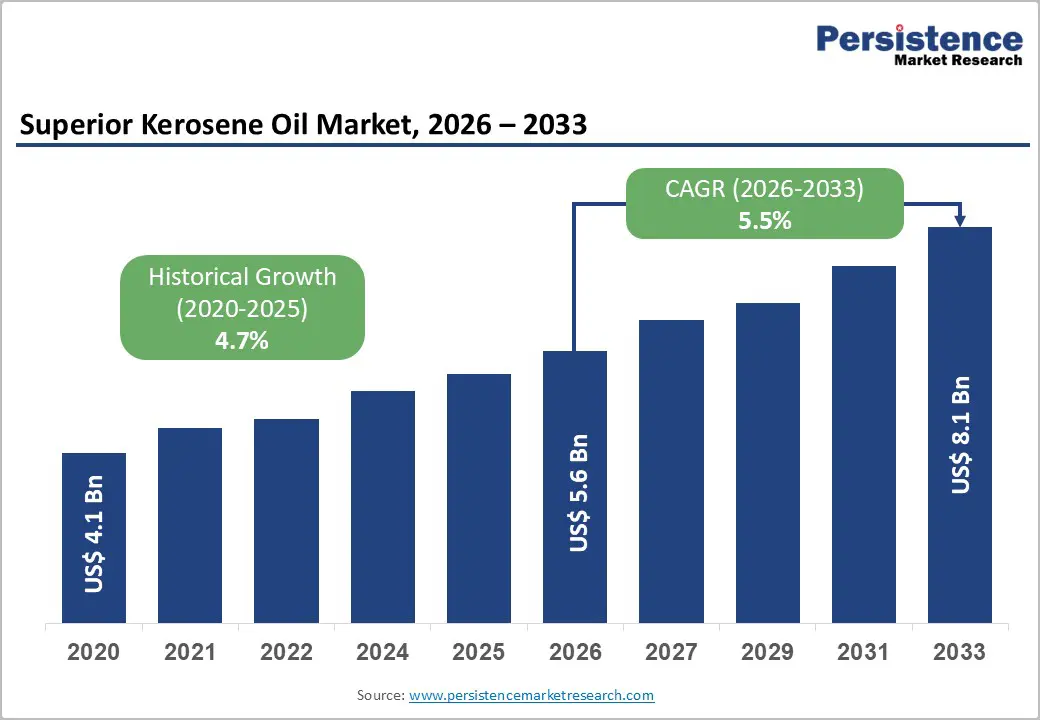
The global Superior Kerosene Oil Market is estimated to grow from US$ 5.6 Bn in 2026 to US$ 8.1 Bn by 2033. The market is projected to record a CAGR of 5.5% during the forecast period from 2026 to 2033.
The Superior Kerosene Oil (SKO) market is growing steadily, driven by rising household energy demand, expanding industrial use, and increasing aviation fuel consumption. Asia Pacific leads the market due to high consumption in residential heating, cooking, and industrial applications, and it also shows the fastest growth, fueled by rapid urbanization, expanding air travel, industrialization, and broader distribution networks. North America and Europe maintain steady demand, mainly from aviation and industrial sectors, whereas Latin America and the Middle East & Africa are emerging markets with growing industrial and household usage.
Key Industry Highlights
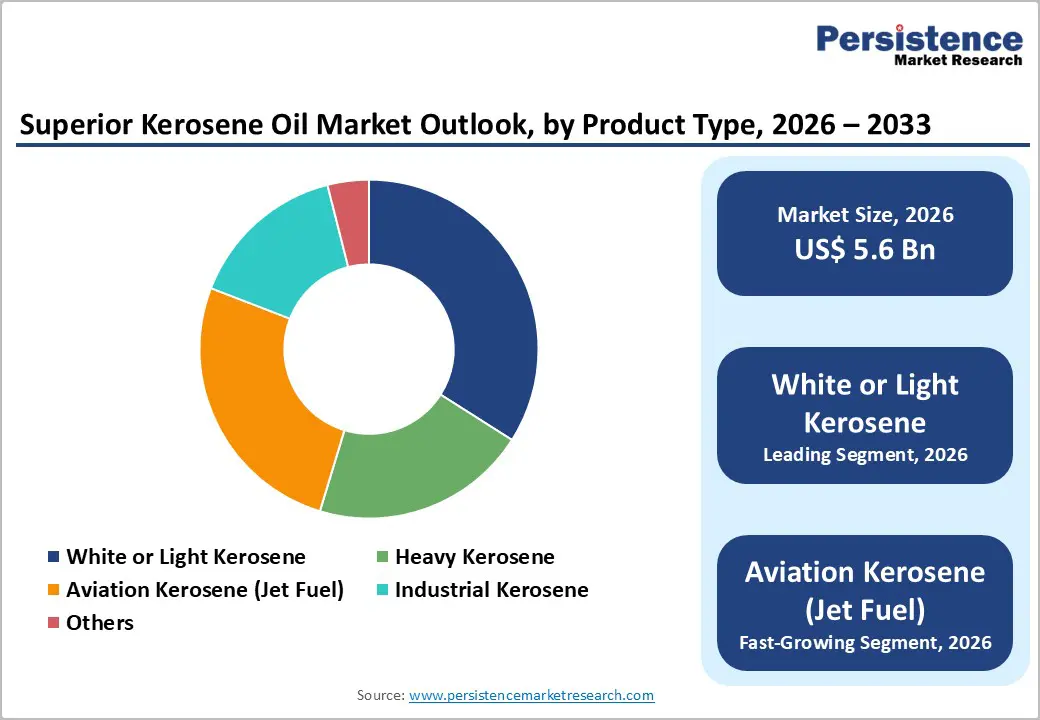
- Dominant Segment: White or light kerosene holds the largest share in 2025 at 34.0%, driven by its widespread use in household heating, lighting, and general-purpose applications. Its versatility and reliability make it the preferred choice across residential and small-scale industrial applications.
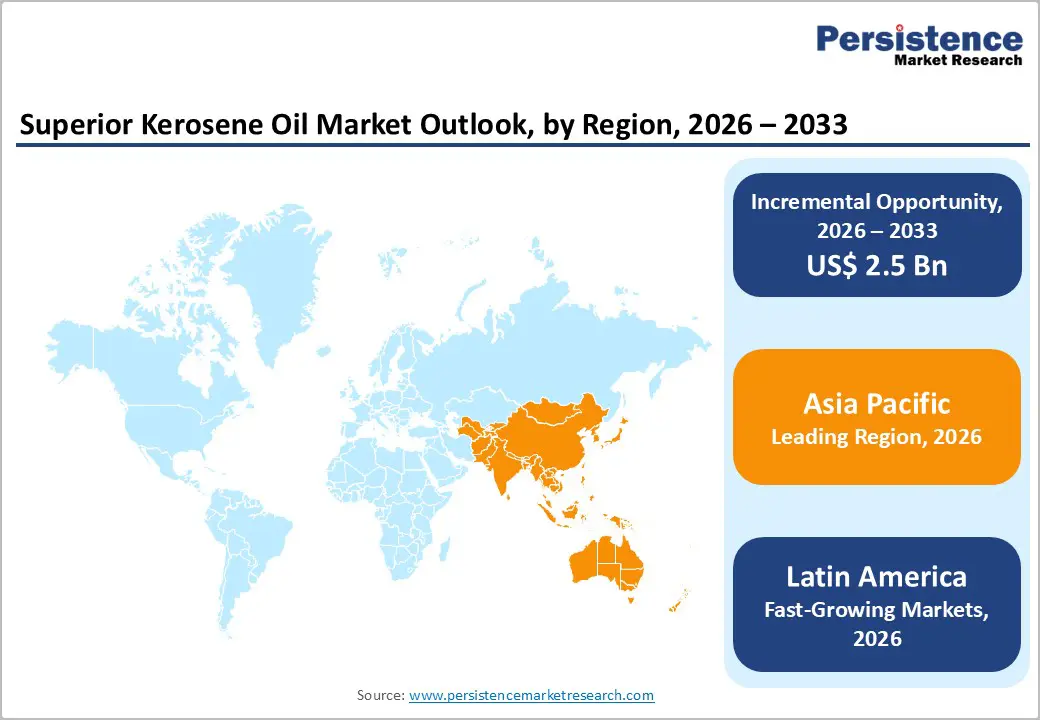
- Dominant Region: Asia Pacific holds the largest share in 2025, supported by high household consumption, growing industrial use, and expanding aviation fuel demand. North America and Europe maintain steady demand primarily from the aviation and industrial sectors, while the Asia Pacific region remains the fastest-growing region due to rapid urbanization, increasing air travel, industrialization, and improved distribution networks.
- Market Drivers: Growth is fueled by rising energy demand in residential, industrial, and aviation sectors, expanding air travel, increasing industrialization, and the need for reliable, accessible, and affordable fuel sources.
- Market Opportunity: Key opportunities include cleaner and low-sulfur kerosene variants, expanding aviation and industrial fuel applications, growth in emerging markets, increasing distribution via modern retail and e-commerce channels, and innovations in fuel quality, packaging, and application efficiency.
| Global Market Attributes | Key Insights |
|---|---|
| Superior Kerosene Oil Market Size (2026E) | US$ 5.6 Bn |
| Market Value Forecast (2033F) | US$ 8.1 Bn |
| Projected Growth (CAGR 2026 to 2033) | 5.5% |
| Historical Market Growth (CAGR 2020 to 2025) | 4.7% |
Market Dynamics
Driver – Rising Household Energy Demand
Household energy demand has historically been a significant driver of kerosene consumption, particularly in developing economies where access to modern energy sources has lagged. For example, in India—the world’s third-largest petroleum consumer—over 163 million households reportedly use kerosene for lighting and cooking, with rural households accounting for more than 82% of kerosene users. Average monthly consumption among rural kerosene-using households is approximately 3.4 litres for lighting and cooking, while urban households consume 5.3 litres per month, indicating sustained residential reliance. This broad household use underscores how kerosene has remained entrenched as a vital energy source in regions still transitioning to cleaner alternatives.
Despite a long-term declining trend in total kerosene consumption in some markets—such as in India, where kerosene use has contracted at a ~26 percent CAGR from 2013–14 to 2022–23 due to fuel substitution policies—the sheer scale of current household use illustrates its continued importance in energy portfolios. Households in rural and peri-urban areas frequently depend on kerosene for essential services, especially for lighting, where access to reliable electricity may be limited. This persistent residential demand supports the broader Superior Kerosene Oil market by maintaining a baseline level of kerosene consumption, even as cleaner fuels gradually gain market share.
Restraints – Shift to Cleaner Alternatives
The growing adoption of cleaner energy sources such as LPG, piped natural gas (PNG), electricity, and solar power is reducing household demand for traditional kerosene. In India, the Ministry of Petroleum and Natural Gas (MoPNG) reports that kerosene allocation under the Public Distribution System fell from 2.45 million tonnes in 2015–16 to 1.12 million tonnes in 2022–23, reflecting a shift toward cleaner fuels supported by schemes such as Pradhan Mantri Ujjwala Yojana (PMUY), which has provided over 90 million LPG connections to rural households. This widespread adoption of LPG and electricity for cooking and lighting directly limits kerosene use, acting as a key market restraint.
Similarly, in Nigeria, kerosene consumption has decreased significantly due to the expansion of electricity access and LPG promotion programs. The Nigerian National Bureau of Statistics (NBS) indicates kerosene use in urban households dropped from 810,000 kilolitres in 2018 to 520,000 kilolitres in 2023, while LPG consumption grew steadily at a CAGR of 8.3% over the same period. Rising awareness of cleaner and safer energy alternatives, along with government incentives for LPG adoption, continues to restrain kerosene demand, particularly in urban and peri-urban households, creating long-term structural challenges for the Superior Kerosene Oil market.
Opportunity – Development of Low-Sulfur & Deodorized Kerosene
The development of low-sulfur kerosene presents a significant opportunity for the Superior Kerosene Oil market by aligning product quality with environmental and health regulations. In the United States, kerosene used in regulated contexts must meet stringent sulfur content standards; for example, EPA regulations require that kerosene blended into fuels subject to a 15 parts-per-million (ppm) sulfur standard comply with that low sulfur level to reduce emissions and improve air quality. This reflects an ongoing regulatory emphasis on low-sulfur fuels across markets, encouraging refiners and distributors to invest in cleaner, lower-sulfur kerosene products that can meet evolving standards and access broader applications.
Similarly, industry and standards bodies define low-sulfur kerosene grades to support cleaner combustion and reduced pollutant output. For instance, the ASTM D3699 specification identifies “1-K” grade kerosene designed to be a low-sulfur fuel suitable for indoor and outdoor applications; such specification targets reduced sulfur (typically no more than 0.04% by mass) compared with traditional grades. This creates an opportunity for market expansion as consumers, industrial users, and government entities increasingly favour fuels with lower emissions footprints to comply with air quality and health guidelines. By prioritising the production of low-sulfur and deodorized kerosene, refiners can capture demand from segments seeking cleaner-burning fuels, including residential, commercial, and specialty industrial applications.
Category-wise Analysis
By Product Type, White or Light Kerosene Dominates the Superior Kerosene Oil Market
White or Light Kerosene occupies 34.0% share of the global market in 2025, because it is the most versatile and widely used kerosene grade, meeting key household and industrial needs. Globally, kerosene consumption exceeds 5.5 million barrels per day, with a large share attributable to residential heating, lighting, and cooking, particularly in regions lacking reliable electricity or LPG access. In India, over 163 million households still rely on kerosene for domestic purposes, while rural and semi-urban areas in Africa and Asia continue to use it extensively. Its low cost, easy storage, and established distribution networks make it preferable to heavier kerosene types. Additionally, light kerosene is used in small-scale industries and as aviation fuel feedstock, reinforcing its dominance in the SKO market.
By Application, Aviation Fuel is gaining traction due to high-performance jet fuel demand, expanding air travel, and limited alternatives
Aviation fuel dominates the Superior Kerosene Oil market because aviation kerosene (Jet A-1) is one of the largest end uses of refined kerosene products globally, driven by the scale of commercial and military air transport. Kerosene-based jet fuel accounted for a substantial share of global petroleum demand, representing approximately 8% of total oil consumption worldwide, underscoring the critical role of aviation in energy markets. Aviation kerosene is preferred for its performance at high altitudes and in cold temperatures, and for its reliability on long-haul flights. The rapid growth of passenger air travel — with over 5 billion passengers flying in 2024 — and the expansion of airline fleets continue to sustain high demand for jet fuel. As airlines recover capacity and expand routes, kerosene-based aviation fuel remains a dominant application segment in the SKO market, supported by the absence of scalable alternatives to replace kerosene in large commercial aircraft in the near term.
Regional Insights
Asia Pacific Superior Kerosene Oil Market Trends
Asia Pacific dominates the Superior Kerosene Oil Market with 40.2% share in 2025, because many countries in the region still rely on kerosene and petroleum products for both basic energy needs and industrial activity. A United Nations report notes that nearly one billion people in the Asia Pacific continue to depend on polluting fuels such as kerosene for cooking and household energy, particularly in rural and peri-urban areas.urban areas where clean cooking access remains limited. This sustained use for daily energy needs supports broad kerosene demand. At the same time, Asia Pacific accounts for significant kerosene consumption in aviation and industrial applications, with large populations, expanding air travel, and extensive energy infrastructure driving overall petroleum product use in the region.
Europe Superior Kerosene Oil Market Trends
Europe is an important region in the Superior Kerosene Oil market because it remains a significant producer and consumer of kerosene-type fuels, particularly for aviation. Refineries in the European Union produced around 31.3 million metric tons of kerosene and jet-fuel type products in 2023, underscoring the scale of regional refining activity. Much of this output supports aviation demand, with countries such as Spain, France, the United Kingdom, Germany and Italy among the top consumers of kerosene-type jet fuel in domestic and international flights, reflecting the continued role of kerosene in air transport energy. At the same time, Europe is shaping the future of kerosene use through policies like ReFuelEU Aviation, which requires increasing shares of sustainable aviation fuels blended with conventional kerosene at EU airports, indicating the region’s influence on kerosene markets even as cleaner alternatives are introduced.
North America Superior Kerosene Oil Market Trends
Is North America one of the fastest-growing regions in the Superior Kerosene Oil market, largely because kerosene-type aviation fuel remains a major energy consumption category and regional air travel continues to expand In the United States, kerosene-type jet fuel accounted for about 10% of total U.S. liquid fuels consumption in 2023, reflecting strong underlying demand from commercial, general aviation, and military sectors. Meanwhile, data show that U.S. jet fuel consumption averaged around 1.65 million barrels per day in 2023, with commercial aviation comprising the bulk of this use, indicating a robust aviation activity that supports kerosene demand. The presence of one of the world’s largest and busiest air transport networks in North America sustains ongoing kerosene consumption even as the region explores cleaner alternatives.
Market Competitive Landscape
Leading companies in the Superior Kerosene Oil market focus on quality, safety, and efficiency, developing low-sulfur and deodorized kerosene for residential, industrial, and aviation use. Investments in R&D improve fuel performance, storage, and combustion efficiency, while partnerships with governments and energy agencies enhance credibility, ensuring reliability and sustained adoption, driving growth and innovation across the global SKO market.
Key Industry Developments:
- In August 2025, ConocoPhillips sold its Anadarko assets for $1.3 billion, reporting profits that exceeded analysts’ estimates. The transaction involved the transfer of Anadarko’s oil and gas holdings, strengthening ConocoPhillips’ financial position and streamlining its portfolio. The company highlighted that the sale contributed positively to its quarterly earnings, reflecting strategic asset management and favorable market conditions in the energy sector.
- In November 2024, ConocoPhillips completed its acquisition of Marathon Oil Corporation, finalizing the merger of the two energy companies. The acquisition combined their oil and gas assets, aiming to enhance operational efficiency, expand resource portfolios, and strengthen market presence.
Companies Covered in Superior Kerosene Oil Market
- ConocoPhillips
- Hindustan Petroleum Corporation Limited (HPCL)
- Rosneft Oil Company
- Valero Energy Corporation
- Lukoil
- Chevron Corporation
- Petronas
- Royal Dutch Shell plc
- Saudi Arabian Oil Co. (Saudi Aramco)
- BP plc
- Indian Oil Corporation Limited
- Qatar Petroleum
- TotalEnergies SE
- Phillips 66
- Marathon Petroleum Corporation
- ExxonMobil Corporation
- Kuwait Petroleum Corporation
- Petrobras
- China National Petroleum Corporation (CNPC)
- Gazprom Neft PJSC
- Others
Frequently Asked Questions
The global Superior Kerosene Oil Market is projected to be valued at US$ 5.6 Bn in 2026.
Rising household energy demand, industrial use, aviation fuel growth, urbanization, and reliable, accessible kerosene supply.
The global Superior Kerosene Oil Market is poised to witness a CAGR of 5.5% between 2026 and 2033.
Low-sulfur and deodorized kerosene, emerging markets, aviation expansion, industrial applications, modern distribution, and fuel innovation opportunities.
ConocoPhillips, Hindustan Petroleum Corporation Limited (HPCL), Rosneft Oil Company, Valero Energy Corporation, Lukoil, Chevron Corporation.


