




- Specialty & Fine Chemicals
- Sodium Propionate Market
Sodium Propionate Market Size, Share, and Growth Forecast 2026 - 2033
Sodium Propionate Market by Grade (Food, Pharmaceutical, Industrial), Application (Food & Beverage, Animal Feed, Pharmaceutical, Industrial & Chemical, Other), and Regional Analysis for 2026 - 2033

Sodium Propionate Market Size and Trend Analysis
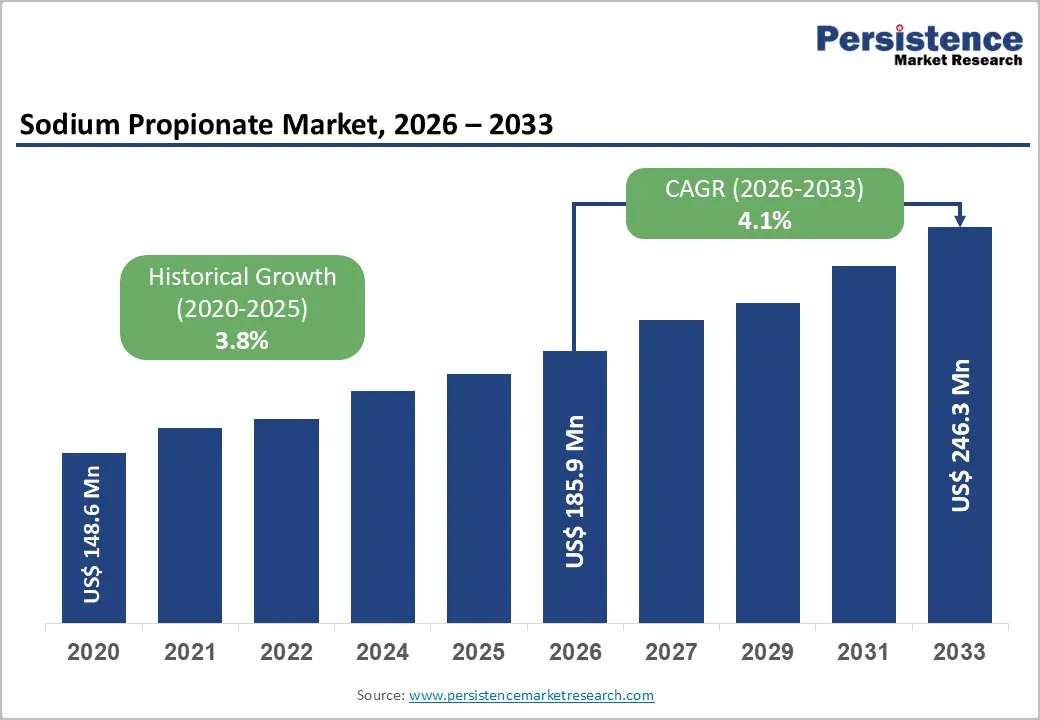
The global sodium propionate market size is supposed to be valued at US$ 185.9 million in 2026 and is projected to reach US$ 246.3 million by 2033, growing at a CAGR of 4.1% between 2026 and 2033. The expansion is primarily driven by rise in consumer demand for shelf-stable and convenience foods, particularly within the bakery and processed food sectors, where sodium propionate serves as an effective mold inhibitor and antimicrobial preservative.
According to the Food and Agriculture Organization (FAO), global wheat production reached approximately 787 million tons in 2024, establishing a substantial end-use base for propionate preservatives across commercial and industrial bakeries worldwide. Furthermore, Sodium propionate's GRAS (Generally Recognized as Safe) status, granted by the U.S. Food and Drug Administration (FDA) and approved by the European Food Safety Authority (EFSA) as food additive E 281, has reinforced its acceptance across food and beverage applications globally.
Key Industry Highlights:
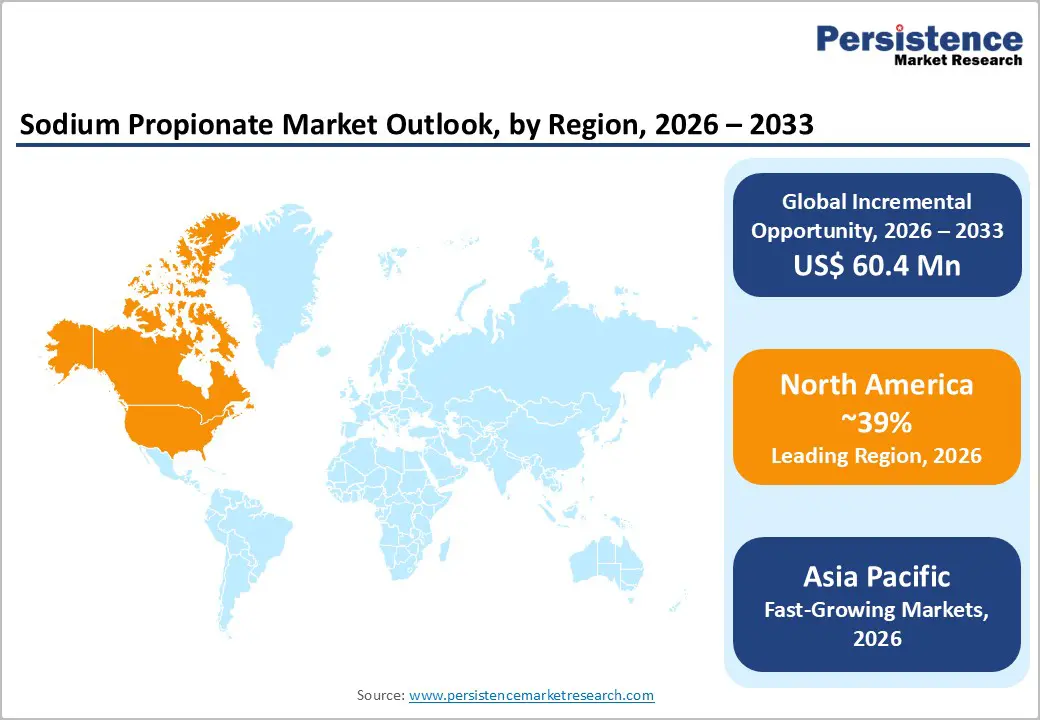
- Regional Leader: North America dominates regional market leadership, commanding approximately 39% of the global sodium propionate market value, driven by established FDA GRAS approval, robust bakery and processed meat industries valued at USD 45.7 billion annually, and stringent food safety compliance frameworks supporting sustained demand.
- Fastest Growing Region: Asia Pacific represents the fastest-growing regional market, with China and India expansion accelerating following regulatory approvals in April 2025 and ongoing pharmaceutical sector growth at 9.43% CAGR, creating substantial penetration opportunities among emerging food processing sectors.
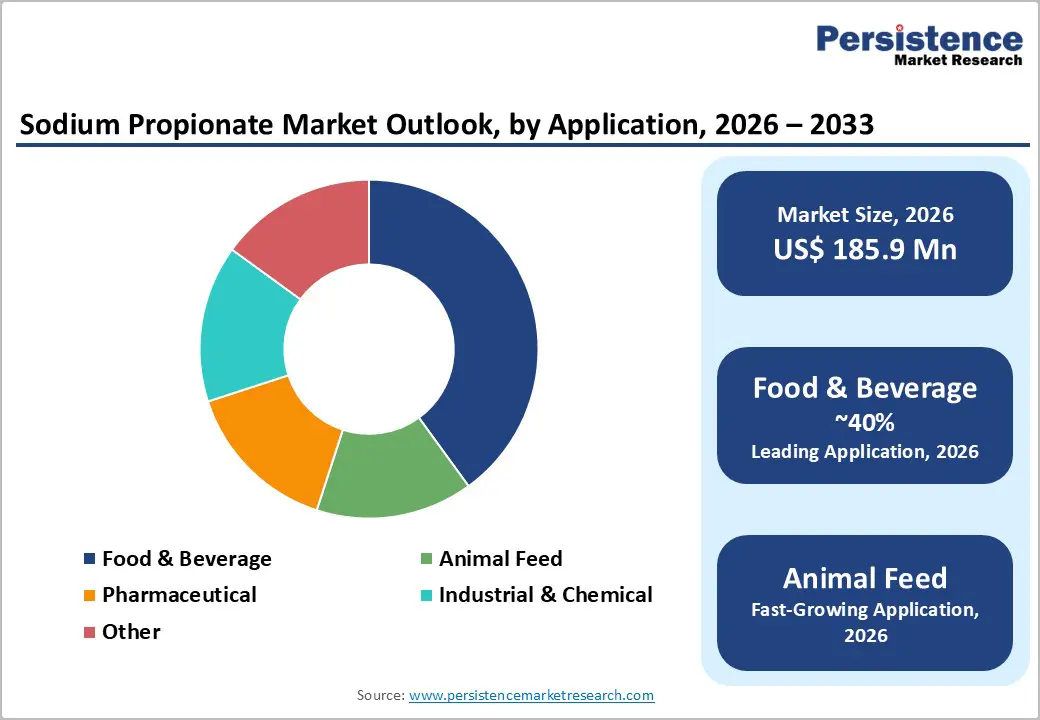
- Leading Segment: Food & Beverage remains the dominant application segment, with bakery and confectionery products accounting for over 40% of total sodium propionate consumption, supported by the expanding global bakery market.
- Fastest Growing Segment: Animal Feed emerges as the fastest-growing application category, driven by aquaculture intensification, scientific validation of sodium propionate efficacy, and regulatory approval across terrestrial animal species.
- Key Market Opportunities: Pharmaceutical and nutraceutical applications represent high-growth opportunity segments, with sodium propionate's FDA GRAS status and pharmaceutical-grade availability enabling expanded adoption across oral and topical formulations.
| Key Insights | Details |
|---|---|
| Sodium Propionate Size (2026E) | US$ 185.9 Mn |
| Market Value Forecast (2033F) | US$ 246.3 Mn |
| Projected Growth CAGR (2026 - 2033) | 4.1% |
| Historical Market Growth (2020 - 2025) | 3.8% |
Market Dynamics
Drivers - Rising Demand for Convenience and Packaged Food Products
The global transition toward rapid urbanization and increasingly fast-paced lifestyles has substantially heightened demand for ready-to-eat and shelf-stable food products. The expanding bakery sector, one of the largest processed food categories worldwide, continues to drive the use of sodium propionate across commercial bakeries, frozen food manufacturers, and processed meat producers.
Classified under 21 CFR Part 172 as a direct food additive without specific usage limits beyond good manufacturing practices, sodium propionate offers manufacturers considerable formulation flexibility. Its proven efficacy in inhibiting molds and yeasts at standardized application levels enhances product shelf life without affecting sensory quality. Increasing regulatory emphasis on transparent labeling, particularly from FSSAI and EU Regulation (EC) 1333/2008, further supports its adoption as a preferred preservative in time-sensitive food production environments.
Expansion of Animal Feed and Aquaculture Applications
The animal feed industry has emerged as the fastest-growing application segment for sodium propionate, driven by the need for extended feed shelf life and enhanced nutritional stability. Peer-reviewed studies confirm its effectiveness as a mold inhibitor and antimicrobial agent in aquaculture, improving growth performance and immune function in farmed fish species. Recent studies indicate that dietary supplementation with 0.4% to 0.6% sodium propionate optimizes hepatic lipid metabolism, antioxidant capacity, and stress resistance in species including spotted seabass and rainbow trout.
The European Commission approved the use of sodium propionate as a feed additive for all terrestrial animals in October 2025, reinforcing regulatory confidence in its safety profile and creating substantial consumption opportunities in livestock and poultry nutrition. The European Food Safety Authority (EFSA) established maximum safe levels of 10,000 mg/kg complete feed for poultry and 30,000 mg/kg complete feed for pigs, enabling commercial-scale adoption across major livestock producers worldwide.
Restraints - Price Volatility and Raw Material Supply Constraints
Sodium propionate manufacturing depends on consistent availability of propionic acid and sodium hydroxide, commodities subject to significant price fluctuations linked to crude oil markets and global supply chain disruptions. Raw material cost instability directly impacts producer profitability and pricing power, particularly among small-to-medium-sized manufacturers who lack economies of scale for cost absorption. Regional manufacturers in China and India, who dominate synthetic feed additives with 55.8% market share, benefit from economies of scale, creating pricing pressures for smaller specialized producers.
Economic uncertainties and supply chain disruptions periodically constrain raw material availability, forcing producers to adjust pricing strategies that may impact market penetration in price-sensitive applications. These constraints particularly affect manufacturers in cost-sensitive emerging markets where price competition remains the primary competitive lever, thereby limiting their ability to implement quality upgrades or invest in capacity expansion.
Regulatory Compliance Complexity and Demand for Natural Alternatives
Manufacturers are increasingly challenged by stringent regulatory frameworks across diverse jurisdictions, with agencies such as the U.S. FDA, EFSA, and regulators in emerging markets enforcing distinct approval pathways and usage limitations. The EFSA currently permits sodium propionate (E281) in bakery and cheese products at a maximum level of 3,000 mg/kg, while the European Commission imposes species-specific restrictions for silage applications.
Furthermore, consumer demand has shifted toward clean-label and natural preservation systems, creating significant headwinds for synthetic additives. Surveys indicate that nearly 60% of consumers in North America and Europe prefer products with reduced artificial preservatives, prompting manufacturers to explore alternatives such as rosemary extract, citric acid, and fermentation-derived compounds. Despite favorable regulatory status, rising preference for preservative-free products and emerging natural technologies intensify competition and elevate compliance complexity and costs.
Opportunities - Pharmaceutical and Nutraceutical Application Expansion
The pharmaceutical sector offers a significantly high-margin opportunity for sodium propionate suppliers, supported by its FDA GRAS (Generally Recognized as Safe) status for antimicrobial and flavoring applications. According to the India Brand Equity Foundation, India’s pharmaceutical industry, ranked third globally in production volume, has grown at a CAGR of 9.43% over the past nine years and is projected to reach USD 130 billion by 2030, with potential expansion to USD 450 billion by 2047.
Sodium propionate serves as a pharmaceutical-grade preservative in oral and topical formulations, ensuring microbial inhibition and chemical stability throughout shelf life. Furthermore, its role extends to nutraceuticals and dietary supplements, functioning as both a preservative and a contributor to gastrointestinal health via short-chain fatty acid generation. Increasing demand for USP, BP, and EP-compliant products creates opportunities for suppliers offering certified, traceable, and documentation-supported solutions.
Southeast Asian Market Expansion Driven by Aquaculture Intensification
Thailand is projected to experience the fastest regional growth at a CAGR of 4.5%, supported by government initiatives aimed at positioning the country as Southeast Asia’s aquaculture hub. These measures include tax exemptions on precision-nutrition imports and accelerated depreciation schedules to encourage feed mill modernization. Strategic partnerships between global leaders such as Cargill, Inc. and DSM-Firmenich AG with local manufacturers are enabling rapid integration of functional additives, including sodium propionate, across aquaculture value chains.
Indonesia’s aquaculture industry is increasingly adopting crystalline amino acid supplementation to reduce nitrogen excretion by 30% while maintaining optimal fish growth, creating complementary demand for antimicrobial preservatives that safeguard feed integrity during storage. With China and India among the largest food producers, expanding processed food manufacturing and modern retail infrastructure further drive sustained demand for food-grade sodium propionate across diverse applications.
Category-wise Analysis
Grade Insights
The food-grade segment holds a dominant position in the global sodium propionate market, accounting for approximately 72% of total market share in 2024. Classified as GRAS by the U.S. Food and Drug Administration for use as an antimicrobial and flavoring agent, sodium propionate enjoys strong regulatory acceptance, fostering widespread utilization. In bakery applications, it is typically incorporated at 0.2% to 0.5% of flour weight, effectively inhibiting mold and extending shelf life from several days to multiple weeks.
The European Food Safety Authority authorizes its use (E281) in bakery and cheese products up to 3,000 mg/kg, with ongoing evaluations for meat and processed fish at levels up to 5,000 mg/kg. Manufacturers prioritize food-grade variants due to stringent purity standards under the Food Chemicals Codex and 21 CFR Part 172, ensuring consistent performance without compromising product quality.
Application Insights
The food & beverage segment represents the largest application area for sodium propionate, accounting for approximately 65% of global consumption. Within this category, bakery and confectionery products dominate, contributing over 40% of total usage. Manufacturers typically incorporate sodium propionate at 0.5% of flour weight to inhibit mold growth and extend shelf life. Dairy products, particularly processed cheese and butter spreads, form the second-largest subsegment, where sodium propionate ensures microbial stability for extended retail periods.
The animal feed application segment exhibits the fastest growth trajectory, propelled by intensifying livestock and aquaculture production across the Asia-Pacific regions. This expansion is driven by rising poultry production, aquaculture intensification, and regulatory approvals for silage additives. Scientific research confirms that dietary inclusion of 0.4-0.6% sodium propionate enhances growth performance and immune function in farmed aquatic species, creating new commercial opportunities.
Regional Insights
North America Sodium Propionate Market Trends
North America holds the largest share of the global sodium propionate market, driven by strong demand from the U.S. food and beverage sector. Sodium propionate enjoys regulatory approval as a GRAS (Generally Recognized as Safe) preservative under FDA guidelines for key categories such as bakery products, processed meats, cheese, and dairy spreads. The regulatory framework codified in 21 CFR Part 172 establishes clear guidelines for food preservatives, requiring transparent labeling that lists preservatives by common name alongside their specific antimicrobial function.
Leading North American manufacturers, including Niacet Corporation, have expanded production capacity by 25% to meet escalating demand for propionate-based preservatives, reflecting robust market fundamentals. Canada represents a significant sub-market where Health Canada authorizes sodium propionate under its List of Permitted Preservatives for bakery, cheese, and processed foods, subject to good manufacturing practices. Regulatory alignment between the U.S. FDA and Health Canada facilitates seamless cross-border operations, supporting supply chain efficiency and market consolidation among major ingredient suppliers.
Europe Sodium Propionate Market Trends
Europe represents a mature and highly regulated market for sodium propionate, characterized by well-established frameworks and standardized usage conditions across the European Union, the United Kingdom, and associated countries. The European Food Safety Authority (EFSA) authorizes sodium propionate (E281) under Regulation (EC) 1333/2008 for use as an antimicrobial agent in bakery and cheese products at levels up to 3,000 mg/kg.
Furthermore, the European Commission’s October 2025 decision extended its approval as a feed additive for all terrestrial animals, reinforcing regulatory confidence and supporting market growth. Germany and France lead regional consumption, driven by traditional bakery production, extensive cheese manufacturing, and strict compliance with EU food safety directives. The United Kingdom maintains alignment through retained EU law, while Spain and Italy remain significant markets, particularly in bakery and dairy-intensive production zones where sodium propionate is the preferred mold inhibitor.
Asia Pacific Sodium Propionate Market Trends
Asia Pacific is projected to be the fastest-growing regional market for sodium propionate, with growth rates surpassing those of historically developed markets. China represents the largest opportunity in the region following the National Health Commission’s approval of sodium propionate as a food additive in April 2025, which eliminated longstanding regulatory barriers. Chinese consumers increasingly prefer natural food additives over synthetic alternatives, driving reformulation activities that favor sodium propionate's clean-label positioning.
India's market expansion reflects governmental initiatives promoting natural and minimally processed food products through the Ministry of Food Processing Industries, complemented by FSSAI regulations mandating clear labeling on pre-packaged foods. India ranks as the second-largest market opportunity, driven by rapid pharmaceutical sector expansion at a 9.43% CAGR and processed food industry growth of 7% annually. Indian manufacturers increasingly adopt sodium propionate to meet stringent Food Safety and Standards Authority of India (FSSAI) regulations governing preservative usage and shelf-life claims.
Competitive Landscape
The global sodium propionate market is moderately to highly fragmented, with leadership distributed among specialized chemical manufacturers, multinational food ingredient suppliers, and regionally focused producers concentrated in Asia and North America. Competitive dynamics emphasize differentiation strategies centered on regulatory compliance, product purity, documentation support, and customer service rather than price competition. Leading suppliers maintain multiple facility certifications, enabling participation in supply chains with stringent quality assurance requirements. This market structure creates opportunities for strategic consolidation, particularly among mid-sized manufacturers lacking economies of scale or regulatory capabilities to sustain competitiveness amid rising compliance demands.
Key Market Developments
- April 2025: China's National Health Commission approved sodium propionate as a new food additive, representing a major regulatory milestone enabling widespread adoption across the nation's food processing industry and eliminating decades-long barriers to market penetration.
- October 2025: The European Commission extended the approved use of sodium propionate and propionates as feed additives for all terrestrial animal species, reinforcing regulatory confidence and supporting sustained market expansion across livestock nutrition applications within the EU.
- October 2023: Niacet Corporation, a leading propionate manufacturer, announced a significant expansion of its production capacity for propionate-based products to meet increasing global demand across food preservation and animal feed applications, representing approximately 25% capacity increase.
Top Companies in the Sodium Propionate Market
- Niacet Corporation (Niagara Falls, U.S.) maintains a market leadership position supported by an established manufacturing infrastructure producing specialty metal-organic acid salt products, including sodium propionate formulated to FDA GRAS specifications. The company supplies food, pharmaceutical, and industrial customers globally, with a significant market share in North American bakery and animal feed applications.
- Foodchem International Corporation (Shanghai, China) operates as a major global supplier of sodium propionate and complementary food additives, leveraging HACCP and ISO certifications to serve international food manufacturers. The company supplies food-grade sodium propionate powder (E281) in bulk quantities with typical shipment volumes of 18 MT per 20' FCL container, serving bakery producers, processed food manufacturers, and animal feed producers across multiple continents and export markets spanning Asia Pacific, Europe, and North America.
- Prathista Industries Ltd. (India) manufactures pharmaceutical-grade and food-grade sodium propionate utilizing proprietary fermentation technology, positioning the company as a preferred supplier for clean-label preservative solutions and animal feed supplements. The company's expanded manufacturing capacity and sustainability-focused product development address growing demand for certified food-grade additives among Indian and regional manufacturers seeking to comply with national food safety regulations and export market requirements aligned with FSSAI and international standards.
Companies Covered in Sodium Propionate Market
- Niacet Corporation
- Macco Organiques Inc.
- Prathista Industries Ltd.
- Fine Organics Industries Pvt. Ltd.
- Dr. Paul Lohmann GmbH & Co. KGaA
- Foodchem International Corporation
- Tengzhou Tenglong Chemical Co., Ltd.
- Qingdao Dawei Biological Engineering Co., Ltd.
- Lianyungang Shuren Kechuang Food Additive Co., Ltd.
- Shanghai Huamei Food Additives
- Titan Biotech Limited
Frequently Asked Questions
The global sodium propionate market is valued at US$ 185.9 Mn in 2026 and is projected to reach US$ 246.3 Mn by 2033, expanding at a CAGR of 4.1% during the forecast period, driven by increasing bakery applications and animal feed demand.
The sodium propionate market is driven by escalating consumer demand for convenience and shelf-stable food products, urbanization trends in developing markets, and increasing adoption in animal feed applications for mold inhibition and antimicrobial efficacy.
The Food & Beverage segment commands the largest application share at 65% of total consumption, with bakery and confectionery products accounting for over 40% of total market consumption, supported by the growing global bakery products market.
North America commands the largest regional market share at approximately 39% of global sodium propionate value, supported by established FDA GRAS approval and stringent food safety compliance frameworks.
Pharmaceutical and antimicrobial applications present significant untapped opportunities through sodium propionate's demonstrated efficacy against MRSA and E. coli, anti-inflammatory properties for dermatological formulations, high-purity specialty grades for medical applications, and commercial launches of pharmaceutical-grade variants validating market viability.
Major market participants include Niacet Corporation, Prathista Industries Ltd., Dr. Paul Lohmann GmbH & Co. KGaA, Macco Organiques Inc., Fine Organics Industries Pvt. Ltd., Foodchem International Corporation, Titan Biotech Limited, and several specialized chemical manufacturers across North America, Europe, and the Asia-Pacific regions.


