




- Non-food Packaging
- Packaging Tensioner Market
Packaging Tensioner Market Size, Share, and Growth Forecast 2026 - 2033
Packaging Tensioner Market by Product Type (Manual Tensioners, Pneumatic Tensioners, Battery-powered Tensioners), by Strap Type (Steel Straps, Polypropylene (PP) Straps, Polyester (PET) Straps), by Application (Logistics & Warehousing, Food & Beverage, Consumer Goods, Industrial Packaging), by End-user (Manufacturing, Transportation & Logistics, E-commerce, Retail, Others), by Regional Analysis, 2026 - 2033

Packaging Tensioner Market Size and Trend Analysis
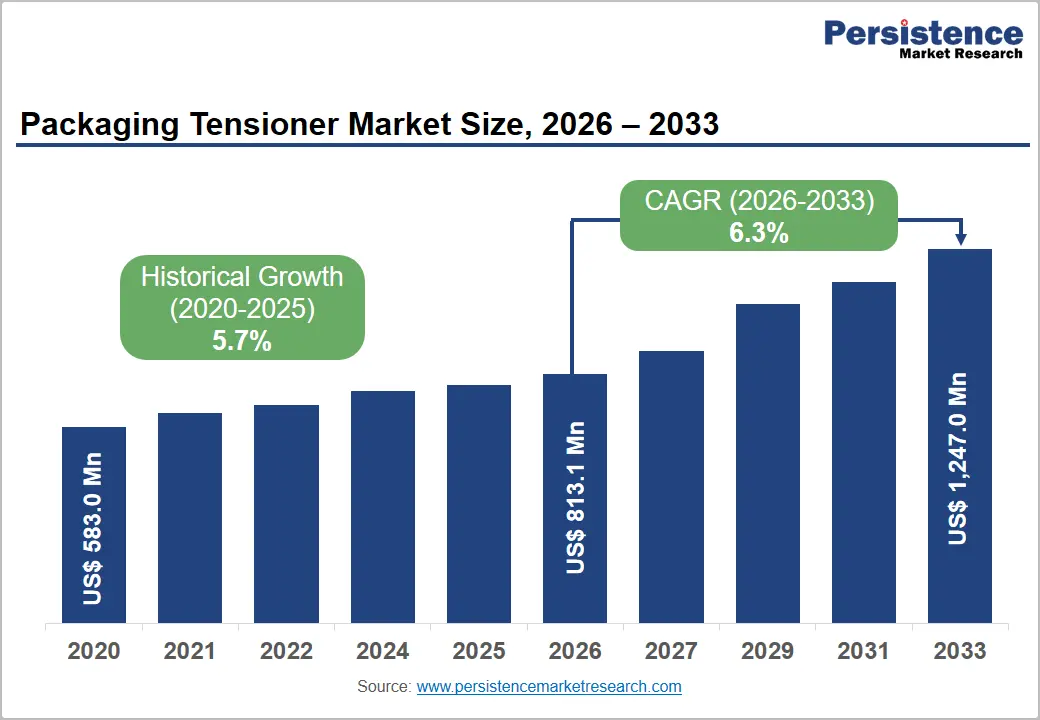
The global packaging tensioner market is expected to be valued at US$ 813.1 million in 2026 and projected to reach US$ 1,247.0 million, expanding at a CAGR of 6.3%. Growth is anchored in rising cross-border freight, where secure load-containment depends on properly tensioned straps.
The World Trade Organization (WTO) projects merchandise trade volumes to grow by 2.7% in 2026, lifting global pallet and bundle shipments. Concurrent manufacturing automation, with the International Federation of Robotics (IFR) recording 4.28 million industrial robots in operation, is accelerating the uptake of pneumatic and battery-powered tensioners across end-of-line packaging workflows worldwide.
Key Market Highlights
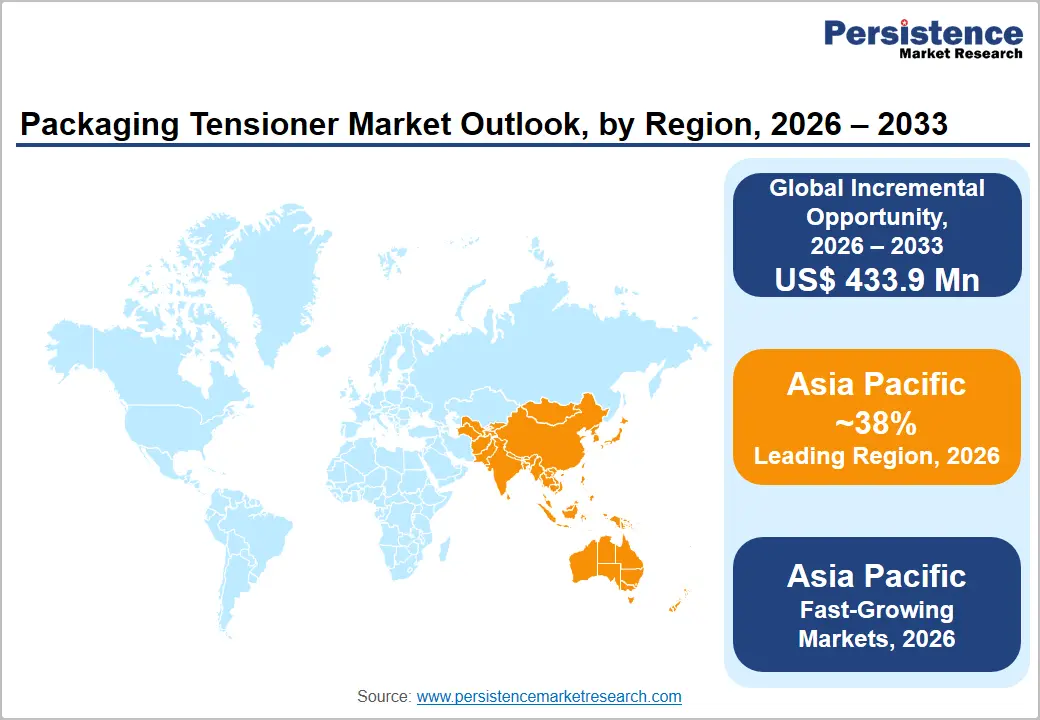
- Leading Region: Asia Pacific is likely to dominate with approximately 38% global share in 2026, anchored by China's manufacturing scale and expanding intra-regional logistics flows.
- Fast-Growing Market: Asia Pacific also leads growth at a 7.2% CAGR, propelled by India's manufacturing push and Southeast Asia's electronics exports.
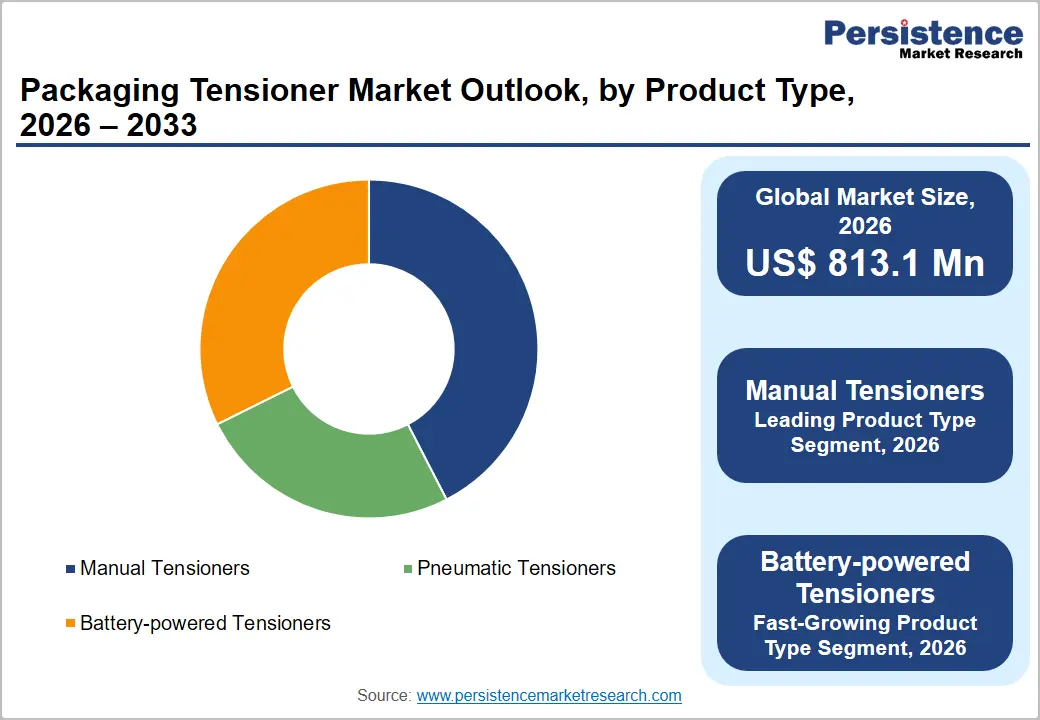
- Dominant Segment: Pneumatic tensioners lead the product-type category with around 42% share in 2026, driven by deployments in heavy-duty industrial packaging lines.
- Fast-Growing Segment: Battery-powered tensioners expand at roughly 7.5% CAGR, fueled by warehouse automation and Industry 4.0 integration trends globally.
- Key Opportunity: Sustainable PET-strap-compatible smart tensioners with Bluetooth diagnostics offer strong growth potential aligned with global circular-packaging commitments.
Market Dynamics
Drivers - Surging E-commerce Parcel Volumes Boost Strapping Tool Demand Globally
The accelerated rise of online retail is intensifying the need for reliable strapping and tensioning solutions across distribution hubs. According to the Universal Postal Union (UPU), global parcel volume surpassed 161 billion items in 2023, with double-digit growth in cross-border flows, pushing warehouses to scale up handling capacity with manual and battery-powered tensioners that reliably secure bundles of corrugated cartons, polybags, and palletized goods.
The U.S. Census Bureau reported that retail e-commerce sales reached US$1.19 trillion in 2024, an 8.1% year-over-year increase. This momentum directly translates into greater demand for portable tensioning equipment optimized for high-throughput packing lines and last-mile staging operations, as fulfillment centers expand sortation throughput and prioritize fast, secure outbound load consolidation.
Workplace Safety Standards Drive Shift to Powered Tensioning Tools
Stringent occupational safety regulations are accelerating the transition from manual to powered tensioning tools across packaging operations. The U.S. Bureau of Labor Statistics recorded 2.6 million nonfatal workplace injuries in private industry during 2023, with overexertion ranking among the most common incidents in material handling, prompting employers to invest in automated tension-and-seal equipment that reduces repetitive-strain exposure on packing line operators.
The European Agency for Safety and Health at Work (EU-OSHA) estimates musculoskeletal disorders cost EU economies up to 2% of GDP annually. Battery-powered and pneumatic tensioners improve compliance with OSHA ergonomic standards, encouraging employers to adopt ergonomically designed tools that lower handle force, shorten cycle times, and reduce absenteeism across high-volume packaging environments worldwide.
Restraints - Volatile Lithium, Steel, and Polymer Input Costs Pressure Margins
Fluctuating prices of lithium-ion cells, steel, and engineering polymers continue to weigh on tensioner manufacturers and downstream equipment buyers. The International Energy Agency (IEA) reported lithium prices rising more than 400% between 2021 and 2022 before easing, creating significant input cost volatility for battery-powered tensioner production and complicating long-term contract pricing across original equipment manufacturers worldwide.
Concurrently, steel rebar prices remain 15-20% above pre-pandemic averages according to World Bank commodity tracking, inflating costs for steel-strap-compatible tensioner production lines. These swings often erode manufacturers' margins or push higher list prices, delaying capital purchase decisions among small- and mid-sized packagers and slowing fleet upgrades and replacement cycles across emerging market geographies.
Substitution by Stretch Film and Adhesive Sealing Solutions
Some end-user segments are migrating from strap-based bundling to stretch wrapping and adhesive sealing, particularly for lightweight consumer goods. According to PlasticsEurope, demand for stretch films grew 6% annually in 2023-2024, supported by reusable pallet wrap initiatives and the growing adoption of automated stretch wrappers at distribution centers that handle fast-moving consumer goods, electronic accessories, and apparel-grade palletization.
This trend partially substitutes traditional strap-and-tensioner workflows, particularly in food and beverage logistics where film offers visibility, tamper resistance, and full-pallet protection from dust and moisture. The shift restrains growth in unit demand for tensioning equipment in select downstream packaging lines, especially among emerging e-grocery, beverage distribution, and last-mile retail replenishment operations across mature consumer markets.
Opportunities - Smart Battery-powered Tensioners Enable Industry 4.0 Packaging Integration
Battery-powered tensioners equipped with Bluetooth connectivity and digital cycle counters are emerging as a high-growth opportunity for tool manufacturers. According to the International Federation of Robotics (IFR), annual installations of industrial robots reached 541,000 units in 2023, with packaging and palletizing among the fastest-growing applications, creating natural pull-through demand for smart tensioners that integrate with robotic cells and conveyor-based packaging architectures.
Smart tensioners that log strap tension data, seal integrity, and operator IDs increasingly feature in Industry 4.0 cells to support traceability and predictive maintenance. The German Engineering Federation (VDMA) reports that packaging machinery exports grew by 5.3% in 2024, signaling strong demand for digital-ready tools among European OEMs, automated logistics providers, and contract packagers seeking premiumization opportunities.
Recyclable PET Strap Adoption Opens Sustainable Tensioner Growth Lane
The shift to polyester (PET) straps made with recycled content offers a structural growth lane for tensioner manufacturers. The Ellen MacArthur Foundation notes that more than 1,000 companies have committed to circular packaging targets by 2025, accelerating adoption of recyclable monomaterials and pushing procurement teams toward strap formats that align with corporate sustainability disclosures and extended producer responsibility frameworks across mature consumer goods markets.
PET straps deliver up to 85% of steel strap break strength at a fraction of the weight, pairing best with battery-powered or pneumatic tensioners calibrated for elastic memory. The U.S. Environmental Protection Agency (EPA) reports PET has the highest recycling rate among rigid plastics nationally, validating the material's sustainability narrative for tensioner manufacturers targeting food, beverage, and e-commerce buyers.
Category-wise Analysis
Product Type Insights
Pneumatic tensioners account for the leading position in the product type category, capturing roughly a 42% share in 2026. Their dominance stems from widespread deployment across heavy-duty industrial packaging lines where consistent high-tension cycles on steel and PET straps are essential. The U.S. Bureau of Labor Statistics records that manufacturing employment surpassed 12.9 million workers in 2024, supporting a large installed base of pneumatic infrastructure that powers these tools efficiently across operations.
Battery-powered tensioners represent the fastest-growing sub-segment, driven by accelerating warehouse automation and rising ergonomic compliance mandates across distribution networks. The International Federation of Robotics (IFR) reports record global industrial robot deployments, reinforcing demand for cordless tools that integrate with mobile packing cells. Brand owners increasingly prefer battery-powered units for their portability, low maintenance, and seamless interface with Industry 4.0 packaging environments across e-commerce, retail, and manufacturing operations.
Strap Type Insights
Polypropylene (PP) straps lead the strap-type category with approximately 45% revenue share in 2026, owing to their lightweight profile, cost-effectiveness, and suitability for light-to-medium-duty bundling. According to PlasticsEurope, global polypropylene production exceeded 80 million tonnes in 2023, underscoring abundant raw material availability that keeps PP strap prices competitive. PP-compatible manual and battery-powered tensioners dominate small-package, e-commerce, and retail-replenishment applications worldwide.
Polyester (PET) straps represent the fastest-growing sub-segment, driven by replacement of steel in moderate-load shipments, superior elastic recovery, and rising sustainability commitments among brand owners. The Ellen MacArthur Foundation highlights growing corporate pledges to recyclable monomaterial packaging, propelling PET adoption across distribution lines. Tensioners calibrated for PET's elastic memory characteristics are gaining traction in food, beverage, and consumer electronics packaging, where lightweighting and circularity goals continue to reshape procurement strategies globally.
Application Insights
Logistics & warehousing is the leading application segment, accounting for nearly 38% of demand in 2026. According to the World Bank Logistics Performance Index 2023, global logistics scores improved steadily, with cross-docking and distribution-center automation driving adoption of tensioners upward. Tensioners are critical for pallet load securement, container loading, and bundle palletization at fulfillment hubs that handle sortation, outbound consolidation, and high-velocity throughput across regional distribution networks.
Food & beverage is the fastest-growing application segment, propelled by expanding cold-chain shipments, rising beverage pallet volumes, and stringent tamper-evident packaging requirements. The International Air Transport Association (IATA) reported that air cargo demand rose 11.3% in 2024, much of it perishables, while sea freight beverage volumes continue to recover. Tensioners are increasingly used to secure bottle bundles, canned goods, and refrigerated case loads across processing plants, breweries, and dairy distribution centers worldwide.
End-user Insights
The manufacturing end-user segment leads the market with around 35% revenue contribution in 2025, anchored by widespread deployment of tensioners across automotive, metals, building products, and industrial machinery factories. According to UNCTAD, global manufacturing value added reached US$16.2 trillion in 2023, with Asia accounting for over half. Manufacturing plants rely on pneumatic and battery-powered tensioners to secure heavy palletized output, steel-strapped coils, and bundled component shipments.
The e-commerce end-user category is the fastest-growing sub-segment, fueled by rapid expansion of online retail, last-mile fulfillment, and high-velocity pick-pack-ship operations. The U.S. Census Bureau indicates e-commerce represented 16.2% of total U.S. retail sales in Q4 2024, signaling strong forward demand for portable, battery-powered tensioners. Operators favor cordless tools for their ergonomic profile, fast cycle times, and compatibility with mobile packing stations across regional fulfillment networks globally.
Regional Insights
North America Packaging Tensioner Market Trends and Insights
North America holds nearly 22% of the global packaging tensioner market in 2026, supported by manufacturing automation, e-commerce expansion, and stringent worker-safety standards under OSHA. Adoption of battery-powered tensioners is rising as warehouses retrofit aging manual fleets, while the region leads PET-strap-compatible tooling deployment for sustainability-driven brand owners.
U.S. Packaging Tensioner Market Size
The U.S. accounts for nearly 85% of North American demand, valued at approximately US$ 180 million in 2026. Robust e-commerce growth, reshoring of manufacturing under the CHIPS Act and Inflation Reduction Act, and stringent OSHA workplace ergonomic guidelines underpin tensioner uptake across distribution hubs and assembly plants nationwide. Rising warehouse automation investments and brand-owner sustainability commitments further accelerate adoption of battery-powered and PET-strap-compatible tensioning equipment.
Europe Packaging Tensioner Market Trends and Insights
Europe is likely to capture around 26% of the global market in 2026, driven by advanced packaging machinery exports, EU Green Deal policies favoring recyclable strapping, and a high concentration of food and beverage manufacturers. Battery-powered and ergonomically designed tensioners are gaining ground, supported by EU-OSHA musculoskeletal injury reduction targets across member states.
Germany Packaging Tensioner Market Size
Germany is likely to lead Europe with a nearly 25% regional share in 2026. The German Engineering Federation (VDMA) reports packaging machinery production worth over €8 billion in 2024, indicating strong domestic OEM demand and export-led growth of pneumatic and battery-powered tensioners across automotive, chemical, and food-processing segments.
U.K. Packaging Tensioner Market Size
UK is likely to register approximately 15% of the regional market value. Growth is propelled by UK Office for National Statistics data showing internet retail at 26.5% of total retail in early 2025, alongside investment in fulfilment centers across the Midlands and Northern England.
France Packaging Tensioner Market Size
France contributes nearly 13% of European demand. Wine, dairy, and aerospace packaging applications underpin tensioner sales. According to INSEE, French industrial production rose modestly in 2024, while sustainability mandates accelerate the move toward recyclable PET straps and compatible battery-powered tensioning tools.
Asia Pacific Packaging Tensioner Market Trends and Insights
Asia Pacific is likely to dominate with approximately 38% global share in 2026, propelled by China's massive manufacturing base, expanding e-commerce ecosystems, and rising intra-regional trade. China alone accounts for over 50% of regional demand, supported by strong electronics, automotive, and white-goods packaging operations. The region also leads PP-strap consumption volumes globally, with growing battery-powered tensioner adoption across modernized fulfilment centers and export-oriented manufacturing zones.
India Packaging Tensioner Market Size
India represents a fast-growing market with approximately 8% regional share in 2026. The Ministry of Commerce and Industry reports merchandise exports of US$ 437 billion in FY 2023-24, while Make in India initiatives expand factory automation and last-mile logistics, fueling tensioner adoption. Rapid growth of e-commerce platforms, organized retail networks, and contract manufacturing in pharmaceuticals, electronics, and automotive components further accelerates pneumatic and battery-powered tensioner uptake nationwide.
Japan Packaging Tensioner Market Size
Japan accounts for roughly 15% of the Asia Pacific market in 2026. According to the Japan External Trade Organization (JETRO), machinery exports remain a core revenue stream, while the country's aging workforce drives demand for lightweight, ergonomic battery-powered tensioners across automotive and electronics packaging lines. Strong investment in robotics-integrated packaging cells and continued export competitiveness in precision machinery further reinforce premium tensioner adoption across major industrial clusters.
Southeast Asia Packaging Tensioner Market Size
Southeast Asia contributes nearly 12% of the regional value. The ASEAN Secretariat reports intra-ASEAN trade exceeding US$ 800 billion, while expanding electronics manufacturing in Vietnam, Thailand, and Malaysia drives steady investment in pneumatic and battery-powered tensioning tools for export-oriented packaging operations. Growing foreign direct investment in electronics assembly, automotive components, and consumer goods, paired with port modernization, continues to accelerate strapping equipment deployment across regional distribution hubs.
Competitive Landscape
The global packaging tensioner market is moderately fragmented, with leading players competing on proprietary battery technologies, ergonomic handle designs, and integration-ready digital interfaces. Key differentiators include cycle durability, tension-force calibration accuracy, weight reduction, and the breadth of after-sales service networks supporting field deployment, spare parts availability, and operator training across distributed packaging operations worldwide.
Emerging business models center on rental agreements and lifecycle service contracts, paired with software dashboards delivering strap-consumption analytics, fleet utilization data, and predictive maintenance alerts. These offerings help packagers cut downtime, optimize total cost of ownership, and align with sustainability reporting, accelerating premiumization opportunities for manufacturers targeting automated and Industry 4.0-ready packaging facilities globally.
Key Developments:
- In March 2025, Signode Industrial Group launched a new battery-powered packaging tensioner featuring extended cycle life and integrated Bluetooth diagnostics, enabling real-time fleet management across large-scale warehouse and distribution center operations.
- In September 2024, Fromm Packaging Systems unveiled an upgraded P329 battery-powered combination tool delivering enhanced tension control and improved seal reliability for PET and PP straps across heavy-duty industrial packaging applications.
- In June 2024, Mosca GmbH announced expansion of its Waldbrunn production facility in Germany, increasing manufacturing capacity for strapping machines and compatible tensioning systems to meet rising European OEM demand.
Companies Covered in Packaging Tensioner Market
- Signode
- FROMM Holding
- Mosca GmbH
- Polychem Corporation
- Samuel Strapping Systems
- StraPack
- Titan Umreifungstechnik
- Cyklop International
- Dynaric
- PAC Strapping Products
- Orgapack
- Transpak Equipment
- Uline
- Greenbridge
- Join Pack Machines
Frequently Asked Questions
The global packaging tensioner market is valued at US$ 813.1 million in 2026 and is projected to reach US$ 1,247.0 million by 2033, expanding at a CAGR of 6.3%.
Rapid expansion of e-commerce logistics, automation in manufacturing, and stringent OSHA and EU-OSHA workplace ergonomic standards are key demand drivers for advanced battery-powered and pneumatic tensioners.
Asia Pacific leads the global market with approximately 38% revenue share in 2025, anchored by China's industrial output, India's manufacturing push, and Southeast Asia's electronics-export-driven packaging volumes.
Sustainable PET-strap-compatible smart tensioners with Bluetooth diagnostics offer strong growth potential, aligned with circular-packaging commitments and rising recyclable monomaterial use across food, beverage, and e-commerce segments.
Major players include Signode Industrial Group, Fromm Packaging Systems, Mosca GmbH, Strapack Inc., Cyklop International, Illinois Tool Works (ITW), and M.J. Maillis Group.


