Water Soluble Packaging Films Market Size, Share, and Growth Forecast, 2025 - 2032

Water Soluble Packaging Films Market By Material Type (Polyvinyl Alcohol (PVA), Others), Type of Usage (Single-use Packaging), Functionality (Barrier Films, Weather Resistant Films, Other), End-user (Food and Beverage, Others), and Regional Analysis for 2025 - 2032

ID: PMRREP17992
Calendar

December 2025

185 Pages

Author : Swapnil Chavan

Key Industry Highlights:

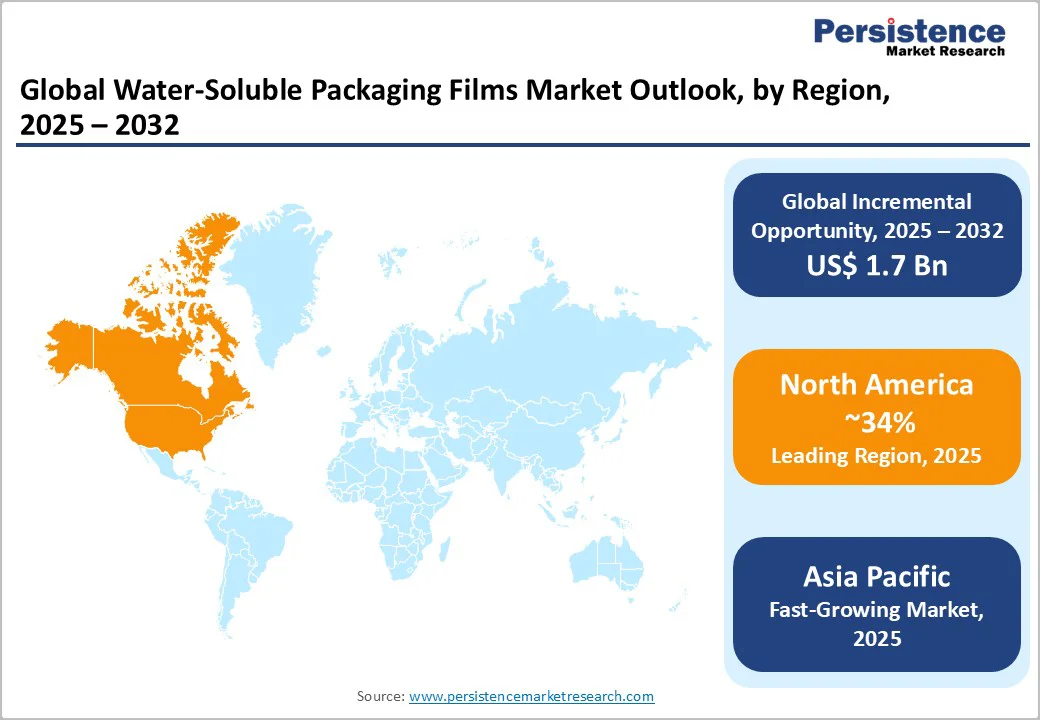
  • Leading Region: North America, commanding a 34% market share in 2025, driven by a strict plastic ban, high prevalence of green packaging, and strong R&D activities in Germany.
  • Fastest-growing Region: Asia Pacific, fueled by increasing environmental regulations, rising awareness of sustainable films, and growing investments in eco-packaging in countries China and India.
  • Dominant Material Type: Polyvinyl Alcohol (PVA), holding approximately 60% of the market share, due to superior solubility and strength.
  • Leading Type of Usage: Single-use packaging, accounting for over 70% of market revenue, driven by detergent pods demand.
  • Leading Functionality: Biodegradable films, contributing nearly 50% of market revenue, due to eco-compliance.
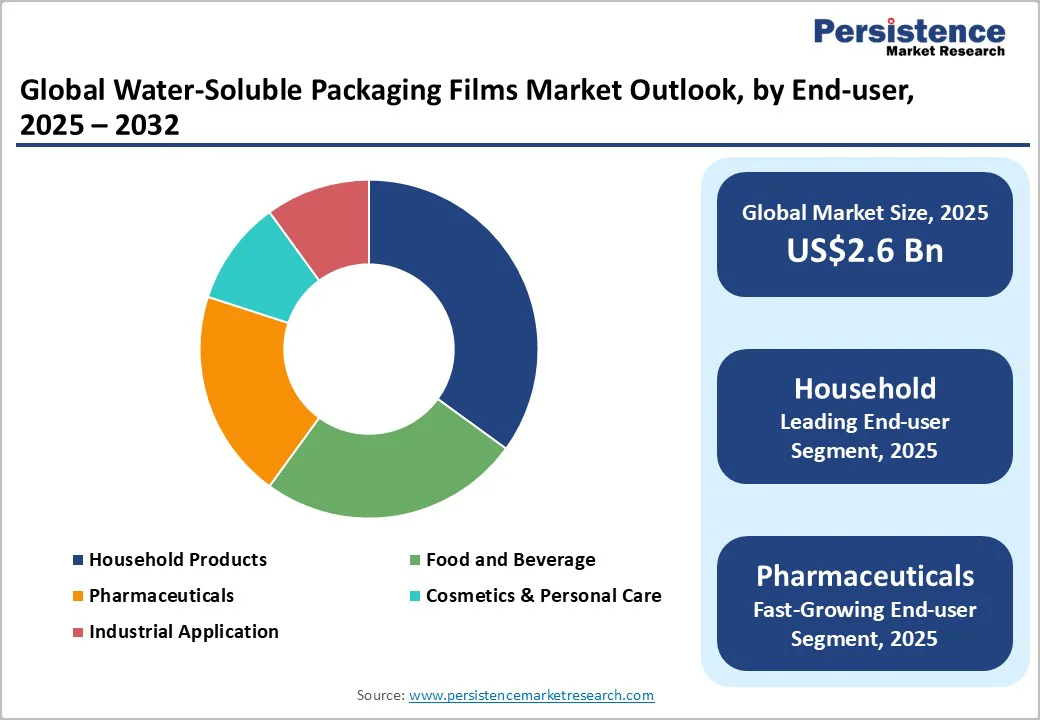
  • Leading End-user: Household products, with approximately 40% share, driven by laundry and dishwashing pods.
  • Key Market Driver: Increasing demand for sustainable, unit-dose packaging solutions that offer precise dosing, improved hygiene, and complete dissolution, helping consumers and industries reduce waste while enhancing safety and convenience.
  • Market Opportunity: Rising demand for smart dissolvable formats across pharmaceuticals, agrochemicals, and household care creates strong potential for high-value innovation.
Key Insights Details
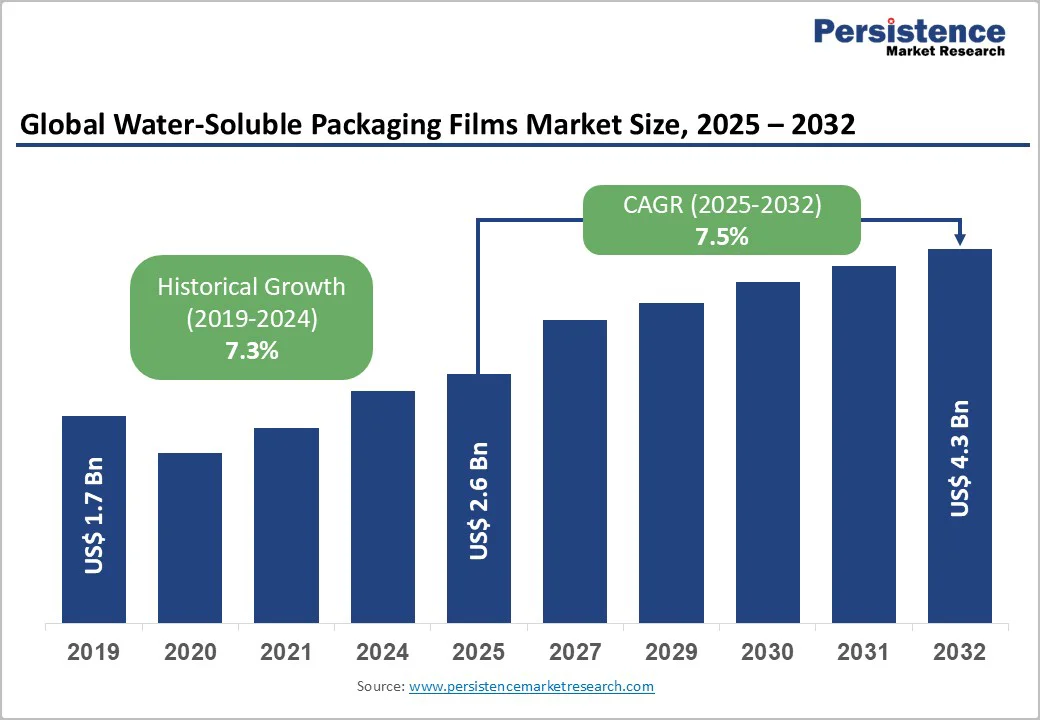
Water Soluble Packaging Films Market Size (2025E) US$2.6 Bn
Market Value Forecast (2032F) US$4.3 Bn
Projected Growth (CAGR 2025 to 2032) 7.5%
Historical Market Growth (CAGR 2019 to 2024) 7.3%

global-water-soluble-packaging-films-market-size-2025-2032

Market Factors - Growth, Barriers, and Opportunity Analysis

Rising Prevalence of Eco-Friendly Packaging Solutions and Demand for Single-Use Dissolvable Films

The increasing prevalence of eco-friendly packaging solutions globally is a primary driver of the water soluble packaging films market. Manufacturers and policymakers place greater emphasis on reducing plastic waste, and dissolvable films have emerged as a practical and environmentally conscious alternative.

These films naturally eliminate the need for traditional plastics by fully dissolving in water, reducing landfill accumulation, and lowering the environmental footprint associated with packaging disposal. Their ability to support waste-free consumption aligns well with modern sustainability goals across households, industries, and institutional sectors.

Single-use dissolvable films are gaining rapid traction as they offer convenience, hygiene, and precise dosing qualities that are essential in applications such as detergents, household cleaners, agrochemicals, and healthcare products. By eliminating direct handling of potentially hazardous substances and ensuring accurate product usage, these films contribute to both safety and operational efficiency. Growing urbanization and busier lifestyles further enhance the appeal of unit-dose, pre-measured formats.

High Production and Solubility Control Costs

The high costs associated with production and precise solubility control of water-soluble packaging films pose a significant restraint on market growth. Producing high-quality dissolvable films requires specialized raw materials, precise formulation processes, and advanced equipment capable of maintaining uniform thickness, strength, and dissolution consistency.

These requirements increase operational expenses compared to conventional plastic film production. Maintaining strict environmental conditions, such as controlled humidity and temperature during manufacturing and storage, also adds further complexity and cost.

Solubility control is another cost-intensive aspect. Creating films that dissolve reliably at specific temperatures or under certain conditions demands extensive testing, fine-tuning of polymer blends, and the use of modified additives.

Ensuring consistent performance across various applications, such as detergents, agrochemicals, or pharmaceuticals, requires ongoing R&D investments and rigorous quality standards. Any variability in solubility can lead to functional failures, resulting in product waste and financial loss.

Advancements in Bio-Based Polymers and Smart Dissolvable Films

Advancements in bio-based polymers and smart dissolvable films are transforming the future of water-soluble packaging by combining environmental responsibility with enhanced functionality. New generations of bio-based polymers derived from plant starches, cellulose, and naturally sourced polyesters are increasingly replacing petroleum-based materials, offering improved biodegradability and reduced carbon impact.

These polymers are being engineered for higher tensile strength, better barrier properties, and more reliable solubility across varying temperatures, making them suitable for both consumer and industrial applications.

Smart dissolvable films are emerging as a major innovation area. These films are designed to dissolve only under specific conditions, such as controlled temperature, pH levels, or moisture exposure, allowing precise release of active ingredients.

This is particularly beneficial for detergents, agrochemicals, pharmaceuticals, and specialty chemicals, where accuracy and safety are critical. Smart films can incorporate indicators, embedded micro-encapsulation, or time-release mechanisms that improve product performance and user convenience.

Category-wise Analysis

Material Type Insights

Polyvinyl Alcohol (PVA) dominates the market, accounting for 60% of the share in 2025. Its dominance is driven by excellent solubility, film strength, and versatility, making it preferred for pods. PVA films, such as those from Cortec Corporation, provide rapid dissolution, ensuring convenience. Its performance and approvals make it preferred for manufacturers.

Starch-based Polymers represent the fastest-growing segment, driven by natural sourcing and increasing adoption in food. Starch offers biodegradability, appealing to the green packaging segment. Focus on modified starch innovation accelerates adoption in Europe and Asia Pacific.

Type of Usage Insights

Single-use packaging leads the market, holding a 70% share in 2025, driven by strong demand for unit-dose convenience in detergents and household cleaning. Its easy handling, precise dosing, and hygiene benefits make it highly preferred across consumer and industrial applications. As users prioritize safety and waste reduction, single-use soluble packaging continues to dominate adoption.

Multi-use packaging is the fastest-growing segment, propelled by rising interest in reusable and long-lasting packaging solutions across industrial applications. Its combination of durability and controlled solubility offers both functionality and reduced waste. As industries seek cost-efficient, sustainable formats that support repeated handling and safe dissolution, multi-use packaging continues to gain rapid traction.

Functionality Insights

Biodegradable films dominate the market, contributing 50% of the revenue in 2025, due to rising eco-compliance requirements and strong regulatory support. Their ability to naturally decompose makes them a preferred alternative to traditional plastics. As industries prioritize sustainability and waste reduction, biodegradable films continue to lead with widespread adoption across packaging applications.

Heat sealing films are the fastest-growing segment, driven by rising demand for secure, tamper-proof packaging across pharmaceuticals and high-value products. Their strong sealing performance ensures product integrity, prevents leakage, and maintains safety during transport. As industries prioritize durability and contamination-free packaging, heat sealing films continue to see rapid adoption and expanding applications.

End-user Insights

Household products dominate the market, with a 40% share in 2025, driven largely by the widespread use of detergent pods and other unit-dose cleaning formats. Their convenience, safety, and ease of handling make water-soluble packaging highly preferred in daily home-care routines. Growing consumer demand for efficient, low-waste solutions continues to strengthen this segment’s leadership.

Pharmaceuticals are the fastest-growing, driven by rising demand for unit-dose medications and the expanding use of dissolvable films in agrochemical applications. Water-soluble packaging enables precise dosing, improves handling safety, and reduces contamination risks. Its efficiency, combined with compliance benefits, is accelerating adoption across medical, agricultural, and industrial use cases.
global-water-soluble-packaging-films-market-outlook-by-end-user-2025-2032

Regional Insights

North America Water Soluble Packaging Films Market Trends

North America accounts for a 34% share in 2025, driven by rising sustainability commitments, increasing regulatory pressure, and a growing preference for environmentally responsible packaging. The region has seen a significant shift toward reducing traditional plastic waste, prompting manufacturers across detergents, household cleaning, agrochemicals, and pharmaceuticals to adopt dissolvable, unit-dose packaging formats.

Water-soluble films, especially those made from PVA, are gaining traction due to their ability to dissolve safely, minimize residue, and support precise dosing qualities that align with both consumer convenience and industrial safety needs.

Technological advancements are also shaping the market, with producers developing films that dissolve effectively in cold water while maintaining higher tensile strength and durability for storage and handling. Growth in e-commerce and packaged household essentials further increases demand for compact, waste-reducing soluble pouches and pods.

Regulatory initiatives encouraging biodegradable materials and extended producer responsibility are motivating brands to transition toward water-soluble solutions.

Europe Water Soluble Packaging Films Market Trends

Europe holds a 22% share in 2025, driven by strict environmental regulations and rising consumer demand for eco-friendly alternatives. The EU’s Single-Use Plastics Directive and broader circular-economy goals are compelling industries to shift from conventional plastics to biodegradable, water-soluble solutions.

This trend is particularly strong in the detergent and household cleaning sectors, where unit-dose pods and dissolvable pouches are widely adopted for convenience and waste reduction.

Pharmaceutical applications are also increasing, with water-soluble films now used in unit-dose packaging, dissolvable drug delivery formats, and precision dosing. Significant R&D investments across the region are focused on enhancing film strength, improving cold-water solubility, and boosting barrier performance, especially for PVA-based materials.

Industrial and agrochemical sectors are adopting dissolvable sachets to improve safety and reduce handling risks. Consumer interest in sustainable packaging continues to rise, encouraging brands to replace traditional plastics with greener solutions.

Asia Pacific Water Soluble Packaging Films Market Trends

Asia Pacific is the fastest-growing region, driven by rising environmental awareness, expanding manufacturing activity, and strong government initiatives aimed at reducing conventional plastic waste. Countries such as China, India, Japan, and South Korea are increasingly adopting biodegradable and water-soluble alternatives as part of large-scale sustainability commitments.

The region’s booming FMCG, detergent, agrochemical, and pharmaceutical industries are accelerating the shift toward unit-dose, eco-friendly packaging formats, creating substantial demand for high-performance water-soluble films.

Local manufacturers are expanding production capabilities and introducing cost-effective solutions tailored to regional needs, strengthening competitiveness against global players. Technological advancements such as improved cold-water solubility, enhanced film strength, and bio-based polymer development are further supporting market penetration.

E-commerce growth also contributes significantly, as unit-dose detergent pods, soluble pouches, and dissolvable sachets become more popular for convenience and waste reduction.
global-water-soluble-packaging-films-market-outlook-by-region-2025-2032

Competitive Landscape

The global water soluble packaging films market is highly competitive, with major players such as Kuraray Co., Ltd. and Sekisui Chemical Co., Ltd. leading in North America and Europe through strong R&D, broad distribution, and consistent innovation. Strict sustainability regulations in these regions further strengthen their position.

In Asia Pacific, companies such as Arrow GreenTech Ltd. are gaining traction with cost-effective, locally tailored solutions. Rapid industrial growth, plastic-reduction initiatives, and rising consumer eco-awareness are accelerating adoption. Increasing focus on bio-based polymers, improved solubility technologies, and strategic partnerships is intensifying competition as manufacturers expand capacity and adapt to evolving regulatory demands.

Key Industry Developments

  • In October 2025, SmartSolve launched the PureNil™ 0 platform as a key strategic initiative to advance sustainable packaging solutions. This new plastic-free, 100% bio-based, printable, and flushable paper-based pouching material positions the company at the forefront of zero-waste flexible packaging innovation and addresses rising global demand for truly sustainable alternatives.
  • In October 2024, Arrow Greentech Ltd. strengthened its strategic positioning in sustainable agrochemical packaging by showcasing its advanced water-soluble film technologies at the PMFAI International Crop Science Conference & Exhibition (ICSCE) 2024 in Delhi.

Companies Covered in Water Soluble Packaging Films Market

  • Kuraray Co., Ltd.
  • Sekisui Chemicals Co., Ltd.
  • Aicello Corporation
  • Cortec Corporation
  • 3M Company
  • DuPont de Nemours, Inc.
  • Ecopol S.p.A.
  • AMC Ltd.
  • INFHIDRO
  • Arrow GreenTech Ltd.
  • Hasonchem
  • Noble Industries
Frequently Asked Questions

The global water soluble packaging films market is projected to reach US$2.6 Billion in 2025.

The rising prevalence of eco-friendly packaging solutions and demand for single-use dissolvable films are the key drivers.

The water soluble packaging films market is poised to witness a CAGR of 7.5% from 2025 to 2032.

The key opportunities include advancements in bio-based polymers and smart dissolvable films.

The key players include Kuraray Co., Ltd., Sekisui Chemicals Co., Ltd., Aicello Corporation, Cortec Corporation, and Arrow GreenTech Ltd.

Water Soluble Packaging Films Market Report Scope
Report Attribute Details
Historical Data/Actuals 2019 - 2024
Forecast Period 2025 - 2032
Market Analysis Value: US$ Bn
Geographical Coverage
  • North America
  • Europe
  • East Asia
  • South Asia & Oceania
  • Latin America
  • Middle East & Africa
Segmental Coverage
  • Material Type
  • Type of Usage
  • Functionality
  • End-user
  • Region
Competitive Analysis
  • Kuraray Co., Ltd.
  • Sekisui Chemicals Co., Ltd.
  • Aicello Corporation
  • Cortec Corporation
  • 3M Company
  • DuPont de Nemours, Inc.
  • Ecopol S.p.A.
  • AMC Ltd.
  • INFHIDRO
  • Arrow GreenTech Ltd.
  • Hasonchem
  • Noble Industries
Report Highlights
  • Market Forecast and Trends
  • Competitive Intelligence and Share Analysis
  • Growth Factors and Challenges
  • Strategic Growth Initiatives
  • Pricing Analysis
  • Future Opportunities and Revenue Pockets
  • Market Analysis Tools
Market Segmentation

By Material Type

  • Polyvinyl Alcohol (PVA)
  • Starch-Based Polymers
  • Cellulose-Based Films
  • Others

By Type of Usage

  • Single-use Packaging
  • Multi-use Packaging
  • Packaging for Industrial Products

By Functionality

  • Barrier Films
  • Weather Resistant Films
  • Heat Sealing Films
  • Biodegradable Films
  • Other

By End-user

  • Food and Beverage
  • Pharmaceuticals
  • Cosmetics & Personal Care
  • Household Products
  • Industrial Application

By Region

  • North America
  • Europe
  • East Asia
  • South Asia & Oceania
  • Latin America
  • Middle East & Africa

Related Reports

  1. Executive Summary
    1. Global Water-Soluble Packaging Films Market Snapshot, 2025 and 2032
    2. Market Opportunity Assessment, 2025 - 2032, US$ Bn
    3. Key Market Trends
    4. Future Market Projections
    5. Premium Market Insights
    6. Industry Developments and Key Market Events
    7. PMR Analysis and Recommendations
  2. Market Overview
    1. Market Scope and Definition
    2. Market Dynamics
      1. Drivers
      2. Restraints
      3. Opportunity
      4. Challenges
      5. Key Trends
    3. COVID-19 Impact Analysis
    4. Forecast Factors - Relevance and Impact
  3. Value Added Insights
    1. Value Chain Analysis
    2. Key Market Players
    3. Regulatory Landscape
    4. PESTLE Analysis
    5. Porter’s Five Force Analysis
    6. Consumer Behavior Analysis
  4. Price Trend Analysis, 2019 - 2032
    1. Key Factors Impacting Product Prices
    2. Pricing Analysis, By Material Type
    3. Regional Prices and Product Preferences
  5. Global Water-Soluble Packaging Films Market Outlook
    1. Market Size (US$ Bn) Analysis and Forecast
      1. Historical Market Size (US$ Bn) Analysis, 2019-2024
      2. Market Size (US$ Bn) Analysis and Forecast, 2025-2032
    2. Global Water-Soluble Packaging Films Market Outlook: Material Type
      1. Historical Market Size (US$ Bn) Analysis, By Material Type, 2019-2024
      2. Market Size (US$ Bn) Analysis and Forecast, By Material Type, 2025-2032
        1. Polyvinyl Alcohol (PVA)
        2. Starch-Based Polymers
        3. Cellulose-Based Films
        4. Others
      3. Market Attractiveness Analysis: Material Type
    3. Global Water-Soluble Packaging Films Market Outlook: Type of Usage
      1. Historical Market Size (US$ Bn) Analysis, By Type of Usage, 2019-2024
      2. Market Size (US$ Bn) Analysis and Forecast, By Type of Usage, 2025-2032
        1. Single-use Packaging
        2. Multi-use Packaging
        3. Packaging for Industrial Products
      3. Market Attractiveness Analysis: Type of Usage
    4. Global Water-Soluble Packaging Films Market Outlook: Functionality
      1. Historical Market Size (US$ Bn) Analysis, By Functionality, 2019-2024
      2. Market Size (US$ Bn) Analysis and Forecast, By Functionality, 2025-2032
        1. Barrier Films
        2. Weather Resistant Films
        3. Heat Sealing Films
        4. Biodegradable Films
        5. Others
      3. Market Attractiveness Analysis: Functionality
    5. Global Water-Soluble Packaging Films Market Outlook: End-user
      1. Historical Market Size (US$ Bn) Analysis, By End-user, 2019-2024
      2. Market Size (US$ Bn) Analysis and Forecast, By End-user, 2025-2032
        1. Food and Beverage
        2. Pharmaceuticals
        3. Cosmetics & Personal Care
        4. Household Products
        5. Industrial Applications
      3. Market Attractiveness Analysis: End-user
  6. Global Water-Soluble Packaging Films Market Outlook: Region
    1. Historical Market Size (US$ Bn) Analysis, By Region, 2019-2024
    2. Market Size (US$ Bn) Analysis and Forecast, By Region, 2025-2032
      1. North America
      2. Latin America
      3. Europe
      4. East Asia
      5. South Asia and Oceania
      6. Middle East & Africa
    3. Market Attractiveness Analysis: Region
  7. North America Water-Soluble Packaging Films Market Outlook
    1. Historical Market Size (US$ Bn) Analysis, By Market, 2019-2024
      1. By Country
      2. By Material Type
      3. By Type of Usage
      4. By Functionality
      5. By End-user
    2. Market Size (US$ Bn) Analysis and Forecast, By Country, 2025-2032
      1. U.S.
      2. Canada
    3. Market Size (US$ Bn) Analysis and Forecast, By Material Type, 2025-2032
      1. Polyvinyl Alcohol (PVA)
      2. Starch-Based Polymers
      3. Cellulose-Based Films
      4. Others
    4. Market Size (US$ Bn) Analysis and Forecast, By Type of Usage, 2025-2032
      1. Single-use Packaging
      2. Multi-use Packaging
      3. Packaging for Industrial Products
    5. Market Size (US$ Bn) Analysis and Forecast, By Functionality, 2025-2032
      1. Barrier Films
      2. Weather Resistant Films
      3. Heat Sealing Films
      4. Biodegradable Films
      5. Others
    6. Market Size (US$ Bn) Analysis and Forecast, By End-user, 2025-2032
      1. Food and Beverage
      2. Pharmaceuticals
      3. Cosmetics & Personal Care
      4. Household Products
      5. Industrial Applications
    7. Market Attractiveness Analysis
  8. Europe Water-Soluble Packaging Films Market Outlook
    1. Historical Market Size (US$ Bn) Analysis, By Market, 2019-2024
      1. By Country
      2. By Material Type
      3. By Type of Usage
      4. By Functionality
      5. By End-user
    2. Market Size (US$ Bn) Analysis and Forecast, By Country, 2025-2032
      1. Germany
      2. France
      3. U.K.
      4. Italy
      5. Spain
      6. Russia
      7. Rest of Europe
    3. Market Size (US$ Bn) Analysis and Forecast, By Material Type, 2025-2032
      1. Polyvinyl Alcohol (PVA)
      2. Starch-Based Polymers
      3. Cellulose-Based Films
      4. Others
    4. Market Size (US$ Bn) Analysis and Forecast, By Type of Usage, 2025-2032
      1. Single-use Packaging
      2. Multi-use Packaging
      3. Packaging for Industrial Products
    5. Market Size (US$ Bn) Analysis and Forecast, By Functionality, 2025-2032
      1. Barrier Films
      2. Weather Resistant Films
      3. Heat Sealing Films
      4. Biodegradable Films
      5. Others
    6. Market Size (US$ Bn) Analysis and Forecast, By End-user, 2025-2032
      1. Food and Beverage
      2. Pharmaceuticals
      3. Cosmetics & Personal Care
      4. Household Products
      5. Industrial Applications
    7. Market Attractiveness Analysis
  9. East Asia Water-Soluble Packaging Films Market Outlook
    1. Historical Market Size (US$ Bn) Analysis, By Market, 2019-2024
      1. By Country
      2. By Material Type
      3. By Type of Usage
      4. By Functionality
      5. By End-user
    2. Market Size (US$ Bn) Analysis and Forecast, By Country, 2025-2032
      1. China
      2. Japan
      3. South Korea
    3. Market Size (US$ Bn) Analysis and Forecast, By Material Type, 2025-2032
      1. Polyvinyl Alcohol (PVA)
      2. Starch-Based Polymers
      3. Cellulose-Based Films
      4. Others
    4. Market Size (US$ Bn) Analysis and Forecast, By Type of Usage, 2025-2032
      1. Single-use Packaging
      2. Multi-use Packaging
      3. Packaging for Industrial Products
    5. Market Size (US$ Bn) Analysis and Forecast, By Functionality, 2025-2032
      1. Barrier Films
      2. Weather Resistant Films
      3. Heat Sealing Films
      4. Biodegradable Films
      5. Others
    6. Market Size (US$ Bn) Analysis and Forecast, By End-user, 2025-2032
      1. Food and Beverage
      2. Pharmaceuticals
      3. Cosmetics & Personal Care
      4. Household Products
      5. Industrial Applications
    7. Market Attractiveness Analysis
  10. South Asia & Oceania Water-Soluble Packaging Films Market Outlook
    1. Historical Market Size (US$ Bn) Analysis, By Market, 2019-2024
      1. By Country
      2. By Material Type
      3. By Type of Usage
      4. By Functionality
      5. By End-user
    2. Market Size (US$ Bn) Analysis and Forecast, By Country, 2025-2032
      1. India
      2. Indonesia
      3. Thailand
      4. Singapore
      5. ANZ
      6. Rest of South Asia & Oceania
    3. Market Size (US$ Bn) Analysis and Forecast, By Material Type, 2025-2032
      1. Polyvinyl Alcohol (PVA)
      2. Starch-Based Polymers
      3. Cellulose-Based Films
      4. Others
    4. Market Size (US$ Bn) Analysis and Forecast, By Type of Usage, 2025-2032
      1. Single-use Packaging
      2. Multi-use Packaging
      3. Packaging for Industrial Products
    5. Market Size (US$ Bn) Analysis and Forecast, By Functionality, 2025-2032
      1. Barrier Films
      2. Weather Resistant Films
      3. Heat Sealing Films
      4. Biodegradable Films
      5. Others
    6. Market Size (US$ Bn) Analysis and Forecast, By End-user, 2025-2032
      1. Food and Beverage
      2. Pharmaceuticals
      3. Cosmetics & Personal Care
      4. Household Products
      5. Industrial Applications
    7. Market Attractiveness Analysis
  11. Latin America Water-Soluble Packaging Films Market Outlook
    1. Historical Market Size (US$ Bn) Analysis, By Market, 2019-2024
      1. By Country
      2. By Material Type
      3. By Type of Usage
      4. By Functionality
      5. By End-user
    2. Market Size (US$ Bn) Analysis and Forecast, By Country, 2025-2032
      1. Brazil
      2. Mexico
      3. Rest of Latin America
    3. Market Size (US$ Bn) Analysis and Forecast, By Material Type, 2025-2032
      1. Polyvinyl Alcohol (PVA)
      2. Starch-Based Polymers
      3. Cellulose-Based Films
      4. Others
    4. Market Size (US$ Bn) Analysis and Forecast, By Type of Usage, 2025-2032
      1. Single-use Packaging
      2. Multi-use Packaging
      3. Packaging for Industrial Products
    5. Market Size (US$ Bn) Analysis and Forecast, By Functionality, 2025-2032
      1. Barrier Films
      2. Weather Resistant Films
      3. Heat Sealing Films
      4. Biodegradable Films
      5. Others
    6. Market Size (US$ Bn) Analysis and Forecast, By End-user, 2025-2032
      1. Food and Beverage
      2. Pharmaceuticals
      3. Cosmetics & Personal Care
      4. Household Products
      5. Industrial Applications
    7. Market Attractiveness Analysis
  12. Middle East & Africa Water-Soluble Packaging Films Market Outlook
    1. Historical Market Size (US$ Bn) Analysis, By Market, 2019-2024
      1. By Country
      2. By Material Type
      3. By Type of Usage
      4. By Functionality
      5. By End-user
    2. Market Size (US$ Bn) Analysis and Forecast, By Country, 2025-2032
      1. GCC Countries
      2. Egypt
      3. South Africa
      4. Northern Africa
      5. Rest of Middle East & Africa
    3. Market Size (US$ Bn) Analysis and Forecast, By Material Type, 2025-2032
      1. Polyvinyl Alcohol (PVA)
      2. Starch-Based Polymers
      3. Cellulose-Based Films
      4. Others
    4. Market Size (US$ Bn) Analysis and Forecast, By Type of Usage, 2025-2032
      1. Single-use Packaging
      2. Multi-use Packaging
      3. Packaging for Industrial Products
    5. Market Size (US$ Bn) Analysis and Forecast, By Functionality, 2025-2032
      1. Barrier Films
      2. Weather Resistant Films
      3. Heat Sealing Films
      4. Biodegradable Films
      5. Others
    6. Market Size (US$ Bn) Analysis and Forecast, By End-user, 2025-2032
      1. Food and Beverage
      2. Pharmaceuticals
      3. Cosmetics & Personal Care
      4. Household Products
      5. Industrial Applications
    7. Market Attractiveness Analysis
  13. Competition Landscape
    1. Market Share Analysis, 2024
    2. Market Structure
      1. Competition Intensity Mapping By Market
      2. Competition Dashboard
    3. Company Profiles (Details - Overview, Financials, Strategy, Recent Developments)
      1. Kuraray Co., Ltd.
        1. Overview
        2. Segments and Material Type
        3. Key Financials
        4. Market Developments
        5. Market Strategy
      2. Sekisui Chemicals Co., Ltd.
      3. Aicello Corporation
      4. Cortec Corporation
      5. 3M Company
      6. DuPont de Nemours, Inc.
      7. Ecopol S.p.A.
      8. AMC Ltd.
      9. INFHIDRO
      10. Arrow GreenTech Ltd.
      11. Hasonchem
      12. Noble Industries.
  14. Appendix
    1. Research Methodology
    2. Research Assumptions
    3. Acronyms and Abbreviations

Research Methodology Framework for Market Research Excellence

At Persistence Market Research, we implement a comprehensive, validated, and multi-dimensional approachto market analysis that delivers actionable insights across complex market landscapes. Our methodology combines the analytical rigor of leading consulting firms with innovative research techniques, ensuring robust market assessments that guide strategic decision-making with confidence.

Core Research Philosophy

Our methodology is built on four foundational pillars:

Research Philosophy Image

At Persistence Market Research, our methodology is designed to transcend conventional market studies by combining analytical rigor, multi-source validation, and future-focused insights.

We integrate advanced research frameworks, robust data collection strategies, cutting-edge analytics, and innovative technologies to deliver a 360-degree view of complex markets.

We integrate advanced research frameworks, robust data collection strategies, cutting-edge analytics, and innovative technologies to deliver a 360-degree view of complex markets.

Each stage spanning from strategic scoping and hypothesis-building to competitive intelligence, quality validation, and actionable recommendations is engineered to provide clients with unmatched clarity, precision, and confidence in decision-making.

By embedding innovation and technology at the core, our approach ensures that insights are not only comprehensive but also predictive, empowering businesses to seize opportunities, mitigate risks, and achieve sustainable growth

Research Philosophy Image

Capturing Key Information and Events

During this phase, key research objectives focus on essential information and data points for assessing the market, including:

Research Philosophy Image

TAM-SAM-SOM Framework Implementation

We employ both top-down and bottom-up approaches to ensure accurate market sizing.

Top-Down Market SizingBottom-Up Market Sizing
Universe Definition: Total global/regional market identificationUnit Economics: Average transaction values, purchase frequencies, customer lifecycle
Segmentation Filters: Geographic, demographic, and behavioral constraintsCustomer Segmentation: Detailed buyer persona development and sizing
Market Share Analysis: Competitive landscape assessment and share allocationPenetration Analysis: Market penetration rates by segment and geography
Growth Rate Application: Historical trends and forward-looking growth assumptionsScaling Methodology: Extrapolation techniques with confidence intervals

Validation & Cross-Verification

  • Triangulation: Comparing top-down and bottom-up results for consistency
  • Sensitivity Analysis: Testing key assumptions and parameter variations
  • Peer Benchmarking: Comparison with analogous markets and industry benchmarks
  • Expert Review: External validation through industry specialist consultation

Research Philosophy Image

Forecasting & Projection Modeling

Our proprietary forecasting models incorporate multiple variables and scenarios.

Forecasting Components

  • Historical Trend Analysis: 10-year historical growth patterns and cyclical variations
  • Driver-Based Modeling: Economic indicators, demographic shifts, technology adoption
  • Scenario Planning: Base case, optimistic, and conservative projections
  • Monte Carlo Simulations: Probability-weighted outcomes and risk assessments

Model Validation

  • Back-Testing: Historical accuracy assessment over 3–5-year periods
  • Cross-Validation: Multiple modeling approaches for result comparison
  • External Benchmarking: Comparison with established market forecasts
  • Continuous Calibration: Quarterly model updates based on new data

Comprehensive Data Collection Strategy

Our secondary research phase establishes a robust knowledge base utilizing diverse, credible sources.

Secondary Data Sourcess

  • Industry Publications & Reports
  • Government & Regulatory Data
  • Financial Intelligence (filings & reports)
  • Academic Research & Digital Intelligence

Quality Assurance Protocol

  • Source credibility assessment and publication date validation
  • Data consistency checks across multiple sources
  • Bias identification and neutralization techniques
  • Information gap tracking for primary research prioritization

Research Philosophy Image

Primary Research Excellence

Our primary research methodology employs best-in-class techniques to capture unique market insights.

Quantitative Research Methods

  • Large-Scale Surveys: Statistically representative samples with 95% confidence intervals
  • Survey Methodology: Multi-channel deployment (online, telephone, in-person)
  • Question Architecture and Response Optimization

Qualitative Research Methods

  • Executive Interviews
  • Focus Groups
  • Expert Consultations

Quality Assurance & Validation Framework

Multi-Stage Validation Process

  • Source Verification and Consistency Testing
  • Outlier Detection and Bias Assessment
  • Peer Review Process and External Validation
  • Sensitivity Analysis and Confidence Intervals

Research Philosophy Image

Methodology Validation & Credibility

Our research methodology has been extensively validated through:

  • Academic Partnerships: Collaborations with top-tier business schools and research institutions
  • Client Success Stories: Documented case studies demonstrating research impact and ROI
  • Continuous Benchmarking: Performance comparison with leading global research firms

This comprehensive methodology framework positions Persistence Market Research at the forefront of market intelligence, combining the analytical sophistication of top-tier consulting firms with innovative research techniques. Our approach ensures that every market assessment delivers precise, actionable, and strategically valuable insights that drive business success in competitive market environments.

Ready to unlock your market potential? Contact our research experts to discuss how our validated methodology can transform your strategic decision-making with data-driven market intelligence.

Copyright © 2026 Persistence Market Research. All Rights Reserved

Connect With Us -
Water Soluble Packaging Films Market Size & Forecast, 2032