




- Display Technologies
- Mobile and Portable Spectrometers Market
Mobile and Portable Spectrometers Market Size, Share, and Growth Forecast, 2026 - 2033
Mobile and Portable Spectrometers Market by Product Type (FTIR Spectrometers, NIR Spectrometers, Others), Application (Chemical, Food Industry, Environmental Monitoring, Biological, Pharmaceuticals), and Regional Analysis for 2026 - 2033

Mobile and Portable Spectrometers Market Size and Trends Analysis
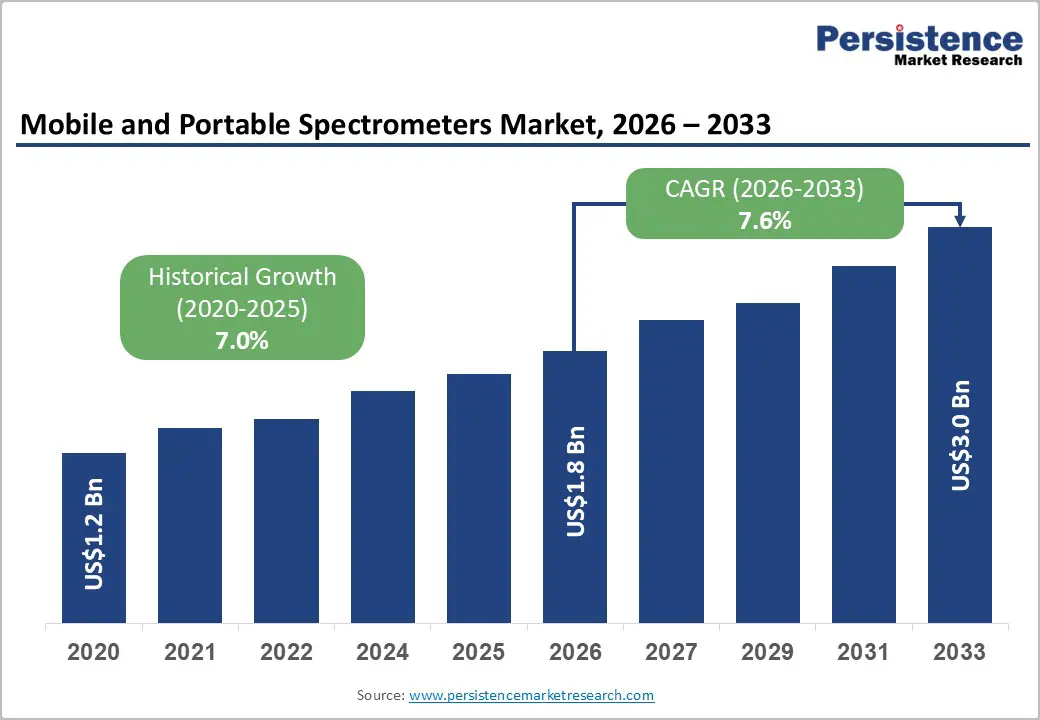
The global mobile and portable spectrometers market size is likely to be valued at US$1.8 billion in 2026 and is expected to reach US$3.0 billion by 2033, growing at a CAGR of 7.6% during the forecast period from 2026 to 2033, driven by the growing need for rapid, on-site analytical capabilities across diverse industries.
Increasing demand for real-time material identification and quality assessment in field environments such as environmental monitoring, food safety inspection, pharmaceutical validation, chemical processing, and industrial manufacturing has significantly accelerated adoption. Continuous advancements in miniaturization, battery efficiency, wireless connectivity, cloud integration, and AI-based spectral analysis have enhanced device performance, accuracy, and ease of use, making portable systems comparable to traditional benchtop instruments. Regulatory frameworks and compliance standards enforced by agencies such as the U.S. Environmental Protection Agency and environmental directives issued by the European Union promote routine field testing and pollution monitoring, encouraging broader deployment of handheld and compact spectrometers.
Key Industry Highlights:
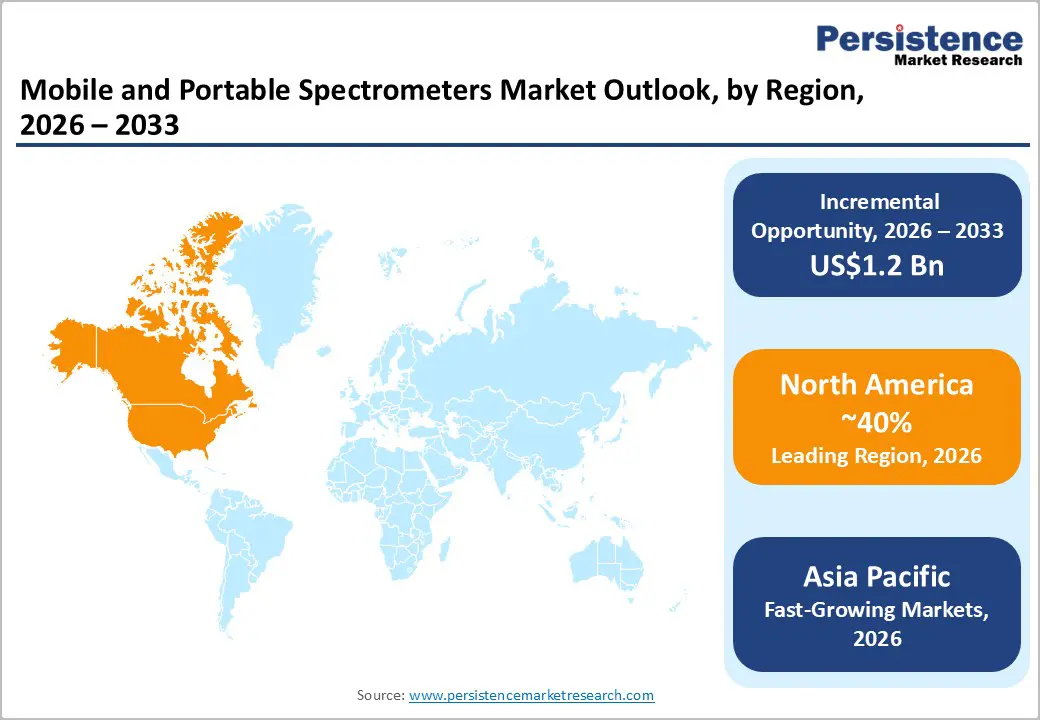
- Leading Region: North America is anticipated to be the leading region, accounting for a market share of 40% in 2026, driven by strong regulatory frameworks, advanced research infrastructure, and widespread adoption across the environmental and pharmaceutical sectors.
- Fastest-growing Region: Asia Pacific is likely to be the fastest-growing region in the mobile and portable spectrometers in 2026, supported by rapid industrialization, expanding pharmaceutical and food sectors, and strengthening regulatory frameworks across China, Japan, India, and ASEAN economies.
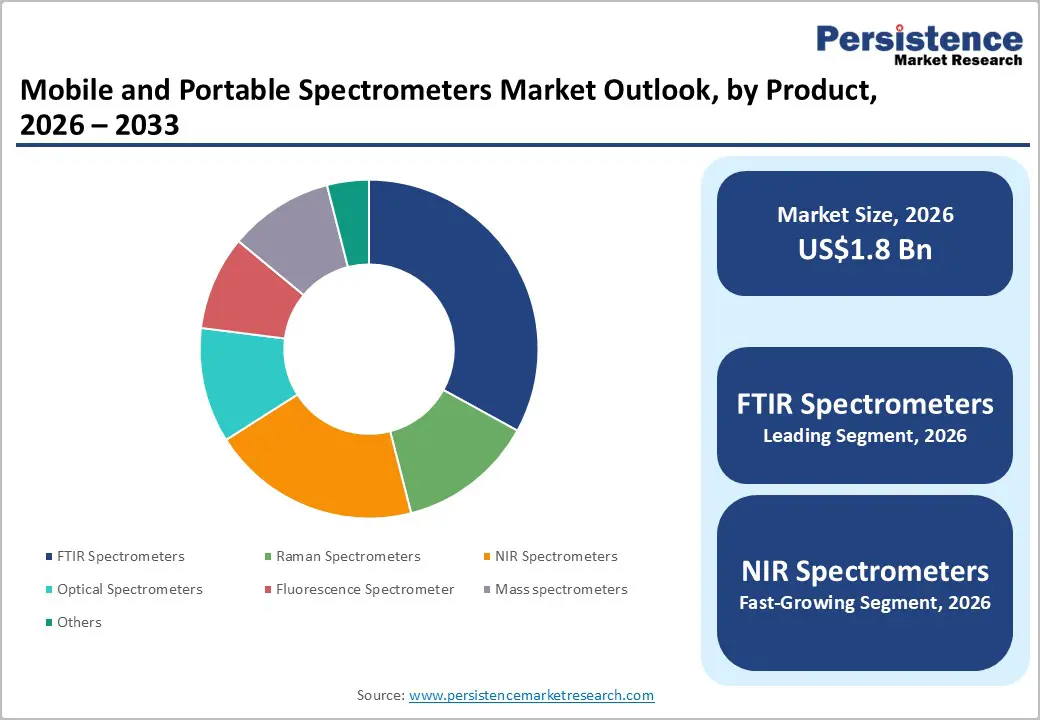
- Leading Product Type: FTIR spectrometers are projected to be the leading product type in 2026, accounting for 35% of revenue share, driven by their broad applicability in chemical and pharmaceutical analysis.
- Leading Application Type: Pharmaceuticals are expected to be the leading application type, accounting for over 32% of revenue share in 2026, driven by stringent quality control and regulatory compliance requirements.
| Key Insights | Details |
|---|---|
| Mobile and Portable Spectrometers Market Size (2026E) | US$1.8 Bn |
| Market Value Forecast (2033F) | US$3.0 Bn |
| Projected Growth (CAGR 2026 to 2033) | 7.6% |
| Historical Market Growth (CAGR 2020 to 2025) | 7.0% |
Market Factors - Growth, Barriers, and Opportunity Analysis
Growth Analysis - Rising Demand for On-Site and Real-Time Analysis
The growing need for immediate decision-making across industries is significantly driving the mobile and portable spectrometers market. Industries such as environmental monitoring, pharmaceuticals, food safety, and chemical manufacturing increasingly require rapid material identification without transporting samples to centralized laboratories. Field-deployable spectrometers enable instant verification of contaminants, raw materials, and finished products, reducing turnaround time and operational delays. Emergency response teams and regulatory inspectors also rely on portable devices for quick hazard detection. This shift toward decentralized testing supports operational efficiency, cost reduction, and improved compliance management across diverse end-use environments worldwide.
Real-time analysis enhances supply chain transparency and quality assurance in manufacturing ecosystems. Food producers use handheld spectrometers to detect adulteration, while pharmaceutical companies use them to authenticate raw materials at receiving points. Environmental agencies deploy portable systems for on-site pollution assessment and soil or water testing. The ability to perform non-destructive testing increases its practicality in sensitive applications. As industries prioritize faster workflows and immediate corrective actions, demand for compact spectroscopic tools continues to strengthen, accelerating their transition from supplementary tools to essential analytical instruments in field operations.
Technological Advancements in Miniaturization and Sensitivity
Continuous technological innovation in optics, microelectronics, and sensor design is propelling the adoption of mobile and portable spectrometers. Advances in miniaturized components have significantly reduced device size and weight without compromising analytical capability. Improvements in detector sensitivity, wavelength resolution, and signal-processing algorithms enable portable systems to deliver performance closer to that of traditional laboratory instruments. Integration with wireless connectivity, cloud platforms, and data analytics software enhances usability and remote monitoring. These innovations expand deployment across industrial, research, and regulatory applications, making portable spectroscopy more reliable and commercially viable.
Enhanced battery efficiency and ruggedized designs improve field operability in harsh environments. AI-driven spectral libraries and chemometric modeling increase analytical accuracy, enabling faster interpretation of complex samples. User-friendly interfaces and smartphone compatibility simplify training requirements and broaden accessibility among non-specialist users. These advancements collectively lower barriers to adoption while expanding the scope of applications. Research institutions and manufacturers continue to invest in high-performance compact systems, miniaturization, and improved sensitivity, which remain central to accelerating market expansion and competitive differentiation within the portable spectroscopy landscape.
Barrier Analysis - Technical Limitations in Accuracy and Resolution Compared to Lab Systems
Despite technological progress, portable spectrometers often face limitations in accuracy, sensitivity, and spectral resolution compared to full-scale laboratory instruments. Compact designs restrict optical path length and detector size, potentially affecting analytical precision for highly complex or trace-level measurements. Certain advanced applications still require high-end laboratory systems capable of delivering superior resolution and repeatability. These performance gaps can reduce confidence among end users operating in regulated industries, where precise quantification is critical for compliance and validation.
Environmental factors such as temperature fluctuations, vibration, and humidity may influence measurement stability in field settings. Calibration challenges and limited sample handling capabilities restrict performance in specialized applications. While portable devices are effective for rapid screening, confirmatory testing often still relies on laboratory analysis. This dependency can slow broader adoption in applications demanding ultra-high sensitivity. Addressing these technical constraints remains essential for manufacturers aiming to enhance reliability and expand usage into highly regulated or research-intensive sectors.
Lack of Standardization across Devices and Methods
The absence of uniform industry standards across portable spectrometer models presents challenges for interoperability and data consistency. Variations in calibration protocols, spectral libraries, and analytical algorithms can lead to inconsistent results between devices from different manufacturers. This lack of harmonization complicates regulatory acceptance and cross-platform validation, particularly in pharmaceuticals and environmental compliance testing. Organizations may face difficulties integrating data into centralized quality management systems, limiting scalability and operational efficiency.
Inconsistent measurement methodologies can hinder adoption in regions with strict regulatory oversight. Laboratories and field operators must often invest additional time in method development and validation to ensure reproducibility. Training requirements may increase when multiple device types are used within the same organization. Standardization gaps also affect data comparability in collaborative research or multinational operations. Establishing clearer industry guidelines and calibration benchmarks is essential to strengthening credibility and accelerating widespread acceptance of portable spectroscopic technologies.
Opportunity Analysis - Growth in Point-of-Care and Field Diagnostics
The expanding use of portable analytical tools in healthcare and diagnostics presents significant growth opportunities for the market. Point-of-care testing environments increasingly require compact, rapid, and accurate diagnostic technologies capable of delivering immediate results. Portable spectrometers can support non-invasive biochemical analysis, drug verification, and disease marker detection outside traditional laboratory settings. Their mobility enhances accessibility in remote or resource-limited regions, supporting decentralized healthcare delivery and faster clinical decision-making processes.
Public health initiatives and emergency response systems benefit from rapid screening capabilities enabled by handheld spectroscopy. Integration with digital health platforms and telemedicine systems strengthens diagnostic efficiency. As healthcare systems prioritize early detection and preventive care, demand for field-deployable analytical solutions is expected to expand. Continuous innovation in sensitivity and miniaturization enhances suitability for clinical environments, positioning portable spectrometers as promising tools in next-generation diagnostic and monitoring applications.
Development of Multifunctional and User-Friendly Devices
The development of multifunctional portable spectrometers capable of performing multiple analytical techniques within a single compact unit creates strong market opportunities. Combining technologies such as NIR, Raman, or fluorescence into integrated platforms increases versatility and broadens application coverage. This multifunctionality reduces the need for multiple instruments, lowering capital expenditure and simplifying operational workflows for industrial and research users.
Enhanced user interfaces, touchscreen controls, automated calibration features, and simplified software integration improve accessibility among non-expert operators. Cloud connectivity and real-time data synchronization enable seamless collaboration across distributed teams. As industries seek cost-effective and adaptable analytical tools, multifunctional and intuitive designs can significantly accelerate adoption. Manufacturers focusing on ergonomic design, automation, and digital integration are well-positioned to capture emerging demand and strengthen competitive advantage in the evolving portable spectroscopy market.
Category-wise Analysis
Product Type Insights
FTIR spectrometers are expected to lead the mobile and portable spectrometers market, accounting for approximately 35% of revenue in 2026, driven by their versatility in chemical identification, material characterization, and environmental testing. Their ability to provide rapid molecular fingerprinting makes them highly suitable for pharmaceuticals, polymer analysis, and hazardous material detection. For example, portable FTIR solutions offered by Thermo Fisher Scientific are extensively used for on-site chemical verification and environmental assessments.
NIR spectrometers are likely to represent the fastest-growing segment, supported by increasing demand for non-destructive and rapid testing in food, agriculture, and pharmaceutical applications. These devices enable quick compositional analysis of raw materials and finished products with minimal sample preparation, improving operational efficiency in production environments. Their portability and ease of integration into quality control workflows enhance adoption across decentralized facilities. For example, handheld NIR analyzers developed by Bruker are widely used for agricultural crop analysis and pharmaceutical raw material verification.
Application Insights
Pharmaceuticals are projected to lead the market, capturing around 32% of the revenue share in 2026, supported by stringent regulatory requirements for drug development, validation, and quality assurance. Portable spectrometers are increasingly deployed for raw material authentication, counterfeit drug detection, and in-process verification within manufacturing sites. Their ability to deliver rapid compound identification enhances compliance and reduces production downtime. For example, portable Raman systems supplied by Shimadzu are utilized for pharmaceutical substance verification and quality control processes.
The food industry is likely to be the fastest-growing application, driven by rising concerns regarding food safety, adulteration detection, and quality assurance. Portable spectrometers enable rapid screening of contaminants, authenticity verification, and compositional analysis directly within processing facilities or supply chains. Increasing regulatory focus on traceability and consumer demand for transparency accelerate adoption. For example, handheld food analyzers from PerkinElmer support real-time testing for contaminants and ingredient validation.
Regional Insights
North America Mobile and Portable Spectrometers Market Trends
North America is anticipated to be the leading region, accounting for a market share of 38% in 2026, driven by advanced regulatory oversight and strong demand across environmental, pharmaceutical, and industrial sectors. The U.S., as a central driver, emphasizes rapid on-site analytical capabilities to support compliance with stringent standards from regulators such as the U.S. Environmental Protection Agency and the U.S. Food and Drug Administration. Industries increasingly adopt portable analytical tools for immediate material verification and quality control, reducing reliance on centralized laboratory testing and shortening decision cycles.
Technological advancements and integration with cloud analytics and AI are strengthening North America’s competitive edge. Manufacturers are embedding sophisticated chemometric software and wireless connectivity into compact spectrometers, enabling real-time data sharing and remote analysis. Collaborative partnerships among government agencies, research institutions, and industry stakeholders are accelerating standard adoption practices and addressing interoperability challenges. For example, Shimadzu has introduced portable NIR systems tailored for food and pharmaceutical testing in North American facilities, combining simplified interfaces with robust performance for non-expert users.
Europe Mobile and Portable Spectrometers Market Trends
Europe is likely to be a significant market for mobile and portable spectrometers in 2026, due to strict environmental legislation, strong pharmaceutical manufacturing standards, and increasing focus on food authenticity across the region. Regulatory frameworks under the European Union emphasize traceability, contamination control, and pollution monitoring, encouraging industries to adopt portable analytical technologies for rapid field verification. Countries such as Germany, France, and Italy are integrating handheld spectrometers into environmental inspections, industrial quality control, and customs enforcement to prevent counterfeit materials and unsafe imports.
Innovation and strong regional manufacturing capabilities are also strengthening Europe’s competitive landscape. Companies are focusing on rugged, compact devices with enhanced spectral libraries and intuitive software to serve diverse end users. For example, portable spectroscopy solutions developed by Oxford Instruments are widely used across European industrial and environmental sectors for material identification and metals analysis in field conditions. Increased collaboration between research institutions and technology providers is accelerating product refinement, while sustainability goals and green chemistry initiatives continue to create long-term demand for efficient, non-destructive portable spectroscopic tools throughout the region.
Asia Pacific Mobile and Portable Spectrometers Market Trends
The Asia Pacific region is likely to be the fastest-growing region, driven by increasing industrialization, expanding pharmaceutical operations, and heightened focus on food safety and environmental monitoring across key economies such as China, India, Japan, and ASEAN countries. Regulatory agencies in the region are strengthening compliance standards for pollution control, product quality, and traceability, prompting the adoption of field-ready analytical tools that provide immediate insights without traditional laboratory delays. Portable spectrometers are widely used in agricultural supply chains for rapid compositional analysis of crops, in manufacturing hubs for quality assurance of raw materials, and by regulatory inspectors conducting on-site safety checks.
Technological improvements and localized innovation are also shaping market trends in Asia Pacific. Manufacturers are focusing on rugged, cost-competitive spectrometers suited to diverse climatic and operational environments across the region, enhancing accessibility for small and medium-sized enterprises. For example, portable near-nfrared (NIR) spectroscopy systems introduced by Analytik Jena with significant distribution and support networks in Asia Pacific, which are increasingly deployed for rapid quality checks in food, pharmaceutical, and agricultural sectors.
Competitive Landscape
The global mobile and portable spectrometers market exhibits a moderately fragmented structure, driven by a combination of long-established analytical instrumentation manufacturers and innovative technology newcomers catering to specialized field applications. Regional players from North America, Europe, and Asia Pacific contribute to competitive diversity, each bringing unique strengths in hardware miniaturization, software integration, or specific spectroscopy modalities such as FTIR, NIR, Raman, and portable mass spectrometry. Continuous research and development investments focused on enhanced sensitivity, cloud connectivity, and AI-enabled spectral interpretation are intensifying competition.
With key leaders including Thermo Fisher Scientific, Bruker, Shimadzu, PerkinElmer, and Oxford Instruments, these players compete through continuous product innovation, expanded distribution networks, and enhanced post-sales support. These players compete through broader spectral libraries, user-friendly interfaces, and strategic partnerships with research institutions and regulatory agencies to enhance market penetration.
Key Industry Developments:
- In October 2025, Metrohm launched the i-Raman NxG, a next-generation laboratory Raman spectrometer designed to enhance precision, sensitivity, and throughput in routine quality control measurements. The instrument supports a wide range of samples, including liquids, solids, gels, pills, and powders, via its fiber optic probe and multiple excitation wavelength options, while the patented i-Raman Duo system extends spectral coverage for precise analysis.
- In June 2024, Konica Minolta announced the launch of the CM-17d and CM-16d, vertical, lightweight, portable spectrophotometers designed for high-accuracy measurements in any situation. The CM-17d features an electronic viewfinder for precise positioning, improved ergonomics, and wireless LAN/Bluetooth connectivity for remote data management. Both models excel at measuring small or curved samples, enhancing efficiency in quality control, production, and R&D across industries such as automobiles, electronics, cosmetics, paints, plastics, construction materials, and textiles.
Companies Covered in Mobile and Portable Spectrometers Market
- Hitachi
- X-Rite
- Konica Minolta
- Shimadzu
- WTW
- Thermo Fisher
- Hach
- PerkinElmer
- Bibby Scientific
- BYK Gardner
- Bruker
- Datacolor
Frequently Asked Questions
The global mobile and portable spectrometers market is projected to reach US$1.8 billion in 2026.
The mobile and portable spectrometers market is driven by the rising demand for rapid, on-site, and real-time analysis across industries such as pharmaceuticals, food, environmental monitoring, and chemicals.
The mobile and portable spectrometers market is expected to grow at a CAGR of 7.6% from 2026 to 2033.
Key market opportunities include the growing adoption of portable spectrometers for point-of-care testing, field diagnostics, and multifunctional, user-friendly analytical devices across diverse industries.
Hitachi, PerkinElmer, X-Rite, Konica Minolta, Shimadzu, and Thermo Fisher are the leading players.


