




- Hardware & Software IT Services
- GPS Trackers Market
GPS Trackers Market Size, Trends, Share, and Growth Forecast, 2026 - 2033
GPS Trackers Market by Product Type (Standalone Trackers, OBD Devices, Advance Trackers, Data Loggers, Data Pushers, Data Pullers), Component (Hardware, Software, Services), End-User (Transportation & Logistics, Automotive, Healthcare, Retail, Construction, Military & Defense, Oil & Gas, Others), and Regional Analysis for 2026-2033

GPS Trackers Market Share and Trends Analysis
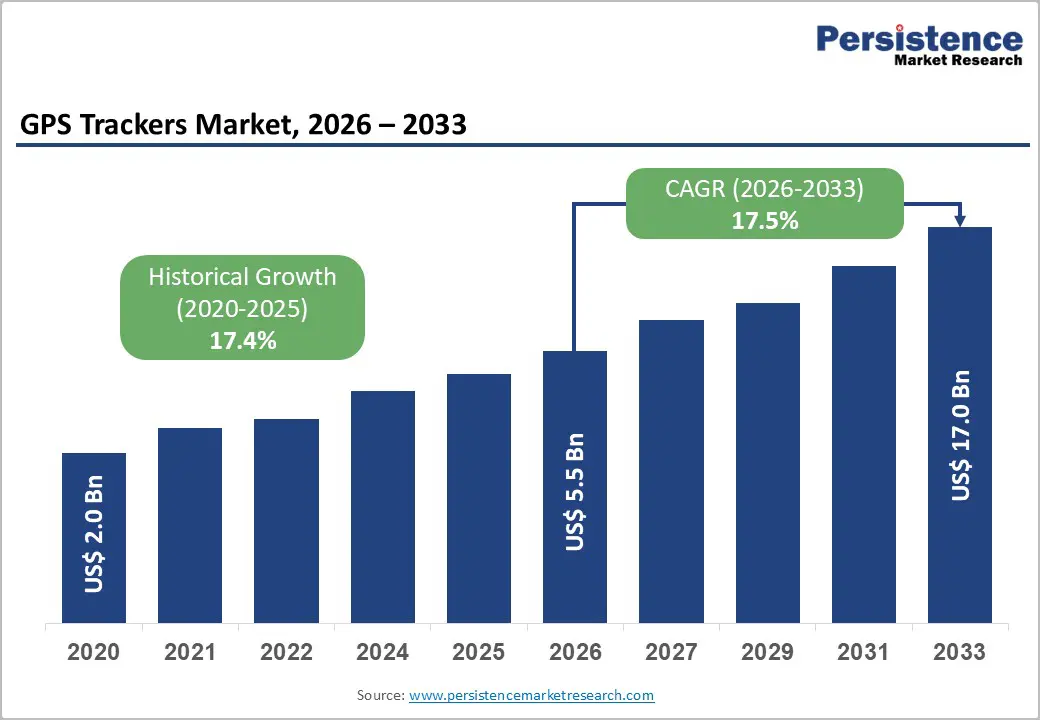
The global GPS trackers market size is likely to be valued at US$ 5.5 billion in 2026, and is projected to reach US$ 17 billion by 2033, growing at a CAGR of 17.5 % during the forecast period 2026−2033. The market demonstrates strong expansion momentum driven by rising asset mobility, increasing population density in urban regions, and heightened demand for real-time visibility across transportation and commercial operations.
Growing awareness around fleet optimization, asset security, and operational accountability directly accelerates adoption across logistics, automotive, and industrial sectors. Integration of GPS tracking solutions with cloud computing, Internet of Things (IoT), and data analytics platforms enhances decision-making capabilities, reinforcing enterprise reliance on continuous tracking systems. Expanding use of connected devices across healthcare, construction, and public safety sectors further strengthens market traction through monitoring of mobile equipment and vulnerable populations. Regulatory emphasis on road safety, emissions monitoring, and workforce compliance indirectly supports structured deployment of GPS-enabled systems across regulated industries.
Key Industry Highlights
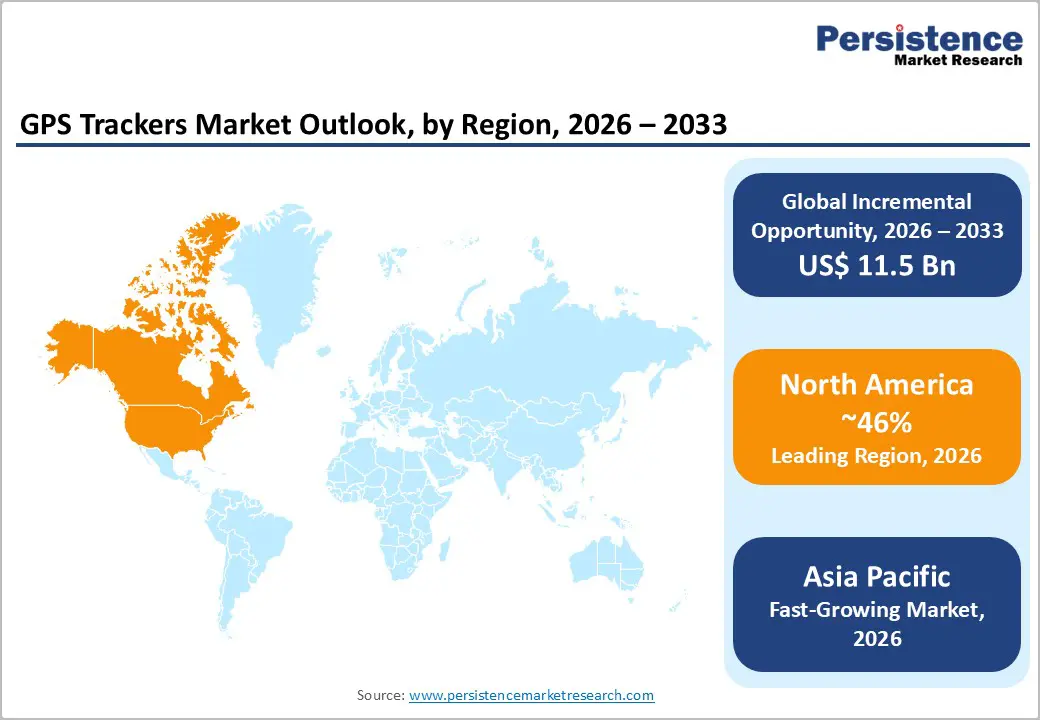
- Dominant Region: North America is expected to hold a 46% market share in 2026, driven by early adoption of GPS tracking technologies and regulatory compliance.
- Fastest-growing Regional Market: Asia Pacific is forecasted to be the fastest-growing market from 2026 to 2033, fueled by the rapid expansion of commercial mobility networks and logistics digitalization.
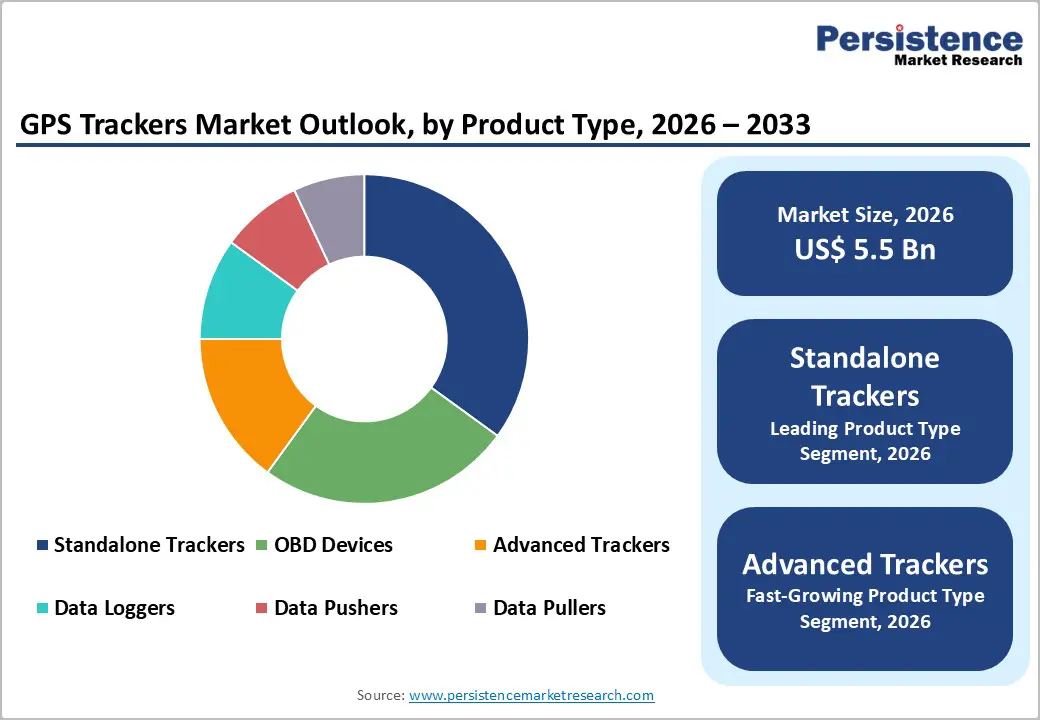
- Leading Product Type: Standalone trackers are likely to lead with a 35% revenue share in 2026 due to their widespread adoption and deployment flexibility.
- Fastest-growing Product Type: Advanced trackers are expected to grow the fastest through 2033, driven by the rising demand for multi-sensor integration and analytics-driven insights.
- September 2025: Tazaar debuted its GeoTag DIN Rail at PLASA Show 2025, a rugged, bolt-on GPS tracker for generators and power equipment that delivers near real-time location via satellite, cell, or Wi-Fi in 170+ countries.?
| Key Insights | Details |
|---|---|
|
GPS Trackers Market Size (2026E) |
US$ 5.5 Bn |
|
Market Value Forecast (2033F) |
US$ 17 Bn |
|
Projected Growth (CAGR 2026 to 2033) |
17.5 % |
|
Historical Market Growth (CAGR 2020 to 2025) |
17.4% |
Market Factors – Growth, Barriers, and Opportunity Analysis
Expansion of Fleet Digitalization and Asset Visibility Requirements
Expansion of fleet digitalization and asset visibility requirements acts as a core growth catalyst as enterprises transition toward precision-driven operations. Fleet assets represent high-value, mobile capital where limited visibility leads to utilization gaps, operational leakage, and accountability risks. Digital fleet systems transform asset oversight into a continuous intelligence function by converting location and movement data into actionable insights. Real-time tracking supports route discipline, fuel optimization, theft deterrence, and service-level adherence across geographically dispersed operations. Asset visibility aligns operational execution with strategic planning by enabling accurate forecasting, capacity balancing, and performance benchmarking. This shift reflects enterprise demand for transparency across supply chains where delivery accuracy, turnaround time, and cost discipline define competitive positioning.
Quantified performance outcomes strengthen adoption momentum. According to a 2025 industry report, nearly 50% of fleet operators achieved a positive return on investment within twelve months of deploying GPS-based tracking systems. This evidence highlights how rapid financial realization stems from improved asset utilization, reduced idle time, and lower maintenance volatility driven by real-time monitoring. Enhanced visibility supports compliance management, audit readiness, and contractual accountability through verifiable movement data. Enterprises gain improved risk governance through continuous asset oversight, reducing exposure to loss events and service disruptions. Asset-centric data ecosystems strengthen cross-functional coordination between operations, finance, and customer service teams, reinforcing data-led decision frameworks.
Data Privacy Regulations and Compliance Complexity
Data privacy regulations and compliance complexity emerge as a key restraint due to the direct handling of sensitive location and behavioral information linked to individuals, vehicles, and assets. Continuous location monitoring creates datasets that can reveal movement patterns, work routines, personal habits, and operational strategies. Regulatory frameworks such as General Data Protection Regulation (GDPR), California Consumer Privacy Act (CCPA), and similar national laws impose strict requirements on consent management, data minimization, cross-border data transfer, and storage duration. Enterprises face elevated legal exposure when real-time tracking data is processed without explicit authorization or transparent disclosure. Penalties for non-compliance include substantial financial fines, operational restrictions, and reputational damage, which increases risk sensitivity among adopters and slows procurement decisions.
Compliance complexity further intensifies restraint through fragmented regulatory standards across regions and industries. Multinational deployments require parallel adherence to varying privacy thresholds, reporting obligations, and audit protocols, raising implementation costs and extending deployment timelines. System architecture must support encryption, anonymization, access control, and detailed audit trails, increasing development and integration expenditure. Small and mid-sized organizations encounter resource limitations in maintaining compliance expertise, internal governance frameworks, and continuous regulatory updates. Procurement teams often prioritize risk avoidance over operational efficiency gains, delaying adoption cycles.
Integration with 5G Networks
Integration with 5G networks stands out as a leading strategic opportunity as it fundamentally transforms GPS tracking systems to operate in real time and at scale. Traditional cellular connectivity often introduces communication delays and limited bandwidth, which constrain the frequency and accuracy of position updates. 5G overcomes these constraints by providing ultra-low latency and dramatically higher network capacity, enabling GPS devices to transmit and receive precise location and sensor data almost instantaneously. This capability enhances decision-making across logistics, field service operations, and security applications where every second matters. With 5G, tracking systems achieve a level of responsiveness that supports dynamic routing, traffic-aware dispatching, and instantaneous alerting without perceptible lag, raising operational efficiency.
Wider adoption of 5G networks by the end of 2025 further reinforces this opportunity by expanding the addressable ecosystem for advanced tracking solutions. Industry data shows 5G subscriptions projected to reach 394 million in India, representing roughly 32% of total mobile subscriptions by year-end 2025, reflecting rapid deployment and growing infrastructure readiness that enterprises can leverage for next-generation tracking applications. This expanding footprint reduces barriers for widespread 5G-enabled GPS deployments across sectors such as logistics, smart cities, and autonomous systems. In addition, 5G makes possible network features such as slicing and dedicated quality of service, which allow service providers and enterprises to tailor connectivity performance to specific tracking use cases.
Category-wise Analysis
Product Type Insights
Standalone trackers are poised to lead with a forecasted 35% revenue share in 2026, owing to widespread adoption across transportation, logistics, and personal asset monitoring applications. These devices offer deployment flexibility, minimal integration complexity, and compatibility with multiple vehicle and asset categories. Enterprises prefer standalone solutions for rapid scalability and ease of replacement across distributed fleets. Accessibility across price tiers supports adoption among both enterprise-scale operators and small fleet owners. Continuous innovation in battery efficiency and form factor design further reinforces demand across commercial and consumer segments. Standardized communication protocols and broad cellular compatibility enable consistent performance across regions, supporting cross-border fleet operations. Simple installation reduces downtime during deployment, strengthening return on investment expectations.
Advanced trackers are anticipated to be the fastest-growing segment between 2026 and 2033, fueled by increasing demand for multi-sensor integration and analytics-driven insights. These solutions support geofencing, environmental monitoring, and behavioral analytics, aligning with enterprise digital transformation strategies. Provider preference shifts toward advanced trackers due to higher data utility and operational intelligence value. Innovation in firmware upgradability and artificial intelligence integration accelerates adoption across high-value asset monitoring use cases. Data-rich outputs enable predictive maintenance planning and compliance monitoring across regulated industries.
Component Insights
Hardware components are likely to be the leading segment with a projected 50% of the GPS trackers market revenue share in 2026, due to foundational dependency on physical tracking devices. Hardware demand remains stable across all end-user categories, supported by ongoing fleet expansion and asset replacement cycles. Consumer trust in durable and certified devices reinforces procurement consistency across regulated industries. Standardization of device specifications enables large-scale deployment across diverse operational environments. Long operational lifecycles and declining unit costs improve total cost efficiency for buyers. Integration readiness with multiple connectivity standards sustains relevance across technology transitions. Strong aftersales support and warranty structures further strengthen long-term hardware procurement commitments.
Software is expected to witness the fastest growth between 2026 and 2033, powered by rising demand for centralized dashboards, analytics, and integration with enterprise systems. Digital commerce expansion and subscription-based delivery models support scalable revenue generation. Preventive monitoring and predictive insights drive recurring software adoption across commercial and public-sector users. Cloud-native architectures enhance accessibility and real-time visibility across distributed operations. Customizable interfaces support sector-specific workflows and compliance requirements. Data-driven optimization improves asset utilization and operational transparency. Continuous feature upgrades and modular licensing structures reinforce sustained software adoption momentum.
End-User Insights
The transportation & logistics segment is slated to hold a dominant position, with an anticipated 45% of the GPS trackers market share in 2026, driven by operational efficiency mandates and regulatory compliance requirements. Fleet operators prioritize GPS tracking for route optimization, fuel management, and delivery transparency. Digitalization of logistics workflows strengthens long-term deployment stability. Large-scale fleet expansion across e-commerce and third-party logistics increases device density per operator. Real-time visibility supports service-level agreement adherence and customer satisfaction benchmarks. Integration with warehouse management and transport management systems improves coordination across supply chains. Standardized reporting capabilities enhance audit readiness and performance evaluation across regional and cross-border operations.
The healthcare segment is forecasted to be the fastest-growing end-user segment between 2026 and 2033, boosted by increasing focus on equipment tracking, patient mobility monitoring, and emergency response coordination. Technology-enabled service delivery and cost efficiency considerations support adoption across hospitals and care providers. Asset utilization optimization reduces equipment idle time and replacement costs. Location visibility improves response times in critical care environments. Integration with hospital information systems strengthens workflow efficiency. Compliance-driven tracking supports safety and accountability standards. Growing emphasis on data-driven healthcare operations reinforces sustained adoption across clinical and non-clinical applications.
Regional Insights
North America GPS Trackers Market Trends
North America is expected to dominate with an estimated 46% of the GPS trackers market share in 2026, reflecting deep-rooted integration of tracking technologies across commercial transportation, government fleets, and regulated industrial operations. High device penetration per fleet stems from stringent compliance frameworks covering safety, electronic logging, and asset accountability, which elevate tracking systems into mandatory operational infrastructure. Strong insurance alignment with telematics-enabled risk assessment reinforces sustained procurement across logistics, construction, and municipal services. Enterprise-scale operators prioritize standardized deployments across geographically dispersed assets, supporting consistent replacement and upgrade cycles. Mature capital investment environments enable adoption of higher-specification devices integrated with diagnostics and operational analytics, strengthening average contract values.
Market leadership is further supported by advanced digital readiness and data-driven operating models across major industries. Organizations increasingly leverage location intelligence to optimize routing, reduce idle time, and enhance service-level adherence, positioning tracking platforms as strategic performance enablers rather than monitoring tools. Integration with enterprise resource planning and transportation management systems supports real-time decision workflows and executive visibility. High adoption of electric fleets, connected infrastructure, and autonomous mobility pilots expands tracking demand beyond traditional vehicle monitoring into infrastructure and asset intelligence use cases. Emphasis on cybersecurity standards and data governance increases trust in large-scale deployments.
Europe GPS Trackers Market Trends
Europe is foreseen to demonstrate steady growth in the market for GPS trackers, supported by strong regulatory alignment, mature transportation infrastructure, and sustained investment in digital mobility systems. Widespread enforcement of road safety, emissions monitoring, and cross-border transport compliance drives consistent deployment across commercial fleets and public transport networks. High concentration of logistics hubs and integrated freight corridors increases reliance on real-time location visibility to maintain operational continuity. Fleet operators emphasize tracking solutions to support fuel optimization, driver behavior monitoring, and service-level transparency within competitive supply chains. Adoption remains stable across automotive leasing, utilities, and municipal services, where long asset lifecycles favor standardized and interoperable tracking hardware.
Growth is further shaped by sustainability priorities and digital transformation initiatives across industrial and public sectors. Transition toward electric vehicles and low-emission zones elevates demand for tracking systems that support energy usage monitoring and route efficiency analysis. Integration with transport management systems and enterprise platforms strengthens operational intelligence across multi-country operations. Expansion of smart city programs and intelligent transport systems increases tracking deployment beyond fleets into infrastructure and public safety applications. High emphasis on data protection and cybersecurity compliance influences solution design and procurement strategies, favoring platforms aligned with regional data governance frameworks. Continuous modernization of rail, maritime, and intermodal transport networks sustains incremental adoption.
Asia Pacific GPS Trackers Market Trends
Asia Pacific is forecasted to be the fastest-growing market for GPS trackers between 2026 and 2033, stimulated by accelerated expansion of commercial mobility networks, fragmented fleet structures, and rapid formalization of logistics operations across emerging and developed economies. Large volumes of small and mid-sized fleet operators are transitioning from manual coordination to digital tracking to control fuel costs, reduce asset misuse, and improve delivery reliability. High growth in last-mile delivery, construction equipment leasing, and cross-border trade corridors creates demand for scalable and cost-efficient tracking deployments. Government-led digital infrastructure programs and smart mobility initiatives strengthen institutional acceptance of location intelligence across public transport, urban utilities, and emergency services. High adoption of smartphones and connected devices lowers integration barriers, enabling faster uptake of cloud-based tracking platforms across enterprises with limited information technology complexity.
Growth momentum is further reinforced by manufacturing concentration, price-sensitive procurement behavior, and rapid innovation cycles. Local device manufacturing and assembly ecosystems reduce unit costs and accelerate product customization for varied operating conditions, supporting wider adoption across agriculture, mining, and informal transport segments. Enterprises increasingly prioritize asset visibility to mitigate theft, downtime, and regulatory non-compliance in high-density operational environments. Expansion of e-commerce fulfillment hubs and regional distribution centers increases demand for real-time tracking across multi-node supply chains. Integration of tracking data with payment platforms, route planning tools, and workforce management systems enhances operational intelligence value. Strong emphasis on operational efficiency and cost control positions tracking solutions as productivity enablers rather than compliance tools.
Competitive Landscape
The global GPS trackers market exhibits a moderately fragmented structure with several global and regional technology providers competing across hardware, software, and service layers. Market concentration remains balanced, with no single participant exercising full control, while leading vendors maintain strong positions through scale, technology depth, and long-term enterprise contracts. Competitive differentiation centers on device durability, connectivity performance, and data accuracy across diverse operating environments. Vendors increasingly align offerings with fleet digitalization, compliance monitoring, and operational intelligence use cases. Integrated platforms that combine tracking hardware with analytics dashboards and application programming interface connectivity gain preference among enterprise buyers. Pricing strategies reflect a mix of volume-based hardware sales and recurring software subscriptions, supporting predictable revenue streams.
Key players such as Geotab Inc., Trimble Inc., Queclink Wireless Solutions Co., Ltd., and CalAmp Corp. shape competitive dynamics through portfolio breadth and ecosystem integration. These companies emphasize end-to-end solutions that extend beyond location tracking into diagnostics, driver behavior analysis, and asset utilization insights. Strong channel partnerships and global distribution networks enable penetration across logistics, construction, public transport, and industrial segments. Investment in cloud platforms and data analytics strengthens customer retention by embedding tracking solutions into core operational workflows. Customization capability and scalability support adoption across both large fleets and distributed asset owners. Strategic focus on interoperability and data security enhances relevance in regulated industries.
Key Industry Developments
- In September 2025, Reliance Jio launched JioFind and JioFind Pro GPS tracking devices with single?number connectivity and real-time nationwide tracking via the JioThings app, enabling geofencing and extended battery features across vehicles and personal items
- In September 2025, Queclink Wireless Solutions introduced the GL30, its smallest real-time GPS micro tracker designed for warehouse and logistics asset monitoring.? Armed with IP67 waterproofing, LTE Cat M1/NB2 connectivity, Wi-Fi/BLE scanning, and up to 170 days standby, it enables precise indoor/outdoor tracking, geozoning, and motion alerts for high-value cargo.
- In February 2025, the UAE unveiled next-generation GPS-less navigation and secure flight control technologies for autonomous aerial systems at IDEX, aimed at strengthening aviation security and resilience against GPS interference.
Companies Covered in GPS Trackers Market
- Geotab Inc.
- Trimble Inc.
- Queclink Wireless Solutions Co., Ltd.
- CalAmp Corp.
- TELTONIKA
- Meitrack Group.
- Sierra Wireless
- Shenzhen Jimi IoT Co., Ltd.
Frequently Asked Questions
The global GPS trackers market is projected to reach US$ 5.5 billion in 2026.
Increasing need for real-time asset monitoring, rising adoption of fleet management solutions, and integration with IoT and analytics platforms are driving the market.
The market is poised to witness a CAGR of 17.5% from 2026 to 2033.
Expansion in emerging economies and integration with AI-driven analytics platforms present key opportunities for the market.
Key players in the GPS trackers market include Geotab Inc., Trimble Inc., Queclink Wireless Solutions Co., Ltd. and CalAmp Corp.


