




- Industrial Machinery
- Industrial Oven Market
Industrial Oven Market Size, Share, and Growth Forecast 2026 - 2033
Industrial Oven Market by Product Type (Batch Oven, Powder Coated Oven, Others), Process Type (Batch process, Continuous), Application (Aerospace, Furniture, Others), and Regional Analysis for 2026 - 2033

Industrial Oven Market Size and Trends Analysis
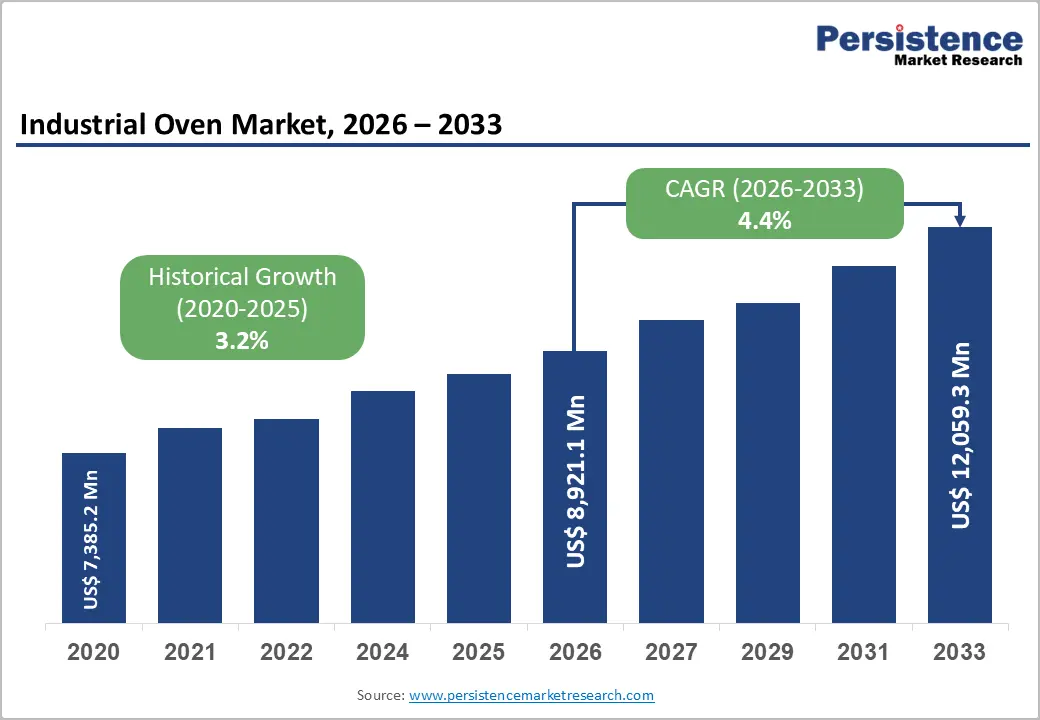
The global industrial oven market size was valued at US$8,921.1 million in 2026 and is projected to reach US$12,059.3 million by 2033, growing at a CAGR of 4.4% during the forecast period from 2026 to 2033, driven by increasing industrial automation and the rising demand for precise, consistent, and energy-efficient temperature control across manufacturing processes.
Industries are increasingly adopting advanced ovens to improve product quality, reduce energy consumption, and comply with evolving safety and environmental regulations. Rapid expansion across key end-user sectors, such as food production, pharmaceuticals, and automotive manufacturing, continues to support market growth. Food processors rely on industrial ovens for baking, drying, and sterilization, while pharmaceutical manufacturers require precise thermal systems to meet strict regulatory standards.
Key Industry Highlights:
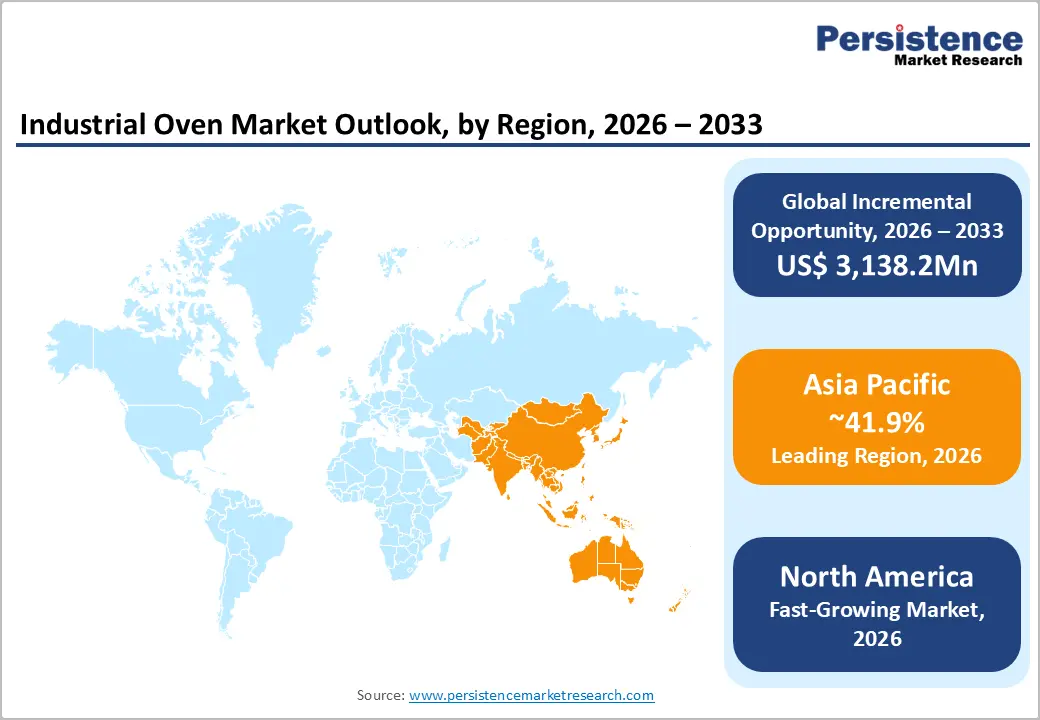
- Leading Region: Asia Pacific is anticipated to be the leading region, accounting for 41.9% of the market in 2026, driven by rapid industrialization and growing demand across the automotive, electronics, food, and pharmaceutical sectors.
- Fastest-growing Region: North America is likely to be the fastest-growing region in 2026, driven by strong demand for energy-efficient, automated, and smart industrial ovens across automotive, pharmaceutical, food processing, and electronics industries.
- Leading Product Type: Batch ovens are projected to be the leading product type in 2026, accounting for 55.0% of revenue share, driven by versatility and widespread use across industries such as food production and automotive manufacturing.
- Leading Process Type: Batch process is anticipated to be the leading process type in 2026, accounting for 42% revenue share, due to its flexibility in handling varied batch sizes and the need for precise, customizable temperature control across multiple industries.
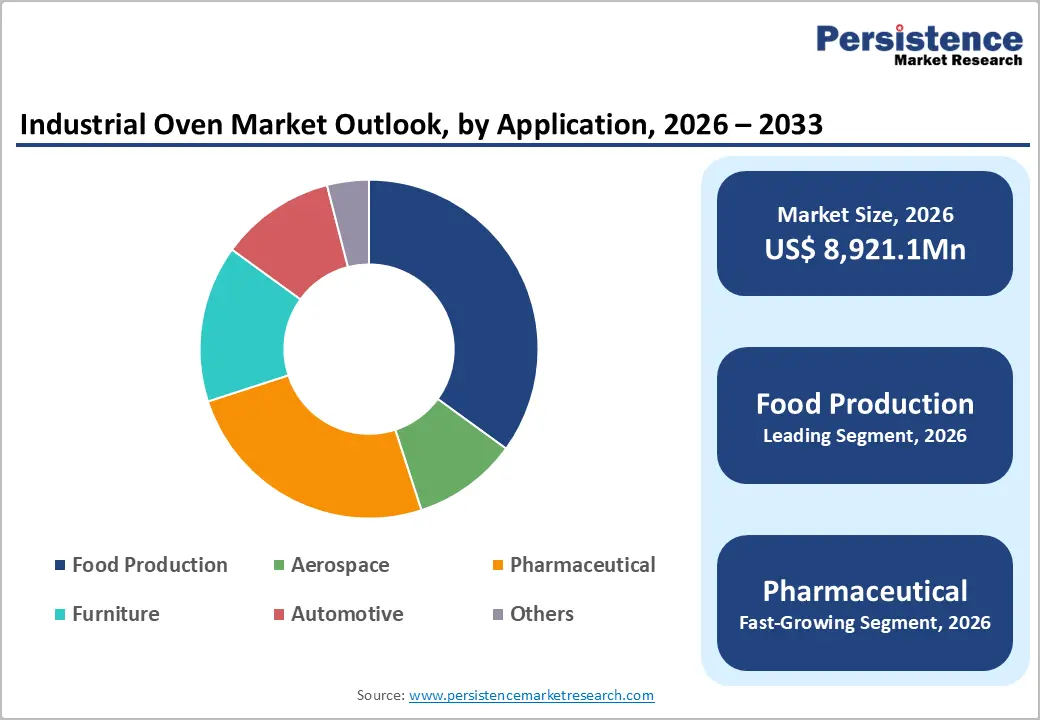
- Leading Application: Food production is projected to represent the leading segment in 2026, accounting for 30% revenue share, driven by strict food safety regulations and the growing need for efficient baking, drying, and sterilization processes.
| Key Insights | Details |
|---|---|
|
Industrial Oven Market Size (2026E) |
US$8,921.1 Mn |
|
Market Value Forecast (2033F) |
US$12,059.3 Mn |
|
Projected Growth CAGR (2026-2033) |
4.4% |
|
Historical Market Growth (2020-2025) |
3.2% |
Market Factors - Growth, Barriers, and Opportunity Analysis
Technological Advancements
Technological advancements are emerging as a major driver for the market, reshaping how ovens are designed, operated, and maintained, and increasing overall demand. Modern ovens increasingly incorporate features such as precise digital temperature controls, energy-efficient heating systems (electric or hybrid), and better insulation. These improvements reduce energy consumption and operating costs while delivering more consistent and reliable thermal performance. In markets such as food production and automotive manufacturing, these improvements help manufacturers meet strict quality standards, increase throughput, and minimize batch-to-batch process variability.
The growth toward automation and smart manufacturing is accelerating the adoption of smart industrial ovens integrated with sensors, real-time monitoring, and connectivity. These Industry-oriented ovens can automatically adjust operating parameters, record process data, and trigger maintenance alerts, supporting improved process control and reduced downtime. In applications such as pharmaceuticals, aerospace, and automotive, where precision and compliance are critical, smart ovens enable standardized thermal cycles and traceability. This capability supports regulatory adherence and enhances operational efficiency, making advanced oven technologies highly relevant across target industrial markets.
High Initial Investment Costs
One of the primary restraints in the market is the high initial investment required to purchase and install advanced ovens. Modern industrial ovens often incorporate sophisticated technologies such as precise digital temperature controls, energy-efficient heating systems, automation, and smart connectivity for real-time monitoring and predictive maintenance. These features improve operational efficiency, product quality, and safety compliance, but they also significantly increase upfront capital expenditures. This challenge is particularly evident among small and mid-sized manufacturers in food processing, automotive components, and metal fabrication, where budget constraints limit rapid technology upgrades.
The installation of industrial ovens often entails additional costs for infrastructure modifications, safety systems, and workforce training. Although advanced ovens deliver long-term benefits such as energy savings, reduced maintenance, and higher productivity, the return on investment may take several years. Companies with limited financial resources may continue using older, less efficient ovens. Fluctuating raw material and energy costs can delay capital investment decisions for upgrading to modern industrial oven systems.
Emerging Technologies and Customization
Innovations such as smart ovens, real-time process monitoring, predictive maintenance, and AI-enabled temperature control are transforming how industries approach thermal processing. These technologies enhance precision, energy efficiency, and safety, making ovens more adaptable to complex production requirements. In the industrial oven market, manufacturers are increasingly integrating IoT-enabled sensors and advanced control systems to reduce downtime and improve process consistency. This is particularly valuable in high-volume sectors such as automotive and electronics, where even minor temperature variations can impact product quality.
Customization drives market growth, as manufacturers increasingly seek ovens tailored to their specific processes, batch sizes, or material types. Industries such as pharmaceuticals, aerospace, food processing, and automotive require ovens with precise temperature uniformity, controlled airflow, and specialized features to meet stringent quality standards. Customized solutions also support compliance with industry-specific regulations and production layouts. By providing modular designs, flexible configurations, and application-specific features, oven manufacturers can effectively tackle unique production challenges and improve throughput.
Category-wise Analysis
Product Type Insights
Batch ovens are expected to dominate, capturing around 55% of total revenue in 2026. Their popularity is driven by their versatility, reliability, and broad adoption across industries such as food production and automotive manufacturing. These ovens are ideal for handling varied batch sizes while providing precise temperature control, ensuring consistent product quality. Their ability to meet diverse thermal processing requirements makes them the preferred choice for manufacturers seeking flexibility and efficiency. For example, Wisconsin Oven Corporation supplies customized batch ovens widely used in automotive and industrial manufacturing for curing, drying, and heat-treatment applications, highlighting the strong demand for batch-based solutions.
Powder-coated ovens are likely to represent the fastest-growing product type in 2026, driven by increased demand in the automotive and construction sectors, where durable and high-quality surface finishing is critical. Modern manufacturing trends such as energy efficiency, automation, and uniform heat distribution further support adoption, as powder-coated ovens enable consistent curing and faster processing. For example, Davron Technologies offers powder-coated ovens designed for automotive and metal fabrication customers, supporting efficient coating operations and compliance with quality standards. These industry-specific requirements and technological enhancements position powder-coated ovens as a key growth driver in the industrial oven market.
Process Type Insights
The batch process is projected to lead the industrial oven market, capturing around 42% of revenue share in 2026, supported by its flexibility for handling intermittent operations and customizable thermal cycles. They are widely used in industries that require precise, repeatable temperature control across varying batch sizes, including food processing, automotive components, and specialty coatings. Their adaptability and reliability make them a staple in many manufacturing setups. For example, International Thermal Systems (ITS) supplies customized batch process ovens for aerospace and industrial applications, demonstrating strong demand for batch-based solutions that require precision and operational flexibility.
The continuous process segment is likely to represent the fastest-growing process type in 2026, as industries such as automotive, electronics, and metal processing increasingly adopt them for large-scale production. These ovens offer higher throughput, improved process efficiency, and reduced energy consumption, making them suitable for high-volume manufacturing environments. The ability to maintain consistent quality over extended production runs further enhances their appeal. For example, Harper International provides continuous thermal processing systems for advanced manufacturing and materials processing, enabling efficient, high-capacity production lines.
Application Type Insights
The food production sector is expected to lead the application market, capturing around 30% of the revenue share by 2026. This growth is driven by stringent food safety regulations and the increasing need for efficient processes in baking, drying, and sterilization. The segment dominates the industrial oven market, especially in regions with expanding food processing industries. Manufacturers use these ovens to ensure compliance while maintaining consistent product quality and operational efficiency. For instance, Bühler provides industrial baking and drying ovens that are widely used in large-scale food and bakery processing, offering high-throughput production with reliable thermal performance.
The pharmaceutical sector is anticipated to be the fastest-growing segment by 2026, spurred by heightened regulatory demands for sterilization, precise thermal cycles, and controlled processing environments. As pharmaceutical manufacturing continues to expand, there is a growing need for specialized ovens that meet strict quality, safety, and validation standards. Many industrial ovens support pharmaceutical, chemical, and bioprocessing applications for drying, sterilization, and controlled heat treatment. For example, SP Scientific offers validated pharmaceutical drying and sterilization ovens used in drug manufacturing and life sciences facilities, demonstrating the sector's strong dependence on compliant and precision-focused thermal processing solutions.
Regional Insights
North America Industrial Oven Trends
North America is likely to be the fastest-growing region in 2026, driven by the strong demand from industries such as food processing, pharmaceuticals, automotive, and electronics. The increasing shift toward energy-efficient and environmentally sustainable ovens. Manufacturers across the U.S. and Canada are upgrading to electric or hybrid systems, featuring advanced insulation and precise digital controls, to reduce operating costs, comply with stricter emissions regulations, and enhance sustainability. For example, Wisconsin Oven Corporation, based in the U.S., provides energy-efficient industrial ovens widely used in the automotive and food processing sectors across North America.
Automation and smart integration are also key trends, with industrial ovens being increasingly equipped with IoT connectivity, sensors, real-time monitoring, and automated process controls. These smart ovens help improve temperature consistency, enable data logging, support predictive maintenance, and allow remote management, benefits particularly valuable for high-volume, high-quality industries such as automotive heat treatment, electronics manufacturing, and pharmaceutical sterilization. Manufacturers are adopting these advanced systems to minimize unplanned downtime and improve traceability for regulatory compliance. There is also a growing demand for customized ovens tailored to specific production needs, including precise size, temperature range, airflow design, and batch or continuous configurations, particularly in food processing and specialty manufacturing applications.
Europe Industrial Oven Trends
Europe is expected to be a major market for industrial ovens in 2026, driven by strict environmental regulations, high energy-efficiency standards, and the presence of advanced manufacturing sectors such as automotive, aerospace, and food processing. The region’s focus on reducing emissions and energy consumption is fueling demand for ovens with better insulation, electric or hybrid heating systems, and optimized thermal performance. Many manufacturers are replacing outdated equipment with modern, compliant solutions. For example, Despatch Industries provides energy-efficient industrial ovens widely used by European automotive and electronics manufacturers to meet stringent requirements for thermal uniformity and sustainability.
In addition to these factors, the demand for ovens customized to specific production needs is rising. This includes precise temperature control, airflow management, chamber sizes, and configurations suited to either batch or continuous processes. Tailoring ovens in this way helps manufacturers uphold product quality, comply with safety and regulatory standards, and enhance operational efficiency. Automation and smart manufacturing technologies are also on the rise, with many ovens now featuring digital controls, real-time monitoring, data logging, and automated process management to ensure consistent output and traceability throughout industrial operations.
Asia Pacific Industrial Oven Trends
Asia Pacific is anticipated to be the leading region, accounting for 41.9% of the market in 2026, driven by a combination of trends in manufacturing, infrastructure development, and regulatory changes. Rapid industrialization in countries such as China and India is driving growth in sectors such as automotive, electronics, metal processing, and food production. In particular, automotive and electronics manufacturing across China, India, Vietnam, and Thailand requires a variety of industrial ovens for curing, drying, and heat treatment. For example, Thermal Product Solutions (TPS) has expanded its footprint in the region by supplying industrial ovens and furnaces to automotive and electronics manufacturers for coating and heat treatment processes.
The rising demand in food processing, pharmaceuticals, and consumer goods is also boosting the need for ovens used in baking, drying, sterilization, and coating. Many manufacturers are transitioning from older, less efficient ovens to newer, energy-efficient or electric-heated models, driven by growing environmental awareness, rising energy costs, and the adoption of stricter safety and quality standards. The region’s low-cost manufacturing advantages and improved infrastructure are attracting foreign investment, increasing the use of advanced, high-performance ovens. Companies such as Harper International and JPW Ovens & Furnaces are expanding their operations in the Asia Pacific, providing specialized ovens for high-volume industrial applications, particularly in automotive, electronics, and food processing sectors. The adoption of smart ovens equipped with real-time monitoring and automated controls is also on the rise, enabling manufacturers to enhance process efficiency, ensure consistent quality, and reduce operational downtime.
Competitive Landscape
The global industrial oven market is moderately fragmented, with a large number of manufacturers ranging from small, specialized firms to major global suppliers operating across diverse regions and end-use industries. This fragmentation is a reflection of the wide variety of oven types, such as batch, continuous, powder-coat, curing, and drying, and the diverse processes they serve, including automotive, electronics, food processing, pharmaceuticals, and metal treatment. Many buyers require customized solutions, further contributing to market diversity.
Key industry leaders such as ASC Process Systems, Harper International, Heatron, Eastman Manufacturing Ltd., Wisconsin Oven Corporation, JPW Ovens & Furnaces, and Davron Technologies compete not only on price but also on specialization. These companies differentiate themselves through a combination of factors, including the breadth of their product offerings, technological innovations (such as energy-efficient and IoT-enabled ovens), customization options (in terms of size, heating modality, and process configuration), after-sales service, and adherence to industrial standards.
Key Industry Developments:
- In 2025, Unox introduced the SPEED.Compact™ ECO oven at the AAHAR Trade Show in New Delhi. Tailored for the quick-service industry, this new oven features a compact 60 cm design, rapid cooking capabilities, and user-friendly operation to maximize space and efficiency. Equipped with technologies such as CLICK & COOK, ADAPTIVE Cooking, and SMART.Preheating, the oven delivers precise, uniform results for snacks, ready meals, and frozen pastries, such as waffles or muffins in just 30 seconds, and sandwiches in 75 seconds.
- In 2025, International Thermal Systems (ITS) enhanced aerospace manufacturing with a custom batch oven solution. ITS partnered with an aerospace company to address operational challenges, including an unsafe plate floor, complicated controls, and recurring floor damage. The company installed a state-of-the-art batch oven with melting-wax technology, advanced control systems, and a durable plate floor. The upgrade delivered a safer working environment, streamlined workflows, and improved operational efficiency.
Companies Covered in Industrial Oven Market
- ASC Process Systems
- Harper International
- Heatron
- Eastman Manufacturing Ltd.
- Rowan Technologies
- Wisconsin Oven Corporation
- JPW Ovens & Furnaces
- Davron Technologies
Frequently Asked Questions
The global industrial oven market is expected to reach US$12,059.3 million by 2033, reflecting robust growth.
Key drivers include growth in food production, pharmaceuticals, and automotive industries, technological advances in energy efficiency and automation, and rapid industrialization in emerging markets.
The food production segment currently leads in the application category, driven by safety standards and efficiency needs.
Asia Pacific is anticipated to be the leading region, accounting for a 41.9% share in 2026, driven by rapid industrialization and growing demand across automotive, electronics, food, and pharmaceutical sectors.
Opportunities lie in customized oven solutions, technological integration such as IoT, and the expanding Asia Pacific market with governmental incentives promoting industrial growth.


