Hand Sanitizer Market Size, Share, Trends, Growth, and Regional Forecasts 2025 - 2032

Hand Sanitizer Market Segment Forecasted by Product Type (Gel, Foaming, Liquid), by Content (Alcohol-based, Non-alcohol-based), by Packaging(Flip-Flop Bottles, Pump Bottles, Dispensing Packets, Jars/Cans), by End Use (Institutional, Household), by Sales Channel and Regional Analysis

ID: PMRREP31396
Calendar

May 2025

244 Pages

Author : Swapnil Chavan

Hand Sanitizer Market Size and Share Analysis

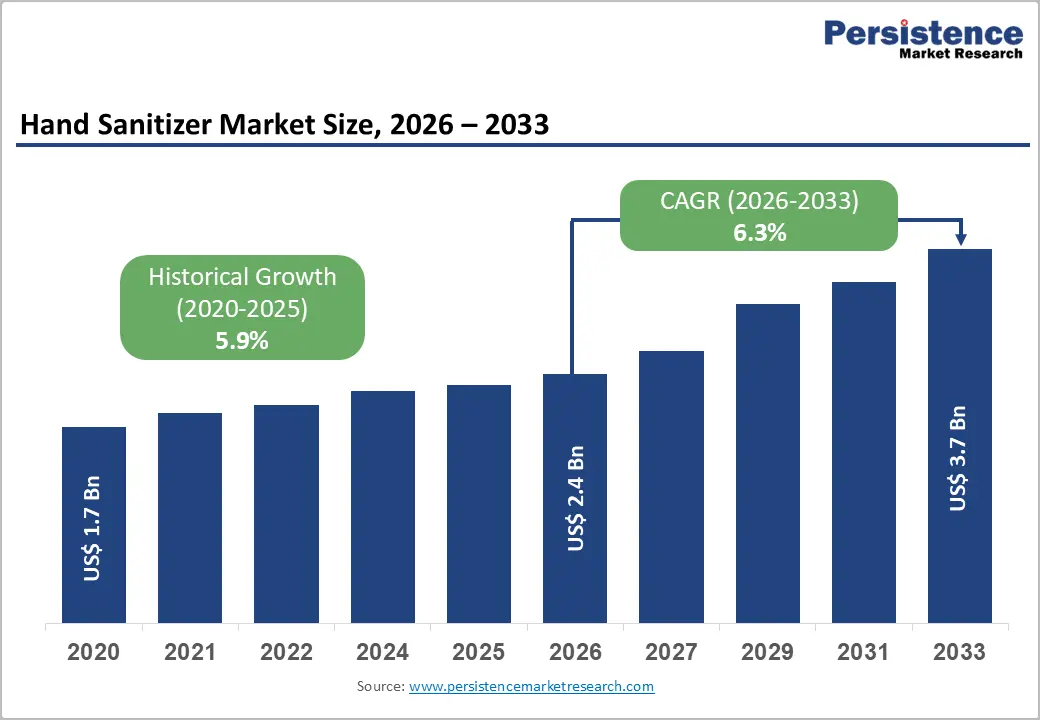
According to Persistence Market Research, the hand sanitizer market generated a revenue of US$ 2,356.6 Mn in 2025. The demand for hand sanitizer will accelerate, with the top market players holding a prominent share of the market in 2025. The global market for hand sanitizer is expected to reach US$ 3,614.3 Mn by 2032, growing at a 6.3% CAGR from 2025 to 2032.

Attributes Key Insights

Global Market Size (2024A)

US$ 2,261.6 Mn

Global Market Size (2025E)

US$ 2,356.6 Mn

Projected Market Value (2032F)

US$ 3,614.3 Mn

Value CAGR (2025-2032)

6.3%

Collective Value Share: Top 3 Countries (2024)

~30-40%

The coronavirus outbreak has rapidly increased the sales of hand sanitizers across the globe. Moreover, increasing company campaign and promotional activities regarding precautions from Covid-19 has highly impacted the sales of hand sanitizers market. Not only big but also small players in hand sanitizers market have witnessed a high growth due to rise in demand for alcohol-based hand sanitizer.

Infections and bacteria are primarily conveyed through hands. Diarrhea outbreaks and other illnesses have been caused by improper hand hygiene practises in children and young people across the world. Therefore, maintaining good hand hygiene is crucial to preventing the spread of hazardous diseases in both hospital settings and the general public.

Moreover, hand hygiene can have the substantial impact on reducing healthcare-associated infections (HAIs). There are various hand hygiene products available in the market in the form of antimicrobial soap, antiseptic agents, detergent, plain soap, and hand sanitizers. Although, there is a significant difference between washing hands with soap and water and cleaning with hand sanitizer.

Nowadays, there are a number of opportunities taking place in the hand hygiene industry such as hospitals and related major organizations are significantly seeking for alternatives to improve the patient’s safety. Additionally, hospitals and long term care centers are installing new technologies and replying solely on them to change hand hygiene behavior and habits. These are some of the factors driving the growth of hand sanitizer market over the forecast period.

Persistence Market Research's report includes a detailed analysis of a number of other distinctive growth factors in addition to a complete evaluation of some of the major challenges facing hand sanitizer.

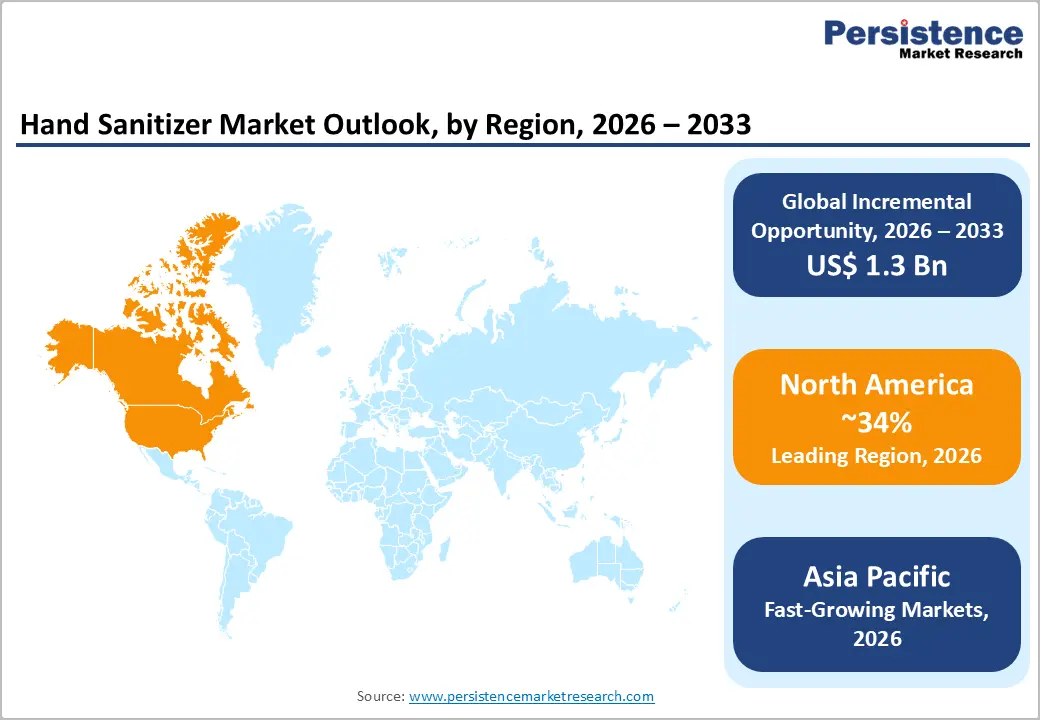
The study also contains a detailed regional analysis, which shows that North America controls the majority of the market for hand sanitizer. The study also provides a comprehensive COVID-19 impact analysis to help readers make well-informed business decisions for the present and future.

Hand Sanitizer Market Analysis from 2019 to 2024 Vs Market Outlook for 2025 to 2032

Between 2019 and 2024, demand for hand sanitizer recorded a 4.2% rise due to shifting consumer preferences towards convenient hygiene products is expected to drive the market.

Additionally, the government actively encourages the use of hand care products to raise consumer awareness and prevent health problems. For instance, the WHO and FDA have taken steps to raise awareness of hand hygiene and the dangers of not practising it, which is anticipated to create a favourable atmosphere for the growth of the hand sanitizer market.

Furthermore, rising influence of online advertisements and social media has exposed people to the latest trends in hygiene and personal care, which is accelerating the use of hand sanitizers. Moreover, key companies such as Hindustan Unilever, Reckitt Benckiser Group plc are also leading among consumers with their initiatives on spreading about basic hand hygiene. All of such factors has encouraged self-care, thus directly driving the sales of hand sanitizers in the market.

Why is Increasing Popularity of Online Retailing Good for Market Growth?

Massive online marketing campaigns and promotions present by manufacturer represent the restructured retail environment, where technological and e-Commerce and behemoths have changed consumer shopping behaviors and the retailing industry. Consumer goods is on the rise as a result of the growing online retailing sector. Both customers and retailers prefer online shopping.

All companies starts to markets their products in the internet channel, which allows for simple categorization to help customers choose the best item. Customers also can compare the qualities they have modified on online sites. Additionally, user evaluations are offered to assist potential consumers in understanding the product feedback.

The market participants can shift their attention from conventional specialty stores to e-commerce platforms, which will bring in more customers and increase their sales. With so many start-ups entering the market with e-Commerce platforms to trade their goods by providing discounts, home deliveries, and other alluring features, the players can now concentrate on increasing their online penetration in addition to their physical presence, as this gives them the chance to access a larger consumer base at once for the lowest possible cost.

How is Consumer Preference for Sustainable Personal Hygiene Providing Growth Opportunities to Market Players?

To avoid skin rashes caused by alcoholic hygiene products, consumers are increasingly turning to personal hygiene items made from sustainable and herbal ingredients such as ocinum sanctum, aloe vera, and others. Furthermore, plant-based hand sanitizers are considered safer than synthetic products as they are free of harmful chemicals.

Synthetic hand sanitizers can cause rashes and allergies, and long-term use can result in health problems. The growing demand for new and innovative products containing natural ingredients is expected to provide significant growth opportunities for players in the hand sanitizer market.

Manufacturers in the market are also constantly engaged in extensive R&D activities in order to develop safer products. Thus the growing demand for sustainable personal hygiene products has accelerated the sales of hand sanitizer in the market.

What are the Restraining Factor for the Market Growth?

Strict government regulations and rising health risks owing to chemical ingredients are set to restrain the growth of the hand sanitizer market. Hand sanitizers may contain methanol, also known as wood alcohol, which is a dangerous and toxic substance.

When in use, methanol can result in blindness or death and can have major negative effects when absorbed through the skin. Hand sanitizers are not suitable for human ingestion due to the high alcohol content and other substances in them.

Furthermore, side effects associated with the use of hand sanitizer such as ocular irritation and cough can limit the market growth to some extent. Hence, excess usage of harmful chemicals in hand sanitizer is a major challenge and is expected to adversely affect the growth of the market during the forecast period.

Country-wise Analysis

What are the Growth Opportunities in the US Hand Sanitizer Market?

The US is expected to register a market value share of ~ 19.5 % in global market.

North America is predicted to be one of the most attractive markets for hand sanitizers during the forecast period. In the region, the market in the US is expected to progress at a notable CAGR.

The market is anticipated to be driven by the majority of the population's increased concern for maintaining their health and hygiene. Due to greater product availability and expanded online and offline channel penetration, the market in the region is growing. Online retailers like Amazon, Flipkart, Grofers, and other online delivery service providers, for instance, sell a variety of hand hygiene items.

Additionally, this nation has the largest penetration of several hand sanitizer varieties, including gel-based, foam-based, spray, and wipes, as well as the most market participants. Because American consumers are more inclined to spend money on personal care and hygiene items, which will fuel market expansion, the country also controls the industry.

How is the China Market Proliferating?

The China is expected to grow at a CAGR of ~10.3% during 2025 to 2032. Consumption of personal hygiene products is increasing significantly coupled with increasing income across the globe. Moreover, a significant change has been observed in lower and middle income countries in terms of living standards, income, and urbanization along with economic contribution of the personal care industry. Consumption of hygiene products has increased significantly in Asian countries especially China over the last decade and the trend is expected to continue in the next few years.

Moreover, the increasing number of COVID-19 patients in this country has resulted in widespread consumption of hand cleaning products for germ protection purposes. This factor has played a significant role in driving the adoption of hand sanitizers in China during the past few years.

How Technology Innovation will drive the Demand for Hand Sanitizer in Germany?

Germany is expected to register a market value share of ~3.2% in global market. Germany has a substantial portion of the European hand sanitizer industry and is predicted to expand quickly. In order to attract customer purchases and broaden their market reach, businesses are continually applying new inventive ways in personal care items.

Further, innovation entails the inclusion of fragrance-effective ingredients in various hand-care categories, which raises consumer awareness of the efficacy of cleansing products. Increasing consumer preferences towards scented personal care products will boost the demand for aromatic hand sanitizers in the Germany market.

Moreover, addition of various ingredients such as water, propylene glycol and many others to develop anti-aging hand sanitizing lotions creates prominent solution for the hand aging problem and drives the market growth.

How is India Market Faring in Current Scenario?

India is expected to grow at a CAGR of ~9.5% during 2025 to 2032. The growth can be attributed to various government programmes and promotions regarding cleanliness and personal hygiene, which are helping to generate demand for personal care products. For instance, to increase public awareness of hand hygiene, WHO launched the "Seconds Save Lives, Clean Your Hands!" campaign on May 5, 2021. Increasing recommendations from doctor and health association for maintaining good hygiene habits are influencing demand for hand sanitizers in the Indian market.

Furthermore, growing infrastructure facilities such as colleges, schools, hospitals, restaurants, and residential facilities have fueled demand for personal care accessories and will continue to drive sales of hand sanitizers in the country.

Category-wise Insights

Which Product Holds Major Revenue Share in the Sales of Hand Sanitizer?

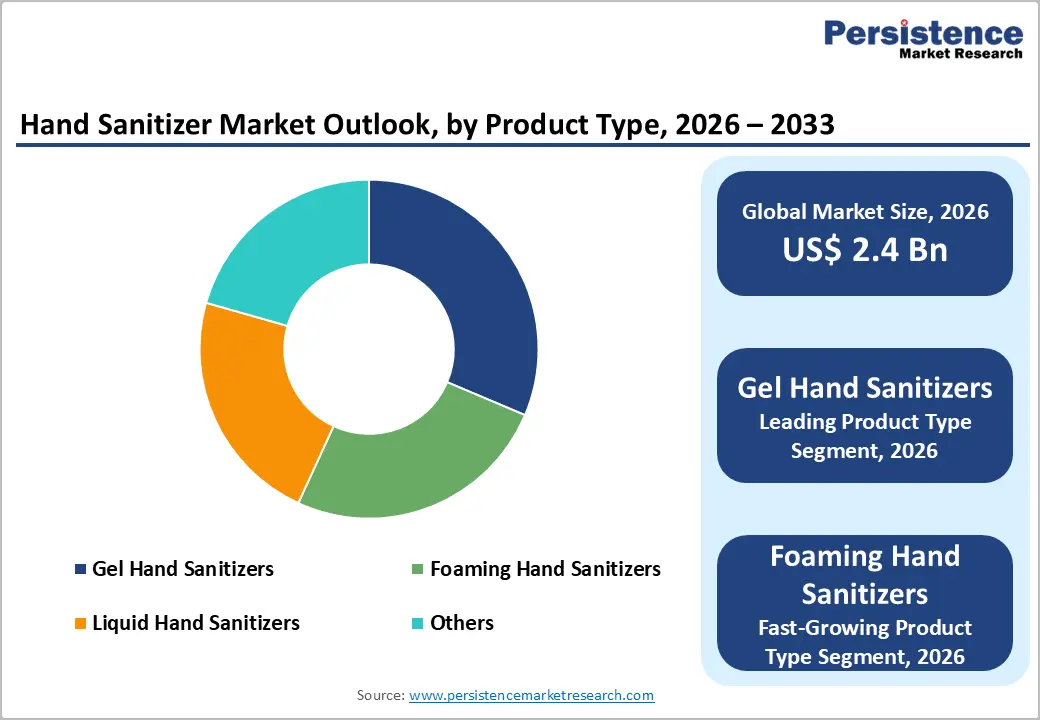
On the basis of product, gel hand sanitizers will continue to be the top-selling product in the market. Gel hand sanitizers are typically thin and watery in formulation, allowing them to be easily spread and penetrate the skin to kill the majority of bacteria. In recent years, the segment's growth has been driven by increased product availability and wider access to this type of hand sanitizer.

Gel hand sanitizers in terms of product segment is expected to register a market value share of 62.0%. Several prominent market players are stepping up their research and development efforts to provide high-quality hand sanitizer goods. As a result of more product advances that support a fiercely competitive sector, sales of hand sanitizer are rising.

Which Content Type is Most Preferred for Hand Sanitizer?

In terms of content, alcohol-based hand sanitizers are expected to dominate the market as they are more effective at protecting against germs. Furthermore, alcohol-based hand sanitizers do not promote antimicrobial resistance as a result, these sanitizers are widely used in hospitals to keep people and the hospital ambience infection-free.

However, the growing popularity of personal hygiene products fuels the demand for non-alcohol-based hand sanitizers. Alcohol-free sanitizers are considered more natural hand sanitizers because they avoid skin irritation and itching problems that are common in alcohol-based sanitizers due to their higher alcohol concentration.

As a result, manufacturers are concentrating on offering hand sanitizer products with alcohol contain. Alcohol-based hand sanitizers in terms of content segment is expected to grow at a rate of 47.5%.

Competition Landscape

The market for hand sanitizer is moderately competitive as compared at global level, with many producers competing for market supremacy. Market participants have been exposed to a variety of expansion tactics utilized by rivals over the past several years, such as partnerships, mergers, and acquisitions.

Companies Covered in Hand Sanitizer Market

  • The Procter and Gamble Company
  • Gojo industry Inc.
  • Reckitt Benckiser Group plc.
  • Best sanitizers Inc.
  • The Himalaya drug company
  • Henkel corporation
  • Unilever
  • Kutol products company
  • Linkwell corporation
  • Vi-Jon Laboratories, Inc.
  • Chattem Inc.
  • Cossmic Products
  • Carroll Company
  • Seatex Ltd.
  • Guangzhou Beaver Cosmetic Co., Ltd.
  • Xi'an Youpai Biotechnology Co., Ltd.
  • Guangdong Kanwan Cosmetics Co., Ltd.
  • Other Players (As Per Request)
Frequently Asked Questions

The global hand sanitizer market is valued at US$ 2,356.6 Mn as of 2025.

Hand sanitizer market is projected to increase at 6.3% CAGR and is expected to be valued at around US$ 3,614.3 Mn by 2032 end.

The Procter and Gamble Company., Gojo industry Inc., Reckitt Benckiser Group plc, Best sanitizers Inc., The Himalaya Drug Company. Henkel Corporation, Unilever, Kutol products company, Linkwell corporation, Vi-Jon Laboratories, Inc., Chattem Inc., Cossmic Products, Carroll Company Seatex Ltd., Guangzhou Beaver Cosmetic Co., Ltd., Xi'an Youpai Biotechnology Co., Ltd., and Unisource Shanghai Co., Ltd. Among others

Top 5 countries driving most of the demand for hand sanitizer are the US, Germany, Japan, China, and GCC Countries.

China, US, France, and Germany are major producers and exporters of hand sanitizer.

In recent years, product innovation has taken the lead in generating a demand for consumer goods, and consequently, manufacturers are investing in research and development, thereby widening growth prospects. Advancement in reusable products is boosting the demand for new product variants, as a consequence of which companies are investing towards sustainable products within the category.

Hand Sanitizer Market Industry Report Scope
Attribute Details

Forecast Period

2025-2032

Historical Data Available for

2019-2024

Market Analysis Units Value: US$ Bn/Mn, Volume: As applicable

Key Regions Covered

  • North America
  • Latin America
  • Europe
  • East Asia
  • South Asia
  • Oceania
  • MEA

Key Countries Covered

  • United States
  • Canada
  • Brazil
  • Mexico
  • Germany
  • UK
  • France
  • Spain
  • Italy
  • Russia
  • South Africa
  • Northern Africa
  • GCC Countries
  • China
  • Japan
  • South Korea
  • India
  • Thailand
  • Malaysia
  • Indonesia
  • Australia
  • New Zealand

Key Segments Covered

  • Product Type
  • Content
  • Packaging
  • End Use
  • Sales Channel
  • Region

Key Companies Profiled

  • The Procter and Gamble Company
  • Gojo industry Inc.
  • Reckitt Benckiser Group plc.
  • Best sanitizers Inc.
  • The Himalaya Drug Company
  • Henkel Corporation
  • Unilever
  • Kutol Products Company
  • Linkwell Corporation
  • Vi-Jon Laboratories, Inc.
  • Chattem Inc.
  • Cossmic Products
  • Carroll Company
  • Seatex Ltd.
  • Guangzhou Beaver Cosmetic Co., Ltd.
  • Xi'an Youpai Biotechnology Co., Ltd.
  • Unisource Shanghai Co., Ltd.
  • Other Players ( As Requested)
Report Highlights
  • Market Forecast and Trends
  • Competitive Intelligence & Share Analysis
  • Growth Factors and Challenges
  • Strategic Growth Initiatives
  • Pricing Analysis & Technology Roadmap
  • Future Opportunities and Revenue Pockets
  • Industry Market Analysis Tools

Customization & Pricing

Available upon Request

Key Segments Covered in Hand Sanitizer Industry Research

By Product Type

  • Gel Hand Sanitizers
  • Foaming Hand Sanitizers
  • Liquid Hand Sanitizers
  • Others

By Content

  • Alcohol-based Hand Sanitizers
  • Non-alcohol-based Hand Sanitizers

By Packaging

  • Flip-Flop Bottles
  • Pump Bottles
  • Dispensing Packets
  • Jars/Cans
  • Others

By End Use

  • Institutional
    • Hospitals & Healthcare
    • Offices/Commercial
    • Foodservice
    • Food Processing
    • Schools & Universities
    • Manufacturing & Industrial
    • Hospitality
    • Grocery, Convenience Stores & Retail
    • Others
  • Household

By Sales Channel

  • Direct Sales
  • Hypermarkets/Supermarkets
  • Pharmacy and Drug Stores
  • Discount Stores
  • Independent Departmental Stores
  • Online Retailers
  • Other Sales Channels

Region

  • North America
  • Latin America
  • Europe
  • East Asia
  • South Asia
  • Oceania
  • Middle East and Africa (MEA)

Related Reports

1. Executive Summary

    1.1. Global Market Outlook

    1.2. Summary of Key Statistics

    1.3. Summary of Key Findings

    1.4. Product Evolution Analysis

    1.5. PMR Analysis and Recommendations

2. Market Overview

    2.1. Market Taxonomy

    2.2. Market Definition

3. Key Market Trends

    3.1. Key Trends Impacting the Market

        3.1.1. Rapidly Growing Consumer Awareness For Hand Hygiene In Developing Countries

        3.1.2. Growing Trend of Personal Hygiene Globally

        3.1.3. Changing Retail Landscape

        3.1.4. Globalization Impacting Lifestyles

        3.1.5. Packaging, A Key To Brand Differentiation For Personal Care Products

    3.2. Product Innovation Trends

    3.3. Future Prospects of Personal Hygiene Industry

        3.3.1. Factors Fuelling Growth

        3.3.2. Influx of Brands

        3.3.3. Innovative Distribution & Marketing Strategies

4. Global Hand Sanitizer Market Demand Analysis 2019-2024 and Forecast, 2025-2032

    4.1. Historical Market Volume (Units) Analysis, 2019-2024

    4.2. Current and Future Market Volume (Units) Projections, 2025-2032

    4.3. Y-o-Y Growth Trend Analysis

5. Global Hand Sanitizer Market - Pricing Analysis

    5.1. Regional Pricing Analysis By Product Type

    5.2. Pricing Break-up

        5.2.1. Manufacturer Level Pricing

        5.2.2. Distributor Level Pricing

    5.3. Global Average Pricing Analysis Benchmark

6. Global Hand Sanitizer Market Demand (in Value or Size in US$ Mn) Analysis 2019-2024 and Forecast, 2025-2032

    6.1. Historical Market Value (US$ Mn) Analysis, 2019-2024

    6.2. Current and Future Market Value (US$ Mn) Projections, 2025-2032

        6.2.1. Y-o-Y Growth Trend Analysis

        6.2.2. Absolute $ Opportunity Analysis

7. Market Background

    7.1. Macro-Economic Factors

        7.1.1. Global GDP Growth Outlook

        7.1.2. Global Consumer Spending Outlook

        7.1.3. Global Population Growth Outlook

        7.1.4. Personal Care Industry Contribution to GDP Outlook

        7.1.5. Global E-Commerce Industry Outlook

        7.1.6. Per Capita Disposable Income

    7.2. Industry Value and Supply Chain Analysis

        7.2.1. Profit Margin Analysis at each sales point

        7.2.2. List & role of key participants

            7.2.2.1. Manufacturers

            7.2.2.2. Distributors/Retailers

            7.2.2.3. List of Private Label Brands

    7.3. Forecast Factors - Relevance & Impact

        7.3.1. Top Companies Historical Growth

        7.3.2. Global Industry Production Outlook

        7.3.3. Manufacturing Sector Gross Value Added

        7.3.4. Global Retail Sales Outlook

    7.4. PESTLE Analysis of Hand Sanitizer Market

    7.5. Region Wise Market Positioning Assessment

    7.6. Investment Feasibility Matrix of Hand Sanitizer Market

    7.7. Porter’s Five Force

    7.8. Market Dynamics

        7.8.1. Drivers

        7.8.2. Restraints

        7.8.3. Opportunity Analysis

8. Global Hand Sanitizer Market Analysis 2019-2024 and Forecast 2025-2032, by Product Type

    8.1. Introduction / Key Findings

    8.2. Historical Market Size (US$ Mn) and Volume (Units) Analysis By Product Type, 2019-2024

    8.3. Current and Future Market Size (US$ Mn) and Volume (Units) Analysis and Forecast By Product Type, 2025-2032

        8.3.1. Gel Hand Sanitizers

        8.3.2. Foaming Instant Hand Sanitizers

        8.3.3. Liquid Hand Sanitizers Gels

        8.3.4. Others

    8.4. Market Attractiveness Analysis By Product Type

9. Global Hand Sanitizer Market Analysis 2019-2024 and Forecast 2025-2032, By Content

    9.1. Introduction / Key Findings

    9.2. Historical Market Size (US$ Mn) and Volume (Units) Analysis By Content, 2019-2024

    9.3. Current and Future Market Size (US$ Mn) and Volume (Units) Analysis and Forecast By Content, 2025-2032

        9.3.1. Alcohol-based Hand Sanitizers

        9.3.2. Non-Alcohol-based Hand Sanitizers

    9.4. Market Attractiveness Analysis By Content

10. Global Hand Sanitizer Market Analysis 2019-2024 and Forecast 2025-2032, By Packaging

    10.1. Introduction / Key Findings

    10.2. Historical Market Size (US$ Mn) and Volume (Units) Analysis By Packaging, 2019-2024

    10.3. Current and Future Market Size (US$ Mn) and Volume (Units) Analysis and Forecast By Packaging, 2025-2032

        10.3.1. Flip-Flop Bottles

        10.3.2. Pump Bottles

        10.3.3. Dispensing Packets

        10.3.4. Jars/Cans

        10.3.5. Others

    10.4. Market Attractiveness Analysis By Packaging

11. Global Hand Sanitizer Market Analysis 2019-2024 and Forecast 2025-2032, By End Use

    11.1. Introduction / Key Findings

    11.2. Historical Market Size (US$ Mn) and Volume (Units) Analysis By End Use, 2019-2024

    11.3. Current and Future Market Size (US$ Mn) and Volume (Units) Analysis and Forecast By End Use, 2025-2032

        11.3.1. Institutional

            11.3.1.1. Hospitals & Healthcare

            11.3.1.2. Offices/Commercial

            11.3.1.3. Foodservice

            11.3.1.4. Food Processing

            11.3.1.5. Schools & Universities

            11.3.1.6. Manufacturing & Industrial

            11.3.1.7. Hospitality

            11.3.1.8. Grocery, Convenience Store & Retail

            11.3.1.9. Others

        11.3.2. Household

    11.4. Market Attractiveness Analysis By End Use

12. Global Hand Sanitizer Market Analysis 2019-2024 and Forecast 2025-2032, by Sales Channel

    12.1. Introduction / Key Findings

    12.2. Historical Market Size (US$ Mn) and Volume (Units) Analysis By Sales Channel, 2019-2024

    12.3. Current and Future Market Size (US$ Mn) and Volume (Units) Analysis and Forecast By Sales Channel, 2025-2032

        12.3.1. Direct Sales

        12.3.2. Hypermarkets/Supermarkets

        12.3.3. Pharmacy and Drug Stores

        12.3.4. Discount Stores

        12.3.5. Independent Departmental Stores

        12.3.6. Online Retailers

        12.3.7. Other Sales Channels

    12.4. Market Attractiveness Analysis By Sales Channel

13. Global Hand Sanitizer Market Analysis 2019-2024 and Forecast 2025-2032, by Region

    13.1. Introduction

    13.2. Historical Market Size (US$ Mn) and Volume (Units) Analysis By Region, 2019-2024

    13.3. Current Market Size (US$ Mn) and Volume (Units) Analysis and Forecast By Region, 2025-2032

        13.3.1. North America

        13.3.2. Europe

        13.3.3. Middle East and Africa (MEA)

        13.3.4. East Asia

        13.3.5. South Asia

        13.3.6. Oceania

        13.3.7. Latin America

    13.4. Market Attractiveness Analysis By Region

14. North America Hand Sanitizer Market Analysis 2019-2024 and Forecast 2025-2032

    14.1. Introduction

    14.2. Pricing Analysis

    14.3. Historical Market Size (US$ Mn) Trend Analysis By Market Taxonomy, 2019-2024

    14.4. Market Size (US$ Mn) and Volume Forecast By Market Taxonomy, 2025-2032

        14.4.1. By Country

            14.4.1.1. U.S.

            14.4.1.2. Canada

        14.4.2. By Product Type

        14.4.3. By Content

        14.4.4. By Packaging

        14.4.5. By End Use

        14.4.6. By Sales Channel

    14.5. Market Attractiveness Analysis

        14.5.1. By Country

        14.5.2. By Product Type

        14.5.3. By Content

        14.5.4. By Packaging

        14.5.5. By End Use

        14.5.6. By Sales Channel

15. Latin America Hand Sanitizer Market Analysis 2019-2024 and Forecast 2025-2032

    15.1. Introduction

    15.2. Pricing Analysis

    15.3. Historical Market Size (US$ Mn) Trend Analysis By Market Taxonomy, 2019-2024

    15.4. Market Size (US$ Mn) and Volume Forecast By Market Taxonomy, 2025-2032

        15.4.1. By Country

            15.4.1.1. Brazil

            15.4.1.2. Mexico

            15.4.1.3. Rest of Latin America

        15.4.2. By Product Type

        15.4.3. By Content

        15.4.4. By Packaging

        15.4.5. By End Use

        15.4.6. By Sales Channel

    15.5. Market Attractiveness Analysis

        15.5.1. By Country

        15.5.2. By Product Type

        15.5.3. By Content

        15.5.4. By Packaging

        15.5.5. By End Use

        15.5.6. By Sales Channel

16. Europe Hand Sanitizer Market Analysis 2019-2024 and Forecast 2025-2032

    16.1. Introduction

    16.2. Pricing Analysis

    16.3. Historical Market Size (US$ Mn) Trend Analysis By Market Taxonomy, 2019-2024

    16.4. Market Size (US$ Mn) and Volume Forecast By Market Taxonomy, 2025-2032

        16.4.1. By Country

            16.4.1.1. Germany

            16.4.1.2. Italy

            16.4.1.3. France

            16.4.1.4. U.K.

            16.4.1.5. Spain

            16.4.1.6. BENELUX

            16.4.1.7. Russia

            16.4.1.8. Rest of Europe

        16.4.2. By Product Type

        16.4.3. By Content

        16.4.4. By Packaging

        16.4.5. By End Use

        16.4.6. By Sales Channel

    16.5. Market Attractiveness Analysis

        16.5.1. By Country

        16.5.2. By Product Type

        16.5.3. By Content

        16.5.4. By Packaging

        16.5.5. By End Use

        16.5.6. By Sales Channel

17. South Asia Hand Sanitizer Market Analysis 2019-2024 and Forecast 2025-2032

    17.1. Introduction

    17.2. Pricing Analysis

    17.3. Historical Market Size (US$ Mn) Trend Analysis By Market Taxonomy, 2019-2024

    17.4. Market Size (US$ Mn) and Volume Forecast By Market Taxonomy, 2025-2032

        17.4.1. By Country

            17.4.1.1. India

            17.4.1.2. Thailand

            17.4.1.3. Indonesia

            17.4.1.4. Malaysia

            17.4.1.5. Rest of South Asia

        17.4.2. By Product Type

        17.4.3. By Content

        17.4.4. By Packaging

        17.4.5. By End Use

        17.4.6. By Sales Channel

    17.5. Market Attractiveness Analysis

        17.5.1. By Country

        17.5.2. By Product Type

        17.5.3. By Content

        17.5.4. By Packaging

        17.5.5. By End Use

        17.5.6. By Sales Channel

18. East Asia Hand Sanitizer Market Analysis 2019-2024 and Forecast 2025-2032

    18.1. Introduction

    18.2. Pricing Analysis

    18.3. Historical Market Size (US$ Mn) Trend Analysis By Market Taxonomy, 2019-2024

    18.4. Market Size (US$ Mn) and Volume Forecast By Market Taxonomy, 2025-2032

        18.4.1. By Country

            18.4.1.1. China

            18.4.1.2. Japan

            18.4.1.3. South Korea

        18.4.2. By Product Type

        18.4.3. By Content

        18.4.4. By Packaging

        18.4.5. By End Use

        18.4.6. By Sales Channel

    18.5. Market Attractiveness Analysis

        18.5.1. By Country

        18.5.2. By Product Type

        18.5.3. By Content

        18.5.4. By Packaging

        18.5.5. By End Use

        18.5.6. By Sales Channel

19. Oceania Hand Sanitizer Market Analysis 2019-2024 and Forecast 2025-2032

    19.1. Introduction

    19.2. Pricing Analysis

    19.3. Historical Market Size (US$ Mn) Trend Analysis By Market Taxonomy, 2019-2024

    19.4. Market Size (US$ Mn) and Volume Forecast By Market Taxonomy, 2025-2032

        19.4.1. By Country

            19.4.1.1. Australia

            19.4.1.2. New Zealand

        19.4.2. By Product Type

        19.4.3. By Content

        19.4.4. By Packaging

        19.4.5. By End Use

        19.4.6. By Sales Channel

    19.5. Market Attractiveness Analysis

        19.5.1. By Country

        19.5.2. By Product Type

        19.5.3. By Content

        19.5.4. By Packaging

        19.5.5. By End Use

        19.5.6. By Sales Channel

20. Middle East and Africa Hand Sanitizer Market Analysis 2019-2024 and Forecast 2025-2032

    20.1. Introduction

    20.2. Pricing Analysis

    20.3. Historical Market Size (US$ Mn) Trend Analysis By Market Taxonomy, 2019-2024

    20.4. Market Size (US$ Mn) and Volume Forecast By Market Taxonomy, 2025-2032

        20.4.1. By Country

            20.4.1.1. GCC Countries

            20.4.1.2. South Africa

            20.4.1.3. Northern Africa

            20.4.1.4. Rest of MEA

        20.4.2. By Product Type

        20.4.3. By Content

        20.4.4. By Packaging

        20.4.5. By End Use

        20.4.6. By Sales Channel

    20.5. Market Attractiveness Analysis

        20.5.1. By Country

        20.5.2. By Product Type

        20.5.3. By Content

        20.5.4. By Packaging

        20.5.5. By End Use

        20.5.6. By Sales Channel

21. Key Countries’ Hand Sanitizer Market Analysis, 2022

    21.1. Introduction

        21.1.1. Market Value Proportion Analysis, By Key Countries

        21.1.2. Global Vs. Country Growth Comparison

    21.2. US Hand Sanitizer Market Analysis

        21.2.1. By Product Type

        21.2.2. By Content

        21.2.3. By Packaging

        21.2.4. By End Use

        21.2.5. By Sales Channel

    21.3. Canada Hand Sanitizer Market Analysis

        21.3.1. By Product Type

        21.3.2. By Content

        21.3.3. By Packaging

        21.3.4. By End Use

        21.3.5. By Sales Channel

    21.4. Mexico Hand Sanitizer Market Analysis

        21.4.1. By Product Type

        21.4.2. By Content

        21.4.3. By Packaging

        21.4.4. By End Use

        21.4.5. By Sales Channel

    21.5. Brazil Hand Sanitizer Market Analysis

        21.5.1. By Product Type

        21.5.2. By Content

        21.5.3. By Packaging

        21.5.4. By End Use

        21.5.5. By Sales Channel

    21.6. Germany Hand Sanitizer Market Analysis

        21.6.1. By Product Type

        21.6.2. By Content

        21.6.3. By Packaging

        21.6.4. By End Use

        21.6.5. By Sales Channel

    21.7. Italy Hand Sanitizer Market Analysis

        21.7.1. By Material

        21.7.2. By Design

        21.7.3. By Distribution Channel

    21.8. UK Hand Sanitizer Market Analysis

        21.8.1. By Product Type

        21.8.2. By Content

        21.8.3. By Packaging

        21.8.4. By End Use

        21.8.5. By Sales Channel

    21.9. China Hand Sanitizer Market Analysis

        21.9.1. By Product Type

        21.9.2. By Content

        21.9.3. By Packaging

        21.9.4. By End Use

        21.9.5. By Sales Channel

    21.10. Japan Hand Sanitizer Market Analysis

        21.10.1. By Material

        21.10.2. By Design

        21.10.3. By Distribution Channel

    21.11. S. Korea Hand Sanitizer Market Analysis

        21.11.1. By Product Type

        21.11.2. By Content

        21.11.3. By Packaging

        21.11.4. By End Use

        21.11.5. By Sales Channel

    21.12. India Hand Sanitizer Market Analysis

        21.12.1. By Product Type

        21.12.2. By Content

        21.12.3. By Packaging

        21.12.4. By End Use

        21.12.5. By Sales Channel

    21.13. Australia and New Zealand Hand Sanitizer Market Analysis

        21.13.1. By Product Type

        21.13.2. By Content

        21.13.3. By Packaging

        21.13.4. By End Use

        21.13.5. By Sales Channel

    21.14. South Africa Hand Sanitizer Market Analysis

        21.14.1. By Product Type

        21.14.2. By Content

        21.14.3. By Packaging

        21.14.4. By End Use

        21.14.5. By Sales Channel

22. Market Structure Analysis

    22.1. Market Analysis by Tier of Companies (Hand Sanitizer)

    22.2. Market Concentration

    22.3. Market Share Analysis of Top Players

    22.4. Market Presence Analysis

        22.4.1. By Regional Footprint of Players

        22.4.2. Product Footprint by Players

        22.4.3. Channel Footprint by Players

23. Competition Analysis

    23.1. Competition Dashboard

    23.2. Pricing Analysis by Competition

    23.3. Competition Benchmarking

    23.4. Competition Deep Dive

        23.4.1. The Procter and Gamble Company.

            23.4.1.1. Overview

            23.4.1.2. Product Portfolio

            23.4.1.3. Profitability by Market Segments (Product/Channel/Region)

            23.4.1.4. Sales Footprint

            23.4.1.5. Strategy Overview

        23.4.2. Gojo industry Inc.

            23.4.2.1. Overview

            23.4.2.2. Product Portfolio

            23.4.2.3. Profitability by Market Segments (Product/Channel/Region)

            23.4.2.4. Sales Footprint

            23.4.2.5. Strategy Overview

        23.4.3. Reckitt Benckiser Group plc.

            23.4.3.1. Overview

            23.4.3.2. Product Portfolio

            23.4.3.3. Profitability by Market Segments (Product/Channel/Region)

            23.4.3.4. Sales Footprint

            23.4.3.5. Strategy Overview

        23.4.4. Best sanitizers Inc.

            23.4.4.1. Overview

            23.4.4.2. Product Portfolio

            23.4.4.3. Profitability by Market Segments (Product/Channel/Region)

            23.4.4.4. Sales Footprint

            23.4.4.5. Strategy Overview

        23.4.5. The Himalaya drug company

            23.4.5.1. Overview

            23.4.5.2. Product Portfolio

            23.4.5.3. Profitability by Market Segments (Product/Channel/Region)

            23.4.5.4. Sales Footprint

            23.4.5.5. Strategy Overview

        23.4.6. Henkel Corporation

            23.4.6.1. Overview

            23.4.6.2. Product Portfolio

            23.4.6.3. Profitability by Market Segments (Product/Channel/Region)

            23.4.6.4. Sales Footprint

            23.4.6.5. Strategy Overview

        23.4.7. Unilever

            23.4.7.1. Overview

            23.4.7.2. Product Portfolio

            23.4.7.3. Profitability by Market Segments (Product/Channel/Region)

            23.4.7.4. Sales Footprint

            23.4.7.5. Strategy Overview

        23.4.8. Kutol Products Company

            23.4.8.1. Overview

            23.4.8.2. Product Portfolio

            23.4.8.3. Profitability by Market Segments (Product/Channel/Region)

            23.4.8.4. Sales Footprint

            23.4.8.5. Strategy Overview

        23.4.9. Linkwell Corporation

            23.4.9.1. Overview

            23.4.9.2. Product Portfolio

            23.4.9.3. Profitability by Market Segments (Product/Channel/Region)

            23.4.9.4. Sales Footprint

            23.4.9.5. Strategy Overview

        23.4.10. Vi-Jon Laboratories, Inc.

            23.4.10.1. Overview

            23.4.10.2. Product Portfolio

            23.4.10.3. Profitability by Market Segments (Product/Channel/Region)

            23.4.10.4. Sales Footprint

            23.4.10.5. Strategy Overview

        23.4.11. Chattem Inc.

            23.4.11.1. Overview

            23.4.11.2. Product Portfolio

            23.4.11.3. Profitability by Market Segments (Product/Channel/Region)

            23.4.11.4. Sales Footprint

            23.4.11.5. Strategy Overview

        23.4.12. Cossmic Products

            23.4.12.1. Overview

            23.4.12.2. Product Portfolio

            23.4.12.3. Profitability by Market Segments (Product/Channel/Region)

            23.4.12.4. Sales Footprint

            23.4.12.5. Strategy Overview

        23.4.13. Carroll Company

            23.4.13.1. Overview

            23.4.13.2. Product Portfolio

            23.4.13.3. Profitability by Market Segments (Product/Channel/Region)

            23.4.13.4. Sales Footprint

            23.4.13.5. Strategy Overview

        23.4.14. Seatex Ltd.

            23.4.14.1. Overview

            23.4.14.2. Product Portfolio

            23.4.14.3. Profitability by Market Segments (Product/Channel/Region)

            23.4.14.4. Sales Footprint

            23.4.14.5. Strategy Overview

        23.4.15. Guangzhou Beaver Cosmetic Co., Ltd.

            23.4.15.1. Overview

            23.4.15.2. Product Portfolio

            23.4.15.3. Profitability by Market Segments (Product/Channel/Region)

            23.4.15.4. Sales Footprint

            23.4.15.5. Strategy Overview

        23.4.16. Xi'an Youpai Biotechnology Co., Ltd.

            23.4.16.1. Overview

            23.4.16.2. Product Portfolio

            23.4.16.3. Profitability by Market Segments (Product/Channel/Region)

            23.4.16.4. Sales Footprint

            23.4.16.5. Strategy Overview

        23.4.17. Guangdong Kanwan Cosmetics Co., Ltd.

            23.4.17.1. Overview

            23.4.17.2. Product Portfolio

            23.4.17.3. Profitability by Market Segments (Product/Channel/Region)

            23.4.17.4. Sales Footprint

            23.4.17.5. Strategy Overview

        23.4.18. Other Players (As Per Request)

            23.4.18.1. Overview

            23.4.18.2. Product Portfolio

            23.4.18.3. Profitability by Market Segments (Product/Channel/Region)

            23.4.18.4. Sales Footprint

            23.4.18.5. Strategy Overview

24. Assumptions and Acronyms Used

25. Research Methodology

Research Methodology Framework for Market Research Excellence

At Persistence Market Research, we implement a comprehensive, validated, and multi-dimensional approachto market analysis that delivers actionable insights across complex market landscapes. Our methodology combines the analytical rigor of leading consulting firms with innovative research techniques, ensuring robust market assessments that guide strategic decision-making with confidence.

Core Research Philosophy

Our methodology is built on four foundational pillars:

Research Philosophy Image

At Persistence Market Research, our methodology is designed to transcend conventional market studies by combining analytical rigor, multi-source validation, and future-focused insights.

We integrate advanced research frameworks, robust data collection strategies, cutting-edge analytics, and innovative technologies to deliver a 360-degree view of complex markets.

We integrate advanced research frameworks, robust data collection strategies, cutting-edge analytics, and innovative technologies to deliver a 360-degree view of complex markets.

Each stage spanning from strategic scoping and hypothesis-building to competitive intelligence, quality validation, and actionable recommendations is engineered to provide clients with unmatched clarity, precision, and confidence in decision-making.

By embedding innovation and technology at the core, our approach ensures that insights are not only comprehensive but also predictive, empowering businesses to seize opportunities, mitigate risks, and achieve sustainable growth

Research Philosophy Image

Capturing Key Information and Events

During this phase, key research objectives focus on essential information and data points for assessing the market, including:

Research Philosophy Image

TAM-SAM-SOM Framework Implementation

We employ both top-down and bottom-up approaches to ensure accurate market sizing.

Top-Down Market SizingBottom-Up Market Sizing
Universe Definition: Total global/regional market identificationUnit Economics: Average transaction values, purchase frequencies, customer lifecycle
Segmentation Filters: Geographic, demographic, and behavioral constraintsCustomer Segmentation: Detailed buyer persona development and sizing
Market Share Analysis: Competitive landscape assessment and share allocationPenetration Analysis: Market penetration rates by segment and geography
Growth Rate Application: Historical trends and forward-looking growth assumptionsScaling Methodology: Extrapolation techniques with confidence intervals

Validation & Cross-Verification

  • Triangulation: Comparing top-down and bottom-up results for consistency
  • Sensitivity Analysis: Testing key assumptions and parameter variations
  • Peer Benchmarking: Comparison with analogous markets and industry benchmarks
  • Expert Review: External validation through industry specialist consultation

Research Philosophy Image

Forecasting & Projection Modeling

Our proprietary forecasting models incorporate multiple variables and scenarios.

Forecasting Components

  • Historical Trend Analysis: 10-year historical growth patterns and cyclical variations
  • Driver-Based Modeling: Economic indicators, demographic shifts, technology adoption
  • Scenario Planning: Base case, optimistic, and conservative projections
  • Monte Carlo Simulations: Probability-weighted outcomes and risk assessments

Model Validation

  • Back-Testing: Historical accuracy assessment over 3–5-year periods
  • Cross-Validation: Multiple modeling approaches for result comparison
  • External Benchmarking: Comparison with established market forecasts
  • Continuous Calibration: Quarterly model updates based on new data

Comprehensive Data Collection Strategy

Our secondary research phase establishes a robust knowledge base utilizing diverse, credible sources.

Secondary Data Sourcess

  • Industry Publications & Reports
  • Government & Regulatory Data
  • Financial Intelligence (filings & reports)
  • Academic Research & Digital Intelligence

Quality Assurance Protocol

  • Source credibility assessment and publication date validation
  • Data consistency checks across multiple sources
  • Bias identification and neutralization techniques
  • Information gap tracking for primary research prioritization

Research Philosophy Image

Primary Research Excellence

Our primary research methodology employs best-in-class techniques to capture unique market insights.

Quantitative Research Methods

  • Large-Scale Surveys: Statistically representative samples with 95% confidence intervals
  • Survey Methodology: Multi-channel deployment (online, telephone, in-person)
  • Question Architecture and Response Optimization

Qualitative Research Methods

  • Executive Interviews
  • Focus Groups
  • Expert Consultations

Quality Assurance & Validation Framework

Multi-Stage Validation Process

  • Source Verification and Consistency Testing
  • Outlier Detection and Bias Assessment
  • Peer Review Process and External Validation
  • Sensitivity Analysis and Confidence Intervals

Research Philosophy Image

Methodology Validation & Credibility

Our research methodology has been extensively validated through:

  • Academic Partnerships: Collaborations with top-tier business schools and research institutions
  • Client Success Stories: Documented case studies demonstrating research impact and ROI
  • Continuous Benchmarking: Performance comparison with leading global research firms

This comprehensive methodology framework positions Persistence Market Research at the forefront of market intelligence, combining the analytical sophistication of top-tier consulting firms with innovative research techniques. Our approach ensures that every market assessment delivers precise, actionable, and strategically valuable insights that drive business success in competitive market environments.

Ready to unlock your market potential? Contact our research experts to discuss how our validated methodology can transform your strategic decision-making with data-driven market intelligence.

Copyright © 2026 Persistence Market Research. All Rights Reserved

Connect With Us -