




- Retail
- Second Hand Books Market
Second Hand Books Market Size, Share, Trends, Growth, Regional Forecasts 2026 - 2033
Second Hand Books Market by Book Type (Academic Books; Fantasy, Horror & Science Fiction; Action & Adventure; Biographies & Comics; Sciences, Technology & Medicine; Art, Music, Film & Photography; Health, Personal Development & Politics; Politics & Religion; Crafts, Home & Lifestyle; Sports & Travel; Miscellaneous), Price Range (Mass / Economy, Premium), End-user, Sales Channel, and Regional Analysis from 2026 - 2033

Second Hand Books Market Share and Trends Analysis
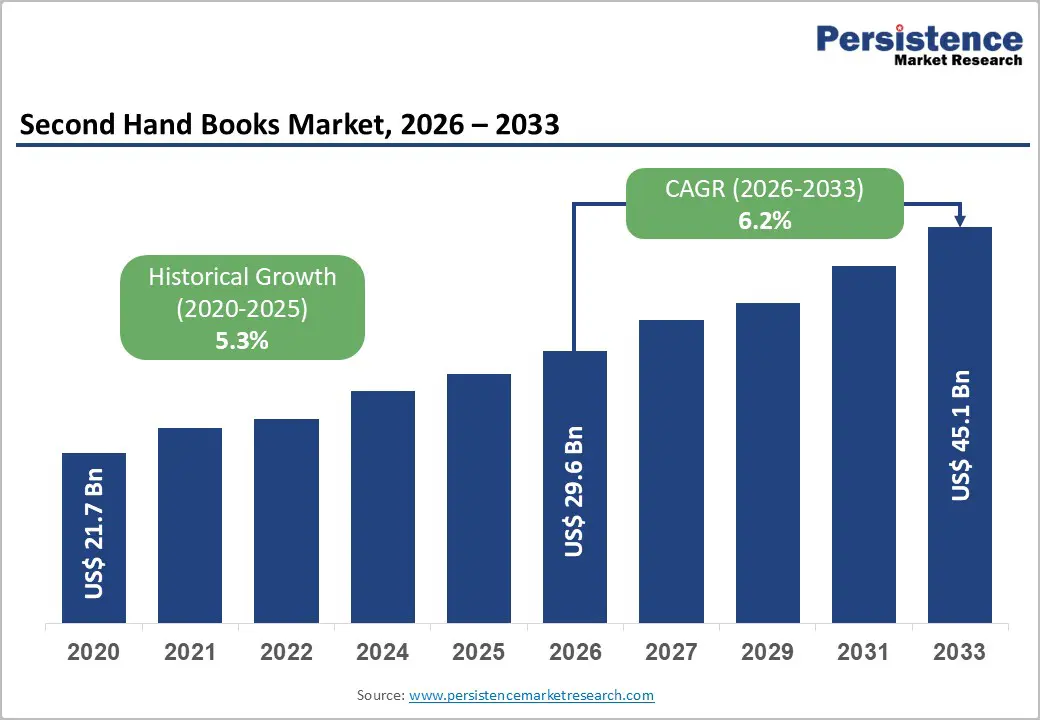
The global second-hand books market size is likely to be valued at US$ 29.6 billion in 2026 and is projected to reach US$ 45.1 billion by 2033, growing at a CAGR of 6.2% between 2026 and 2033.
Market expansion is driven by environmental consciousness supporting circular-economy book reuse, rising affordability pressures favoring second-hand alternatives, and accelerating e-commerce adoption, which is improving access to diverse inventories. North America holds a prominent share via sustainability awareness, Asia Pacific leads with ~33% share from literacy growth, while Europe grows at 5.4% CAGR.
Key Industry Highlights:
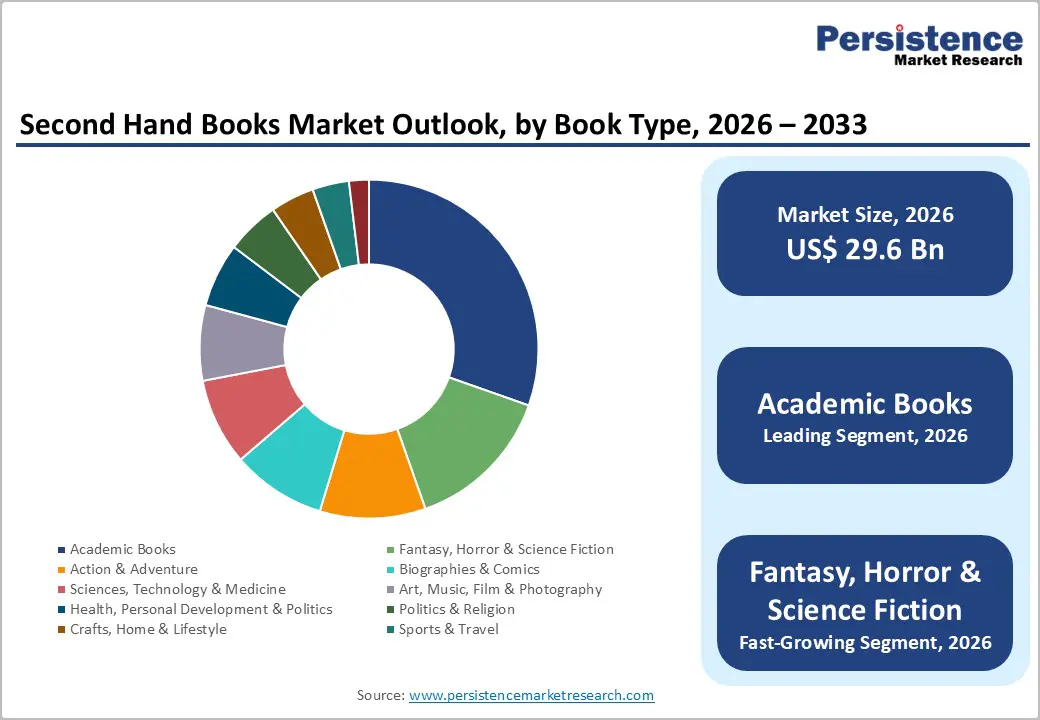
- Academic books command 30% market share, while Health, Personal Development & Politics segment accelerates at 6.5% CAGR reflecting wellness consciousness growth.
- Mass/Economy price range dominates with 74% market share, while premium second-hand segment expands at 5% CAGR supporting margin expansion.
- Individual consumers maintain 64% market dominance, while institutional buyers expand at 7.2% CAGR, supporting B2B channel growth.
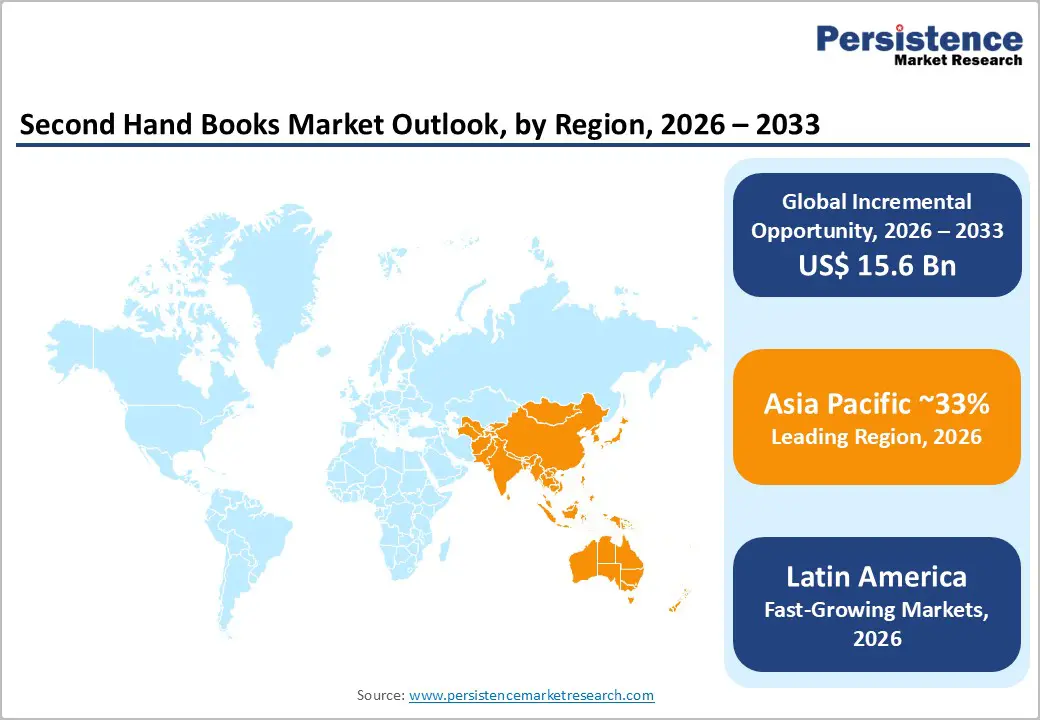
- North America holds 30% market share, Europe is likely to expand at a 5.4% CAGR at 27% share, while Asia Pacific commands 33% share, driven by emerging market growth.
- ThriftBooks expanded to 13+ million title inventory, Crossword targets 300 stores by 2030, and Better World Books advances social responsibility positioning, demonstrating competitive momentum and strategic differentiation.
| Key Insights | Details |
|---|---|
|
Second Hand Books Market Size (2026E) |
US$ 29.6 billion |
|
Market Value Forecast (2033F) |
US$ 45.1 billion |
|
Projected Growth CAGR (2026-2033) |
6.2% |
|
Historical Market Growth (2020-2025) |
5.3% |
Market Dynamics Analysis
Drivers - Environmental Sustainability Consciousness and Circular Economy Adoption Supporting Market Growth
Rising environmental consciousness and circular economy participation are systematically driving second-hand book market expansion, with purchasing one used book instead of new saving approximately one pound of carbon emissions and over two cups of water, supporting consumer preference for sustainable consumption patterns and resource conservation.
Paper production requires approximately 24 trees per ton, demonstrating substantial deforestation implications of new book manufacturing. Carbon reduction of 60%+ compared to new book purchases, quantifying environmental benefits and supporting sustainability justification. Global sustainability awareness is accelerating with consumers seeking alternatives to resource-intensive new products, supporting a market preference shift toward second-hand options. Regulatory frameworks, including European environmental policies promoting reuse and recycling, create institutional drivers for second-hand book adoption. Extended book lifecycle through reuse, reducing landfill waste and supporting circular economy objectives across consumer segments.
Cost-Effective Alternative to New Books Supporting Affordability-Driven Consumer Demand
Escalating new book prices and budget constraints are systematically driving consumer preference for affordable second-hand alternatives, with second-hand books typically priced 50-75% below new book retail prices, substantially improving affordability and supporting purchase volume expansion across cost-sensitive demographics. Educational cost pressures driving student and institutional buyer preference for used academic textbooks, creating sustained demand from education segment. Rising literacy and reading habits coupled with limited discretionary income, supporting demand for affordable reading materials. Income inequality and economic pressures affecting middle and lower-income consumer segments driving second-hand adoption. Digital media competition reducing new book demand and increasing inventory availability for second-hand channels. Rental market emergence offering alternatives to purchase-based consumption patterns supporting cost management.
Restraints - Quality Assurance Challenges and Condition Variability Affecting Consumer Confidence
Second-hand book market growth is constrained by quality assurance challenges and inconsistent condition descriptions, with condition variability across sellers and limited standardized grading protocols creating consumer frustration and purchase hesitation particularly for premium and rare books. Seller description inconsistency regarding book condition, damage, and markings creating buyer disappointment. Product inspection constraints in online sales limiting physical assessment capability. The complexity of return and refund policies affects consumer confidence in purchase decisions. Quality inconsistency across seller networks supporting competitive disadvantage for quality-focused sellers. Reputational risks from negative buyer experiences affect platform trust and repeat purchases.
Limited Inventory Availability for Specific Titles and High-Demand Books
Second-hand book market expansion is constrained by supply limitations for specific titles, particularly recent releases and high-demand publications, with limited availability of newly released books in second-hand channels, creating inventory constraints that restrict market addressability for current bestsellers and popular fiction. Supply lag for recent publications as second-hand inventory typically accumulates with time delay. Competitive purchasing from multiple buyers creating scarcity for popular titles. Geographic inventory disparities affecting regional book availability. Out-of-print inventory concentration supporting rare but limiting common title availability. Consumer preference for new releases, particularly in fiction categories, constrains the applicability of the second-hand channel.
Opportunity - Emerging Markets and Developing Region Expansion Supporting Literacy Growth
Emerging markets and developing regions represent a substantial opportunity driven by rising middle-class populations and expanding literacy initiatives, with the Asia Pacific commanding 33% global market share and demonstrating accelerated growth that supports affordability-led expansion across developing economies. India and Southeast Asia are witnessing rapid literacy gains, creating new reader populations and sustained demand for low-cost reading materials. The affordability imperative in emerging markets strongly favors second-hand books over new purchases, reinforcing reuse cycles. Ongoing infrastructure development is improving e-commerce logistics, payment systems, and last-mile delivery capabilities. Government-led literacy and education programs are supporting institutional procurement volumes, while rising smartphone penetration enables seamless access to digital platforms, price comparison, and inventory discovery, collectively accelerating second-hand market penetration across urban regions.
Specialized Niche Markets and Rare Book Segment Expansion
Specialized niche markets including rare, collectible, and out-of-print books represent a significant opportunity driven by growing collector demand and bibliophile interest, supporting premium pricing and margin expansion across curated inventory segments. The rare book market continues to expand among private collectors, libraries, and academic institutions seeking long-term value preservation. Demand for out-of-print and discontinued titles remains strong, particularly for academic, technical, and reference materials with limited reprint availability.
Signed copies and first-edition books enable premium positioning, commanding substantially higher price realization than standard second-hand titles. Carefully curated genre collections spanning academic, technical, and vintage categories support niche differentiation strategies. The expansion of global e-commerce platforms enables international collectors to access the market, supports cross-border transactions, and broadens visibility, further accelerating the growth of the specialized second-hand book market.
Category-wise Analysis
Book Type Insights
Academic books command 30% of global second-hand market share, representing dominant category driven by cost-driven student demand for textbooks and educational materials, supporting sustained institutional purchasing and individual consumer preference for affordable education materials supporting dominant market positioning. Textbook market leadership reflecting education cost pressures. Reference material demand among students and professionals. Educational institution purchasing supporting volume demand. Content stability enabling long-lived utility despite publication age.
Health, personal development, and political books expand at 6.5% CAGR, driven by growing wellness consciousness and personal development interest supporting emerging category growth and sustained reader engagement with self-improvement and health-focused content supporting expanding market segment. Wellness and mindfulness trend supporting health book demand. Personal development industry expansion driving category growth. Political awareness and engagement supporting political book readership. Self-help market growth supporting category expansion.
Price Range Insights
Mass market and economy second-hand books command 74% market share, representing dominant price positioning reflecting broad affordability preference and cost-conscious consumer base supporting widespread market accessibility and volume-driven business model supporting market dominance. Budget-driven purchasing among general consumer population. Volume sales model supporting profitability. Broad accessibility across demographic segments.
Premium second-hand books expand at 5% CAGR, driven by rare, collectible, and specialty book demand supporting margin expansion and affluent collector segment targeting supporting premium positioning and profitability improvement among specialized sellers. Rare book premium pricing supporting margin expansion. Collectible market growth among affluent consumers. Specialty book demand supporting differentiation.
End-user Insights
Individual consumers command 64% of market share, representing dominant end-user segment driven by general reading population and cost-conscious consumer preference for affordable books supporting consumer-focused retail and platform dominance across market channels. General reading population demand supporting volume market. Cost-conscious purchasing driving market expansion. Diverse genre preferences enabling broad inventory development.
Institutional buyers expand at 7.2% CAGR, driven by library procurement programs and educational institution purchasing supporting volume growth and institutional segment expansion supporting B2B channel development and sustained institutional demand. Library collection development supporting institutional purchasing. Educational institution budgets driving volume demand. Sustainability programs supporting institutional commitment. Cost management driving institutional adoption.
Sales Channel Insights
Online retailers command 41% of market share, representing dominant sales channel reflecting e-commerce platform proliferation and digital consumer preference supporting online channel dominance and digital transformation supporting market concentration among platform leaders. Amazon and eBay dominance controlling substantial market share. Specialized platforms including ThriftBooks, AbeBooks, and Alibris. Platform convenience supporting consumer adoption. Technology advantage enabling inventory management.
Specialty and multi-brand bookstores expand at a 5.3% CAGR, driven by a preference for physical retail experiences and community engagement, supporting brick-and-mortar channel growth and traditional retail channel expansion, and fueling an experiential retail resurgence. Physical bookstore experience supporting community engagement. Local store development in emerging markets. Crossword Bookstores' expansion to 300 stores by 2030. In-store curation supporting differentiation.
Regional Market Insights
North America Second Hand Books Market Trends
North America maintains prominent 30% global market share, driven by mature e-commerce infrastructure, strong sustainability consciousness, and established digital literacy supporting market leadership and sustained growth momentum across diversified consumer segments. U.S. market dominance reflecting e-commerce maturity. Amazon platform leadership commanding substantial used book sales. Strong environmental consciousness supporting sustainability adoption. Established book culture supporting reader populations. Digital infrastructure maturity enabling seamless e-commerce transactions. Consumer preference for convenience supporting online channel adoption.
North American market is characterized by online channel dominance, with Amazon and eBay commanding substantial volumes. E-commerce platform proliferation is enabling competitive dynamics. Environmental consciousness supporting green purchasing motivations. Mature logistics infrastructure supporting efficient delivery.
Europe Second Hand Books Market Trends
Europe commands 27% global market share with 5.4% CAGR growth, driven by established book culture, environmental policy frameworks promoting reuse and recycling, and developed retail infrastructure supporting sustained market expansion across mature markets. German and U.K. market strength supporting regional growth. Environmental policy support for the circular economy. Developed retail infrastructure enabling market penetration. Strong book culture supporting reader populations. Regulatory framework support for sustainability initiatives.
European market is characterized by strong environmental consciousness and policy support for second-hand consumption. Established bookstore networks providing retail access. Digital platform integration supporting online channels. Sustainability-focused consumer segments driving market preference.
Asia Pacific Second-Hand Books Market Trends
Asia Pacific commands a significant 33% market share, driven by expanding middle-class populations, emerging literacy initiatives, affordability imperatives that are supporting rapid growth in emerging markets, and e-commerce platform expansion that is creating substantial market opportunity. China and India market growth support population-driven demand. Affordability priority driving second-hand adoption. E-commerce platform development enabling market access. Rising literacy rates support reader population expansion. Mobile commerce dominance enabling digital platform adoption.
Asia Pacific market is characterized by rapid growth in emerging markets, particularly India and Southeast Asia. Affordability-driven consumer preference supporting second-hand adoption. Mobile platform dominance enables digital accessibility. Government literacy initiatives supporting institutional demand.
Competitive Landscape
The global second-hand books market exhibits consolidated structure with Amazon dominance through AbeBooks acquisition and massive Marketplace used book sales, commanding estimated 40-45% global market share, complemented by eBay, ThriftBooks maintaining 15-20% combined share, with specialized players including Alibris, Better World Books, and Biblio supporting 10-15% combined share, and regional specialists including Crossword Bookstores in India and specialty platforms supporting 20-25% collective share.
Strategic Developments
- In May 2024, ThriftBooks became the exclusive national book partner for Little Free Library, sponsoring 15 Little Free boxes and committing 10,000+ book donations annually, supporting community access expansion and literacy advancement nationwide.
- In 2024, Crossword Bookstores successfully opened flagship stores in Patna, Lucknow, Dehradun, and Jamshedpur, with expansion planned in Chennai, Siliguri, and Hyderabad, demonstrating tier-2/3 city market readiness and expansion momentum.
Companies Covered in Second Hand Books Market
- Amazon Inc.
- eBay Inc.
- ThriftBooks
- Alibris Inc.
- Better World Books
- Biblio.com
- Crossword Bookstores Ltd.
- Bookadda
- BookChor
- 99bookscart
- Powells.com
- BookMafiya
Frequently Asked Questions
The global second-hand books market is likely to be valued at US$ 29.6 billion in 2026 and is projected to reach US$ 45.1 billion by 2033.
Market growth is driven by rising environmental sustainability awareness supporting circular economy adoption, strong affordability advantages with used books priced 50–75% lower than new books, and rapid e-commerce penetration enabling large-scale digital access to diverse inventories.
The market is projected to grow at a 6.23% CAGR during 2026–2033.


