




- Food Ingredients & Additives
- Gum Benzoin Market
Gum Benzoin Market Size, Share and Growth Forecast, 2026-2033
Gum Benzoin Market by Product Type (Natural Gum Benzoin, Tinctures & Extracts, Absolutes & Resinoids, Essential Oils & Concentrates), Consumer Demand Dynamics (Organic Demand, Functional Wellness & Therapeutic Use, Premium & Artisan Product Positioning, Sustainability & Traceability), End Use Industry (Fragrances & Perfumery, Cosmetics & Personal Care, Pharmaceuticals & Healthcare, Food & Beverages, Aromatherapy & Wellness, Religious & Ritual Products, Specialty Industrial & Artisan Uses) and Regional Analysis for 2026-2033

Gum Benzoin Market Share and Trends Analysis
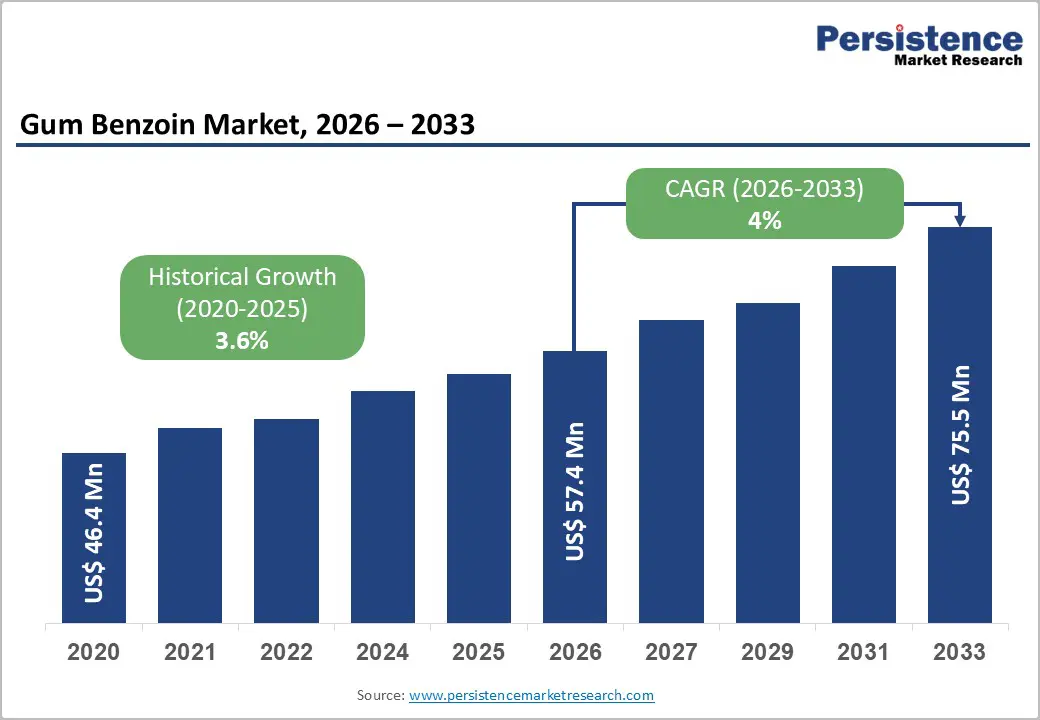
The global gum benzoin market size is likely to be valued at US$ 57.4 million in 2026, and is projected to reach US$ 75.5 million by 2033, growing at a CAGR of 4.0% during the forecast period of 2026–2033. The expansion of the market is primarily driven by increasing demand for natural resins in perfumery, incense, and pharmaceutical applications, coupled with consumer preference for plant-based ingredients. Gum benzoin is widely used as a fixative, fragrance stabilizer, and antimicrobial agent, strengthening downstream demand. Supply is concentrated in Southeast Asia, resulting in pricing sensitivity but maintaining long-term value due to limited botanical availability and slow regeneration cycles.
Key Industry Highlights
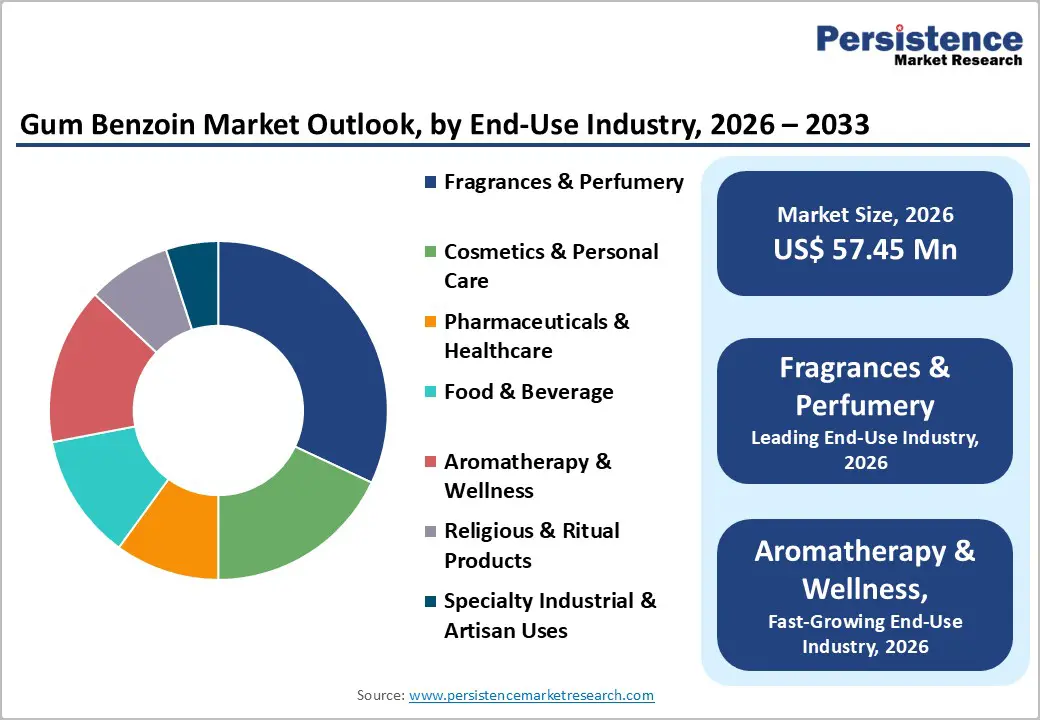
- End?Use Industry: Fragrances & perfumery is likely to lead with around 32% share in 2026, while aromatherapy & wellness is set to grow the fastest at a 2026-2033 CAGR of 8.5%, driven by the development of holistic wellness and natural therapeutic products.
- Product Form Dominance: Natural gum benzoin (raw resin) is slated to hold about 40% share, whereas absolutes & resinoids are poised to be the fastest-growing at roughly 9.2% CAGR through 2033, favored in premium perfumes and artisan wellness.
- Consumer Demand Dynamics: Clean, natural, and organic demand is expected to lead at nearly 38% share, while premium & artisan positioning is set to the grow at 8.8% CAGR, fueled by luxury and handcrafted products.
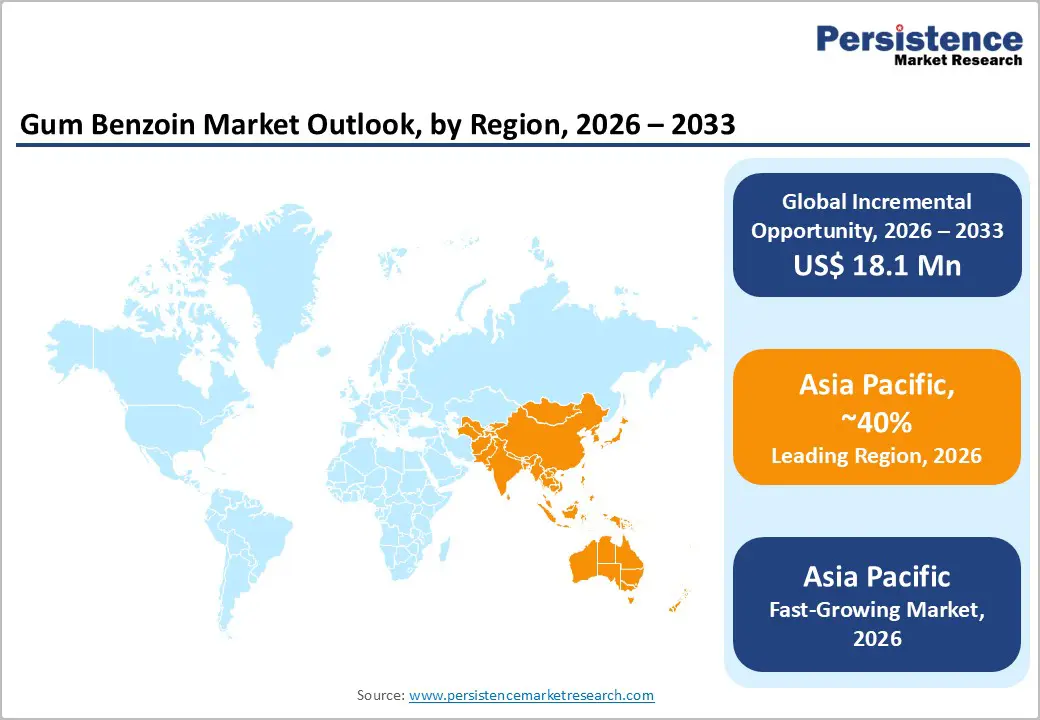
- Regional Leadership: Asia Pacific is expected to dominate with an estimated 40% share in 2026, supported by raw material availability, cost advantages, and high regional consumption.
- Regulatory Impact: Compliance with quality standards, certifications, and sustainability guidelines favors certified and traceable suppliers.
| Key Insights | Details |
|---|---|
|
Gum Benzion Market Size (2026E) |
US$ 57.45 Mn |
|
Market Value Forecast (2033F) |
US$ 75.5 Mn |
|
Projected Growth (CAGR 2026 to 2033) |
4.0% |
|
Historical Market Growth (CAGR 2020 to 2025) |
3.6% |
Market Factors – Growth, Barriers, and Opportunity Analysis
Increasing Demand for Natural Resins across Diverse Applications
Gum benzoin is witnessing robust demand as industries increasingly prefer natural and sustainable ingredients over synthetic alternatives. Its use as a fragrance fixative, antimicrobial agent, and binding resin positions it as a multi-functional input in perfumery, traditional medicine, and incense production. The structural resilience of incense consumption in regions like India, China, and ASEAN, combined with the growing adoption of plant-based formulations in topical pharmaceuticals and inhalants, reinforces steady demand. Several Indonesian resin producers partnered with regional exporters to enhance traceable, sustainable supply chains, ensuring consistent quality for international fragrance and pharmaceutical manufacturers.
Government initiatives are also supporting this growth. For example, in 2025, the Indian Ministry of MSME announced programs to modernize incense sticks production units and improve access to high-quality natural resins, encouraging small and medium manufacturers to adopt certified raw materials. Leading regional companies are planning capacity expansions and investments in sustainable sourcing to capitalize on rising demand. This combination of industry and government support underlines gum benzoin’s strategic relevance and ensures that its supply chain evolves in alignment with increasing consumer and regulatory expectations.
Supply and Regulatory Challenges Dampening Market Prospects
The gum benzoin market growth faces structural challenges due to its highly concentrated supply base and agricultural dependency. Styrax trees require 8–10 years to reach commercial tapping maturity, and production is largely confined to Indonesia, Laos, Thailand, and Vietnam. This geographic concentration exposes the market to climatic variability and labor shortages, as witnessed when unusual monsoon patterns in Sumatra, Indonesia caused temporary disruptions in resin collection. Such fluctuations create price volatility and can affect downstream planning for incense, perfumery, and pharmaceutical manufacturers, highlighting the need for stable, traceable sourcing systems.
Regulatory compliance further compounds these challenges. Pharmaceutical and food applications must meet stringent purity standards and traceability requirements set by authorities such as the U.S. FDA and European Pharmacopoeia. Several exporters in Indonesia and India invested in modernized processing and certification infrastructure to align with international norms after a portion of consignments required re-certification. These combined supply and compliance constraints restrict market entry for smaller producers while motivating leading companies and regional governments to invest in sustainable production, quality assurance, and capacity-building initiatives to safeguard market growth.
Broadening Global Applications and Market Expansion for Gum Benzoin
The gradual shift toward natural, sustainable, and clean?label ingredients across multiple industries is creating compelling opportunities for gum benzoin beyond its traditional uses. In the fragrance sector, rising consumer demand for authentic, plant?derived scent bases is increasing the inclusion of benzoin as a natural fixative and base note enhancer, especially in Europe and North America, where artisanal perfumery and clean?beauty brands are expanding product lines. In aromatherapy and wellness, benzoin’s soothing aroma and antimicrobial properties are gaining traction in premium essential oils, candles, and wellness blends, aligning with the growing global wellness movement. Indonesia’s 2025 initiative to develop downstream processing and higher?value benzoin derivatives underscores industrial efforts to move beyond raw resin exports toward finished products such as essential oils and cosmetic extracts, strengthening global competitiveness and product differentiation.
Opportunities also extend into functional consumer goods and specialty formulations as markets increasingly favor natural alternatives to synthetics. Benzoin resin is being evaluated for its preservative and flavor?enhancing roles in niche beverage and specialty food segments, supporting clean?label commitments. Parallel trends in related natural resin markets, such as the expanded use of gum arabic in food emulsification and natural gelling agents in pharmaceuticals and personal care, illustrate widening application scope for plant?based resins globally. The green finance and investment facilities in Europe and Asia Pacific continue to support sustainable sourcing and certified supply chains for natural gums and resins, enabling manufacturers to meet stricter environmental standards and capture premium pricing across regions.
Category-wise Analysis
Product Type Insights
Natural gum benzoin is expected to be the leading product form, accounting for approximately 40% of the market revenue share in 2026. It is widely used across perfumery, cosmetics, and ritual applications due to its affordability, unprocessed aroma, and versatility. Minimal processing preserves its natural properties, which are highly valued in bulk formulations. Southeast Asian production ensures steady supply for global demand. Its widespread use in mass-market perfumery and traditional applications solidifies its revenue share. Manufacturers benefit from flexibility in integrating raw resin across diverse products, making it a key pillar of the market.
Absolutes & resinoids are projected to be the fastest-growing product form, expected to register a CAGR of approximately 9.2% through 2033. These concentrated derivatives are ideal for premium perfumes, high-end cosmetics, and wellness products, offering intense aroma and consistent quality. Increasing consumer preference for artisan, luxury, and organic products drives growth. They require smaller quantities, optimizing cost efficiency while delivering high sensory impact. Moreover, their growing adoption in clean-label formulations and boutique perfumery enhances market potential. The segment also benefits from premiumization trends across developed and emerging markets.
End Use Industry
The fragrances & perfumery segment likely to be the leader in 2026, capturing around 32% of the gum benzoin market revenue share. Its dominance is driven by rising demand for natural aromatic ingredients in both luxury and mass-market fragrances. Gum benzoin is valued for its fixative properties and warm, vanilla-like scent that enhances perfume longevity. Increased adoption in home fragrances, candles, and handcrafted artisanal scents supports its sustained revenue contribution. Growing consumer interest in natural and clean-label products further strengthens this segment. Southeast Asia, Europe, and North America remain key markets, offering both production and consumption hubs for perfumery applications.
The aromatherapy & wellness segment is projected to be the fastest-growing, with a CAGR of 8.5% from 2026 to 2033. The expansion of this segment is driven by the rapidly gather momentum of holistic wellness trends around the globe, including stress relief, meditation, and spa therapies. Gum benzoin’s incorporation in essential oils, diffusers, and massage oils broadens its consumer base. Younger, health-conscious consumers are increasingly embracing natural aromatherapy products, particularly in North America and Europe. Partnerships with lifestyle and wellness brands further accelerate adoption. While smaller than perfumery, its growth potential is significant, offering lucrative opportunities for market players.
Consumer Demand Dynamics
The clean, natural, and organic demand segment is expected to lead the market, representing about 38% revenue share in 2026. Consumers prioritize sustainably sourced, chemical-free ingredients across cosmetics, wellness, and fragrance products. Transparency in sourcing and certifications strengthens consumer trust and brand reputation. This trend is especially strong in Europe and North America, where organic labeling influences purchasing decisions. Manufacturers are responding with certified natural and organic formulations, aligning with broader health-conscious and eco-friendly preferences. The segment ensures a steady growth base for gum benzoin applications across multiple industries.
The premium & artisan product positioning segment is anticipated to be the fastest-growing, projected to grow at a CAGR of 8.8% during the 2026–2033 forecast period. Its growth is fueled by demand for luxury perfumes, niche cosmetics, and specialized wellness products. High-quality gum benzoin derivatives, such as absolutes and resinoids, are increasingly incorporated into signature and artisanal offerings. Consumers are willing to pay a premium for exclusivity, craftsmanship, and natural authenticity. Boutique perfumers and small-scale wellness brands are key adopters. Sustainability and traceable sourcing further enhance the appeal of these premium products in developed markets.
Regional Insights
North America Gum Benzoin Market Trends
North America is a significant market for gum benzoin, with the United States serving as the principal hub across premium perfumery, natural cosmetics, specialty pharmaceuticals, and incense substitutes. Gum benzoin is increasingly incorporated into high-end fragrance blends and aromatherapy products due to rising consumer preference for natural, ethical ingredients. Regulatory oversight by food and drug authorities ensures strict quality standards, which favors importers with traceable supply chains. In 2025, North American fragrance houses and wellness brands expanded their traceable sourcing and certification programs to meet elevated consumer expectations for ingredient transparency. The regional market is characterized by value-led growth, with demand centered on high-margin sectors rather than raw volume.
Investment activity in 2025 saw several U.S. and Canadian specialty chemical firms extend supplier contracts with Southeast Asian resin producers, ensuring supply continuity for formulations in perfumery and skincare. Collaboration between raw material suppliers and fragrance formulators strengthened quality compliance, while retailers promoted benzoin-based aromatherapy and wellness products. North American importers are also exploring certified sustainable benzoin derivatives to reduce dependency on raw imports. Consumer demand for natural products continues to support steady expansion in niche applications. The region remains stable and innovation-oriented, with growth driven by premium end-uses and regulatory alignment.
Europe Gum Benzoin Market Trends
The Europe gum benzoin market is pulled forward by Germany, France, and the U.K., where luxury perfumery and regulated wellness products dominate usage. Gum benzoin is widely incorporated as a natural aromatic base and fixative in fine fragrances, particularly in premium and artisanal formulations. The region’s mature consumer base places strong emphasis on ingredient provenance, sustainability, and product safety. Harmonized chemical and pharmaceutical standards raise entry barriers but strengthen overall market credibility. France continues to function as a global fragrance innovation hub, while Germany anchors pharmaceutical and herbal medicine applications. Imports remain the primary supply channel due to limited regional resin production. Demand remains quality-intensive and compliance-focused.
European fragrance and cosmetic manufacturers strengthened supplier compliance frameworks in response to updated sustainability and chemical safety requirements. A clear example includes French fragrance houses expanding direct sourcing partnerships with certified resin suppliers to ensure traceability and ethical harvesting practices. In Germany, pharmaceutical producers increased the use of standardized benzoin tinctures in licensed herbal medicinal formulations. Procurement teams increasingly required detailed documentation on resin origin, processing methods, and contaminant controls. These changes elevated sourcing expectations across the supply chain.
Asia Pacific Gum Benzoin Market Trends
Asia Pacific is forecasted to dominate in 2026, accounting over 40% of the gum benzoin market share, and is also projected to be the fastest-growing regional market, with a 2026-2033 CAGR of 6.5%. Powered by China, India, Indonesia, and ASEAN countries, the region market benefits from direct access to Styrax resin sources, cost-efficient processing capabilities, and strong domestic consumption of incense and traditional aromatic products. Gum benzoin is extensively used in incense sticks, cones, perfumery bases, and medicinal preparations across the region. Deep-rooted cultural and religious practices ensure consistent baseline demand. Export-oriented manufacturing further strengthens regional leadership. These structural advantages support sustained growth momentum. The region also functions as both a major supply base and a key consumption center.
The governments and industry bodies across Southeast Asia expanded agro-forestry and sustainable resin harvesting programs to secure long-term supply growth. A notable example includes Indonesia formally promoting benzoin resin as a priority agro-forest export commodity, encouraging downstream processing into standardized aromatic extracts and derivatives. Indian and ASEAN exporters simultaneously upgraded processing facilities to meet stricter international purity and traceability requirements. Regional producers invested in certification systems and logistics modernization to improve export readiness. These coordinated initiatives reinforce supply reliability and export competitiveness. Asia Pacific continues to anchor the global gum benzoin value chain, supporting its role as the fastest-expanding regional market.
Competitive Landscape
The global gum benzoin market operates with moderate fragmentation, and competition is shaped by access to Styrax resin sources and the strength of long-term supplier relationships. No single company holds a dominant position, as supply is geographically concentrated and relies on networks of smallholder harvesters. Established exporters compete by offering consistent quality, expert grading, and compliance with regulatory standards, especially for perfumery and pharmaceutical uses. Market entry is difficult due to sourcing complexities and certification requirements, making supply reliability a major competitive advantage. ?
Regional producers in Southeast Asia control the upstream collection of resin, while international distributors and fragrance companies manage downstream processing and formulation. Competition is increasingly focused on traceable sourcing, sustainability certifications, and readiness for compliance. Strategic partnerships between growers, processors, and global buyers are strengthening supply chains, but consolidation remains selective rather than widespread. Players that combine ethical sourcing with robust global distribution are gaining a competitive edge in this market.
Key Industry Developments
- In May 2025, Indonesia began positioning benzoin resin as a priority commodity in its downstream processing strategy, aiming to boost exports and add value through local refining and product development. This initiative leverages the country's dominant supply of Styrax benzoin, targeting growth in perfumery, pharmaceuticals, and cosmetics amid global demand for sustainable resins.
Companies Covered in Gum Benzoin Market
• PT RAMNU
• Duc Phu AAF
• Kancor Ingredients Ltd
• Berjé Inc.
• TRI-K Industries
• Indo World Trading Co.
• Guangzhou Baihua Flavours & Fragrances
• PG India Group
• RAM Aromatics
• KAPS International
• Nata Artha Mandiri
• ISPAK
Frequently Asked Questions
The global gum benzoin market is projected to reach US$ 57.4 million in 2026.
Key growth drivers include rising demand for natural fragrance fixatives, expansion of traditional medicine and pharmaceutical usage, and structurally resilient incense consumption across Asia Pacific and the Middle East.
The market is poised to witness a CAGR of 4% during 2026–2033.
Opportunities arise from premium natural perfumery, sustainable incense manufacturing, expansion of traceable and certified supply chains, and emerging applications in natural food preservation and wellness products.
Some of the players leading the market include PT RAMNU, Duc Phu AAF, Kancor Ingredients Ltd, Berjé Inc., and TRI-K Industries, among others.


