




- Food Ingredients & Additives
- Karaya Gum Market
Karaya Gum Market Size, Share, Growth, and Regional Forecast, 2025 - 2032
Karaya Gum Market by Form (Powder, Granules, Lumps), End-user (Food and Beverages, Cosmetics, Pharmaceuticals), and Regional Analysis from 2025 - 2032

Karaya Gum Market Share and Trends Analysis
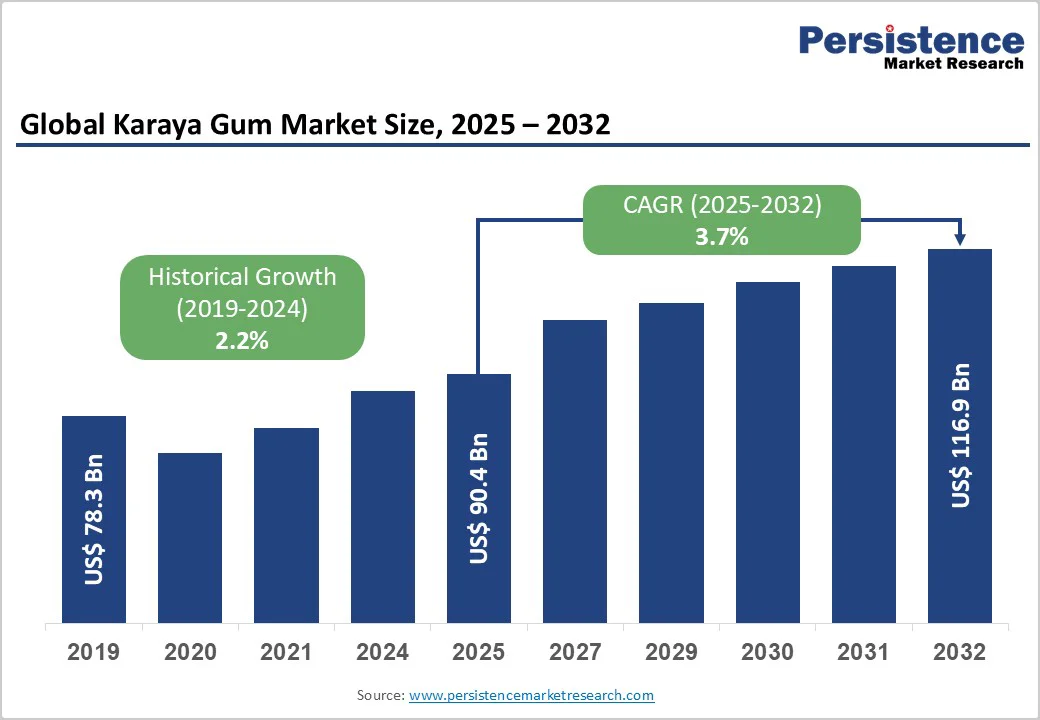
The global karaya gum market size is likely to be valued at US$90.4 million in 2025 and is projected to reach US$116.9 million, growing at a CAGR of 3.7% during the forecast period from 2025 to 2032. The global karaya gum industry is witnessing steady growth driven by its increasing use across the food, pharmaceutical, and cosmetic industries. Extracted from the Sterculia urens tree, karaya gum serves as a natural thickener, stabilizer, and emulsifier.
Rising consumer preference for plant-based and clean-label ingredients is driving demand for these ingredients in processed foods and beverages. In pharmaceuticals, its role in wound care, dental adhesives, and drug formulations enhances market prospects.
Key Industry Highlights:
- The global shift toward clean-label and plant-derived ingredients is fueling demand for natural thickeners like karaya gum.
- Karaya gum’s bioadhesive and non-toxic properties drive its use in pharmaceutical formulations. It is widely employed in wound dressings, dental adhesives, and controlled drug-release systems.
- In the cosmetics industry, karaya gum is increasingly used as a natural thickening and binding agent in creams, lotions, and hair gels.
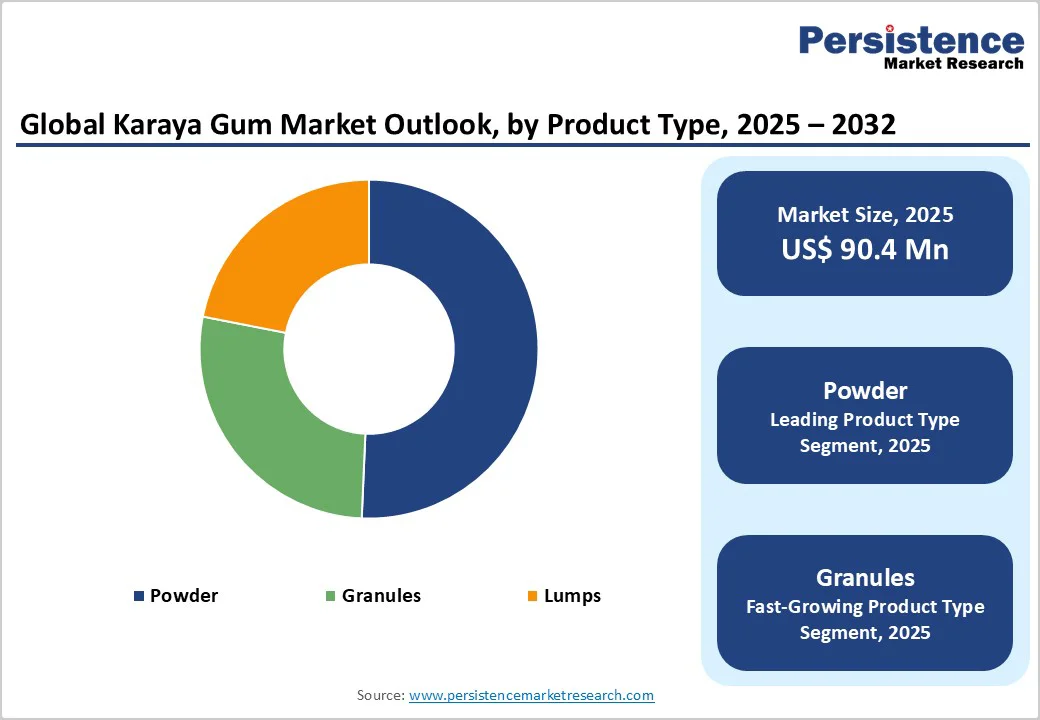
- The powder form of karaya gum accounts for the highest market share globally. This dominance is driven by its superior solubility, ease of blending, and uniform dispersion in formulations across food, pharmaceutical, and cosmetic industries.
| Key Insights | Details |
|---|---|
|
Karaya Gum Market Size (2025E) |
US$90.4 Mn |
|
Market Value Forecast (2032F) |
US$116.9 Mn |
|
Projected Growth (CAGR 2025 to 2032) |
3.7% |
|
Historical Market Growth (CAGR 2019 to 2024) |
2.2% |
Market Dynamics
Driver - Pharmaceutical Bioadhesive Applications of Karaya Gum
Karaya gum has emerged as a highly valuable bioadhesive in the pharmaceutical industry due to its non-toxic, biocompatible, and natural polymer properties. It is widely used in wound dressings, where it helps maintain moisture, promote healing, and protect wounds from infection. In dental adhesives, karaya gum provides strong adhesion while being gentle on oral tissues, making it suitable for temporary fillings and denture adhesives. Additionally, its unique swelling and gel-forming abilities are exploited in controlled-release drug formulations, allowing medicines to be released gradually for improved efficacy and patient compliance. The increasing demand for natural excipients and plant-based bio-adhesives in healthcare is driving the global adoption of karaya gum across pharmaceutical applications.
Restraints - Labor-Intensive Extraction Process
The extraction of karaya gum is inherently labor-intensive, relying predominantly on manual tapping of the Sterculia urens trees. Skilled workers carefully make incisions on the bark, allowing the gum to exude naturally, which is then collected and processed. This method is time-consuming and requires significant human effort, often limiting the speed and scale of production. Unlike synthetic alternatives, which can be produced in controlled industrial environments with consistent output, natural karaya gum extraction depends heavily on seasonal conditions, tree maturity, and local labor availability. These factors not only increase production costs but also introduce variability in yield and quality, creating challenges for large-scale industrial applications. Consequently, the labor-intensive process remains a critical bottleneck for market expansion and cost competitiveness.
Opportunity - Plant-Based Meat & Dairy Alternatives
Karaya gum presents a significant opportunity in the rapidly expanding plant-based food sector, particularly in vegan dairy and meat alternatives. Its natural thickening, gelling, and stabilizing properties allow manufacturers to create products with creamy textures, smooth mouthfeel, and consistent quality that closely mimic traditional dairy and meat products. In vegan cheeses and yogurts, karaya gum enhances creaminess and prevents syneresis, while in plant-based meat, it improves binding, juiciness, and structural integrity.
As consumer preference shifts toward sustainable, protein-rich, and clean-label foods, incorporating karaya gum offers both functional and marketing advantages. Its plant-derived origin also aligns with eco-conscious and allergen-free trends, making it a valuable ingredient for innovation in the global vegan and flexitarian food market.
Category-wise Analysis
By Form Insights
The powder form of karaya gum holds around 40% share and dominates the market due to its unmatched versatility and ease of use across industries. Unlike granules or lumps, the powdered form dissolves quickly, ensures uniform viscosity, and blends seamlessly in food, pharmaceutical, and cosmetic formulations. Its fine consistency allows precise dosing, superior texture control, and consistent product quality, essential for large-scale manufacturing. Additionally, powdered karaya gum offers better storage stability, reduced risk of microbial contamination, and convenient transportation. Its adaptability to automated processing systems and diverse applications—from thickening sauces to stabilizing oral suspensions—makes it the preferred choice for manufacturers, securing its largest market share.
By End-user Insights
The Food & Beverages segment accounts for the highest share in the Karaya Gum market. This is because karaya gum is widely used as a natural thickener, stabilizer, and emulsifier in products such as ice creams, sauces, dairy desserts, bakery items, and beverages. Its ability to improve texture, prevent syneresis, and enhance shelf life makes it highly valued in food processing. Additionally, the growing consumer demand for clean-label, plant-based, and natural ingredients further strengthens its adoption in the food and beverage sector, outpacing cosmetics, pharmaceuticals, and other industrial applications in terms of market share.
Region-wise Insights
North America Karaya Gum Trends
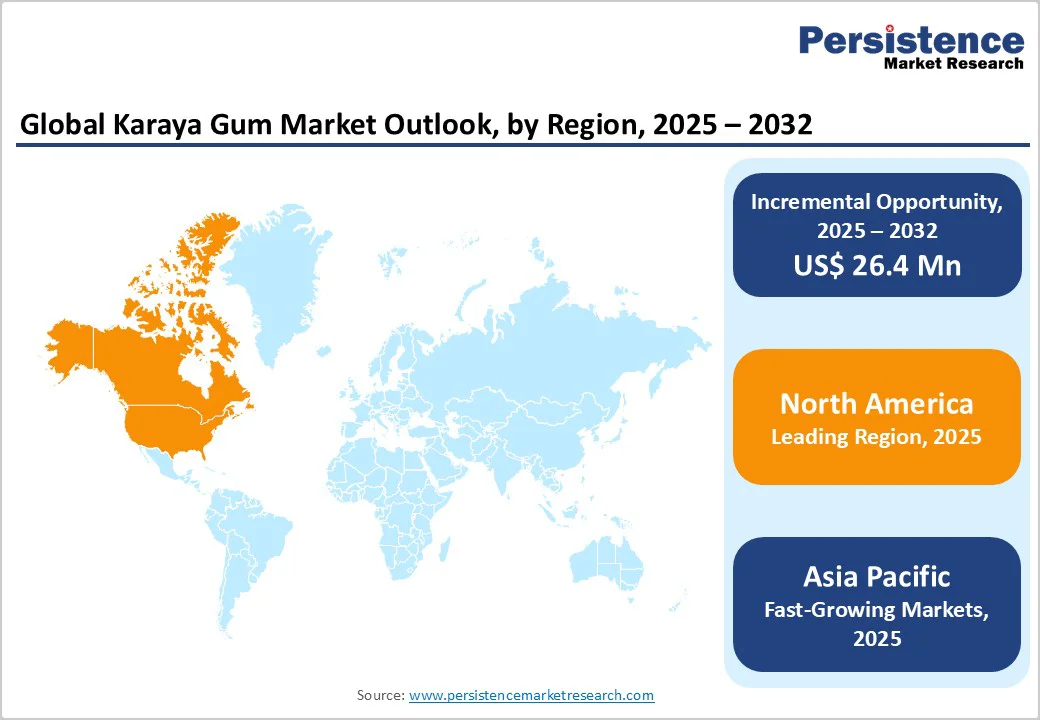
North America, particularly the U.S., leads the global karaya gum market due to strong demand across the food, pharmaceutical, and personal care sectors. Consumers increasingly favor clean-label, plant-based, and natural ingredients, driving adoption in processed foods, dairy alternatives, and beverages. In pharmaceuticals, its use in wound care, dental adhesives, and controlled drug delivery is expanding. Advanced manufacturing infrastructure, well-established supply chains, and stringent quality standards further support market growth. Additionally, rising awareness of sustainable and biodegradable ingredients aligns with regional regulatory focus on natural additives. These trends position North America as a dominant market, with continuous innovation and high-value applications sustaining its leadership.
Asia Pacific Karaya Gum Market Trends
Asia-Pacific is emerging as a key growth market for karaya gum, driven by the abundant availability of Sterculia urens in India and surrounding regions. Rising industrialization, expanding food processing units, and the growth of the pharmaceutical and cosmetic sectors are fueling demand. Increasing consumer awareness of natural, clean-label, and plant-based ingredients supports their adoption in dairy alternatives, sauces, and personal care products. Additionally, cost advantages, government initiatives promoting agro-based industries, and rising exports to North America and Europe enhance market potential. Investment in advanced processing technologies and research on innovative applications, such as biopolymers and functional foods, positions the Asia Pacific as the fastest-growing and strategically important region globally.
Competitive Landscape
The global karaya gum market exhibits a moderately competitive landscape, driven by a mix of established players and regional suppliers. Companies are focusing on product innovation, quality enhancement, and sustainable sourcing to gain a competitive edge. Strategic collaborations, mergers, and acquisitions are common, enabling portfolio expansion and geographic reach. Manufacturers are also investing in advanced extraction and processing technologies to improve solubility, consistency, and functionality.
Key Industry Development:
- In October 2024, Merck KGaA signed a definitive agreement to acquire Mirus Bio in a deal valued at $600 million, aiming to complement its existing portfolio of novel modalities.
Companies Covered in Karaya Gum Market
- Merck KGaA
- Simosis International
- Andina Ingredients, LTD
- Kapadia Gum Industries Pvt. Ltd.
- Spectrum Chemical Manufacturing Corp.
- Alland & Robert
- Nutriroma
- AEP Colloids
- ISC Gums
- Neelkanth Finechem LLP
- Herbal World
- Other
Frequently Asked Questions
The global karaya gum market is projected to be valued at US$90.4 Mn in 2025.
Growing consumer preference for plant-based, clean-label, and chemical-free products in food, beverages, and personal care is boosting karaya gum adoption.
The global karaya gum market is poised to witness a CAGR of 3.7% between 2025 and 2032.
Enhancing texture, stability, and mouthfeel in dairy alternatives, vegan cheeses, yogurts, and plant-based meat products.
Merck KGaA, Simosis International, Andina Ingredients, LTD, Kapadia Gum Industries Pvt. Ltd., and others


