




- Food Ingredients & Additives
- Fruit Pomace Market
Fruit Pomace Market Size, Share, and Growth Forecast, 2026 - 2033
Fruit Pomace Market by Nature (Organic, Conventional), Product Form (Powder, Pellets, Others), Source (Apple, Banana, Berries, Citrus, Grape, Mango, Others), and Regional Analysis for 2026 - 2033

Fruit Pomace Market Share and Trends Analysis
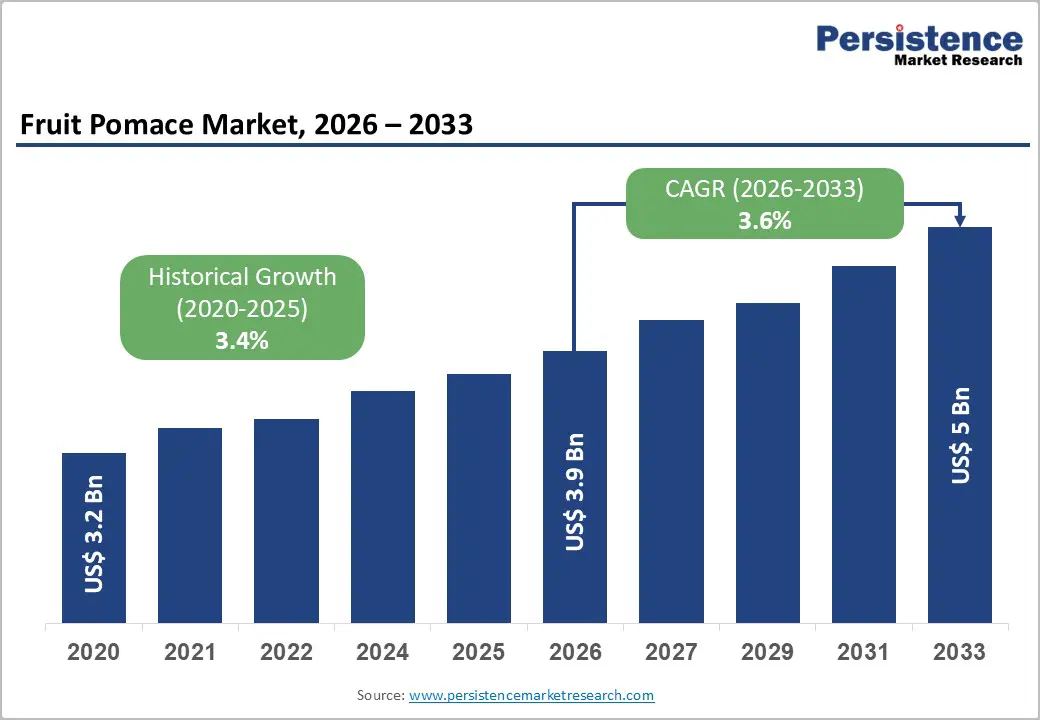
The global fruit pomace market size is likely to be valued at US$ 3.9 billion in 2026, and is projected to reach US$ 5 billion by 2033, growing at a CAGR of 3.6% during the forecast period 2026 - 2033.
Market expansion is primarily driven by the rising utilization of fruit by-products in food ingredients, animal nutrition, and bio-based industrial applications, supported by global waste reduction mandates. Increasing fruit processing volumes across juice, wine, and puree manufacturing continue to generate large quantities of pomace, positioning it as a scalable secondary raw material rather than disposal waste. Regulatory alignment with circular economy objectives in Europe and North America accelerates commercialization pathways. Demand growth is reinforced by measurable shifts toward fiber enrichment, natural antioxidants, and plant-based functional inputs in packaged food formulations.
Key Industry Highlights
- Dominant Region: North America is expected to lead in 2026 with around 40% share, driven by high-quality by-product supply and efficient logistics networks.
- Fastest-growing Market: Asia Pacific is set to be the fastest-growing market through 2033, fueled by rapid expansion in fruit processing and increased feed production.
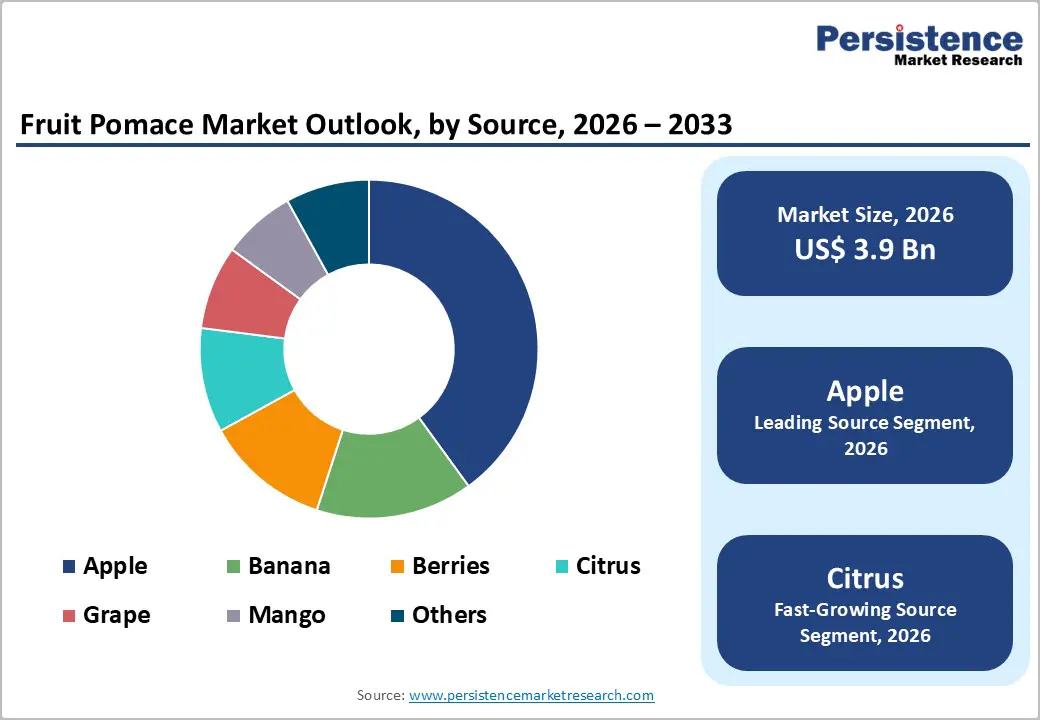
- Leading Source: Apples are expected to hold around 40% market share in 2026, supported by large-scale juice and cider production and consistent by-product availability.
- Fastest-growing Source: Citrus pomace is set to be the fastest-growing segment through 2033, owing to its high pectin and fiber content and growing demand for functional and fortified products.
| Key Insights | Details |
|---|---|
| Fruit Pomace Market Size (2026E) | US$ 3.9 Bn |
| Market Value Forecast (2033F) | US$ 5 Bn |
| Projected Growth (CAGR 2026 to 2033) | 3.6% |
| Historical Market Growth (CAGR 2020 to 2025) | 3.4% |
Market Factors - Growth, Barriers, and Opportunity Analysis
Enormous Demand for Sustainable and Upcycled Ingredients
The demand for sustainable and upcycled ingredients has risen at a tremendous rate worldwide, driven by structural shifts in food processing, ingredient sourcing, and brand positioning strategies, acting as the central growth force for this market. Large-scale fruit processing generates substantial organic residue, and pomace offers a commercially viable pathway to convert this residue into value-added inputs. Corporations face increasing pressure to reduce waste intensity, optimize raw material yield, and align operations with circular economy principles. Pomace-derived ingredients support these objectives by extending the economic lifecycle of agricultural inputs while lowering disposal costs.
Consumer purchasing behavior increasingly prioritizes transparency, clean-label positioning, and environmental accountability, reshaping formulation decisions across food, beverage, nutraceutical, and cosmetic industries. Pomace-based ingredients align with sustainability narratives while delivering functional benefits such as dietary fiber enrichment, natural color stabilization, and antioxidant content. Brand owners leverage upcycled inputs to strengthen environmental, social, and governance positioning, support premium pricing strategies, and enhance brand differentiation in competitive categories. Ingredient buyers value traceability and low environmental footprint, making pomace an attractive alternative to synthetic or resource-intensive inputs.
High Moisture Content and Shelf-Life Challenges
High moisture content creates structural and logistical constraints across the value chain. Fresh output retains significant water after pressing, accelerating microbial activity and enzymatic degradation. Rapid onset of spoilage shortens usable time windows, limiting storage flexibility and increasing dependency on immediate processing. Transport economics weaken as water weight inflates handling costs while offering limited functional value. Inconsistent moisture levels across fruit varieties complicate standardization, reducing batch reliability for industrial buyers. Processing infrastructure must manage drainage, drying, or stabilization at scale, raising capital intensity and operational risk. Small deviations in temperature or hygiene translate into quality loss, elevating rejection rates.
Shelf-life constraints restrict expansion into higher value applications demanding ingredient stability. Functional uses in food formulations and feed systems require predictable microbiological safety and physicochemical consistency. Short shelf life undermines long-distance trade, concentrating utilization near production sites. Preservation techniques such as drying introduce cost, energy use, and nutrient loss trade-offs, compressing margins. Quality deterioration during storage erodes fiber integrity and bioactive efficacy, increasing formulation risk and compliance exposure for buyers globally.
Expansion in Organic and Premium Segments
Consumer preferences have fundamentally shifted toward clean-label products and traceable sourcing, creating substantial opportunities for producers to expand their portfolios into organic and premium segments. Food, beverage, and nutraceutical companies are systematically realigning their ingredient sourcing strategies to meet rising demand for sustainably produced raw materials that support organic certification and transparent supply chains. Pomace derived from organically cultivated fruits directly addresses these market demands by delivering functional fiber, natural antioxidants, and plant-based coloring compounds. This alignment has become particularly influential in functional foods, pet nutrition formulations, and dietary supplement categories, where consumers increasingly expect ingredients to demonstrate documented agricultural origins, minimal processing intervention, and scientifically substantiated nutritional benefits.
The circular economy framework has catalyzed renewed investment in by-product valorization, prompting processors and ingredient manufacturers to recognize that premium-grade pomace streams can be systematized, refined, and repositioned as specialty ingredients commanding higher margins rather than remaining commodity-grade inputs. This strategic repositioning has unlocked differentiated applications including targeted gut health formulations, plant-based protein texture optimization, and fortified baked goods, each generating superior pricing power through tailored functionality. Brands have increasingly adopted these refined pomace-derived inputs as they fulfill environmental sustainability commitments while simultaneously enabling premium retail price realization.
Category-wise Analysis
Nature Insights
Conventional pomace is poised to dominate, with a forecasted market share of 72% in 2026, supported by large-scale fruit processing operations. Its dominance is reinforced by the consistent supply of by-products from high-volume fruit processing, ensuring industrial users such as animal feed producers, food ingredient processors, and nutraceutical manufacturers can secure reliable raw materials at lower procurement costs. Well-established supply chains, minimal certification requirements, and standardized processing methods allow companies to maintain operational efficiency while meeting production targets.
Organic pomace is estimated to be the fastest-growing segment from 2026 to 2033, propelled by increasing consumer preference for certified organic foods and beverages. Growth in organic juice and fruit-based product manufacturing directly increases the availability of organic by-products. Europe and North America are primary growth hubs due to stringent labeling regulations and high organic food adoption. Processors and premium product manufacturers seek organic pomace for functional foods, supplements, and clean-label applications, supporting higher pricing potential and strategic differentiation.
Form Insights
The powder form is anticipated to secure around 46% of the fruit pomace market revenue share in 2026, driven by the convenience, extended shelf life, and standardized dosing of powdered pomace. This form offers high versatility, allowing manufacturers to seamlessly incorporate it into food products, nutraceutical supplements, and cosmetic formulations without compromising quality or efficacy. The consistent texture and composition of powdered pomace simplify quality control, storage, and handling, while minimizing the risk of spoilage and contamination. These benefits make the powder format particularly suitable for large-scale industrial applications, where efficiency, reliability, and product uniformity are critical to meeting production demands and consumer expectations.
Pellets are expected to be the fastest-growing segment during the 2026-2033 forecast period, on account of the rising demand for livestock feed and enhanced operational efficiency. Pelletization of pomace ensures optimized transport, reduced spoilage, and uniform feed quality, which is highly attractive for feed manufacturers, especially in high-demand regions such as Asia Pacific. The compact form facilitates large-volume handling, integration with automated feed production systems, and consistent nutrient delivery. These factors make pellets a preferred choice for livestock producers seeking cost-effective, scalable, and reliable feed solutions that enhance productivity and operational efficiency across farming operations.
Source Insights
Apple pomace is projected to hold an approximate revenue share of 40% in 2026, owing to the widespread production of apple juice and cider and the consistent availability of high-quality by-products. As one of the most processed fruits globally, apples generate a reliable and abundant stream of pomace that meets the quality standards required for various applications. The by-product is rich in dietary fiber and contains moderate levels of natural sugars, making it highly versatile for use in food products, nutraceutical formulations, and animal feed. Its nutritional profile and availability continue to drive strong industrial demand.
Citrus pomace is set to represent the fastest-growing segment between 2026 and 2033, driven by expansion in orange juice and citrus oil processing and the growing demand for functional ingredients. Naturally high pectin and fiber content enhance its application across food, beverage, and nutraceutical products. Increasing citrus processing capacity in emerging markets supports new supply streams. Manufacturers leverage citrus pomace for product fortification, texture improvement, and nutritional enhancement, positioning it as a high-potential growth segment in the by-product utilization landscape.
Regional Insights
North America Fruit Pomace Market Trends
North America is expected to dominate with an estimated 40% of the fruit pomace market share in 2026, reflecting its highly developed fruit processing infrastructure and consistent supply of high-quality by-products. The United States and Canada lead in large-scale juice, cider, and puree production, generating consistent and high-volume pomace supply. Industrial processors prioritize supply reliability, quality standardization, and scalability, enabling seamless integration of pomace into feed, nutraceutical, and functional food applications. Advanced logistics networks and cold-chain facilities support storage and transportation of high-quality by-products, reducing spoilage and operational inefficiencies. Major global players in fruit processing and ingredient manufacturing also reinforce dominance, leveraging the area as a base for innovation and high-value product development.
A key factor supporting the dominance of North America in this market is the early adoption of circular economy practices and sustainability-driven processing models. Market stakeholders are increasingly focusing on minimizing waste streams and converting pomace into high-value ingredients such as fiber concentrates, pectin, and natural colorants. Strong regulatory frameworks for food safety, organic certification, and labeling heighten the credibility of North American pomace, enhancing attractiveness for premium applications in domestic and export markets. Rising demand for functional foods, plant-based products, and clean-label nutrition drives higher utilization of fruit pomace as a cost-efficient, nutrient-rich input.
Europe Fruit Pomace Market Trends
Europe is expected to hold a steady position in the market for fruit pomace, underpinned by a mature fruit processing industry, consistent production volumes, and established industrial infrastructure. Countries such as Germany, France, and Poland lead in juice, cider, and puree processing, generating a reliable and high-quality supply of pomace. Industrial processors utilize mechanized facilities, automated handling systems, and efficient logistics networks to maintain product consistency and minimize losses. Demand for functional foods, dietary fiber-enriched products, and natural colorants sustains pomace utilization across food, nutraceutical, and cosmetic applications.
Steady regulatory frameworks for food safety, organic certification, and labeling reinforce reliability and trust in European pomace for premium product formulations. Consumer preference for clean-label and natural ingredients ensures continuous adoption in fortified bakery products, functional beverages, and plant-based offerings. Collaboration between industrial players, research institutions, and technology providers drives development of applications such as fiber concentrates, pectin extraction, and natural antioxidants.
Asia Pacific Fruit Pomace Market Trends
Asia Pacific is projected to emerge as the fastest-growing market for fruit pomace during the 2026-2033 forecast period, supported by rapid expansion in fruit cultivation, processing infrastructure, and increasing demand for functional ingredients. Countries such as China, India, and Southeast Asian nations are significantly scaling up juice, puree, and citrus oil production, generating new streams of pomace. Rising investment in mechanized processing facilities and cold-chain logistics ensures quality preservation, reduces spoilage, and enables high-volume handling. Growing livestock farming and feed production further enhance the utilization of pomace, creating steady demand for pelletized and powdered forms. .
Emerging consumer and regulatory trends amplify growth potential. Increasing focus on sustainability, clean-label formulations, and circular economy practices encourages processors to maximize by-product utilization. Expansion in urban and semi-urban markets, coupled with rising disposable incomes, supports higher consumption of fortified foods and functional ingredients containing pomace. Regional trade agreements and infrastructure development facilitate cross-border supply chain efficiency, enabling manufacturers to scale operations rapidly.

Competitive Landscape
The global fruit pomace market structure is likely to remain moderately fragmented, with the top five players, Citrosuco, AGRANA Beteiligungs AG, Louis Dreyfus Company, Kerry Group, and Cargill, Incorporated, accounting for approximately 38% of global revenue. These companies maintain a strong presence across fruit processing and by-product utilization, ensuring consistent access to high-quality pomace. Moderate fragmentation allows new entrants and regional players to operate alongside established companies, creating opportunities for innovation and niche product development.
Vertical integration with juice processing enhances cost efficiency and supply security for leading players. By controlling both raw fruit sourcing and processing, companies reduce dependency on external suppliers, minimize spoilage, and ensure steady output for feed, nutraceutical, and functional food applications. Integration also enables standardization of quality, supports sustainability objectives, and allows manufacturers to capture higher margins by converting by-products into value-added ingredients, strengthening long-term competitiveness in the market.
Key Industry Developments
- In December 2025, Nagaland University researchers showed that pineapple peels can be fermented into high-grade vinegar, turning fruit processing waste into a sustainable, value-added product that supports rural livelihoods and reduces environmental burden.
- In September 2025, Cornell University researchers showed that apple processing waste can be converted into a high-fiber powder for protein-rich foods, turning fruit waste into a profitable and sustainable ingredient.
- In March 2025, Citrosuco secured the prestigious Gold rating in the EcoVadis Environmental, Social, & Governance (ESG) certification program. This accolade underscores the company's leadership in sustainable citrus processing and supply chain transparency.
Companies Covered in Fruit Pomace Market
- Citrosuco
- AGRANA Beteiligungs-AG
- Louis Dreyfus Company
- Kerry Group plc
- Cargill, Incorporated
- ADM
- SunOpta
- Tate & Lyle
- Symrise
- Olam Group
Frequently Asked Questions
The global fruit pomace market is projected to reach US$ 3.9 billion in 2026.
Rising demand for functional foods, sustainable by-product utilization, and high-fiber, nutrient-rich ingredients drives the market.
The market is poised to witness a CAGR of 3.6% from 2026 to 2033.
Expansion in organic and premium segments offers key market opportunities through higher-value, clean-label, and functional applications.
Key players in the market include Citrosuco, AGRANA Beteiligungs-AG, Louis Dreyfus Company, and Kerry Group.


