




- Medical Devices
- Global FLECT/CT Imaging Market
Global FLECT/CT Imaging Market Size, Share, Growth, and Regional Forecast, 2026 to 2033
FLECT/CT Imaging Market by Technology (Cone Beam Computed Tomography, Multi-Slice Computed Tomography, Single-Slice Computed Tomography), Application (Oncology, Cardiology, Neurology, Orthopedics, Others), Usage (Diagnostic Imaging, Interventional Procedures, Research Applications, End User (Hospitals, Diagnostic Imaging Centers, Academic & Research Institutes, Others), and Regional Analysis from 2026 to 2033

FLECT/CT Imaging Market and Trends Analysis
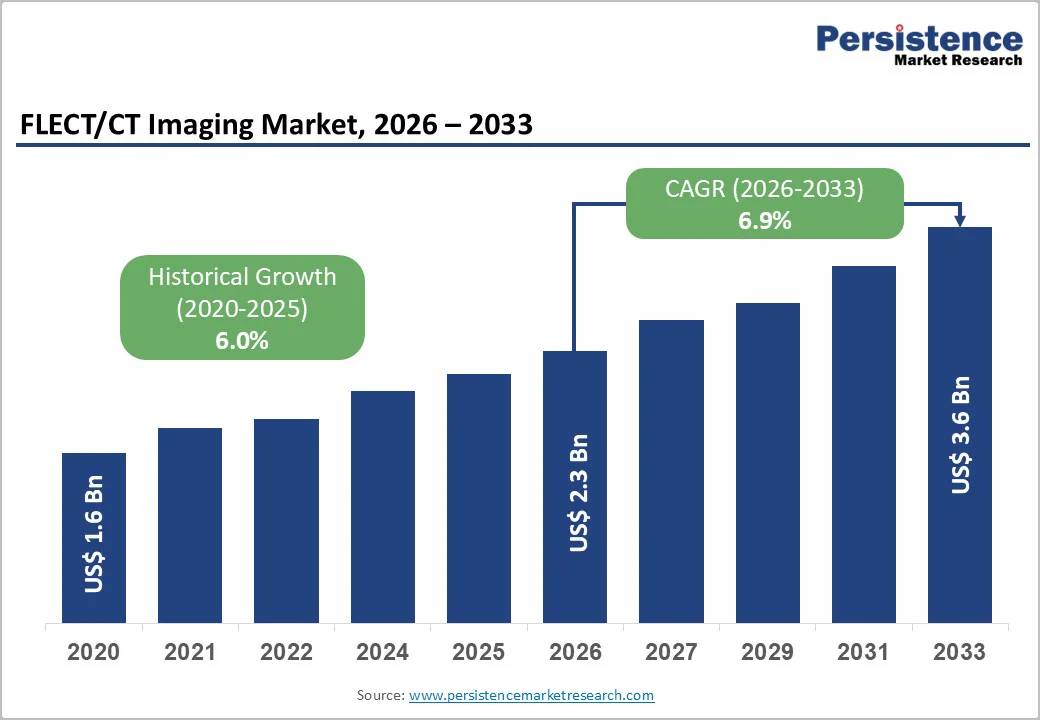
The global FLECT/CT Imaging Market is estimated to grow from US$ 2.3 Bn in 2026 to US$ 3.6 Bn by 2033. The market is projected to record a CAGR of 6.9% during the forecast period from 2026 to 2033.
The FLECT/CT Imaging Market is expanding steadily, driven by rising demand for advanced preclinical and molecular imaging in oncology, drug discovery, and translational research. North America dominates due to strong research funding and imaging infrastructure, while Asia-Pacific is growing rapidly, supported by expanding research facilities, healthcare investments, and increasing adoption of hybrid imaging technologies.
Key Industry Highlights
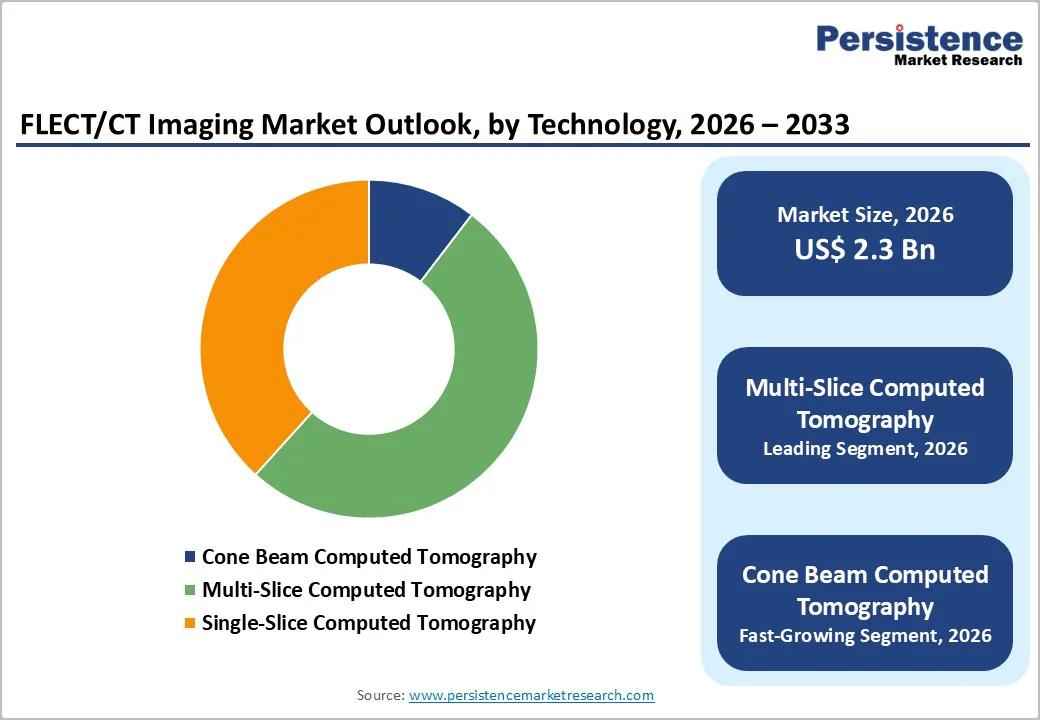
- Dominant Segment: Multi-Slice Computed Tomography (MSCT) is a leading technology segment with 51.3% share in the FLECT/CT Imaging Market for 2025, valued for its high-speed scanning, superior spatial resolution, and multi-planar imaging capabilities. MSCT enables precise anatomical visualization, rapid data acquisition, and integration with FLECT for co-registered functional-anatomical imaging, making it widely adopted in preclinical research, oncology studies, and translational medicine.
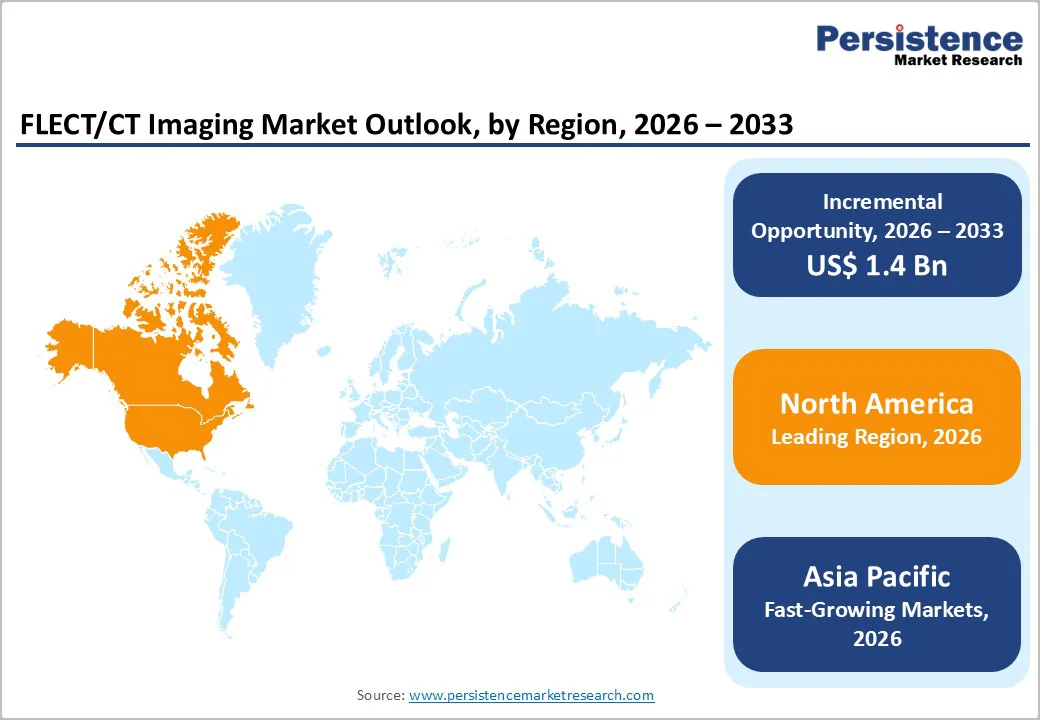
- Dominant Region: North America leads the market in 2025 with 38.9% share, supported by strong research funding, advanced imaging infrastructure, and high adoption in academic and pharmaceutical research. Asia-Pacific is the fastest-growing region, fueled by expanding biomedical research, rising healthcare investments, and increasing installation of preclinical imaging facilities.
- Market Drivers: Market growth is driven by rising cancer research activities, increasing demand for non-invasive molecular imaging, growth in drug development pipelines, and wider adoption of multimodal preclinical imaging technologies.
- Market Opportunity: Key opportunities include development of high-resolution and AI-enabled FLECT/CT platforms, expansion into emerging research markets, increased collaboration with pharma and CROs, and broader applications in translational and personalized medicine research.
| Global Market Attributes | Key Insights |
|---|---|
| Global FLECT/CT Imaging Market Size (2026E) | US$ 2.3 Bn |
| Market Value Forecast (2033F) | US$ 3.6 Bn |
| Projected Growth (CAGR 2026 to 2033) | 6.9% |
| Historical Market Growth (CAGR 2020 to 2025) | 6.0% |
Market Dynamics
Driver – Rising Preclinical and Translational Research
The FLECT/CT imaging market is propelled by expanding preclinical and translational research, where non invasive imaging is essential for understanding disease mechanisms and testing therapies in animal models before human trials. Preclinical imaging technology, which includes CT components integrated with functional modalities, is increasingly employed in drug discovery and disease research as researchers prioritize efficiency and accuracy. Government data shows that overall R&D expenditure continues to grow globally, with China’s R&D spending rising 8.7% in 2023 and remaining high relative to OECD levels, highlighting increased investment in scientific research infrastructure that underpins preclinical studies.
Market related projections further support this trend: global preclinical imaging demand is expected to expand significantly, This rising demand reflects the growing volume of investigations requiring advanced imaging for translational research and drug development, particularly in oncology and neurological studies where FLECT/CT imaging adds value. These increases underscore how expanding research activity directly drives adoption of sophisticated imaging solutions in preclinical settings.
Restraints – Complexity of Operation
The complexity of operation for advanced imaging technologies like FLECT/CT systems represents a major restraint on market growth. These hybrid platforms require highly trained personnel to manage image acquisition, reconstruction, co registration and functional analysis, increasing operational challenges. Globally, there is a significant shortage of qualified imaging professionals; the World Health Organization estimates that two thirds of the global population lacks access to basic radiology services, largely due to insufficient trained personnel to operate and interpret complex imaging systems. This shortage directly limits optimal utilization of advanced modalities, including FLECT/CT systems, in both clinical and research settings.
Supporting this operational restraint, workforce data highlights substantial gaps in trained technologists and specialists. In the United States, a recent American Society of Radiologic Technologists survey found an 18.1% vacancy rate for radiology technologists, up sharply from 6.2% three years earlier, reflecting increasing demand unmet by the available workforce. Such shortages extend to radiologists and CT specialists, with stagnant training program capacity and high competition for residency slots further constraining supply. These workforce limitations complicate training, workflow and adoption of complex imaging systems like FLECT/CT, increasing operational burdens and potentially delaying imaging studies.
Opportunity – AI and Software Integration
AI and software integration presents a significant opportunity for the FLECT/CT imaging market by enhancing image processing, quantitative analysis, and workflow efficiency. In particular, the rapid increase in AI-enabled medical imaging tools approved by regulators reflects this shift: by mid 2025, the U.S. FDA had cleared approximately 873 AI algorithms, with radiology comprising the majority of approvals. Radiology AI tools assist with tasks such as automated image interpretation, segmentation, and reconstruction, directly benefiting hybrid imaging workflows like FLECT/CT that generate complex multimodal datasets. This regulatory momentum supports broader adoption of AI augmented imaging systems.
Wider clinical adoption of AI technologies further underscores their value for imaging markets. Surveys and usage trends demonstrate that AI applications are increasingly integrated into radiology practice, enabling faster and more accurate interpretation of CT images, which in turn enhances data quality for combined modalities like FLECT/CT. For example, AI tools can reduce CT scan analysis time by up to 40%, as noted in research on AI applications in medical imaging. These performance improvements help laboratories and research facilities manage growing imaging volumes and support advanced analysis, making FLECT/CT systems more powerful and efficient for preclinical and translational research purposes.
Category-wise Analysis
By Technology, Multi-Slice Computed Tomography Dominates the FLECT/CT Imaging Market
Multi-Slice Computed Tomography dominates with 51.3% share of the global market in 2025, because it combines high throughput, superior anatomical detail, and broad clinical applicability, making it the preferred technology for hybrid imaging integration. Globally, multislice detectors are the standard in modern CT practice; surveys have shown that more than 80% of installed CT systems in hospitals utilize multislice detector technology over single slice units due to performance advantages. Contemporary clinical inventories further show that 64 slice and 128 slice systems account for the majority of units, reflecting the predominance of multislice configurations for detailed organ imaging. This preference arises because multislice CT significantly accelerates scan speed, expands coverage area per rotation, and enhances spatial resolution, benefiting FLECT/CT workflows by enabling co registered functional anatomical imaging with fewer motion artifacts and improved quantitative accuracy.
By Application, Oncology dominates driven by high cancer incidence and extensive preclinical imaging needs
Oncology dominates the FLECT/CT imaging market because cancer research and care rely heavily on advanced imaging for early detection, staging, treatment planning, and monitoring therapeutic response. According to World Health Organization data, cancer is a leading global health burden, with approximately 19.3 million new cases and 10 million cancer deaths in 2020, underscoring extensive clinical and research imaging needs. CT is routinely used in oncology to evaluate tumor size, metastasis, and treatment effects across lung, liver, colorectal, and head and neck cancers. In research settings, hybrid imaging like FLECT/CT enhances molecular characterization of tumors in preclinical models, aligning with substantial increases in oncology clinical trials worldwide. The high volume of cancer imaging drives the largest share of FLECT/CT utilization compared with cardiology or neurology domains.
Regional Insights
North America FLECT/CT Imaging Market Trends
Asia Pacific dominates the FLECT/CT Imaging Market with 38.9% share in 2025, due to its advanced research infrastructure, high healthcare spending, and strong imaging utilization. The United States alone accounts for a significant share of global biomedical research expenditure, with federal research funding exceeding $150 billion annually, much of which supports cancer, neuroscience, and translational imaging studies. The region also has one of the highest per capita rates of CT scans performed; U.S. data show that over 85 million CT procedures are conducted each year, reflecting widespread clinical and research use of advanced imaging technologies. Robust investments in academic institutions, pharmaceutical R&D, and hospital imaging facilities further reinforce North America’s leading position in adopting and integrating hybrid modalities like FLECT/CT for both preclinical research and clinical applications.
Europe FLECT/CT Imaging Market Trends
Europe is an important region in the FLECT/CT imaging market due to its substantial diagnostic infrastructure and widespread availability of CT technology across member states. In 2022, European Union countries collectively had approximately 12,500 CT scanners, reflecting strong hardware presence relative to population size and supporting both clinical and research imaging activities. Additionally, Europe maintains an average of around 25 CT scanners per million inhabitants, indicating broad access to advanced imaging modalities that can underpin hybrid FLECT/CT applications. Countries such as Germany, Italy, and France lead in scanner availability, while ongoing increases in equipment in nations like Romania and Norway demonstrate continued investment in diagnostic capacity. These factors make Europe a key region for adoption and utilization of advanced imaging systems.
Asia-Pacific FLECT/CT Imaging Market Trends
Asia Pacific is the fastest growing region in the FLECT/CT imaging market because healthcare infrastructure, diagnostic access, and imaging utilization are expanding rapidly across key countries. Japan alone has over 115 CT scanners per million people, far exceeding many other nations, demonstrating entrenched imaging capacity. China is investing heavily in healthcare modernization under initiatives that aim to expand diagnostic equipment availability, while India’s healthcare spending has grown by more than 20% in recent years, increasing access to advanced imaging services. Per capita health expenditure in many Asia Pacific economies is rising faster than GDP, supporting broader adoption of CT based technologies. Collectively, these trends reflect widening demand for diagnostic imaging and hybrid modalities like FLECT/CT, driven by population growth, aging demographics, and greater emphasis on early disease detection.
Market Competitive Landscape
Leading FLECT/CT imaging applications focus on preclinical oncology, drug discovery, and molecular research. By combining functional fluorescence with high-resolution CT, they enhance quantitative analysis, improve co-registration accuracy, and support advanced translational studies, enabling efficient research workflows, precise disease modeling, and reliable data generation, driving widespread adoption and fueling growth in the global FLECT/CT Imaging Market.
Key Industry Developments:
- In December 2024, Siemens Healthineers expanded its Photon-Counting CT portfolio, introducing advanced imaging systems designed to improve image resolution and reduce radiation exposure. The expansion aimed to enhance diagnostic capabilities across clinical applications, offering hospitals and research centers improved visualization, faster scan times, and more precise patient assessments.
- In September 2024, PET/CT biomarkers enabled clinicians to advance Alzheimer’s disease care, improving early diagnosis and treatment monitoring. These biomarkers allowed physicians to detect disease-related changes in the brain more accurately, facilitating timely interventions and personalized treatment plans, ultimately enhancing patient management and outcomes in Alzheimer’s care.
Companies Covered in Global FLECT/CT Imaging Market
- Siemens Healthineers
- Mindray
- Canon Medical Systems
- Konica Minolta
- General Electric
- Esaote
- Neusoft Medical Systems
- Samsung Medison
- Fujifilm Medical Systems
- Carestream Health
- Hitachi Medical Systems
- Philips Healthcare
- Toshiba Medical Systems
- Hologic
- MarkeTech International
- Others
Frequently Asked Questions
The global FLECT/CT Imaging Market is projected to be valued at US$ 2.3 Bn in 2026.
Rising preclinical research, oncology studies, hybrid imaging adoption, and technological advancements drive FLECT/CT growth.
The global FLECT/CT Imaging Market is poised to witness a CAGR of 6.9% between 2026 and 2033.
AI integration, emerging markets, high-resolution systems, pharma collaborations, and translational research expand FLECT/CT opportunities globally.
Siemens Healthineers, Mindray, Canon Medical Systems, Konica Minolta, General Electric, Esaote.


