




- Media & Entertainment
- Event Management Services Market
Event Management Services Market Size, Trends, Share, and Growth Forecast 2026 - 2033
Event Management Services Market by Component (Software, Service), Deployment Type (On‑Premise, Cloud), Enterprise (Small & Medium Enterprises, Large Scale Enterprises), Regional Analysis, 2026 - 2033

Event Management Services Market Size and Trend Analysis
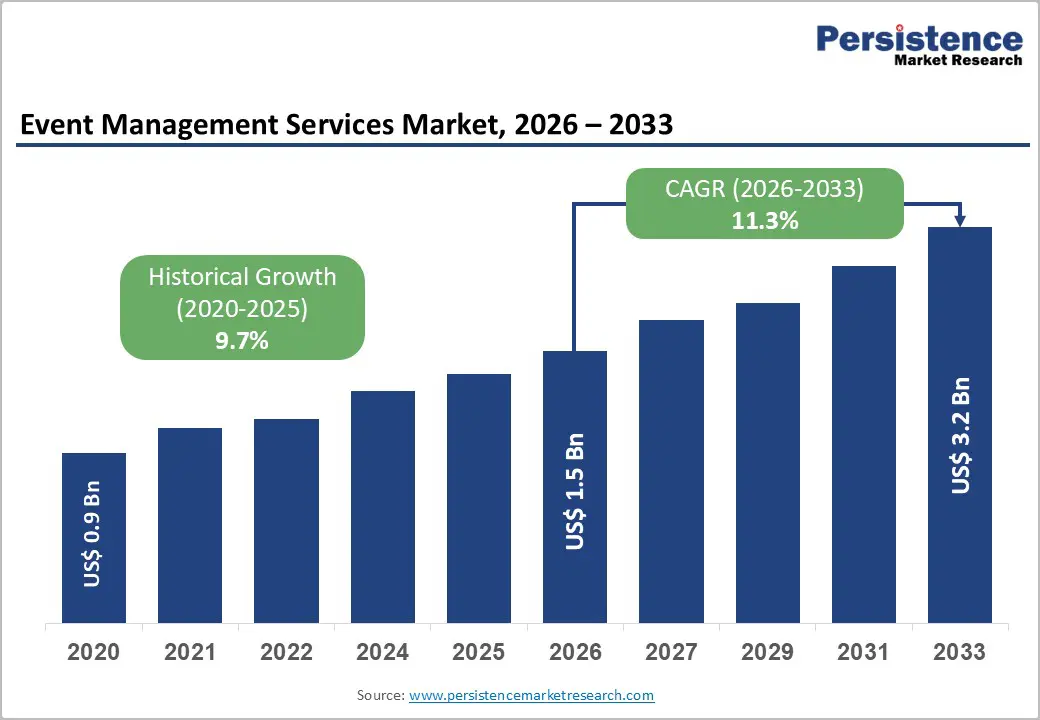
The global Event Management Services Market size is likely to be valued at US$ 1.5 trillion in 2026 and is expected to reach US$ 3.2 trillion by 2033, growing at a CAGR of 11.3% during the forecast period from 2026 to 2033. This rapid expansion is driven by the resurgence of in-person events, rising adoption of digital and hybrid event platforms, and growing demand for end-to-end event management solutions across corporate, government, education, and entertainment sectors.
Key Industry Highlights:
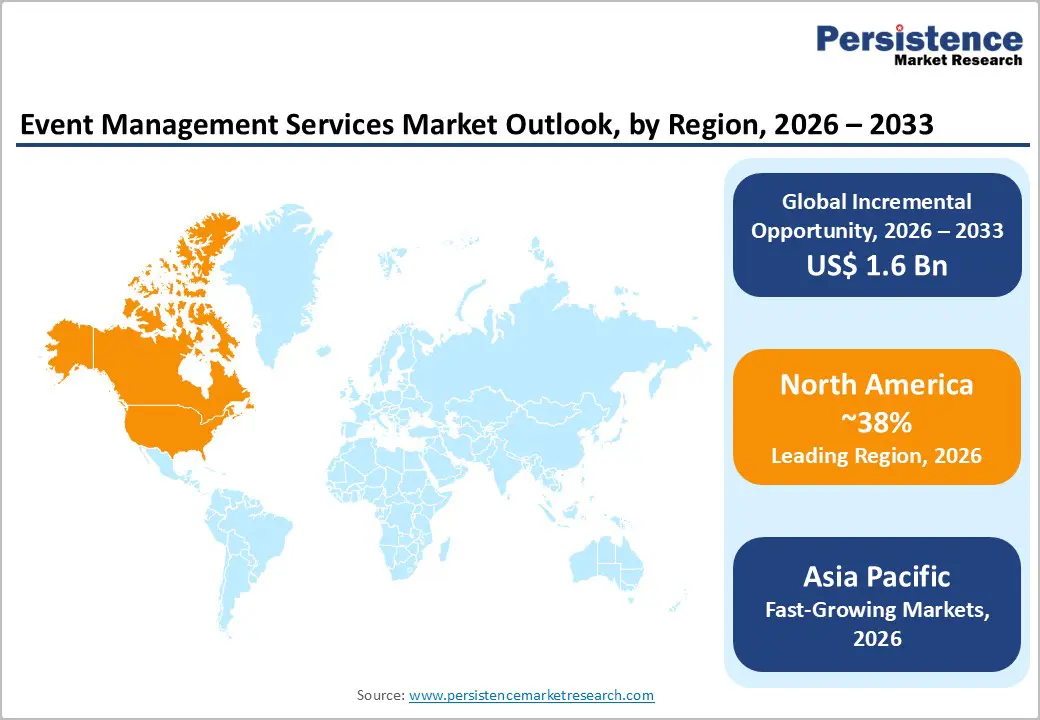
- Leading Region: North America is likely to lead with a 38% share in 2026, due to strong digital infrastructure, high adoption of event management software, and a mature event-organizing ecosystem in the United States.
- Fastest-growing region: Asia Pacific is the fastest-growing region, anticipated a 14.3% CAGR, driven by corporate, government, and entertainment events in China, Japan, India, and ASEAN countries.
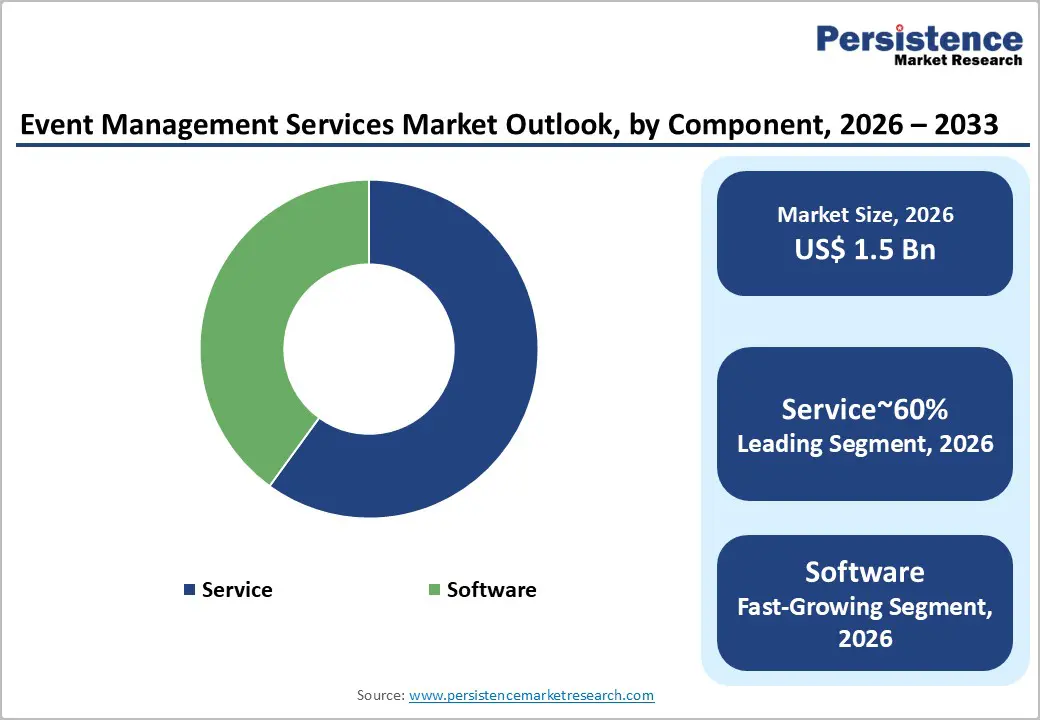
- Dominant segment: Service is the dominant component segment, capturing 60% of demand due to extensive use of full-service event management for corporate conferences, trade shows, and product launches.
- Fastest-growing segment: Cloud deployment is one of the fastest-growing segments, expanding at a higher CAGR than the overall market as hybrid and virtual events gain traction.
- Key Opportunity: The expansion of hybrid and virtual event management services for SMEs represents a high-value growth opportunity, particularly in Asia Pacific and Latin America.
| Key Insights | Details |
|---|---|
|
Event Management Services Market Size (2026E) |
US$ 1.5 Trillion |
|
Market Value Forecast (2033F) |
US$ 3.2 Trillion |
|
Projected Growth CAGR (2026–2033) |
11.3% |
|
Historical Market Growth (2020–2025) |
9.7% CAGR |
Market Dynamics
Drivers - Strong Recovery of Physical and Hybrid Events Driving Renewed Demand for Professional Event Management Services Worldwide
One of the main growth drivers for the Event Management Services Market is the strong return of in-person, hybrid, and virtual events after the COVID-19 pandemic. By 2025, global event attendance had recovered to more than 90% of pre-pandemic levels, showing renewed confidence in live gatherings. Corporate conferences, trade shows, product launches, and entertainment events are once again operating at full scale.
As organizations aim to deliver high-quality experiences, they are increasingly relying on professional event management companies for venue planning, logistics coordination, speaker management, audience engagement, and smooth on-site execution. This approach reduces internal workload and improves overall event impact. With travel restrictions fully lifted and business travel rising steadily, companies are also expanding their global events footprint. As confidence continues to strengthen, demand for structured, professional event management services is expected to grow consistently across industries and regions worldwide.
Rapid Adoption of Digital Event Platforms Transforming Planning Efficiency and Accelerating Software-Driven Market Growth
Another important growth factor is the increasing use of digital event management platforms that simplify event planning and execution. These tools support registration, ticketing, scheduling, networking, live engagement, and post-event performance tracking. Leading providers such as Eventbrite, Cvent, and XING Events offer cloud-based solutions that reduce manual effort and improve efficiency. Today, more than 70% of mid-to-large enterprises use some form of event software to manage meetings, conferences, and exhibitions. These platforms help businesses control costs, gather useful data insights, and support remote participation. As hybrid and virtual events become standard practice, digital tools are becoming essential for event success. This shift toward technology-driven planning is expected to drive faster growth for software-enabled event services compared to traditional event management models.
Restraints - High Service Costs Limiting Event Management Adoption Among Small and Medium Enterprises Across Price-Sensitive Markets
A major challenge in the Event Management Services Market is the high cost associated with professional event planning and advanced digital platforms. Full-service event packages often include venue rentals, staffing, technical equipment, marketing, and software subscriptions, which can quickly exceed the budgets of small and medium enterprises (SMEs). Many smaller businesses find it difficult to justify these expenses, especially for one-time or small-scale events.
As a result, they may choose in-house planning teams or lower-cost alternatives instead of hiring professional service providers. This trend is particularly common in emerging markets where price sensitivity remains high. Although professional event services deliver better quality and efficiency, affordability continues to be a barrier for many organizations. These cost pressures limit wider adoption among SMEs and slow overall market expansion, especially in regions where smaller businesses dominate economic activity.
Rising Data Privacy Risks Creating Hesitation Around Cloud-Based Event Management Platforms and Digital Solutions
Data security is another key restraint affecting the adoption of digital event management platforms. Event organizers collect large volumes of personal information, including attendee details, payment data, and participation behavior. This data must comply with strict privacy regulations, increasing operational risk. Any data breach or compliance failure can lead to heavy penalties, legal issues, and damage to brand reputation. These concerns make some organizations hesitant to fully rely on cloud-based systems.
In addition, maintaining strong cybersecurity infrastructure requires continuous investment, which raises service provider costs. Smaller vendors often struggle to meet advanced security standards, limiting customer trust. As cyber threats continue to grow, security remains a major challenge across the industry. Until data protection frameworks become more robust and standardized, privacy risks will continue to slow digital platform adoption and create hesitation among event organizers worldwide.
Opportunity - Growing Popularity of Hybrid and Virtual Events Creating High-Growth Opportunities for Technology-Enabled Event Services
Hybrid and virtual events represent one of the strongest growth opportunities in the Event Management Services Market. These formats allow organizations to combine physical attendance with online participation, enabling wider global reach and reduced travel costs. Attendees can join live sessions, networking rooms, and virtual exhibitions through streaming platforms and interactive tools. Today, more than 60% of corporate events include some hybrid features, reflecting changing audience expectations and flexible working environments.
Businesses value the ability to reach international audiences without logistical limitations. Hybrid formats also offer strong data insights, engagement tracking, and long-term content value. As internet infrastructure improves and digital platforms become more sophisticated, hybrid event experiences are becoming more immersive and user-friendly. This trend is expected to continue accelerating, making hybrid and virtual event services one of the fastest-growing segments within the overall market in the coming years.
Affordable and Scalable Event Solutions Unlocking Large Untapped Demand Among Small and Medium Enterprises Globally
Another high-potential opportunity lies in providing affordable and scalable event solutions for small and medium enterprises. SMEs increasingly use events for brand promotion, customer engagement, and product launches, but often lack professional planning resources. To meet this demand, service providers are developing modular service packages, subscription-based tools, and self-service platforms that reduce costs while maintaining efficiency.
These offerings allow SMEs to access ticketing, registration, marketing, and analytics without paying for full-service event management. Currently, SMEs account for over 40% of event-organizing activity globally, yet many remain underserved. As digital adoption rises and online business models expand, SMEs are becoming more comfortable using technology-driven event platforms. This creates a large untapped customer base for simplified and budget-friendly event solutions, making the SME segment a major driver of future market growth.
Category-wise Analysis
Component Insights
The service segment remains the largest contributor, accounting for approximately 60% of total revenue. This dominance reflects the strong demand for end-to-end event planning across corporate conferences, exhibitions, entertainment shows, and government events. Professional service providers manage venue sourcing, logistics coordination, guest handling, technical setup, content scheduling, and on-site operations. These services significantly reduce internal workload while ensuring smooth execution and high event quality.
Large-scale events especially depend on experienced professionals to avoid operational risks and maintain brand reputation. Companies such as ACTIVE Network have built strong service ecosystems across corporate, education, and community events. As organizations continue to prioritize experience quality and operational efficiency, full-service event management is expected to remain the backbone, supporting consistent long-term demand growth across all major industries.
Deployment Type Insights
Cloud-based deployment leads the event management services market, accounting for approximately 55% of total value. Organizations increasingly prefer cloud platforms due to their flexibility, scalability, and remote accessibility. Cloud systems allow teams to manage events in real time, collaborate across locations, update schedules instantly, and store large volumes of data securely. These platforms also reduce upfront IT infrastructure costs and simplify maintenance.
Cloud-native solutions are especially well suited for hybrid and virtual events, where real-time streaming, attendee engagement, and data analytics are essential. Service providers continue to enhance cloud features with AI-driven insights, automated workflows, and advanced security tools. As remote work and global collaboration become standard business practices, cloud adoption is expected to rise further. This makes cloud deployment the fastest-growing and most strategically important segment in the event management ecosystem moving forward.
Enterprise Insights
Large enterprises dominate market demand, accounting for nearly 50% of total Event Management Services Market revenue. These organizations regularly host large conferences, international summits, product launches, training programs, and trade exhibitions. Their events require professional coordination, strong branding, audience engagement, and measurable return on investment. As a result, large companies invest heavily in full-service management, advanced software platforms, and hybrid event technologies.
They also prioritize data analytics to evaluate attendee engagement and business outcomes. Global expansion strategies further increase the need for professional event execution across multiple regions. With digital transformation accelerating and corporate communication becoming more experience-driven, large enterprises continue to expand their event budgets. This ensures stable, long-term demand for both service providers and software vendors. The large enterprise segment is expected to remain the core revenue contributor throughout the forecast period.
Regional Insights
North America Event Management Services Market Trends
North America remains a mature and technology-driven region for event management services, with the United States leading adoption across corporate, entertainment, and government sectors. The region benefits from advanced digital infrastructure, strong cloud adoption, and a well-established event ecosystem. Hybrid and virtual events are widely used to support remote workforces and global audiences. Regulatory frameworks such as data privacy laws are also pushing service providers to strengthen security features and compliance standards.
Corporate conferences, trade shows, and large entertainment events continue to generate strong service demand. Investments in smart cities, innovation hubs, and business expos further support long-term growth. With continuous technological innovation and high event spending, North America remains a high-value market offering stable revenue opportunities for both service providers and software platform developers.
Europe Event Management Services Market Trends
Europe is a regulation-focused and sustainability-driven market, with strong demand across corporate, trade show, and cultural events. Key countries including Germany, United Kingdom, France, and Spain are major contributors to the regional growth. Strict data protection rules are encouraging secure cloud-based event platforms. Sustainability initiatives are also shaping event formats, with increased use of hybrid and digital experiences to reduce environmental impact.
Government-led programs supported by organizations such as the European Commission are promoting digital transformation and low-carbon business activities. Corporate ESG commitments are further accelerating demand for eco-friendly event solutions. Together, these factors position Europe as a stable, innovation-focused market with strong long-term growth potential.
Asia Pacific Event Management Services Market Trends
Asia Pacific is the fastest-growing region in the Event Management Services Market, driven by rapid urbanization, expanding corporate sectors, and strong digital adoption. Countries such as China, Japan, and India are leading demand for large-scale conferences, trade exhibitions, and digital events. Government initiatives supporting smart cities, manufacturing growth, and digital economies are fueling professional event planning needs. Southeast Asian markets including Vietnam, Thailand, and Indonesia are emerging as popular event destinations due to growing tourism and infrastructure investments. With rising internet penetration and business globalization, Asia Pacific is expected to remain the strongest growth engine.
Competitive Landscape
New business models such as subscription services, event-as-a-service platforms, and integrated marketing solutions are becoming increasingly common. Sustainability is also emerging as a competitive advantage, with providers offering low-carbon event formats and digital alternatives. Regional players remain competitive by offering customized services and strong local partnerships. Overall, the market is shifting toward technology-driven, scalable, and environmentally responsible solutions, where innovation capability, security compliance, and service quality determine long-term competitive success.
Key Developments:
- In March 2025: Eventbrite launched an AI-driven event planning assistant that automates attendee registration, ticket sales, promotional campaigns, and scheduling tasks. The solution reduced organizer workload by nearly 30%, particularly benefiting SMEs and independent creators.
- In August 2024: Cvent acquired a specialized virtual event technology provider focused on interactive sessions, real-time networking, and advanced analytics. This move strengthened Cvent’s hybrid-event offerings, enabling seamless digital and physical event integration for enterprise clients.
- In January 2023: ACTIVE Network launched a budget-friendly event management suite tailored for small businesses, community groups, and non-profits. The platform offers essential planning tools, ticketing, and performance tracking, expanding accessibility to professional event solutions.
Companies Covered in Event Management Services Market
- Eventbrite
- Cvent
- XING Events
- ACTIVE Network
- etouches
- EMS Software
- Ungerboeck Software International
- SignUpGenius
- Certain
- Social Tables
- Eventmobi
- Hubb
- Babylon Software Solution (Macedonia)
- Regpack
- Webconnex LLC
- Hopin
- Zoom Events
- On24
- Bizzabo
- Cvent
Frequently Asked Questions
The global event management services market is valued at US$ 1.5 trillion in 2026 and is projected to reach US$ 3.2 trillion by 2033, growing at a CAGR of 11.3% from 2026 to 2033, with a historical CAGR of 9.7% between 2020 and 2025.
Key demand drivers include resurgence of in‑person and hybrid events, adoption of event management software and digital platforms, and rising corporate and government event activity, which drive adoption of professional event management services.
The service segment is the leading component category, capturing 60% of demand due to extensive use of full‑service event management for corporate conferences, trade shows, and product launches.
North America is the largest regional market for event management services, accounting for roughly 38% of global value, driven by strong digital infrastructure, high adoption of event management software, and a mature event‑organizing ecosystem in the United States.
A key opportunity lies in the expansion of hybrid and virtual event management services for SMEs, particularly in Asia Pacific and Latin America, where digital adoption and e‑commerce are growing rapidly.


