




- Specialty & Fine Chemicals
- Cosmetic Active Ingredient Market
Cosmetic Active Ingredient Market Size, Share, and Growth Forecast, 2026 - 2033
Cosmetic Active Ingredient Market by Functionality (Conditioning Agents, UV Filters, Anti-aging Agents, Skin Lightening Agents, Hair-Repair Agents, Nourishing Agents, Rejuvenating and Smoothing Agents), Application (Skin and Hair), Type (Non-prescription Active Drug and Functional Ingredients), End-User (Research and Academic Institutes, Pharmaceutical and Biotechnological Companies, Contract Manufacturing Organizations (CMOs)), and Regional Analysis for 2026 - 2033

Cosmetic Active Ingredient Market Share and Trends Analysis
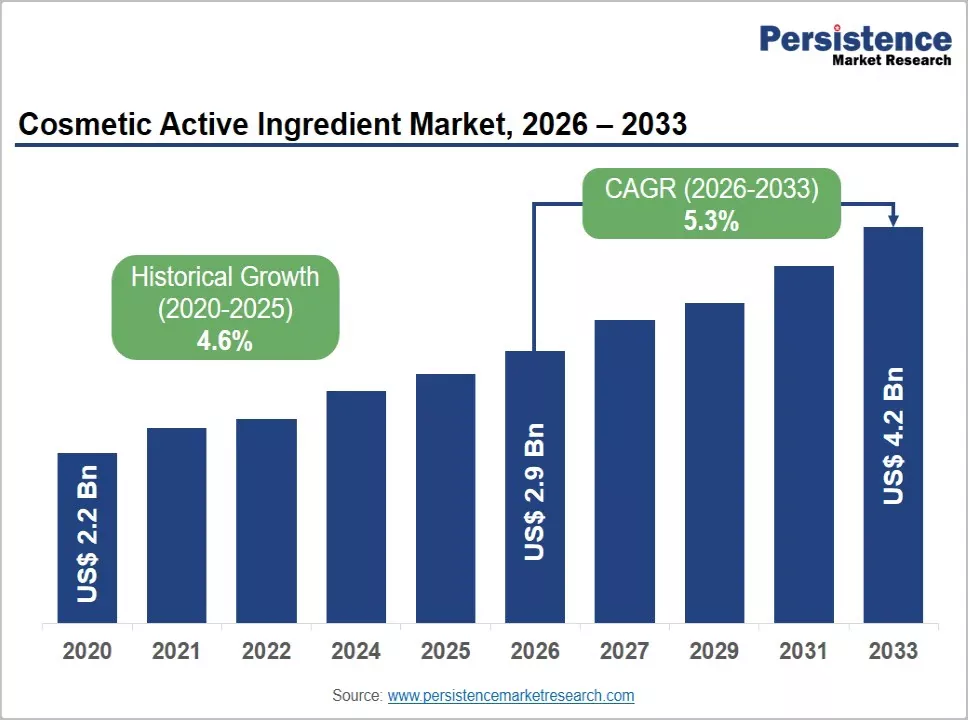
The global cosmetic active ingredient market size is likely to be valued at US$2.9 billion in 2026, and is estimated to reach US$4.2 billion by 2033, growing at a CAGR of 5.3% during the forecast period from 2026 to 2033, driven by rising consumer demand for science-backed skincare and haircare, growing awareness of sun protection and healthy aging, and expanding use of biotechnology-derived ingredients across developed and emerging economies.
The market has been experiencing steady growth, tempered by raw material cost fluctuations and tightening regulatory scrutiny of certain ingredients. The forecast period anticipates firmer momentum as formulators prioritize efficacy, sustainability, and clinically substantiated claims.
Key Industry Highlights:
- Dominant Functionality: Anti-aging agents are set to command around 26% of the revenue share in 2026, while hair-repair agents are likely to grow the fastest at 6.8% CAGR through 2033, as demand rises for bond-building and scalp-health formulations.
- Leading Application: Skin applications are expected to lead with 71% in 2026, while hair applications are likely to be the fastest-growing at about 6.2% CAGR during 2026 - 2033, reflecting premiumization of haircare.
- Dominant End-User: Pharmaceutical and biotechnological companies are anticipated to lead with an estimated 54% share in 2026, while contract manufacturing organizations are slated to represent the fastest-growing segment at 6.6% CAGR from 2026 to 2033.
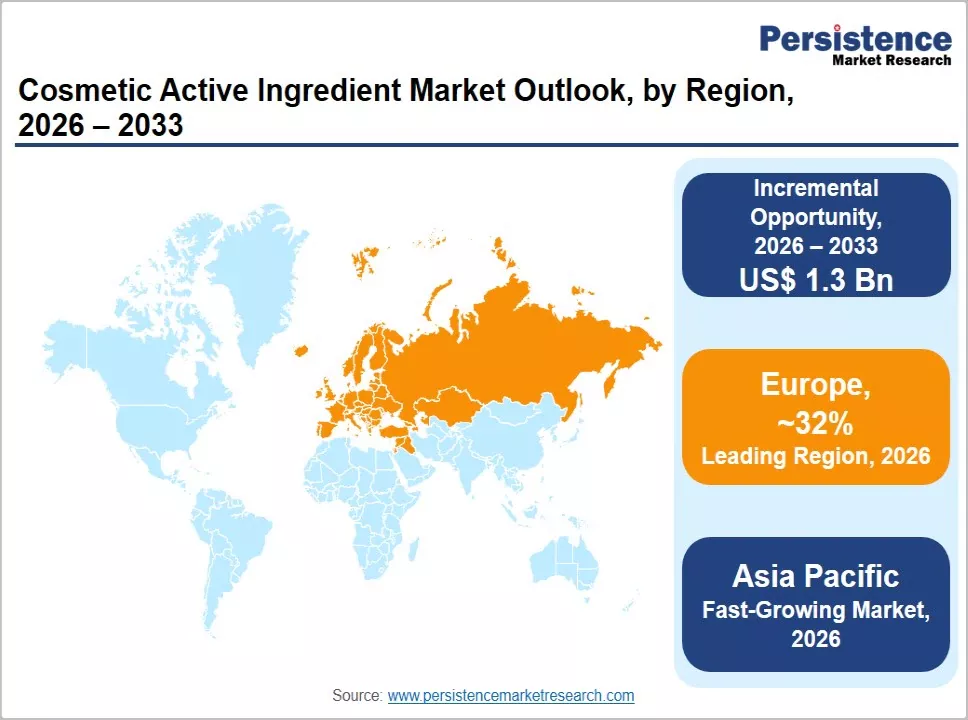
- Regional Leadership: Europe is poised to lead with an estimated 32% share in 2026, while Asia Pacific is expected to be the fastest-growing region at 6.7% CAGR through 2033, led by China, South Korea, India, and Japan.
- Competitive Environment: Competitive dynamics include investment in biotech-derived actives, strategic focus on beauty and wellbeing portfolios, and partnerships between ingredient suppliers and beauty brands.
- April 2025: Ingredient suppliers at in-cosmetics Global in Paris highlighted biotechnology-derived peptides, postbiotics, and sustainable sun care technologies, reflecting a sector-wide shift toward clinically supported, lower-impact active ingredients.
DRO Analysis
Driver: Demand for Clinically Proven, Science-Backed Skincare and Haircare as Primary Growth Catalyst
Growing demand for efficacy-driven personal care is the leading force driving the cosmetic active ingredient market growth, as consumers read ingredient lists, compare clinical evidence, and favor products that target specific concerns such as wrinkles, pigmentation, sun damage, hair breakage, and scalp health. The boundary between cosmetics and dermatology is narrowing, with brands adopting peptides, retinoid alternatives, niacinamide, vitamin C derivatives, ceramides, and plant-derived antioxidants backed by in vitro and in vivo testing. Social media and dermatologist-led education have accelerated this trend, making ingredient literacy common among younger consumers and pushing brands to demonstrate measurable results.
Technology is also expanding the active ingredient toolbox. Biotechnology and fermentation allow suppliers to produce high-purity peptides, hyaluronic acid variants, and postbiotics with a lower environmental footprint than traditional extraction.
Delivery systems, including encapsulation and liposomal carriers, improve stability and skin penetration, enabling lower-dose, more effective formulations. Aging populations in Japan, Europe, and North America, together with rising sun-protection awareness, add to demand for anti-aging and UV protection actives. This convergence of consumer education, scientific innovation, and demographic change ensures sustained growth in the cosmetic active ingredient market in the coming years.
Restraints: Regulatory Complexity and Raw Material Price Volatility
Regulatory complexity has become a major challenge for the cosmetic active ingredient market, as authorities in Europe, North America, and Asia continue to reassess the safety of certain ingredients, particularly UV filters, preservatives, and substances with potential endocrine or environmental concerns. Approval timelines for new actives are lengthy, and differences in regional definitions of cosmetics, over-the-counter drugs, and quasi-drugs force suppliers to run separate safety and efficacy programs for different markets. These requirements raise development costs and delay product launches, particularly for smaller innovators.
Supply-side pressures add further complexity. Prices of botanical extracts, specialty chemicals, and fermentation feedstocks are exposed to climate variability, energy costs, and trade disruptions, which squeeze margins for suppliers and formulators.
The EU restriction on intentionally added microplastics, adopted in 2023, is also pushing reformulation of encapsulates and sensory polymers, adding cost and technical effort. Moreover, concerns about greenwashing and rising demand for sustainability certifications and traceability put additional pressure on sourcing practices. These factors collectively restrain faster adoption of new actives despite their performance benefits, highlighting the need for robust safety data, flexible supply chains, and harmonized regulatory frameworks.
Opportunities: Biotechnology-Derived Actives and Growing Premium Beauty Demand in Asia Pacific
Emerging economies are propelling the market through rising incomes, urbanization, and rapid expansion of organized beauty retail and e-commerce. Asia Pacific, Latin America, and the Middle East are home to young, digitally engaged consumers who spend more on skincare and haircare, creating demand for advanced actives in mass and prestige products. South Korea and Japan lead innovation in brightening, hydration, and barrier repair, and their formulation approaches are influencing global product development, while China's domestic beauty brands are investing heavily in proprietary ingredients and local research.
India exemplifies this trend, with growing consumer interest in dermocosmetics, sun care, and hair treatments, supported by domestic brands and rising dermatology awareness. Biotechnology offers a significant opportunity, as fermentation-derived peptides, ceramides, and plant cell culture ingredients meet clean beauty and sustainability expectations while ensuring consistent quality. Contract manufacturers are also expanding capacity to serve independent brands that outsource formulation and production.
Consequently, emerging markets are expected to increase their share of the global cosmetic active ingredient market substantially, creating additional opportunities in localized manufacturing, research collaborations, and technology partnerships.
Category-wise Analysis
Functionality Insights
Anti-aging agents are the leading functionality segment, expected to hold about 26% of the cosmetic active ingredient market revenue share in 2026. They include peptides, retinoids and retinol alternatives, antioxidants, growth factor mimetics, and hyaluronic acid, which target wrinkles, loss of firmness, and uneven tone. Aging demographics and prevention-oriented routines among younger consumers keep demand strong, and suppliers are launching ingredients with clinical data on collagen support and skin barrier function.
UV filters follow closely, driven by rising sun protection awareness, though regulatory review of certain filters is shaping reformulation toward newer, photostable options, many classified as non-prescription active drugs in some regions.
Hair-repair agents are likely to grow the fastest through 2033, at an estimated 6.8% CAGR. Bond-building molecules, proteins, amino acids, and scalp-care actives address damage from coloring, heat styling, and environmental stress, and their use is expanding from salon treatments into mass retail. Conditioning agents, nourishing agents, skin lightening agents, and rejuvenating and smoothing agents continue to form large, stable segments, supported by formulation needs across leave-on and rinse-off products. Demand for natural-origin and biodegradable conditioning agents is increasing as brands replace silicones and petrochemical-derived ingredients.
Application Insights
Skin applications dominate the application segment, projected to capture about 71% of the revenue share in 2026. Facial care, body care, sun care, and color cosmetics all rely on actives that hydrate, protect, brighten, or repair the skin. Growth is supported by the popularity of multi-step skincare routines, dermocosmetics sold through pharmacies, and the increasing use of actives in makeup products that offer skincare benefits. Suppliers focus on well-documented, multifunctional ingredients that can be incorporated into serums, creams, and mineral-based sunscreens at low dosage levels while meeting stability and sensory requirements.
Hair applications are the fastest-growing, anticipated to achieve about 6.2% CAGR during the 2026 - 2033 period. Consumers increasingly treat scalp as an extension of facial skin, boosting demand for actives that address hair loss, thinning, dandruff, and sensitivity. Premium shampoos, serums, masks, and leave-in treatments incorporate peptides, botanical extracts, and bond-repair ingredients to deliver visible results. While the segment is smaller than skin applications, its higher growth rate attracts investment from ingredient suppliers and brands seeking to differentiate in a crowded market, particularly in Asia Pacific and North America.
End-User Insights
Pharmaceutical and biotechnological companies lead the end-user segment, anticipated to account for around 54% of the revenue share in 2026. These organizations develop, test, and supply advanced actives, often supported by in-house research and clinical capabilities, and they supply both cosmetic brands and dermatology-oriented product lines. Their strengths in biotechnology, formulation science, and regulatory affairs allow them to commercialize high-value ingredients such as peptides, recombinant proteins, and postbiotics. Partnerships with beauty brands and licensing agreements are common ways to expand reach and speed up product launches.
Contract manufacturing organizations are likely to be the fastest-growing end-user segment, expected to showcase an approximate 6.6% CAGR through 2033. Independent and digitally native brands increasingly outsource formulation, testing, and production, which drives CMOs to integrate new actives, build specialized capacity, and offer regulatory support. Research and academic institutes represent a smaller but strategically important segment, contributing to discovery of novel bioactives, mechanisms of skin and hair biology, and sustainability-focused alternatives. Collaboration between universities, startups, and ingredient suppliers supports early-stage innovation and creates pipelines for future commercial actives.
Regional Insights
Europe Cosmetic Active Ingredient Market Trends
Europe is predicted to command an estimated 32% of the cosmetic active ingredient market share in 2026. France, Germany, Italy, Spain, and the U.K. are home to leading beauty brands, ingredient suppliers, and research clusters. The EU Cosmetics Regulation sets rigorous safety and labeling standards, which favors well-documented actives and encourages innovation in sustainable, biodegradable ingredients. The EU microplastics restriction adopted in 2023 is also reshaping formulations.
Major ingredient groups are sharpening their focus on beauty and wellbeing, as illustrated by dsm-firmenich's 2025 move to separate its animal nutrition business, while L'Oréal's announced agreement to acquire Kering Beauté in October 2025 indicates continued consolidation.
The Europe market is characterized by strong emphasis on sustainability, green chemistry, and traceable sourcing, with suppliers such as BASF, Givaudan, Symrise, Croda, and Evonik competing on biotechnology, clinical substantiation, and natural-origin portfolios. Eastern European countries such as Poland and the Czech Republic represent emerging opportunity zones, with expanding contract manufacturing and growing demand for mid-priced skincare.
North America Cosmetic Active Ingredient Market Trends
North America is likely to hold 25% of the global market share in 2026. The U.S. provides the regional growth anchor, driven by a large and diverse consumer base, strong dermatology influence, and the rapid growth of indie brands and online beauty retail. UV filters are regulated as over-the-counter drugs, which makes approval of new filters slower than in Europe or Asia and heightens interest in innovative formulation strategies, mineral filters, and non-prescription active drug ingredients. Demand for clinically tested, multifunctional actives is rising as consumers adopt ingredients such as peptides, niacinamide, and bakuchiol.
Canada's market is supported by a strong natural and organic beauty segment. The North America market is characterized by intense competitive dynamics, with global suppliers, specialty ingredient companies, and contract manufacturers competing on innovation speed, supply reliability, and marketing support for brand customers.
Asia Pacific Cosmetic Active Ingredient Market Trends
Asia Pacific is anticipated to be the fastest-growing region, commanding an estimated 31% in 2026 and projected to achieve a 6.7% CAGR through 2033. China provides the dominant regional growth engine, with a rapidly expanding domestic beauty industry, strong e-commerce ecosystem, and tightening ingredient registration rules that favor suppliers with robust safety and efficacy data. South Korea and Japan remain innovation hubs, supporting global demand for brightening, hydration, barrier repair, and anti-aging actives.
India is expected to offer the most dynamic growth opportunities, supported by rising disposable incomes, growing awareness of sun care and hair treatments, and a vibrant base of domestic personal care brands. The India market is attracting aggressive competition from multinational corporations and emerging local ingredient providers. Southeast Asia is also experiencing accelerated deployment of advanced actives, driven by a young population, social commerce, and demand for products suited to humid climates and sun exposure.
Competitive Landscape
The global cosmetic active ingredient market structure is moderately consolidated, with the top suppliers, including BASF, Givaudan, Symrise, dsm-firmenich, and Croda, controlling a significant portion of the revenue share. These established players leverage extensive R&D capabilities, broad product portfolios, and long-standing relationships with global beauty brands. They are also known to invest heavily in biotechnology, clinical testing, and sustainable sourcing to maintain technological leadership and meet evolving regulatory and consumer expectations.
Regional and niche competitors such as Seppic, Gattefossé, Ashland, and Lubrizol are focusing on specialized segments and geographic strongholds. Barriers such as regulatory compliance, clinical testing costs, and the need for strong technical service limit new entrants, but advances in fermentation and precision biology are enabling startups to develop novel ingredients through partnerships. Market consolidation is expected to increase gradually as global leaders acquire smaller vendors to expand geographically and technologically, while brands and suppliers continue collaborating through co-development agreements.
Key Industry Developments
- In October 2025, L'Oréal announced an agreement to acquire Kering Beauté, a move that expands its luxury beauty portfolio and signals continuing consolidation among major beauty groups. As leading brand owners enlarge their portfolios, demand is expected to grow for advanced, clinically supported actives that help differentiate premium skincare, fragrance-adjacent care, and hair products.
- In September 2023, the European Commission adopted a restriction on intentionally added synthetic polymer microparticles, with staged transition periods affecting cosmetics. The regulation continues to influence formulation, encapsulation, and delivery system choices through 2025 and 2026, accelerating the shift toward biodegradable carriers, natural-origin conditioning agents, and alternative sensory ingredients.
Companies Covered in Cosmetic Active Ingredient Market
- BASF SE
- Givaudan SA
- Symrise AG
- dsm-firmenich AG
- Croda International Plc
- Evonik Industries AG
- Ashland Inc.
- Clariant AG
- The Lubrizol Corporation
- Seppic SA
- Gattefossé SAS
Frequently Asked Questions
The global cosmetic active ingredient market is projected to reach US$ 2.9 billion in 2026.
Rising consumer demand for science-backed skincare and haircare, growing awareness of sun protection and healthy aging, and expanding use of biotechnology-derived ingredients are driving the market.
The cosmetic active ingredient market is poised to witness a CAGR of 5.3% from 2026 to 2033.
Biotechnology-derived actives, growth in premium beauty demand across Asia Pacific, and expanding contract manufacturing are key market opportunities.
BASF SE, Givaudan SA, Symrise AG, and Croda International Plc are some of the key players in the market.


