




- Biotechnology
- Europe Cosmetic CDMO Market
Europe Cosmetic CDMO Market Size, Share, Growth, and Regional Forecast, 2025 to 2032
Europe Cosmetic CDMO Market by Service Type (Formulation Development, Manufacturing, Packaging Services, Quality Control & Testing, Regulatory & Compliance Support, Others), Product, Form, and Country Analysis from 2025 to 2032

Europe Cosmetic CDMO Market Share and Trends Analysis
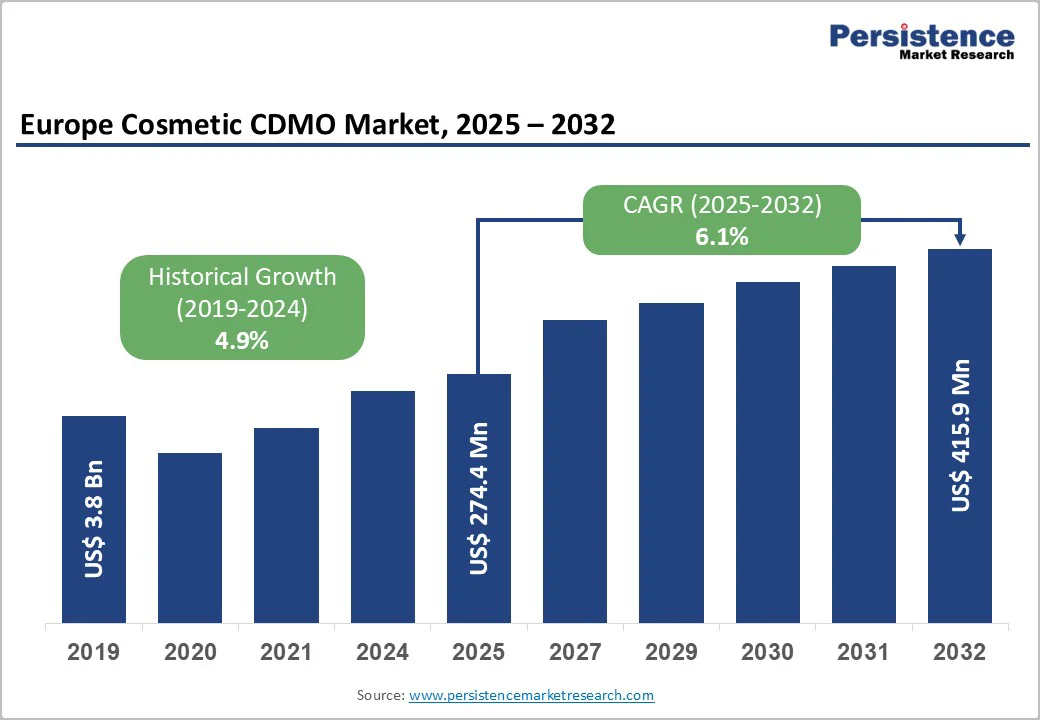
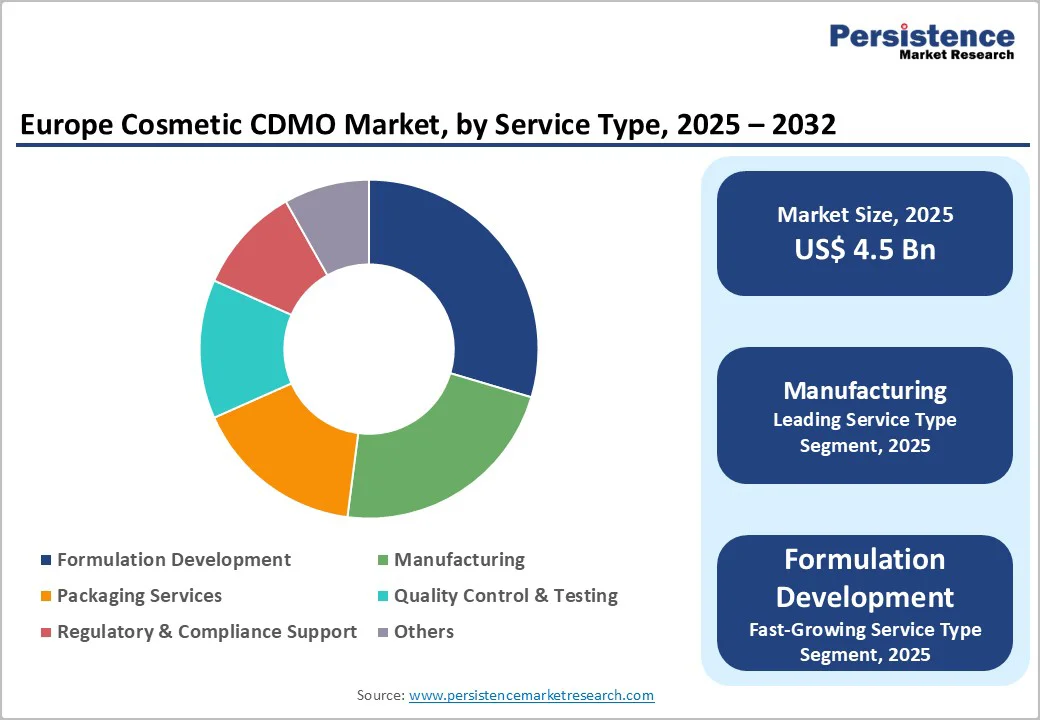
Europe cosmetic CDMO market size is valued at US$4.5 billion in 2025 and projected to reach US$5.9 billion, growing at a CAGR of 3.9% during the forecast period from 2025 to 2032.
Europe cosmetic contract development and manufacturing organization (CDMO) market represents a vital sector within the healthcare industry, catering specifically to the dynamic and ever-evolving needs of the beauty and personal care market. As consumers prioritize personalized skincare solutions and demand innovative products, cosmetic brands are turning to CDMOs for their expertise and resources.
These organizations offer a range of services, including formulation development, manufacturing, packaging, and quality assurance, allowing cosmetic companies to outsource these critical functions while focusing on branding and marketing.
Key Industry Highlights:
- Growing competition and reduced product life cycles are pushing beauty companies to outsource formulation, manufacturing, and packaging to CDMOs.
- Active-based skin care retinol, peptides, ceramides, niacinamide, hyaluronic acid, and vitamin C are major drivers. Brands seek CDMOs with dermatology knowledge, clinical study support, and safety testing capabilities.
- Manufacturing accounts for the largest share of the Cosmetic CDMO market. This is because most brands outsource bulk production due to high capital costs of operating manufacturing plants, need for scale-up capacity, multi-format filling lines, GMP compliance, and access to specialized equipment for skin, hair, fragrance, and cosmeceuticals.
| Key Insights | Details |
|---|---|
| Europe Cosmetic CDMO Market Size (2025E) | US$274.4 Mn |
| Market Value Forecast (2032F) | US$415.9 Mn |
| Projected Growth (CAGR 2025 to 2032) | 6.1% |
| Historical Market Growth (CAGR 2019 to 2024) | 4.9% |
Market Dynamics
Driver - Rising Demand for Customized Skincare Solutions
The surge in consumer preference for personalized skincare solutions is a significant driver fueling the growth of the Europe Cosmetic CDMO Market. Modern consumers seek products tailored to their specific skin types, concerns, and preferences, driving cosmetic brands to innovate and diversify their product offerings. CDMOs play a crucial role in this landscape by offering formulation development services that cater to individualized skincare needs.
Through collaborative partnerships with cosmetic brands, CDMOs leverage their expertise in ingredient selection, formulation optimization, and product testing to create bespoke skincare solutions. This trend not only fosters consumer satisfaction but also enables brands to differentiate themselves in a competitive market, driving increased demand for CDMO services.
As customization continues to shape the beauty industry, the Europe cosmetic CDMO market is poised for sustained growth by meeting the evolving needs of both brands and consumers.
Restraints - Regulatory Complexity and Pricing Pressure Limiting CDMO Profitability
A key restraint hampering the growth of the Europe cosmetic CDMO market is the dual challenge of stringent regulatory compliance and escalating pricing pressure. CDMOs must adhere to rigorous safety, ingredient transparency, and manufacturing standards under frameworks such as the EU Cosmetics Regulation (EC) No 1223/2009, requiring continuous investment in expert regulatory teams, documentation, and monitoring.
Non-compliance risks penalties, product recalls, and reputational damage. At the same time, the market is highly competitive, with numerous players aggressively bidding for contracts, intensifying price negotiations and compressing margins. Balancing high compliance costs with declining price flexibility makes profitability difficult, creating a tough operating environment that limits the scalability and growth potential of many CDMOs across Europe.
Opportunity - Rising Consumer Inclination Towards Sustainable and Ethical Products
One prominent opportunity in the Europe cosmetic CDMO market is the growing demand for sustainable and ethical products. With increasing awareness of environmental issues and ethical considerations, consumers are actively seeking beauty products that are produced with minimal environmental impact and adhere to ethical sourcing practices.
This presents an opportunity for CDMOs to differentiate themselves by offering formulation development and manufacturing capabilities focused on sustainability and ethical sourcing.
CDMOs can collaborate with cosmetic brands to develop eco-friendly formulations using renewable ingredients, reduce packaging waste through innovative packaging solutions, and implement sustainable manufacturing processes such as energy-efficient production and waste reduction initiatives.
By aligning with consumer values and market trends, CDMOs can capitalize on the rising demand for sustainable and ethical beauty products, positioning themselves as preferred partners for brands seeking to enhance their sustainability credentials and meet the evolving preferences of environmentally conscious consumers.
Category-wise Analysis
By Service Type Insights
Manufacturing accounts for the largest share of the cosmetic CDMO market because it represents the most capital-intensive and capacity-driven stage of product commercialization. Most beauty brands, including premium and emerging labels, avoid investing in large production facilities, advanced filling lines, GMP infrastructure, and bulk material handling, making outsourcing the most economical route.
Once a formulation is finalized, recurring batch manufacturing generates continuous revenue for CDMOs across product lifecycles, unlike one-time formulation or regulatory services. Additionally, the surge in diverse product formats-serums, gels, emulsions, fragrances, masks, tubes, and airless packaging-demands specialized equipment and scalability that only experienced CDMOs can provide.
This recurring, high-volume production dependency positions manufacturing as the dominant service segment.
By Form Insights
Creams account for the highest share of the cosmetic CDMO market because they dominate skincare portfolios across anti-aging, moisturizers, brightening, acne control, sun care, and derma-cosmetic applications. Their strong consumer acceptance, thicker texture benefits, and ability to incorporate multiple active ingredients make them the preferred format for both premium and mass brands.
CDMOs also generate high production volumes from creams due to repeat purchases and continuous product reformulation cycles. The demand for functional actives like peptides, retinol, hyaluronic acid, and ceramides further drives higher formulation complexity and manufacturing dependency, reinforcing creams as the largest revenue-contributing segment.
Country Insights
Italy Leads Europe’s Cosmetic CDMO Market
Italy leads the Europe cosmetic CDMO market due to its long-standing expertise in beauty manufacturing, strong heritage in skincare and fragrances, and world-class production infrastructure. The country hosts a dense network of technologically advanced CDMOs that specialize in high-quality formulations, luxury packaging, and export-ready cosmetics.
Italian CDMOs are preferred partners for global premium and niche beauty brands because of their innovation capabilities, strong compliance with EU regulations, and fast speed-to-market. Additionally, Italy’s reputation for “Made in Italy” excellence supports international demand, enabling CDMOs to secure high-value manufacturing contracts across skincare, haircare, cosmeceuticals, and perfumes, reinforcing its market leadership.
Competitive Landscape
The Europe cosmetic CDMO market is highly competitive and fragmented, with numerous mid-sized and large contract manufacturers competing intensely for long-term outsourcing partnerships.
Competition is driven by service breadth, formulation expertise, production scalability, packaging innovation, and regulatory compliance capabilities. CDMOs increasingly focus on offering full end-to-end services from product concept to manufacturing and logistics to differentiate in a price-sensitive environment.
Key Industry Developments:
- In November 2025, Granules India completed the acquisition of Swiss CDMO Senn Chemicals AG, securing 100 percent equity from the founding Senn family as part of the agreement.
Companies Covered in Europe Cosmetic CDMO Market
- Catalent, Inc
- Pierre Fabre group
- INTERCOS S.p.A
- Biofarma Srl C.F.
- FINE FOODS & PHARMACEUTICALS N.T.M. S.p.A.(Euro Cosmetics) )
- Merck KGaA
- C.O.C. Farmaceutici Srl
- Cosmoproject
- Farcoderma S.p.A.
- IRA Istituto Ricerche Applicate S.p.A
- Biogei Cosmetici srl
- O.F.I. Officina Farmaceutica Italiana
- Others
Frequently Asked Questions
Europe Cosmetic CDMO market is projected to be valued at US$4.5 Bn in 2025.
The European cosmetic CDMO market is propelled by several inter-linked factors: firstly, the growing trend of outsourcing enables beauty brands to focus on branding and innovation while leaving formulation, scale-up and manufacturing to specialist CDMOs.
Europe cosmetic CDMO market is poised to witness a CAGR of 3.9% between 2025 and 2032.
The shift toward botanical, toxin-free and “clean label” products creates opportunities for CDMOs with expertise in natural ingredient sourcing, novel actives and compliant manufacturing processes.
Germany accounts for a major share.


