




- Automotive
- Car Detailing Service Market
Car Detailing Service Market Size, Share, and Growth Forecast, 2026 - 2033
Car Detailing Service Market by Detailing Type (Exterior Type, and Interior Type), By Car Type (SUV, Hatchback, and Sedan), and Regional Analysis for 2026 - 2033

Car Detailing Service Market Size and Trends Analysis
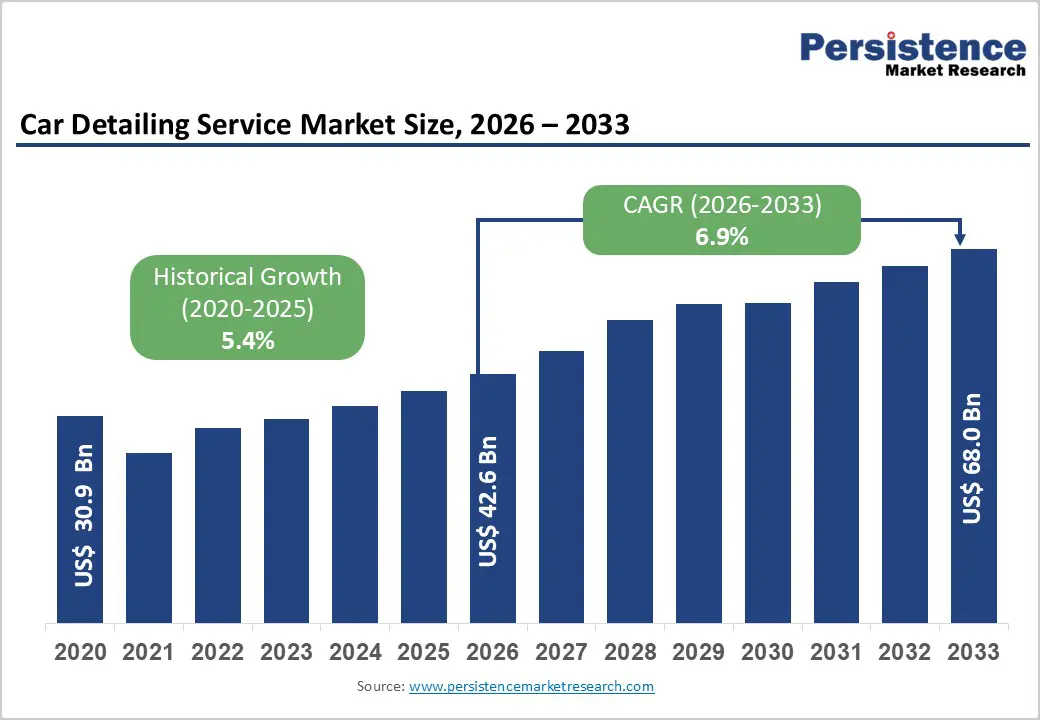
The global car detailing service market size was valued at US$ 30.9 billion in 2020, reached US$ 42.6 billion in 2026, and is projected to reach US$ 68 billion by 2033, growing at a CAGR of 6.9% between 2026 and 2033.
This robust growth trajectory reflects escalating consumer demand for premium vehicle maintenance, expanding vehicle ownership in emerging markets, and increased consumer spending on vehicle aesthetics and protection. The market's expansion is primarily driven by rising disposable incomes in Asia Pacific, regulatory focus on vehicle environmental standards, and the proliferation of professional detailing service providers offering specialized solutions. The historical CAGR of 5.4% (2020-2026) has accelerated to 6.9% (2026-2033), demonstrating market maturation and sustained commercial viability across developed and developing economies.
Key Industry Highlights:
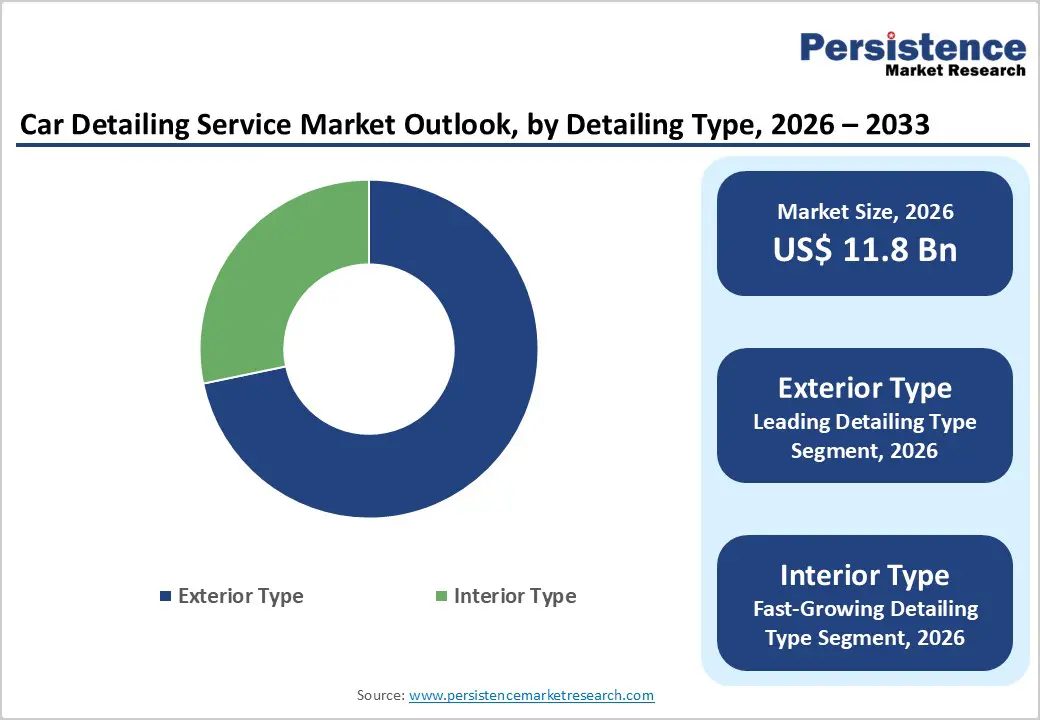
- Detailing Type Analysis: Exterior detailing maintains revenue dominance with robust growth characteristics: Exterior services commanding 65%+ market share supported by consumer prioritization of vehicle aesthetics and paint protection; interior detailing emerging as the fastest-growing segment at 7.5% CAGR, driven by wellness and air quality awareness expansion.
- Car Type Analysis: SUV segment leadership combined with emerging hatchback growth dynamics: SUV vehicles dominating with 45%+ revenue share aligned with global vehicle sales composition shifts; hatchback category accelerating at 7.8% CAGR reflecting emerging market urbanization and affordability prioritization, projecting 30-35% market share by 2033.
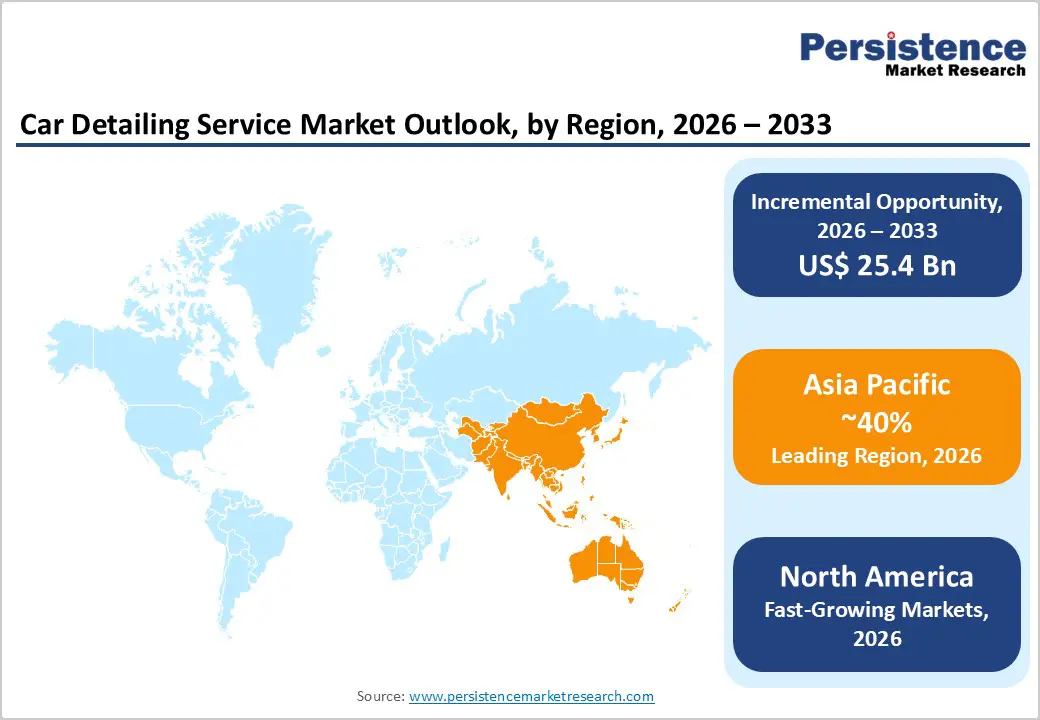
- Regional Analysis: Asia Pacific regional dominance with North America demonstrating premium growth acceleration: Asia Pacific commanding 40%+ global market share with 6.8-7.2% CAGR; North America positioned as highest-growth developed market at 7.9% CAGR, indicating market maturation acceleration and premium service segment expansion.
- Competition Analysis: Market consolidation and organized player expansion representing primary growth catalysts: Organized market players currently capturing 35-40% market value with projection to reach 50-55% by 2033; private equity consolidation initiatives and franchise expansion platforms driving professionalization and geographic market penetration in emerging regions.
- Premium service segment expansion and digital integration platforms supporting margin enhancement: Ceramic coatings, paint protection film, and subscription-based service models capturing 25-30% revenue premium positioning; mobile detailing platform adoption and digital booking integration expanding addressable market through convenience-driven consumer segments.
| Global Market Attributes | Key Insights |
|---|---|
| Car Detailing Service Market Size (2026E) | US$ 42.6 Bn |
| Market Value Forecast (2033F) | US$ 68.0 Bn |
| Projected Growth (CAGR 2026 to 2033) | 6.9% |
| Historical Market Growth (CAGR 2020 to 2025) | 5.4% |
Market Dynamics
Drivers - Rising Consumer Spending on Vehicle Maintenance and Aesthetics
Growing middle-class populations, particularly in Asia Pacific and Latin America, have substantially increased vehicle ownership rates and corresponding maintenance expenditures. According to global automotive industry data, vehicle parc (total vehicles in operation) has expanded by approximately 8-10% annually in emerging markets. Consumers increasingly view professional detailing as essential vehicle care rather than luxury service, driven by awareness of paint protection benefits, ceramic coating durability, and long-term vehicle value preservation. The premium segment (vehicles priced above US$25,000) demonstrates detailing service adoption rates exceeding 60% in developed markets, directly correlating with discretionary spending growth. Market analysis indicates that consumers spending US$500+ annually on vehicle detailing services has increased by 22-25% in the past three years, validating the market's expansion trajectory and reinforcing revenue growth projections through 2033.
Restraint - Market Fragmentation and Competitive Intensity
The detailing service market remains highly fragmented, with organized players representing approximately 35-40% of total market value globally. Informal and unorganized service providers compete aggressively on price, creating margin compression that discourages professional market entry. High service labor intensity limits operational scaling, preventing achievement of significant economies of scale. Regional market concentrations vary substantially-organized market penetration exceeds 70% in North America and Northern Europe but remains below 25% in developing Asian markets, creating uneven competitive dynamics and pricing instability.
Opportunity - Market Consolidation and Organized Player Expansion
The fragmented market structure presents substantial consolidation opportunities for organized regional and national players. Private equity and strategic automotive service groups have identified detailing as a high-margin service category, with acquisition multiples reaching 4.5-5.5x EBITDA. Consolidation strategies targeting unorganized regional operators in emerging markets (India, Southeast Asia, Mexico) offer acquisition costs of 2.0-3.5x EBITDA, enabling substantial return profiles. Market sizing indicates that achieving 50% organized market penetration (from current 35-40%) would generate incremental value of US$8-12 billion by 2033, directly supporting projected market expansion.
Category-wise Analysis
Product Type Insights
Exterior Dominance and Rapid Interior Growth Reshape Global Automotive Detailing Service Demand
Exterior detailing continues to command a dominant position within the automotive detailing market, accounting for more than 65% of total revenue. This leadership is driven by strong consumer emphasis on vehicle appearance and long-term protection against depreciation. Services such as paint correction, ceramic coating application, paint protection film installation, and full exterior restoration directly address visible wear and environmental damage caused by UV exposure, acid rain, coastal salt spray, and industrial pollutants. High-value offerings, including ceramic coatings priced between US$500 and US$1,500 per vehicle and paint protection films ranging from US$800 to US$2,500, support superior margins and reinforce the segment’s revenue leadership. Established service familiarity, premium pricing, and clear value perception are expected to sustain exterior detailing’s dominance throughout the forecast period.
In contrast, interior detailing represents the fastest-growing segment, expanding at a CAGR of approximately 7.5%, well above the overall market average. Growth is fueled by rising awareness of cabin hygiene, air quality, allergen removal, upholstery protection, and odor control. Adoption is particularly strong in luxury vehicles, where 45-55% of owners invest US$300-800 per service. Advancements in steam cleaning, enzymatic treatments, and nano-protective coatings have enhanced service effectiveness and pricing power. Together, these factors position interior detailing for continued acceleration and rising market share by 2033.
Car Type Insights
SUV Dominance and Hatchback Momentum Reshape Global Automotive Detailing Services Demand
The global automotive detailing services market shows clear differentiation by car type, shaped by evolving vehicle sales patterns and consumer behavior. SUVs represent the dominant category, accounting for over 45% of total detailing service revenue. This leadership closely mirrors global vehicle sales trends, as SUVs and crossovers now contribute approximately 40-45% of total vehicle volumes and more than half of premium vehicle sales. SUV owners typically belong to higher-income and younger demographic groups, with greater discretionary spending on vehicle appearance and maintenance. In addition, SUVs’ larger exterior surface areas, frequent exposure to dirt and mud during recreational use, and premium brand positioning support higher service intensity and pricing, often commanding 20-30% premiums compared to sedans. With global SUV sales projected to grow at a 6-8% CAGR through 2033, this segment is expected to maintain both revenue dominance and strong pricing power.
In contrast, hatchbacks are emerging as the fastest-growing car type segment, expanding at a CAGR of approximately 7.8%. Growth is primarily driven by Asia Pacific and Latin America, where hatchback sales are rising 8-12% annually due to urbanization, fuel efficiency needs, and affordability. Although per-vehicle spending remains lower, detailing adoption among younger owners is increasing rapidly, supporting sustained long-term growth through 2033.
Regional Insights and Trends
Asia Pacific Leads Global Auto Detailing Growth Through Expanding Vehicle Ownership and Investments
Asia Pacific dominates the global vehicle detailing services market, accounting for over 40% of total revenue and representing approximately US$17.0-18.0 billion in market value in 2026. The region is projected to expand at a CAGR of 6.8-7.2%, reaching an estimated US$28-32 billion by 2033. This growth is driven by rising vehicle ownership, increasing disposable incomes, and growing acceptance of professional detailing services across emerging economies. China leads the region, contributing 45-50% of total market value, followed by Japan at 15-20% and India at 10-12%. ASEAN countries, including Thailand, Vietnam, the Philippines, and Indonesia, represent high-growth markets, collectively expanding at 8-10% CAGR.
Vehicle parc expansion from around 450 million units in 2020 to over 550 million in 2026 has significantly boosted demand. While professional detailing penetration remains below 30% in most Asian markets, this low adoption highlights strong untapped potential. Environment-focused regulations and consumer awareness are also encouraging bundled service offerings.
The market remains 60-65% fragmented, creating consolidation opportunities. Organized players are expected to increase penetration to 50-55% by 2033, supported by private equity investments, franchise expansion, and technology-driven service models, generating US$10-13 billion in incremental value.
North America Detailing Services Market Driven by Premiumization, Regulation, and Consolidation Trends
North America accounted for approximately 28-30% of the global detailing services market value in 2026, with the regional market estimated at US$12.0-12.8 billion. Supported by strong consumer spending and high vehicle ownership, the market is projected to expand at a robust CAGR of 7.9%, significantly outpacing global averages and reaching nearly US$18-20 billion by 2033. The United States dominates the region, contributing nearly 85-90% of total value. It exhibits mature market characteristics, including organized player penetration exceeding 75%, premium service adoption levels of 55-60%, and increasing consolidation through regional and national service chains.
Demand growth is underpinned by a large vehicle parc of over 280 million vehicles, rising disposable incomes, and heightened consumer focus on vehicle longevity and resale value. Regulatory oversight, particularly EPA guidelines governing wastewater disposal and chemical handling, has standardized service quality while creating compliance barriers that favor established operators. Pricing power remains strong, with basic detailing services ranging from US$150-400 and premium ceramic applications reaching US$500-1,500.
The competitive landscape reflects accelerating consolidation, driven by private equity-backed roll-up strategies targeting fragmented independents. Organized players have expanded their market share from 68% in 2020 to over 75% in 2026, with projections of 82-85% by 2033. Strategic differentiation increasingly centers on digital platforms, mobile service models, subscription offerings, and technology-enabled customer engagement.
Competitive Landscape
The global car detailing service market is characterized by moderate fragmentation, with organized players accounting for approximately 35-40% of total market value. Within this organized segment, the top 10-15 global and regional operators collectively capture around 12-15% of the market, while an additional 20-25% is distributed among roughly 50-80 regional and national chains. Despite the presence of these organized participants, a substantial 60-65% of market value remains concentrated among unorganized independent operators and small local service providers. This structure highlights significant consolidation potential, particularly for strategic and financial investors seeking scale, brand leverage, and operational efficiencies. The large unorganized base also indicates considerable white space for the expansion of organized service models, especially in emerging economies.
Market concentration dynamics vary notably by region. Developed markets such as North America and Western Europe exhibit higher levels of organization, with the top 20 operators capturing approximately 50-60% of regional market value. In contrast, emerging regions including Asia Pacific (excluding Japan) and Latin America remain far more fragmented, where leading operators typically account for only 15-25% of market value. Franchise-based business models have gained strong traction in developed markets, accelerating consolidation and promoting standardized service quality. Overall, the competitive landscape points toward sustained consolidation, with organized players’ market share projected to rise from about 40% in 2026 to nearly 50-55% by 2033.
Key Industry Developments
- In January 2025, Caliber Car Wash launched its “Triple C” coating, delivering enhanced paint protection and shine through industry-leading technology offered to customers at no additional cost nationwide.
- In 2025, Uno Minda introduced a new car care product line in the Indian aftermarket, formulated to remove dust, road debris, and oily contaminants while preserving vehicle surface quality.
- In 2025, Luminous released its 2025 Car Care Products Catalog, presenting a comprehensive guide detailing specifications, features, and availability across its premium vehicle care solutions portfolio.
- In November 2024, Splash Car Wash opened its 65th site, highlighting strong demand for automated, eco-friendly car wash services and reinforcing its aggressive regional expansion strategy and industry momentum.
- In November 2024, 3M launched mobile car detailing services in India, offering doorstep, eco-friendly vehicle care and strengthening its position in the fast-growing on-demand automotive services market.
- In April 2023, Mondo Mannequins participated in Shop! in Austin, engaging global retail stakeholders and showcasing innovations aimed at enhancing in-store customer experience standards.
Companies Covered in Car Detailing Service Market
- 3M Company
- Splash Car Wash
- Autobell Car Wash, Inc.
- Carzspa
- MotorServ
- MPIRE Cars
- Topaz Detailing
- Mr Wash
- Autokorrect
- Elite Detailing and Protection
- Other Market Players
Frequently Asked Questions
The Car Detailing Service market is estimated to be valued at US$ 42.6 Bn in 2026.
The primary demand driver for the car detailing service market is the rising global vehicle parc combined with increasing consumer focus on vehicle appearance, longevity, and resale value.
In 2026, the Asia Pacific region will dominate the market with an exceeding 40% revenue share in the global Car Detailing Service market.
Among detailing types, Exterior Type has the highest preference, capturing beyond 65% of the market revenue share in 2026, surpassing interior detailing.
3M Company, Splash Car Wash, Autobell Car Wash, Inc. , Carzspa, MotorServ, MPIRE Cars, and Topaz Detailing . There are a few leading players in the Car Detailing Service market.


