




- Animal Feed & Additives
- Animal Feed Ingredients Market
Animal Feed Ingredients Market Size, Share, Growth, and Regional Forecast, 2026 to 2033
Animal Feed Ingredients Market by Product (Compound Feed, Fodder, Forage, Oilseed Meals, and Others), by Source (Animal Based Protein and Plant Based Protein) by Sale Channel (Poultry, Ruminants, Swine, Aquatic Animals, and Others), and Regional Analysis from 2026 to 2033

Animal Feed Ingredients Market Share and Trend Analysis
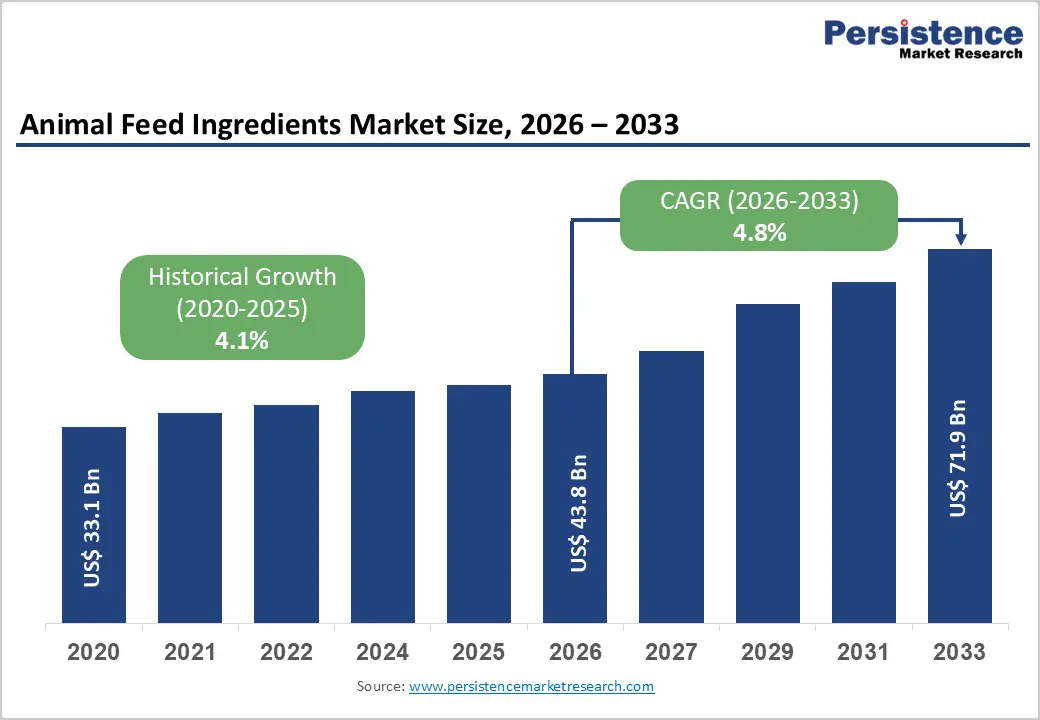
The global animal feed ingredients market size is estimated to grow from US$ 43.8 billion in 2026 to US$ 71.9 billion by 2033. The market is projected to grow at a CAGR of 4.8% from 2026 to 2033. Global consumption of animal feed ingredients continues to expand as livestock producers intensify production to meet rising demand for meat, dairy, eggs, and aquaculture products. The emphasis on feed efficiency, animal health management, and productivity optimization is encouraging the use of nutritionally balanced ingredients such as protein meals, amino acids, enzymes, and mineral supplements. Commercial farming systems are steadily transitioning toward scientifically formulated feed solutions that enhance growth performance while reducing input waste.
Growing awareness regarding disease prevention, gut health, and antibiotic reduction strategies is further accelerating adoption of functional feed additives. Industrialization of poultry and aquaculture farming, coupled with improvements in feed manufacturing technologies, is strengthening ingredient consumption across both developed and emerging economies. Expansion of integrated livestock operations and large-scale feed mills supports consistent procurement volumes, while advancements in precision nutrition enable customized formulations tailored to species and life-stage requirements. Rising disposable incomes and evolving dietary habits are indirectly stimulating feed demand through higher animal protein consumption. Additionally, sustainability initiatives promoting improved nutrient utilization and lower environmental impact are encouraging innovation in alternative proteins and performance-enhancing feed solutions, reinforcing long-term market expansion.
Key Industry Highlights:
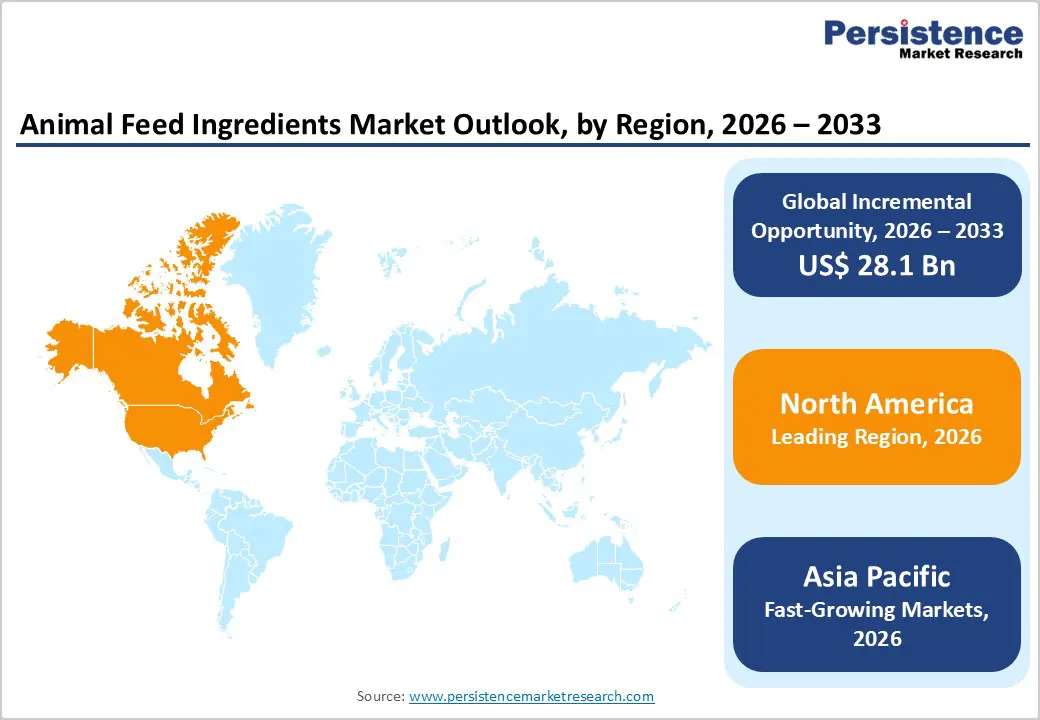
- Leading Region: North America accounts for the largest share at 46.7%, supported by advanced livestock production systems, strong adoption of precision nutrition, well-established feed manufacturing infrastructure, and continuous investment in animal performance technologies.
- Fastest-Growing Region: Asia Pacific is witnessing the fastest expansion due to rapid livestock industrialization, increasing protein consumption, favorable agricultural raw material availability, and growing investments in commercial feed production.
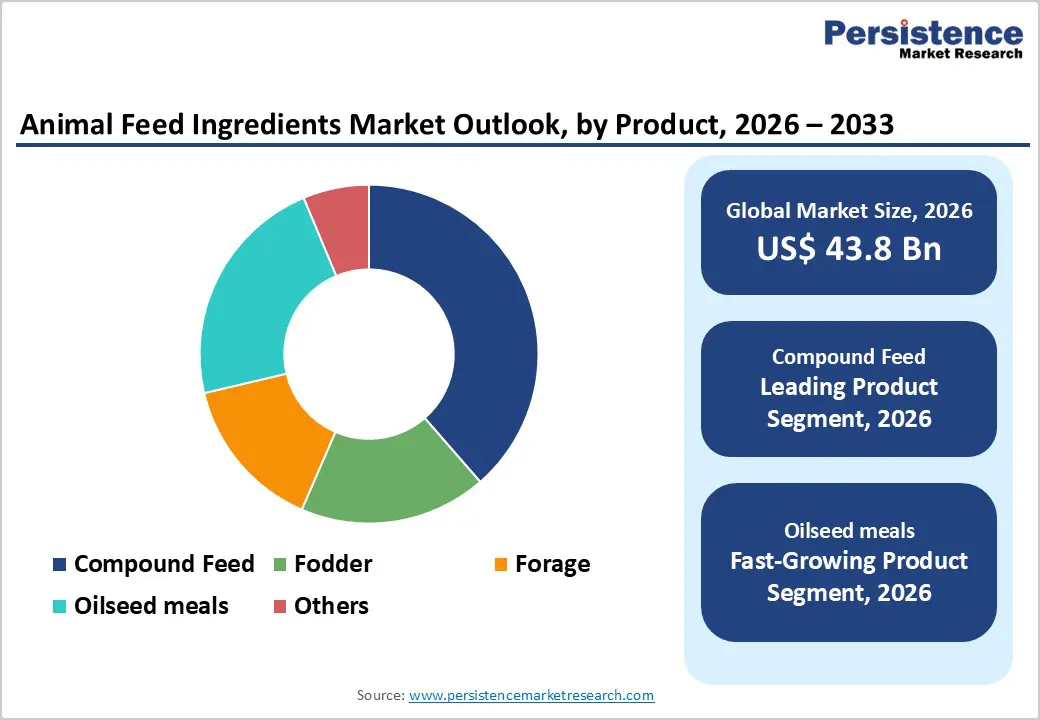
- Leading Product Segment: Compound feed holds market leadership owing to its balanced nutritional composition, scalability for intensive farming operations, and widespread use across poultry, ruminant, and swine production systems.
- Fastest-Growing Product Segment: Oilseed meals are growing rapidly as demand increases for high-protein, cost-effective feed inputs supporting improved feed conversion efficiency and sustainable livestock nutrition.
- Leading Source Segment: Animal based protein remains dominant, supported by superior digestibility, strong amino acid profiles, and extensive utilization in high-performance poultry and aquaculture feed formulations.
- Fastest-Growing Source Segment: Plant based protein is expanding steadily due to sustainability considerations, improved processing technologies, and increasing adoption as an alternative protein source in modern feed formulations.
| Key Insights | Details |
|---|---|
| Animal Feed Ingredients Market Size (2026E) | US$ 43.8 Bn |
| Market Value Forecast (2033F) | US$ 71.9 Bn |
| Projected Growth (CAGR 2026 to 2033) | 4.8% |
| Historical Market Growth (CAGR 2020 to 2025) | 4.1% |
Market Dynamics
Driver - Expanding Global Livestock Production and Increasing Focus on Feed Efficiency
Growing consumption of meat, milk, eggs, and aquaculture products worldwide is significantly accelerating demand for nutritionally balanced feed inputs. Population expansion, urban dietary transitions, and rising income levels are encouraging higher intake of animal protein, prompting livestock producers to improve productivity through optimized feeding strategies. Modern commercial farming increasingly relies on scientifically formulated ingredients such as protein meals, amino acids, enzymes, and mineral blends to enhance growth rates, reproductive performance, and overall animal health. Feed efficiency has become a critical economic factor, as producers aim to reduce input costs while maximizing output quality.
Technological advancements in animal nutrition, including precision feeding and performance-based formulations, are further supporting ingredient adoption across poultry, ruminant, and aquaculture sectors. Additionally, restrictions on antibiotic growth promoters in several regions are accelerating the use of functional additives that support immunity and gut health naturally. Expansion of integrated farming operations and large-scale feed mills is strengthening bulk procurement of specialized ingredients. Improved awareness regarding sustainable livestock production and reduced environmental impact also drives the use of digestibility-enhancing inputs that minimize nutrient waste. Collectively, these structural changes are positioning advanced feed ingredients as essential components in modern animal production systems rather than optional supplements.
Restraints - Raw Material Price Fluctuations and Supply Chain Vulnerabilities
Market expansion continues to face pressure from volatility in agricultural commodities and logistical inefficiencies affecting ingredient availability. Feed ingredient production depends heavily on crops such as corn, soybean, and oilseeds, whose prices are influenced by weather variability, geopolitical disruptions, export restrictions, and fluctuating fertilizer costs. Sudden increases in raw material prices directly impact feed manufacturing margins and create uncertainty for long-term procurement planning. In addition, transportation bottlenecks, storage limitations, and inconsistent infrastructure in developing regions can disrupt supply continuity and raise operational expenses.
Quality standardization also presents challenges, particularly when sourcing from fragmented agricultural systems where variations in nutrient composition may occur. Smaller producers often struggle to maintain consistent processing conditions, affecting product uniformity and performance outcomes. Regulatory differences across countries regarding feed safety, additive approvals, and labeling requirements further complicate cross-border trade. Moreover, price-sensitive livestock farmers may hesitate to adopt premium or specialty ingredients during periods of economic instability, favoring lower-cost alternatives. Competition from locally available feed materials and traditional feeding practices can slow adoption in emerging markets. These combined factors create cost pressures and operational risks that may restrain faster market penetration despite strong underlying demand.
Opportunity - Precision Nutrition, Sustainable Protein Sources, and Aquaculture Expansion
Shifting industry priorities toward efficiency, sustainability, and animal health are creating substantial opportunities for ingredient innovation. Precision nutrition approaches, supported by data analytics and advanced feed formulation software, are encouraging the development of targeted nutrient solutions tailored to species, life stage, and production objectives. Increasing investment in alternative protein sources, including microbial, insect-derived, and fermentation-based ingredients, is opening new avenues for sustainable feed production while reducing reliance on traditional raw materials.
Rapid growth of aquaculture represents another major opportunity, as fish and shrimp farming require highly specialized feed compositions with optimized protein and digestibility characteristics. Demand for functional additives such as probiotics, enzymes, and toxin binders is rising as producers seek to enhance disease resistance and improve feed conversion efficiency without relying on antibiotics. Environmental regulations promoting reduced emissions and better nutrient utilization are also accelerating adoption of advanced feed technologies. Emerging economies offer strong long-term potential due to modernization of livestock farming, expansion of commercial feed manufacturing, and supportive government initiatives focused on food security. Strategic collaborations between biotechnology firms, feed manufacturers, and agricultural producers are further enabling innovation, positioning next-generation feed ingredients as a central driver of future industry value creation.
Category-wise Analysis
By Product, Compound Feed Dominates Owing to High Nutritional Efficiency and Large-Scale Livestock Adoption
The compound feed segment is anticipated to hold the largest position in the global animal feed ingredients market in 2026, accounting for 38.6% of total revenue. Its leadership stems from balanced nutrient formulation, consistent quality, and suitability for commercial livestock production systems. Feed manufacturers increasingly rely on compound feed to improve feed conversion ratios, animal growth performance, and operational efficiency. The availability of diversified raw materials such as cereals, oilseed meals, vitamins, and amino acids enables scalable production across poultry, ruminant, and swine sectors. Industrial farming practices favor compound formulations because they reduce feeding errors and support standardized nutrition programs. Additionally, expanding intensive farming operations and rising meat and dairy consumption worldwide are strengthening demand. Continuous advancements in feed processing technologies, pellet optimization, and precision nutrition strategies further reinforce the segment’s dominant market position.
By Source, Animal-Based Protein Leads Due to High Digestibility and Performance Benefits
Animal-based protein is projected to lead the global animal feed ingredients market in 2026, capturing a 71.5% revenue share. This dominance is supported by superior amino acid profiles, higher digestibility, and strong performance outcomes in livestock and aquaculture production. Ingredients such as fish meal, meat and bone meal, and blood meal are widely incorporated into feed formulations to enhance growth rates, reproductive performance, and feed efficiency. Aquaculture and poultry sectors particularly depend on animal protein sources to meet intensive nutritional requirements. Established rendering industries and efficient utilization of animal by-products also contribute to cost optimization and circular economy benefits. Despite increasing interest in plant proteins, animal-derived ingredients remain essential in high-performance feed formulations. Growing global protein consumption and the need for productivity improvements in commercial farming continue to sustain this segment’s leadership.
By Application, Poultry Segment Leads Driven by Rapid Production Cycles and Rising Global Chicken Consumption
The poultry segment is expected to dominate the global animal feed ingredients market in 2026, accounting for 41.2% of total revenue. Poultry production requires nutritionally precise feed formulations to support rapid growth cycles, efficient weight gain, and disease resistance, driving significant ingredient demand. Increasing consumer preference for affordable animal protein, particularly chicken meat and eggs, has accelerated poultry farming expansion worldwide. Compared with other livestock categories, poultry offers shorter production timelines and lower feed conversion costs, encouraging commercial producers to scale operations. Feed ingredient consumption remains high due to continuous feeding requirements across broilers, layers, and breeder birds. Additionally, advancements in genetics, farm automation, and nutrition management are increasing reliance on specialized feed ingredients such as amino acids, enzymes, and mineral blends, further strengthening the segment’s market leadership.
Regional Insights
North America Animal Feed Ingredients Market Trends
North America is projected to account for 46.7% of the global animal feed ingredients market value in 2026, with the United States representing the primary contributor. The region benefits from highly industrialized livestock production systems, advanced feed manufacturing infrastructure, and strong adoption of scientifically formulated nutrition programs. Large poultry, dairy, and swine operations rely heavily on performance-enhancing feed ingredients to improve productivity and maintain consistent output quality. Increasing demand for high-protein diets and premium animal products continues to encourage investment in feed optimization technologies. Regulatory oversight from agencies such as the FDA and USDA ensures ingredient safety and traceability, supporting market confidence and innovation.
Producers are increasingly incorporating functional additives, enzymes, and specialty nutrients aimed at improving gut health and feed efficiency while reducing antibiotic dependence. Well-established grain supply chains, strong research capabilities, and widespread adoption of precision livestock farming further strengthen regional dominance. Additionally, strategic partnerships between feed manufacturers and biotechnology companies accelerate product development, enabling North America to maintain leadership in advanced animal nutrition solutions.
Europe Animal Feed Ingredients Market Trends
Europe’s animal feed ingredients market is expected to experience stable expansion in 2026, supported by stringent regulatory frameworks and a strong emphasis on sustainable livestock production. Countries such as Germany, the U.K., France, Spain, Italy, and the Netherlands represent major consumption centers due to their advanced animal husbandry practices and well-regulated feed industries. European producers increasingly focus on improving feed efficiency while minimizing environmental impact, encouraging adoption of specialty additives, alternative proteins, and nutrient-optimized formulations. Policies targeting antibiotic reduction and animal welfare standards have accelerated the use of probiotics, enzymes, and functional feed solutions.
Sustainability initiatives, including circular agriculture and reduced carbon emissions, influence ingredient sourcing decisions across the region. Feed manufacturers also emphasize traceability, transparency, and compliance with EU feed safety regulations, strengthening product quality standards. Growing demand for premium dairy and meat products continues to drive innovation in feed formulations designed to enhance productivity and animal health. Continuous investments in research collaborations and sustainable nutrition technologies support long-term market stability throughout Europe.
Asia Pacific Animal Feed Ingredients Market Trends
The Asia Pacific animal feed ingredients market is forecast to register the fastest growth, with a CAGR of around 6.6% between 2026 and 2033, making it the key expansion hub globally. Rapid urbanization, population growth, and rising disposable incomes are increasing consumption of meat, dairy, and aquaculture products across China, India, Indonesia, Vietnam, and Thailand. Expanding poultry and aquaculture industries are significantly driving demand for protein meals, amino acids, and functional additives. The region benefits from abundant agricultural raw materials, enabling cost-efficient feed ingredient production and regional supply advantages. Governments are actively supporting livestock modernization programs, feed quality regulations, and domestic production capacity expansion to ensure food security. Growth of integrated farming operations and commercial feed mills is further accelerating ingredient consumption.
Additionally, multinational nutrition companies are investing in manufacturing facilities and partnerships to strengthen distribution networks and technical advisory services. Increasing awareness of animal health management and productivity optimization continues to promote adoption of advanced feed formulations, positioning Asia Pacific as the primary long-term growth engine for the global animal feed ingredients market.
Competitive Landscape
The global animal feed ingredients market is highly competitive, with strong participation from DuPont de Nemours, Inc., The Mosaic Company, Burcon NutraScience Corporation, Archer Daniels Midland Company (ADM), and Cargill, Incorporated. These companies leverage diversified agricultural sourcing networks, integrated processing capabilities, advanced nutrition science expertise, and strong relationships with feed manufacturers and livestock producers to develop protein meals, feed additives, enzymes, and mineral nutrition solutions.
Rising demand for animal protein, improving livestock productivity requirements, and growing adoption of precision nutrition are driving innovation. Manufacturers are focusing on sustainable sourcing, functional feed additives, performance optimization, and expanding distribution across emerging livestock and aquaculture markets.
Key Industry Developments:
- In February 2026, dsm-firmenich, a global innovator in nutrition, health, and beauty solutions, announced an agreement with CVC, a leading international private markets investment firm, to divest its Animal Nutrition & Health (ANH) business at an enterprise valuation of approximately €2.2 billion, including a potential earnout of up to €0.5 billion. Under the transaction, dsm-firmenich will retain a 20% equity stake in the ANH entities while partnering with CVC following the divestment.
- In October 2025, Bioiberica introduced an expanded version of its Nucleoforce product portfolio aimed at supporting animal immune function and intestinal health. The newly launched range includes Nucleoforce Immunity, Nucleoforce Performance, and Nucleoforce High Flowability (HF), with the company highlighting emerging scientific evidence indicating enhanced synergistic benefits when these ingredients are used alongside complementary bioactive compounds.
- In September 2025, Archer Daniels Midland Company (ADM) and Alltech signed a definitive agreement to establish a North American animal feed joint venture, combining their extensive industry expertise and complementary capabilities to deliver enhanced nutritional solutions and greater value for customers across the region.
Companies Covered in Animal Feed Ingredients Market
- DuPont de Nemours, Inc.
- The Mosaic Company
- Burcon NutraScience Corporation
- Archer Daniels Midland Company (ADM)
- Cargill, Incorporated
- Hamlet Protein A/S
- Koninklijke DSM N.V.
- CHS Inc.
- J.R. Simplot Company
- BRF S.A.
- Kemin Industries, Inc.
- Biomin Holding GmbH
- BASF SE
- Nutreco N.V.
- Alltech, Inc.
- Others
Frequently Asked Questions
The global animal feed ingredients market is projected to be valued at US$ 43.8 Bn in 2026.
Rising global demand for animal protein, expansion of commercial livestock production, and increasing adoption of nutritionally optimized feed formulations drive market growth.
The global animal feed ingredients market is poised to witness a CAGR of 4.8% between 2026 and 2033.
Growth opportunities lie in precision nutrition, sustainable protein alternatives, functional feed additives, and rapid expansion of aquaculture and industrial farming systems.
DuPont de Nemours, Inc., The Mosaic Company, Burcon NutraScience Corporation, Archer Daniels Midland Company (ADM), and Cargill, Incorporated, are some of the key players in the animal feed ingredients market.


