




- Advanced Materials
- Aluminum Composite Panels Market
Aluminum Composite Panels Market Size, Share, and Growth Forecast, 2026 - 2033
Aluminum Composite Panels Market By Top Coating (Polyester, Polyvinylidene Fluoride, Others), Application (Interior Decoration, Hoarding, Insulation, Cladding, Railway Carrier, Others), End-user (Building and Construction, Others), and Regional Analysis for 2026 – 2033

Aluminum Composite Panels Market Size and Trends Analysis
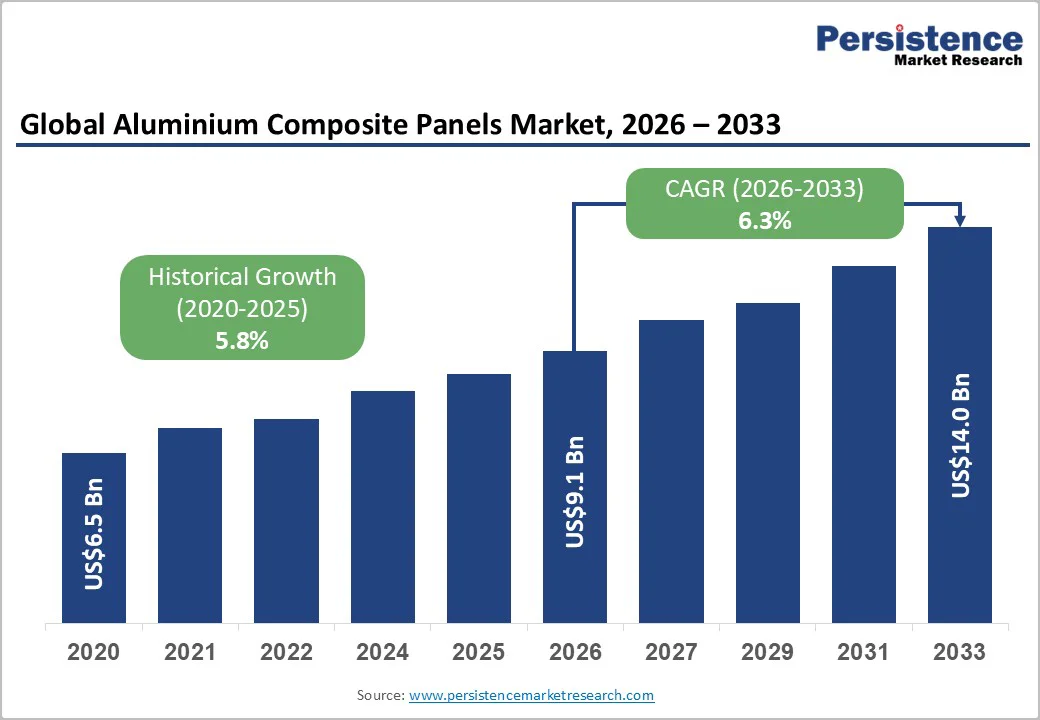
The global aluminum composite panels market size is likely to be valued at US$9.1 billion in 2026 and is expected to reach US$14.0 billion by 2033, growing at a CAGR of 6.3% during the forecast period from 2026 to 2033, driven by the increasing prevalence of urbanization-driven construction, rising demand for lightweight cladding in building and transportation, and advancements in durable coating technologies. Growing demand for aesthetic, fire-resistant panels for interior décor and insulation is accelerating aluminum composite panel adoption. Advances in polyester and PVDF coatings are boosting uptake by delivering weather-resistant, eco-friendly options. Rising use of aluminum composite panels in sustainable infrastructure, particularly in emerging markets, continues to drive strong market growth.
Key Industry Highlights:
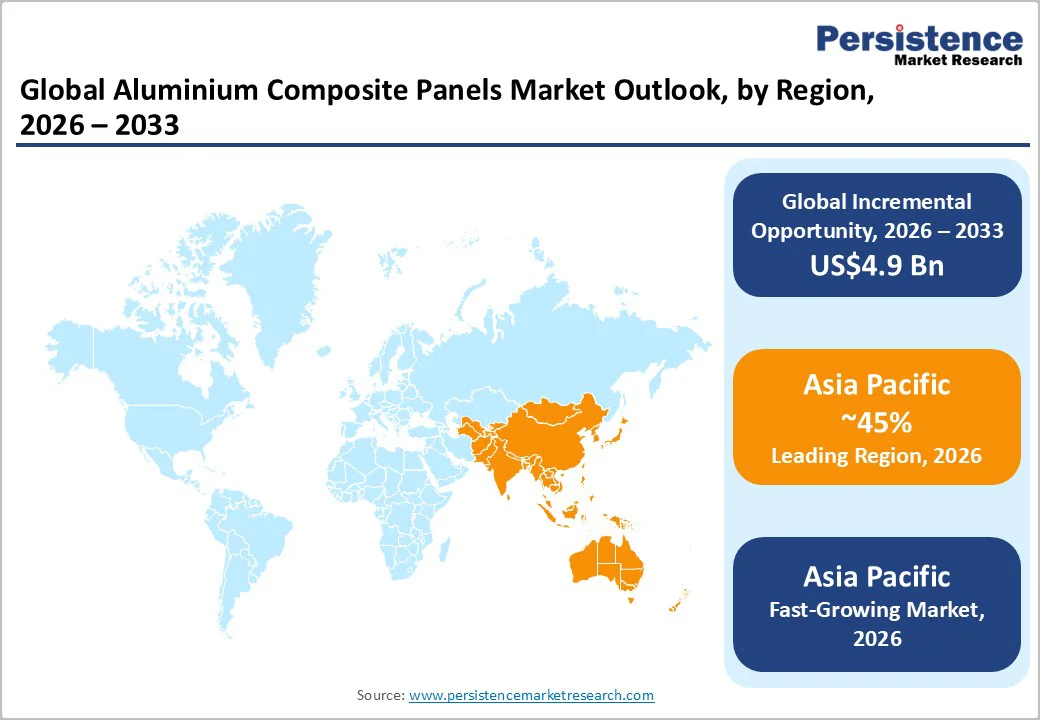
- Leading Region: Asia Pacific is anticipated to account for a 45% market share in 2026, driven by rapid infrastructure booms, high urbanization rates, and strong manufacturing in China and India.
- Fastest-growing Region: Asia Pacific is likely to be the fastest-growing, fueled by government investments in smart cities, rising awareness of energy-efficient facades, and growing exports in building materials.
- Dominant Top Coating: Polyvinylidene fluoride is estimated to hold approximately 40% of the market share in 2026, as it provides superior UV resistance and longevity in harsh exteriors.
- Leading Application: Cladding is projected to account for over 50% of the market revenue in 2026, due to aesthetic versatility, weatherproofing, and widespread use in commercial high-rises.
- Leading End-user: Building and construction, to contribute nearly 70% of the market revenue in 2026, due to its advanced durability, lightweight design, and capacity for large-scale facades.
| Key Insights | Details |
|---|---|
|
Aluminum Composite Panels Market Size (2026E) |
US$9.1 Bn |
|
Market Value Forecast (2033F) |
US$14.0 Bn |
|
Projected Growth (CAGR 2026 to 2033) |
6.3% |
|
Historical Market Growth (CAGR 2020 to 2025) |
5.8% |
Market Factors – Growth, Barriers, and Opportunity Analysis
Urbanization Fuels Demand for Lightweight Cladding
The rising preference for urbanization-driven construction is quickly becoming a major opportunity for aluminum composite panel manufacturers, driven by growing demand for versatile, durable materials in facades and interiors. Traditional heavy cladding often creates weight issues, especially in high-rises and transportation, leading to higher structural costs and lower efficiency. Lightweight technologies, including aluminum composite panels, PVDF coatings, polyester finishes, fire-retardant cores, and insulated variants, address these concerns by offering a slim, robust alternative. These formats simplify installation, reduce the need for heavy reinforcements, and are particularly effective during large-scale projects or retrofits where rapid deployment is critical.
Aluminum composite panels significantly lower the risk of corrosion, thermal bridging, and aesthetic degradation, which remain major concerns in building settings. They also support improved energy efficiency and easier maintenance, especially for cladding and column covers, making them ideal for urban or coastal regions. As global development organizations push for broader infrastructure coverage and user-friendly materials, demand continues to expand across interior decoration, hoarding, and railway carrier applications.
High Development and Coating Costs
High development and coating costs present a significant barrier for companies advancing next-generation aluminum composite panels and novel facade systems. Developing innovative variants such as PVDF-coated, insulated, or fire-rated aluminum composite panels requires extensive research, specialized alloys, and advanced extrusion technologies that are far more expensive than traditional metal sheets. Durability is an even greater challenge: many modern composites, nano-enhanced cores, and weatherproof coatings are sensitive to humidity, UV exposure, and impacts, requiring rigorous optimization to ensure they remain intact throughout fabrication and installation. Achieving long-term performance often involves costly weathering trials, sophisticated adhesion testing, and the use of high-grade fluoropolymers, which significantly increase R&D expenditures.
Meeting stringent regulatory expectations for fire safety data, weather resistance, and batch uniformity requires multiple performance studies under various conditions and across several production runs. This adds both time and financial burden to development timelines. Scaling up manufacturing requires controlled environments, specialized lamination equipment, and quality-assurance systems, further driving up overall costs. For smaller fabricators, these challenges can limit product diversification or delay market entry.
Advancements in Fire-Retardant and Eco-Friendly Panel Platforms
Advancements in fire-retardant and eco-friendly aluminum composite panel platforms are transforming the global construction landscape by addressing two major challenges, flammability risks and sustainability barriers. Fire-retardant panels are engineered to achieve Class A ratings, reducing reliance on additives and enabling safe use in high-occupancy buildings. Innovations, such as mineral-filled cores, nano-flame suppressants, polymer engineering, and hybrid laminates, significantly improve safety and reduce smoke emission, lowering compliance costs for developers and regulatory bodies.
Progress in eco-friendly platforms, including recycled aluminum sheets, low-VOC polyester coatings, bio-based adhesives, and modular cladding systems, supports more sustainable builds by minimizing waste, the industry’s first line of defense against environmental impact. These formats enhance recyclability, boost energy efficiency, and allow prefabrication without skilled labor, making them highly suitable for mass urban projects. New technologies such as antimicrobial surfaces, solar-integrated panels, and VLP-based composites further enhance functionality and aesthetic response.
Category-wise Analysis
Top Coating Insights
Polyvinylidene fluoride is anticipated to dominate the market, accounting for approximately 40% of the market share in 2026. Its dominance is driven by exceptional UV stability, chemical resistance, and gloss retention, making it preferred for exterior cladding. Polyvinylidene Fluoride coatings provide weatherproofing, ensure longevity, and contribute to low maintenance, making them suitable for large-scale building campaigns. For example, 3A Composites uses Kynar® 500 PVDF coatings in its ALUCOBOND® panels, ensuring long-lasting color durability and high-performance weather resistance in high-rise façades and infrastructure projects worldwide.
Polyester represents the fastest-growing segment, due to its cost-efficiency and expanding use in interior decoration. Its strong adhesion profile makes it ideal for decorative wraps, reducing installation costs. Continuous innovations in nano-enhanced polyesters are further strengthening their durability, driving rapid adoption across Asia Pacific and Europe, where demand for budget-friendly, high aesthetic coatings is accelerating. For example, GEESHINE Building Materials Co., Ltd., its ACP product line includes interior-grade polyester-coated ACP panels marketed specifically for “wall decoration” and indoor applications.
Application Insights
Cladding is anticipated to lead the market, holding approximately 50% of the share in 2026, driven by persistent aesthetic needs, large renovation programs, and strong global demand for facade solutions. Their dominance continues as developers expand use for high-rises, signage, and column covers. Rising adoption of insulated cladding and expanded hoarding campaigns highlight the growing focus on multifunctional protection. For example, Alucobond is widely used for exterior façades and cladding in commercial and high-rise buildings due to its lightweight, durable, weather-resistant ACP panels.
Interior decoration is likely to be the fastest-growing segment, due to strong momentum in sustainable designs and expanding inclusion of decorative panels in commercial interiors. The growing shift toward lightweight, easy-install platforms, along with better acoustic properties, accelerates the adoption. Advancements in antimicrobial interiors and continued progress of beam wrap solutions entering pilot trials drive market growth. For example, Mitsubishi Chemical America’s (MCA) ALPOLIC Division, a leader in metal composite material (MCM) manufacturing, expanded its Timber Series by adding two new wood-pattern decorative panels. These lightweight, realistic wood-finish MCM panels are designed for interior applications such as office walls, reception areas, retail interiors, hotel lobbies, and mall refurbishments.
End-user Insights
Building and construction is likely to dominate the market, with approximately 70% share in 2026, due to the high volume of urban developments and strong global emphasis on resilient facades. Regular cladding schedules, code requirements, and widespread access to modular systems drive consistent demand. Rising focus on insulated panels and railway carriers further strengthens leadership. For example, ALPOLIC (by Mitsubishi Chemical) panels are widely used for façade cladding and ventilated rainscreen systems in commercial and institutional buildings. They are promoted for their durability, weather-resistance, ease of installation, and architectural flexibility, ideal for high-rise exteriors, building façades, and urban construction projects.
Transportation is the fastest-growing field, driven by the rising need for lightweight panels, vulnerability to vibrations, and expanding adoption of aerodynamic covers. Improved fire ratings, tailored thickness, and stronger impact resistance for vehicles support rapid uptake. The growing use of column wraps, signage, and others among fleet operators further accelerates market growth. For example, AluWall uses its ACP panels for transportation applications such as buses, metro coaches, and rail compartments. The panels are selected for their lightweight structure, high strength, corrosion resistance, and design versatility, enabling reduced vehicle weight, improved fuel efficiency (or extended electric range), and durable, low-maintenance surfaces for both vehicle interiors and exteriors.
Regional Insights
North America Aluminum Composite Panels Market Trends
North America is driven by the region’s advanced construction infrastructure, strong research and development capabilities, and high public awareness of sustainable materials. Building systems in the U.S. and Canada provide extensive support for facade programs, ensuring wide accessibility of aluminum composite panels across cladding, interiors, and transportation populations. Increasing demand for PVDF-coated, convenient, and easy-to-install panels is further accelerating adoption, as these formats improve efficiency and reduce barriers associated with heavy alternatives.
Innovation in aluminum composite panel technology, including stable cores, improved adhesion delivery, and targeted fire resistance, is attracting significant investment from both public and private sectors. Government initiatives and green building campaigns continue to promote the use against urban expansion, seismic events, and emerging weather threats, creating sustained market demand. The growing focus on hoarding and beam wraps, particularly for commercial and rail, is expanding the target applications for aluminum composite panels.
For example, 3A Composites announced that their ALUCOBOND PLUS panels combined with TENMAT fire block systems successfully passed rigorous NFPA 285 fire safety tests, making them fully compliant with New York City 2022 building codes. This development highlights the adoption of ACP panels in façade applications where safety, fire resistance, and code compliance are critical, reinforcing their growing use in commercial and urban construction projects across North America.
Europe Aluminum Composite Panels Market Trends
Europe is likely to be driven by increasing awareness of sustainable benefits, strong building systems, and government-led renovation programs. Countries such as Germany, France, and the U.K. have well-established construction frameworks that support routine facades and encourage the adoption of innovative panel delivery methods, including aluminum composite panels. These versatile formulations are particularly appealing for interior populations, cost-averse developers, and transportation users, improving compliance and coverage rates.
Technological advancements in aluminum composite panel development, such as enhanced durability, coating-targeted delivery, and improved eco-formulations, are further boosting market potential. European authorities are increasingly supporting research and trials for panels against both routine and extreme conditions, strengthening market confidence. The growing emphasis on convenient, prefabricated options is aligned with the region’s focus on preventive construction and reducing site disruptions.
Public awareness campaigns and development drives are expanding reach in both urban and rural areas, while manufacturers are investing in alloys and novel cores to increase performance. For example, ALUCOBOND® (by 3A Composites), a leading ACP supplier in Europe, is widely used for façades and exterior cladding across European commercial, institutional, and residential buildings. Their ACP façade panels are promoted for their durability, recyclability, weather resistance, and architectural flexibility.
Asia Pacific Aluminum Composite Panels Market Trends
Asia Pacific is projected to be the fastest-growing region and is expected to dominate in 2026, accounting for a market share of 45%, driven by rising construction awareness, increasing government initiatives, and expanding infrastructure programs across the region. Countries such as India, China, Japan, and Southeast Asian nations are actively promoting building campaigns to address urban density and emerging mobility needs. Aluminum composite panels are particularly attractive in these regions due to their lightweight administration, ease of fabrication, and suitability for large-scale cladding drives in both urban and rural populations.
Technological advancements are supporting the development of stable, effective, and easy-to-install aluminum composite panels, which can withstand challenging climatic conditions and minimize waste dependence. These innovations are critical for reaching remote sites and improving overall project coverage. Growing demand for interior, hoarding, and transportation applications is contributing to market expansion.
Public-private partnerships, increased construction expenditure, and rising investment in material research and manufacturing capacity are further accelerating growth. The convenience of panel delivery, combined with improved durability and reduced risk of failures, positions aluminum composite panels as a preferred choice. For example, Aludecor (India), one of the leading ACP suppliers in Asia Pacific supplies aluminum composite panels for large-scale construction and infrastructure projects across India, including façades, cladding, and modular panel systems for commercial buildings, malls, hospitals, and institutional complexes.
Competitive Landscape
The global aluminum composite panels market features competition between established material leaders and emerging fabricators. In North America and Europe, 3A Composites and Alcoa lead through strong R&D, distribution networks, and construction ties, bolstered by innovative coatings and building programs. In Asia Pacific, Alstrong advances with localized solutions, enhancing accessibility. Lightweight delivery boosts efficiency, cuts weight risks, and enables mass projects across regions. Strategic partnerships, collaborations, and acquisitions merge expertise, expand portfolios, and speed commercialization. Eco-formulations solve sustainability issues, aiding penetration in green-focused areas.
Key Industry Developments
- In May 2025, Alcoa advanced its strategic product development roadmap by completing field trials in India for its insulated ACP variant (1,000 sqm). The results confirmed performance parity with existing PE-coated panels in thermal efficiency, while delivering a superior lightweight profile, strengthening Alcoa’s positioning in high-performance building materials.
- In April 2025, 3A Composites advanced its strategic regulatory compliance and market expansion efforts by achieving successful NFPA 285 certification for its ALUCOBOND PLUS panels when used with TENMAT fire block systems, ensuring full alignment with New York City’s 2022 building codes. This milestone strengthened the company’s position in high-priority façade applications requiring stringent fire safety performance, supporting wider adoption across commercial and urban construction markets in North America.
Companies Covered in Aluminum Composite Panels Market
- 3A Composites
- Alcoa
- Alfrex
- Alpolic Materials
- Alstrong
- Alucopanel
- Alumanate
- Alumax Industrial
- Alumaze
- Alutec
- Mitsubishi Chemical Corporation
- Stacbond
- Vanco
- Viva ACP
- Yaret
- Other
Frequently Asked Questions
The global aluminum composite panels market is projected to reach US$9.1 billion in 2026.
The rising prevalence of urbanization-driven construction and demand for lightweight cladding are key drivers.
The aluminum composite panels market is poised to witness a CAGR of 6.3% from 2026 to 2033.
Advancements in fire-retardant and eco-friendly panel platforms are key opportunities.
3A Composites, Alcoa, Mitsubishi Chemical Corporation, Alstrong, and Viva ACP are the key players.


