




- Industrial Machinery
- Adhesive Dispensing Equipment Market
Adhesive Dispensing Equipment Market Size, Share, and Growth Forecast 2026 - 2033
Adhesive Dispensing Equipment Market by Product Type (Industrial Hot Melt, Adhesive Controllers, Cold Glue Applicators, Others), Application (Packaging, Construction, Lamination, Others), and Regional Analysis for 2026 - 2033

Adhesive Dispensing Equipment Market Size and Trends Analysis
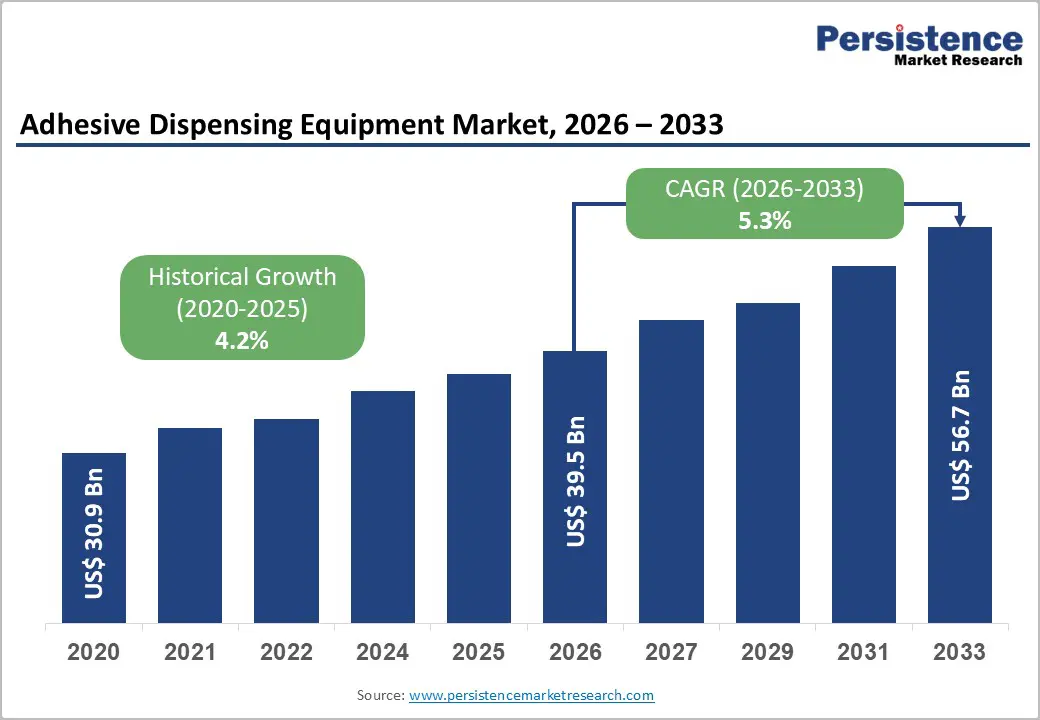
The global adhesive dispensing equipment market size is likely to be valued at US$39.5 billion in 2026 and is expected to reach US$56.7 billion by 2033, growing at a CAGR of 5.3% during the forecast period from 2026 to 2033, driven by rising demand across key end-use industries, including construction, packaging, lamination, disposable hygiene products, and technical textiles.
The increasing shift toward automated manufacturing processes, combined with more complex product designs and tighter quality standards, is significantly accelerating the adoption of advanced adhesive dispensing systems. Technological advancements in adhesive formulations, such as hot melt, polyurethane, and specialty adhesives, are shaping market trends by driving demand for dispensing equipment capable of handling a wide range of viscosities and application requirements.
Key Industry Highlights:
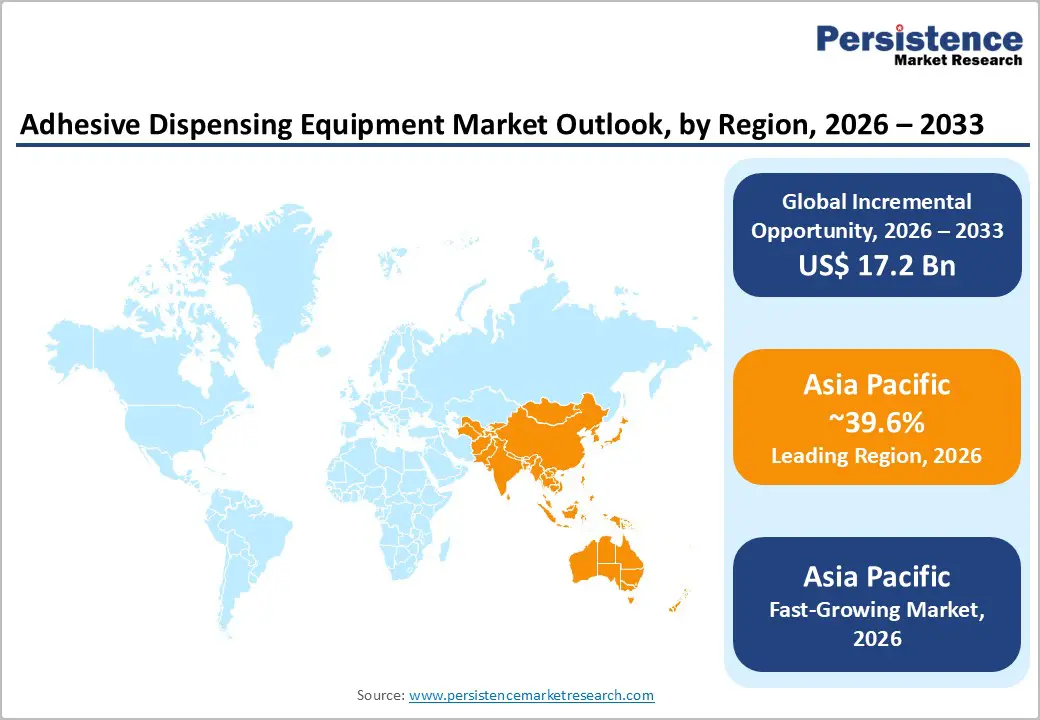
- Leading Region: Asia Pacific is expected to lead the market, accounting for around 39.6% of revenue, driven by extensive urbanization and high construction spending across China, India, Japan, and ASEAN.
- Fastest-Growing Region: Asia Pacific is likely to be the fastest-growing region, driven by increasing electronics, automotive, and EV manufacturing.
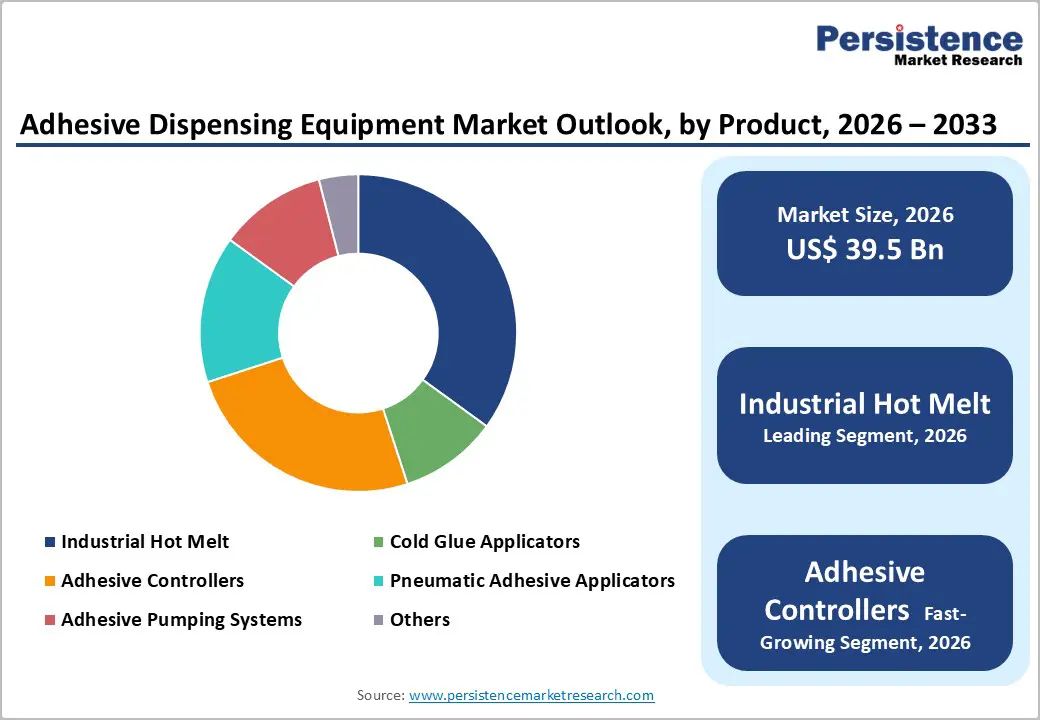
- Leading Product Type: The industrial hot melt segment is anticipated to lead with 36.8% revenue share, driven by its widespread use in packaging, labeling, and construction, and its ability to provide rapid bonding with varied adhesive types in automated processes.
- Leading Application Type: The packaging segment is expected to lead with about 31.7% revenue share, driven by the growth of e-commerce and consumer-goods sectors that demand fast, precise sealing and by the growing adoption of sustainable, automated packaging solutions.
| Key Insights | Details |
|---|---|
| Adhesive Dispensing Equipment Market Size (2026E) | US$39.5 Bn |
| Market Value Forecast (2033F) | US$56.7 Bn |
| Projected Growth CAGR (2026 - 2033) | 5.3% |
| Historical Market Growth (2020 - 2025) | 4.2% |
Market Factors - Growth, Barriers, and Opportunity Analysis
Expansion in Packaging and Lamination Industries
The rapid expansion of e-commerce, food and beverage, pharmaceutical, and consumer goods industries has heightened the demand for fast, reliable, and precise packaging solutions. Automated adhesive dispensing systems are increasingly being adopted to ensure consistent bonding, high-speed sealing, and reduced material waste across packaging lines. As packaging trends move toward lightweight, flexible, and multi-material designs, precise adhesive application has become crucial to preserving product integrity and visual appeal. Manufacturers are also prioritizing improved line efficiency and minimized downtime, further driving the adoption of advanced dispensing equipment.
Lamination processes are further fueling market growth, as they heavily depend on adhesives to bond multiple layers in flexible packaging, medical products, and industrial films. The growing focus on sustainable and recyclable packaging materials has created a need for advanced dispensing systems capable of handling specialized adhesive formulations with accuracy and efficiency. Increasing automation and stringent quality requirements in lamination processes are encouraging investments in precision dispensing technologies, making adhesive dispensing equipment a vital component of modern packaging and lamination operations. The rising use of high-performance laminates in medical and industrial applications is also boosting demand for dependable adhesive dispensing solutions.
Raw Material Price Volatility
The production and performance of adhesives are highly dependent on key raw materials such as polymers, resins, and solvents, which are often affected by price fluctuations due to changes in crude oil costs, supply chain disruptions, and geopolitical uncertainties. These variations increase manufacturing costs for adhesive producers, which, in turn, can raise the overall cost of dispensing equipment and adhesive systems for end-users. Frequent price changes also complicate long-term procurement planning for manufacturers, impacting production stability. Rising raw material costs can reduce profit margins for equipment suppliers, limiting their ability to invest in innovation and expand capacity.
Price volatility also poses challenges in maintaining consistent adhesive quality, as manufacturers may modify formulations to manage costs, potentially affecting dispensing performance and bonding reliability. Consequently, equipment manufacturers must continuously adjust systems to accommodate varying material properties, driving up development and operational costs. This uncertainty can delay investment decisions, particularly for small and medium-sized enterprises, and may restrict the adoption of advanced dispensing technologies in cost-sensitive sectors such as packaging, construction, and lamination. It also adds complexity to system calibration and maintenance, especially in high-precision applications.
Growing Demand in Emerging Markets
Rapid industrialization, urbanization, and infrastructure development in regions such as Asia-Pacific, Latin America, and the Middle East are driving increased adoption of adhesives across packaging, construction, automotive, and consumer goods industries. As local manufacturers expand production to meet growing domestic and export demand, the need for efficient, precise, and automated adhesive-dispensing systems is increasing. The growth of e-commerce and flexible packaging in these markets further accelerates demand for high-speed, reliable dispensing equipment. Investments in modern manufacturing facilities are encouraging a shift from manual processes to advanced, automated adhesive application technologies.
Emerging markets also offer advantages such as cost-effective labor, expanding industrial bases, and supportive government policies aimed at boosting manufacturing output. These factors are encouraging investment in automated production lines and modern dispensing solutions. Increasing awareness of product quality, sustainability, and operational efficiency is motivating manufacturers to transition from manual to automated adhesive dispensing systems. This creates strong opportunities for equipment suppliers to provide affordable, scalable, and customized solutions tailored to the specific needs of emerging economies, supporting long-term market growth.
Category-wise Analysis
Product Type Insights
The industrial hot melt segment is expected to lead the market, accounting for approximately 36.8% of revenue in 2026, driven by its extensive use in packaging, labeling, and construction applications. Hot melt systems provide rapid bonding across a wide range of adhesives, making them ideal for high-speed automated processes and large-scale production lines. They deliver strong, durable bonds with consistent application while minimizing material waste, key for e-commerce, flexible packaging, and construction sectors. For instance, hot-melt systems are commonly used for corrugated box sealing in e-commerce fulfillment centers and for carton and case sealing on food and beverage packaging lines. They are also widely applied in panel bonding and insulation installation in prefabricated and modular construction projects.
Adhesive controllers, meanwhile, are the fastest-growing product type, driven by the need for precise flow and temperature control in complex applications such as disposable hygiene products, technical textiles, and multi-material bonding. As production lines become increasingly automated and products incorporate multiple substrates, advanced controllers enable accurate dispensing, reduce errors, and enhance operational efficiency. For example, sophisticated controllers are essential in diaper and sanitary napkin production to ensure uniform adhesive application, as well as in technical textile lamination, where precise bonding is required to maintain fabric performance and durability.
Application Type Insights
The packaging segment is expected to remain the leading application area, capturing around 31.7% of revenue in 2026. This growth is driven by the rapid expansion of e-commerce and consumer goods industries, which demand fast and precise sealing solutions. The shift toward sustainable and innovative packaging further supports the adoption of automated adhesive dispensing systems, ensuring efficiency, consistency, and product quality. For instance, adhesive dispensers are extensively used in carton sealing and case packaging for online retail shipments, as well as in labeling and flexible packaging for food and beverage products. Automated systems also facilitate the use of recyclable and lightweight materials by enabling accurate adhesive application with minimal waste.
The construction segment is the fastest-growing application, supported by the use of energy-efficient building materials, prefabrication methods, and a preference for adhesives over traditional mechanical fasteners to reduce labor and enhance aesthetics. Adhesives are increasingly used to bond insulation panels and façade elements in green buildings, as well as to assemble modular wall and flooring systems in prefabricated construction projects. Other sectors, such as lamination, disposable hygiene products (DHP), and technical textiles, are also seeing steady growth, driven by rising demand in medical and personal care products, industrial textiles, and composite materials that require specialized adhesives and precision dispensing technologies.
Regional Insights
North America Adhesive Dispensing Equipment Market Trends
In North America, the adhesive dispensing equipment market is increasingly propelled by automation and smart manufacturing. The U.S. and Canada are leading this shift, with manufacturers adopting IoT-enabled dispensers and real-time monitoring systems to boost productivity and minimize downtime. This movement aligns with broader Industry 4.0 initiatives, as companies implement predictive maintenance and data-driven quality control to enhance overall equipment efficiency. For instance, Nordson Corporation has been rolling out smart adhesive-dispensing solutions across North American manufacturing facilities, enabling real-time process control and improved operational performance.
The automotive sector, particularly electric vehicles, is a major growth area that utilizes adhesive dispensing for structural bonding, battery sealing, and noise reduction. The electronics industry is driving demand for micro- and precision-dispensing systems to manage delicate PCB and microchip assembly. North American manufacturers are increasingly adopting low-emission, energy-efficient adhesive systems, including closed-loop and recyclable dispensing technologies. Stricter environmental regulations and corporate sustainability goals are accelerating the use of solvent-free and low-VOC adhesives. Investments in advanced manufacturing facilities are further enabling the integration of high-precision dispensing equipment to meet evolving performance standards and compliance requirements.
Europe Adhesive Dispensing Equipment Market Trends
Europe remains a key market for adhesive dispensing equipment, supported by its well-established industrial base, mature manufacturing sectors, and high adoption of automation technologies. The market is heavily shaped by strict environmental and safety regulations, such as REACH and the EU Green Deal, which promote the use of eco-friendly adhesives, including water-based and solvent-free formulations. This trend drives demand for specialized, energy-efficient dispensing systems that ensure precise adhesive application while minimizing waste. For instance, Germany-based Scheugenpflug AG provides advanced automated dispensing solutions designed for precision bonding and environmentally friendly adhesive applications across European manufacturing industries.
Regional industry trends are also shaping market growth. In the automotive sector, the rise of electric vehicles and lightweight materials is increasing reliance on automated adhesive dispensing for structural bonding, battery sealing, and noise reduction. The packaging industry remains a major application area, driven by consumer demand for fast, sustainable, and visually appealing packaging. The construction and prefabrication sectors are adopting adhesives as alternatives to mechanical fasteners, driven by productivity, aesthetics, and sustainability goals. Additionally, the electronics and medical device industries are fueling demand for precision and micro-dispensing systems to handle delicate components.
Asia Pacific Adhesive Dispensing Equipment Market Trends
Asia Pacific is expected to lead the global adhesive dispensing equipment market, accounting for 39.6% of the market in 2026, driven by rapid industrialization, expanding manufacturing bases, and strong demand across the packaging, construction, electronics, and automotive sectors. Growth in the region is supported by increasing automation on production lines, adoption of high-speed packaging systems, and the need for precise bonding in flexible and multi-material applications. Sectors such as e-commerce, consumer goods, and healthcare are driving demand for fast, reliable, and consistent adhesive-dispensing solutions. Local manufacturing advantages, including cost-effective labor and materials, further support the deployment of automated adhesive systems, while sustainability concerns are promoting low-emission, water-based, and energy-efficient dispensing technologies.
Asia Pacific is also projected to be the fastest-growing region, driven by rising electronics, automotive, and electric vehicle manufacturing. There is strong demand for high-precision and automated dispensing systems for microelectronics assembly, battery bonding, and structural applications in EVs. The booming e-commerce and packaging industries are increasing the need for fast, accurate, and reliable dispensing solutions. For example, Yamaha Motor has launched its YRM-D high-speed dispenser in the region, featuring a compact design, ±0.05 mm precision, and integration with intelligent factory systems to enhance productivity. Government initiatives supporting industrial automation, smart factories, and infrastructure development in countries such as China, India, and South Korea are further encouraging the adoption of advanced adhesive dispensing technologies.
Competitive Landscape
The global adhesive dispensing equipment market exhibits a moderately fragmented structure, driven by growing demand across packaging, automotive, electronics, and construction sectors, as well as rapid technological advancements in automated and smart dispensing systems. Numerous regional players operate in this space, offering a variety of products ranging from industrial hot melt systems to adhesive controllers and pneumatic applicators.
With key leaders including Nordson Corporation, Graco Inc., ITW Dynatec, Scheugenpflug AG, and Henkel AG & Co. KGaA, the market exhibits a mix of established multinational companies and specialized regional manufacturers. These players compete through continuous product innovation, advanced technology integration, and strategic partnerships with end-use industries. Companies are focusing on IoT-enabled, robotic, and precision dispensing systems to differentiate themselves, while also investing in after-sales services, customization, and local manufacturing to improve responsiveness and reduce costs.
Key Industry Developments:
- In July 2025, Nordson launched the VersaBlue® II Melter, an advanced adhesive dispensing system for the disposable hygiene market. Designed for applications such as baby diapers, adult incontinence products, and feminine hygiene items, the system delivers precise adhesive control, reduces material waste, and integrates seamlessly with existing production lines. The VersaBlue® II Melter features advanced gear dosing, variable-speed drives, EtherCAT and OPC UA support for system integration, enhanced thermal insulation for up to 10% energy savings, and real-time diagnostics to minimize downtime.
- In November 2025, Nordson launched the Presto™ nozzle, designed for precision adhesive application on super-fine elastics in hygiene products. The patented slot nozzle enables clean, uniform adhesive placement at gaps as narrow as 1.5 mm, protecting fragile fibers and reducing waste. Ideal for baby diapers, adult incontinence briefs, and feminine hygiene products, Presto™ maintains consistent quality across variable line speeds, supporting high-speed automated production and modern product designs.
Companies Covered in Adhesive Dispensing Equipment Market
- Robatech
- Glue Machinery Corporation
- Gluefast Company
- Henkel
- Nordson Corporation
- Adhesive & Equipment, Inc.
- Valco Melton
- Dymax Corporation
- Henline Adhesive Equipment Corporation
- ITW Dynatec
- Graco Inc.
- 3M
- Adhesive Dispensing Limited
Frequently Asked Questions
The global adhesive dispensing equipment market is valued at US$39.5 billion in 2026 and is expected to reach US$56.7 billion by 2033, reflecting robust growth.
Primary drivers include growth in the construction and packaging industries, advances in adhesive and dispensing technologies, and increased adoption of automation for precision and efficiency.
Industrial hot melt leads the market with 36.8% revenue share, driven by its widespread use in packaging, labeling, and construction, and its ability to provide rapid bonding with varied adhesive types in automated processes.
Asia Pacific leads the market with around 39.6% revenue share, driven by extensive urbanization and high construction spending across China, India, Japan, and ASEAN.
A major opportunity in the adhesive dispensing equipment market lies in the automation and digitalization of dispensing systems, alongside the rising demand for sustainable and environmentally friendly adhesive application technologies.


