




- Medical Devices
- Home Infusion Therapy Market
Home Infusion Therapy Market Size, Share, Growth, and Regional Forecast, 2026 to 2033
Home Infusion Therapy Market by Product (Infusion Pumps, Intravenous Sets, Needleless Connectors, IV Cannulas), Application (Anti-infectives/Antibiotics, Enteral Nutrition, Specialty Pharmaceuticals, Total Parenteral Nutrition (TPN), Pain Management, Chemotherapy, Hydration Therapy, Others), Sales Channel, and Regional Analysis from 2026 to 2033

Home Infusion Therapy Market Share and Trends Analysis
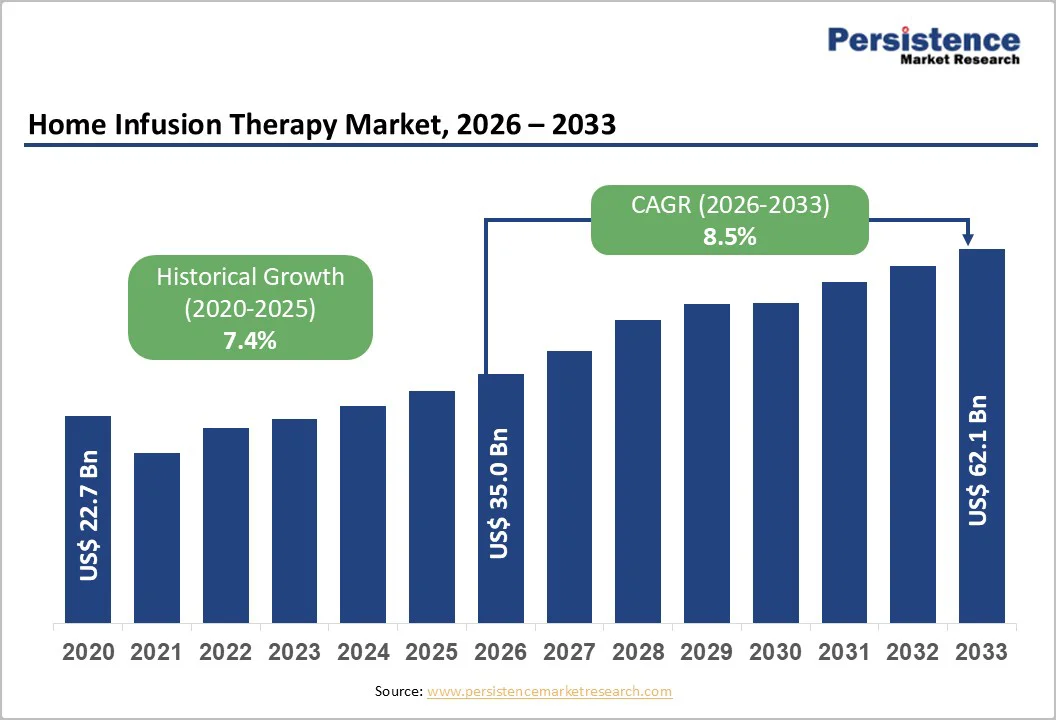
The global home infusion therapy market size is estimated to reach US$ 35.0 billion in 2026 and is projected to reach US$ 62.1 billion by 2033, growing at a CAGR of 8.5% between 2026 and 2033.
Infusion therapy is increasingly recognized as an effective treatment modality for conditions where oral medications offer limited relief or poor absorption. It plays a critical role in managing gastrointestinal disorders, diabetes, cancer-related pain, cystic fibrosis, chronic dehydration, and a wide range of acute and chronic illnesses requiring precise, timely drug delivery.
As healthcare systems emphasize convenience and continuity of care, home infusion therapy has emerged as a preferred alternative, reducing frequent hospital visits, lowering overall treatment burden, and significantly improving medication adherence and patient comfort within familiar home environments.
Key Industry Highlights
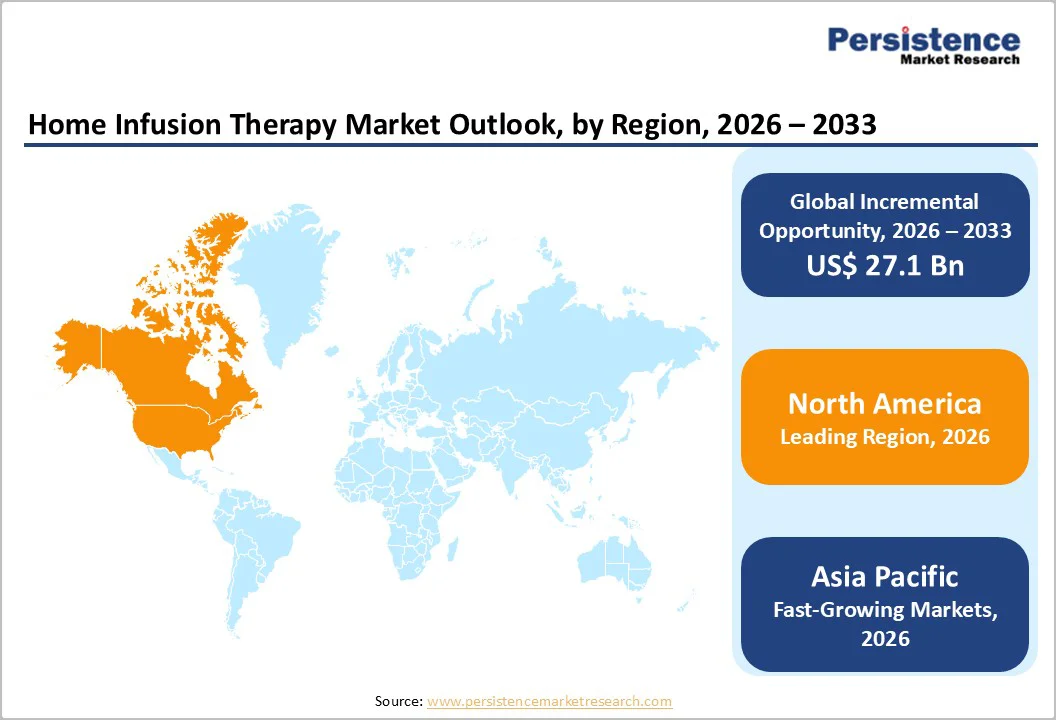
- Leading Region: North America dominates the global market with 42.2%, driven by strong home-care adoption, advanced infusion technologies, and extensive payer support improving access to home-based therapies.
- Fastest-Growing Region: Asia Pacific market is expected to grow rapidly with a CAGR of 10.5% in forecast period, fueled by rising chronic illnesses, rapid digital-health adoption, infusion-device launches, and expanding home-care infrastructure across major economies.
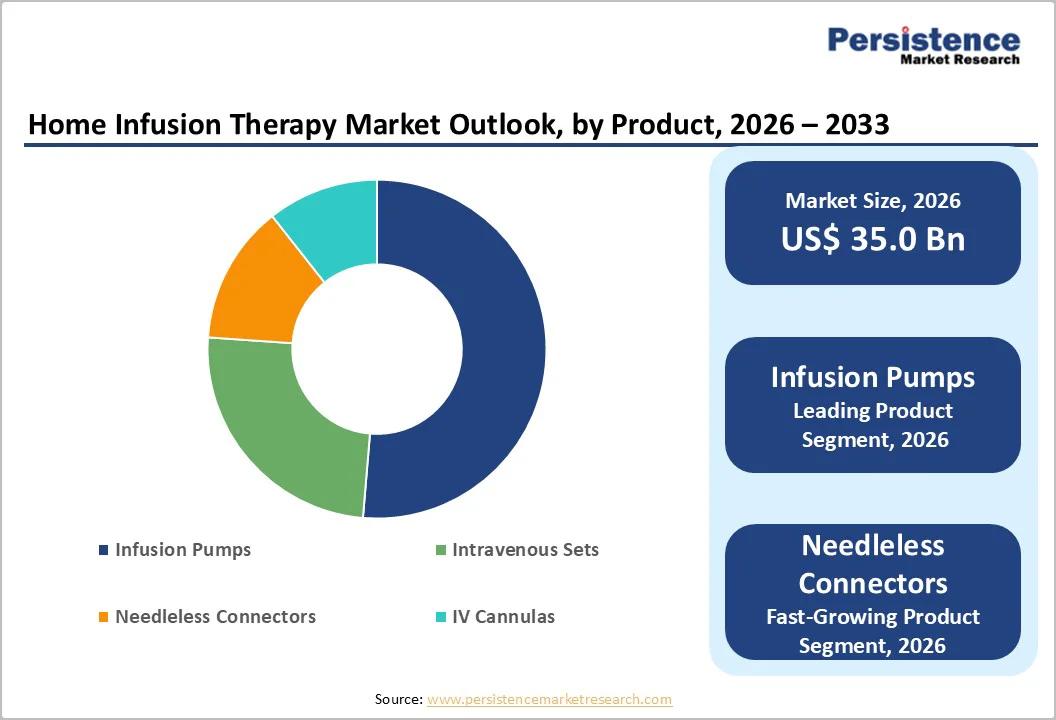
- Leading Product: Infusion Pumps lead with 58.4% share, supported by high accuracy, safer drug delivery, smart connectivity, and increasing replacement demand for advanced pump platforms.
- Leading Application: Anti-infectives/Antibiotics to remain dominant, driven by increasing outpatient infection management, need for long-term IV therapy, and strong shift from hospital to home-based antimicrobial care.
- Leading Sales Channel: Institutional Sales lead with 68.8% share, due to strong procurement by hospitals, infusion centers, and home-care agencies that rely on bulk purchasing and standardized clinical protocols.
- Collaboration among hospitals, home-care agencies, and infusion pharmacies creates streamlined IV-therapy pathways, reducing hospital load and improving therapy continuity.
- Virtual monitoring, digital adherence tools, and remote nurse supervision improve safety and outcomes, accelerating acceptance of at-home infusion across multiple conditions.
| Key Insights | Details |
|---|---|
| Global Home Infusion Therapy Market Size (2026E) | US$ 35.0 Billion |
| Market Value Forecast (2033F) | US$ 62.1 Billion |
| Projected Growth (CAGR 2026 to 2033) | 8.5% |
| Historical Market Growth (CAGR 2020 to 2025) | 7.4% |
Market Dynamics
Driver - Rise in Clinical Needs, Home-Based Care Preference, and Advanced Infusion Technologies
The global home infusion therapy market is expanding as patients increasingly shift from conventional in-facility treatments to specialized home-based infusion services that better accommodate complex clinical needs.
Home infusion pharmacies have safely delivered IV medications for over several decades, demonstrating strong clinical outcomes for elderly, rural, disabled, and transport-challenged populations. This well-established care model aligns with rising demand for cost-effective alternatives, supported by the National Infusion Association’s findings that home infusion is significantly less expensive than hospitalization.
Market growth is further driven by the increasing prevalence of cancer, diabetes, immune disorders, cardiovascular diseases, and other chronic conditions requiring long-term infusion support. The widening application of advanced infusion devices in home settings, coupled with technological innovations-including telehealth integration and remote monitoring-enhances safety, adherence, and care continuity.
Additionally, the rising burden of hospital-acquired infections (HAIs) is accelerating the shift toward home-based therapies as a safer care environment. However, risks related to medication administration, device malfunction, user error, and complex reimbursement structures continue to challenge broader adoption.
Restraints - Workforce Shortages, Clinical Risks, High Patient Burden in Rural Regions, and Complex Reimbursement Limitations
The growth of the global home infusion therapy market is constrained by significant operational, clinical, and economic barriers that disproportionately affect underserved regions. One major challenge is the persistent shortage of trained nurses, pharmacists, and infusion-certified clinicians-particularly in rural settings-where specialized personnel are essential for safe drug preparation, aseptic handling, and real-time monitoring of infusion reactions. This workforce gap severely limits the availability and scalability of home infusion services.
Patients living in remote areas also face substantial financial and logistical burdens when accessing specialty infusion centers, including long travel distances, unreliable transportation, high fuel or vehicle-maintenance costs, hotel stays for multi-day treatments, and weather-related disruption, all of which reduce continuity of care.
Clinical risks further impede market adoption. Improper administration techniques, catheter-related complications, and device misuse remain concerns, especially in homes lacking adequate caregiver support. Additionally, variability in device reliability and the need for routine maintenance create safety and usability challenges.
Furthermore, reimbursement remains a major systemic restraint, as fragmented payer policies, limited coverage for certain infusion drugs and supplies, and administrative complexity often shift costs to patients. Together, these factors create significant barriers to equitable access and slow broader market expansion.
Opportunity - Rapid Adoption of Smart Infusion Technologies, AI Automation, EMR Connectivity, and Personalized Care Models
The global home infusion therapy market is poised for significant opportunity as advanced digital, connected, and AI-enabled technologies reshape how infusions are delivered outside traditional clinical settings.
Smart infusion pumps, remote monitoring platforms, and connectivity-driven systems are expanding the feasibility and safety of home-based care. In February 2023, Mindray’s BeneFusion i and u Series introduced high-precision delivery with drug libraries, BolusGUARD safety features, and centralized M-IoT device management-illustrating how intelligent hardware can reduce dosing errors and increase clinician oversight from a distance.
Similarly, in April 2024, Mackenzie Health deployed BD Alaris EMR Interoperability technology, enabling two-way communication between IV pumps and the EMR, automating pump programming, and reducing keystrokes by 86%, a breakthrough that can be adapted to home settings for safer, error-free infusions.
Expanding AI adoption presents another major opportunity: in March 2025, Uptiv Health partnered with Lamar Health to automate referral intake and prior authorization, significantly shortening time-to-treatment-an advantage directly relevant to infusion-dependent chronic disease patients.
Growing use of intravenous immunoglobulin (IVIG) for autoimmune and immunodeficiency disorders, along with personalized treatment plans supported by telehealth, allows home infusion providers to deliver tailored, patient-centric care models. Collectively, these innovations open strong growth pathways by improving safety, efficiency, access, and overall patient experience.
Category-wise Analysis
By Product Insights
Infusion pumps are expected to capture a 58.4% share of the global home infusion therapy market by 2026, reflecting their critical role in ensuring accurate, controlled, and safe drug delivery in home settings. Their ability to manage complex therapies, automate dosing, and minimize administration errors makes them indispensable for chronic and acute conditions treated at home.
Rising adoption of connected and smart pumps, including remote monitoring and drug library integration, further strengthens their dominance. The shift toward advanced digital home-care solutions continues to position infusion pumps as the core technology within home infusion therapy.
By Application Insights
Anti-infectives/antibiotics are projected to hold nearly 32.7% of the global home infusion therapy market in 2026, driven by the rising prevalence of chronic, post-surgical, and hospital-acquired infections requiring prolonged treatment. Home infusion provides a safer, more convenient alternative for patients needing daily or continuous antimicrobial therapy, reducing hospital stays and lowering overall treatment costs.
The growing shift toward outpatient parenteral antimicrobial therapy (OPAT) further supports category leadership. Increased physician confidence in home-based antibiotic delivery and expanding protocols for remote infection management reinforce the continued dominance of this application segment.
By Sales Channel Insights
Institutional sales are projected to account for nearly 68.8% of the global home infusion therapy market in 2026, reflecting the strong influence hospitals and care centres hold in therapy initiation, equipment procurement, and clinical decision-making. Healthcare institutions purchase pumps, consumables, and infusion sets in bulk, ensuring standardization, quality control, and compliance with safety guidelines.
Their role in prescribing home-based treatments, managing chronic-disease pathways, and coordinating with home-health agencies further strengthens this channel’s dominance. As hospitals increasingly shift suitable cases to home settings, institutional-driven demand continues to steer the market.
Regional Insights
North America Home Infusion Therapy Market Trends
North America is projected to capture 42.2% of the global home infusion therapy market by 2026, supported by strong clinical demand, advanced infrastructure, and rapid digital transformation in infusion care. The region’s growing geriatric population and high prevalence of cancer, AIDS, diabetes, and chronic immune disorders continue to elevate the need for long-term infusion support.
Technology-enabled care models are accelerating this shift: in August 2023, WeInfuse and NeuroNet Pro partnered to streamline scheduling, documentation, and revenue-cycle workflows for neurology infusion practices, improving operational efficiency across centers.
Strategic collaborations further strengthen home-based delivery-most notably, in January 2024, Paragon Healthcare designated BrightStar Care as its premier home infusion partner, expanding access to nurse-led, patient-centric infusions, including in-home administration of Rebyota.
Innovation in infusion hardware also played a key role; in April 2024, Baxter’s Novum IQ Large Volume Pump received FDA 510(k) clearance, enhancing safety through unified interfaces and connected digital features.
Policy momentum is equally supportive: in March 2025, the reintroduction of the Preserving Patient Access to Home Infusion Act aimed to protect Medicare beneficiaries’ access to home IV therapy.
Additionally, collaborative safety initiatives-such as B. Braun joining the National Infusion Collaborative in June 2025-are strengthening national benchmarking, education, and medication stewardship. These combined forces are driving sustained market growth across North America.
Europe Home Infusion Therapy Market Trends
Europe is projected to account for 31.4% of the global home infusion therapy market by 2026, supported by strong patient preference for non-hospital procedures and a rapidly expanding geriatric population requiring frequent, long-term infusion support.
The region’s long-standing emphasis on community-based and decentralized care models continues to accelerate the adoption of home infusion services, especially for chronic conditions where continuous drug delivery improves outcomes.
Technological advancements further reinforce demand: in May 2025, Penlon introduced its new infusion system range-including the HP TCi Syringe Pump with intuitive 3.0″ touchscreen interfaces and advanced TCi models such as Eleveld-offering higher accuracy, simplified workflows, and reliable anesthesia and medication delivery across varied clinical settings.
These next-generation pumps, alongside systems such as SYS-56 and SYS-70 designed for consistent infusion control and broad rate variability, are enabling safer transitions from hospitals to home care environments.
Additionally, Europe’s strong regulatory focus on patient safety, digital health integration, and remote monitoring creates favorable conditions for home infusion expansion. As healthcare systems continue prioritizing cost-effective, high-quality care, the combination of aging demographics, rising chronic disease burden, and advanced infusion technologies is driving sustained market growth across the region.
Asia Pacific Home Infusion Therapy Market Trends
Home infusion therapy industry in Asia Pacific is rapidly expanding, projected to achieve a positive CAGR over the forecast period, driven by rising chronic disease prevalence, growing preference for home-based care, and increasing adoption of smart infusion technologies. As hospitals face capacity constraints and patients seek convenient care models, demand for safer, more accurate infusion delivery solutions has increased across the region.
This shift is also pushing providers toward digitally enabled infusion systems that can improve remote monitoring and reduce clinical errors. Terumo’s August 2025 launch of the Terufusion™ Advanced Infusion Systems directly supports this trend-offering connected syringe and volumetric pumps that enhance dosing precision, safety, and workflow efficiency, making home-based therapy easier to manage.
In another instance, strengthening of clinical standards and infusion-safety training is improving the confidence of healthcare providers in administering home infusions. This is reinforced by BD’s collaboration with the Infusion Nurses Society India to launch INSPIRE, a national program focused on elevating IV-line safety practices and nursing competencies-critical enablers for expansion of home infusion services.
On a broader scale, the rise of local medical-device manufacturing hubs also fuels growth: the Yamuna Expressway Industrial Development Authority (YEIDA) is developing a Japanese medical-device cluster near Noida Airport, in collaboration with Japanese firms (October 2025). This regional manufacturing aims to reduce equipment costs, making home-based infusion more accessible and sustainable across Asia Pacific markets.
Competitive Landscape
The competitive landscape of the home infusion therapy market is shaped by global med-tech leaders expanding advanced infusion devices, regional players strengthening distribution networks, and growing partnerships between device manufacturers and home-health agencies. Companies increasingly focus on smart pumps, safety-enhancing software, and remote monitoring capabilities, intensifying innovation-driven competition across mature and emerging markets.
Key Industry Developments:
- In April 2025, McKesson launched “Specialty and Infusion for Health Systems,” a tailored suite to help hospitals establish, grow, and optimize their specialty pharmacy and infusion services. The program ranges from fully managed models to advisory services, aiming to improve patient outcomes, satisfaction, and retention within the health system’s own infrastructure.
- In April 2025, ICU Medical received FDA 510(k) clearance for its Plum Solo single-channel and updated Plum Duo dual-channel precision IV pumps - along with LifeShield safety software - launching a new category of precision infusion devices. These pumps deliver ±3% accuracy, resist variability from bag placement or hospital conditions, and integrate with EHR via LifeShield for safer, more predictable infusions.
Companies Covered in Home Infusion Therapy Market
- B. Braun Melsungen AG
- Fresenius Kabi AG
- ICU Medical, Inc.
- Baxter
- Terumo Corporation
- Medtronic
- BD
- Convatec Group PLC
- Nipro
- Shenzhen Mindray Bio-Medical Electronics Co., Ltd.
- Polymed
- BIO-MED
- CUBIT MEDISURGE LLP
- ANGIPLAST PRIVATE LIMITED
- Vygon
- Diposafe.com
- InfuSystem
- EMED Technologies Corporation
- Progressive Medical, Inc.
- Cencora, Inc.
- CANÈ SpA
- RAUMEDIC AG
- Micrel Medical Devices SA
Frequently Asked Questions
The global home infusion therapy market is projected to be valued at US$ 35.0 billion in 2026.
Growing preference for home-based care, rising chronic disease burden, and advancements in smart infusion technologies drives market growth.
The global market is poised to witness a CAGR of 8.5% between 2026 and 2033.
Expanding digital health integration, remote monitoring, and partnerships enabling wider home-care delivery present major growth opportunities.
Major players in the global home infusion therapy market include are B. Braun Melsungen AG, Fresenius Kabi AG, ICU Medical, Inc., Baxter, Terumo Corporation, Medtronic, BD, and others.


