




- Media & Entertainment
- Web Content Management Market
Web Content Management Market Size, Share, and Growth Forecast 2026 - 2033
Web Content Management Market by Component (Solutions, Services), by Deployment Mode (Cloud-based, On-premises, Hybrid), by Industry Vertical (BFSI, IT & Telecom, Retail & eCommerce, Healthcare & Life Sciences, Education, Media & Entertainment, Hospitality & Travel, Government & Public Sector, Manufacturing, Others), by Regional Analysis, 2026-2033

Web Content Management Market Size and Trend Analysis
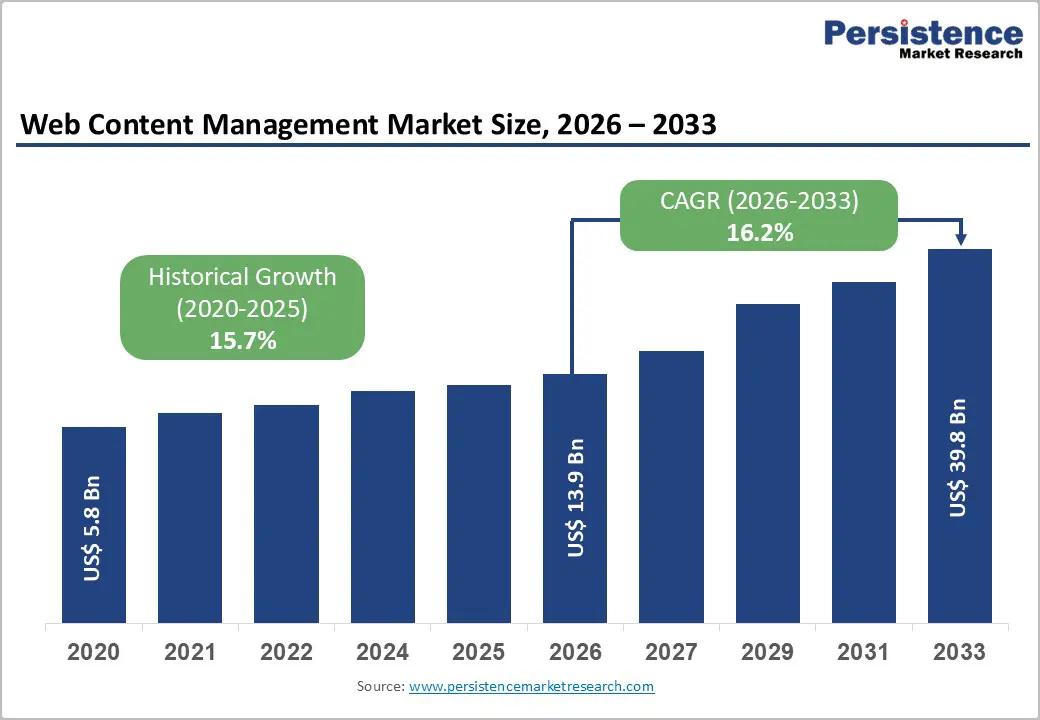
The global Web Content Management market size is expected to be valued at US$ 13.9 billion in 2026 and projected to reach US$ 39.8 billion by 2033, growing at a CAGR of 16.2% between 2026 and 2033. This growth is driven by enterprises’ increasing demand for scalable digital platforms that deliver personalized omnichannel experiences. The adoption of cloud-based solutions is accelerating, with around two-thirds of global enterprises prioritizing cloud for new content initiatives due to faster deployment and lower maintenance. Additionally, AI-powered content automation enhances efficiency, enabling quicker content creation, tagging, and SEO optimization amid rising digital transformation spending.
Key Market Highlights
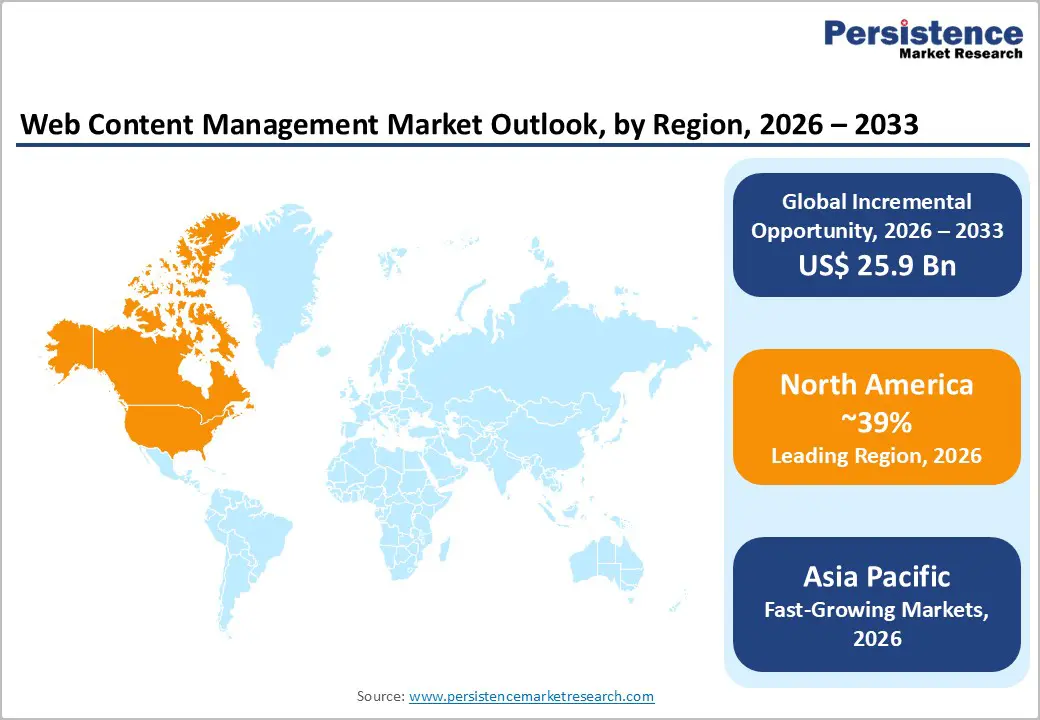
- Leading Region: North America leads the WCM market with a 34% share in 2025, driven by U.S. innovation and regulatory initiatives for digital services.
- Fastest-Growing Region: Asia Pacific is the fastest-growing region with an 18% CAGR from 2025 to 2032, fueled by digital adoption in China and India.
- Leading Category: Cloud-based deployment dominates the market with a 56% share, providing scalability and flexibility for enterprises.
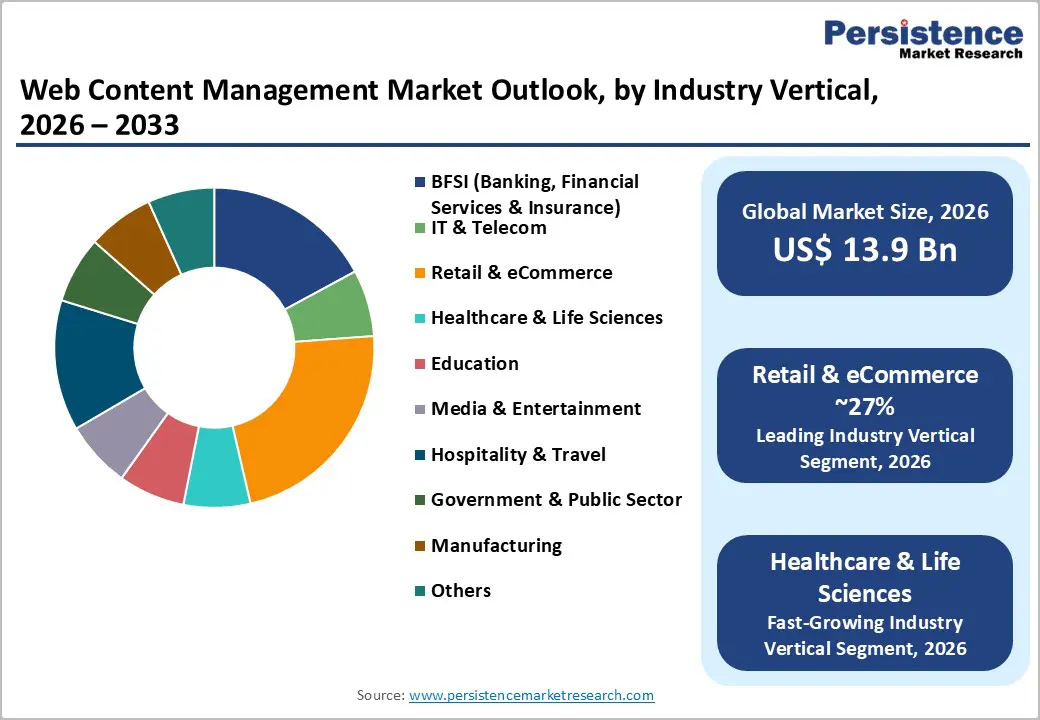
- Fastest-Growing Category: Healthcare is the fastest-growing industry vertically with a 24.7% CAGR, driven by patient portals and telehealth adoption.
- Key Market Opportunity: AI-powered personalization in cloud WCM offers a major opportunity for omnichannel content growth and enhanced customer engagement.
| Key Insights | Details |
|---|---|
| Web Content Management Market Size (2026E) | US$ 13.9 Bn |
| Market Value Forecast (2033F) | US$ 39.8 Bn |
| Projected Growth (CAGR 2026 to 2033) | 16.2% |
| Historical Market Growth (CAGR 2020 to 2025) | 15.7% |
Market Dynamics
Market Drivers
Acceleration of Digital Transformation Initiatives Driving WCM Adoption
Across industries, digital transformation is significantly boosting demand for Web Content Management as organizations seek unified platforms to manage and deliver content efficiently. Enterprises increasingly rely on WCM solutions for real-time personalization, enabling improved customer engagement and higher conversion rates. Automation within these platforms enhances operational agility, reducing time-to-market for content updates by nearly half and supporting dynamic, omnichannel strategies.
WCM systems empower businesses to deliver tailored experiences across websites, apps, and digital channels while integrating seamlessly with marketing and analytics tools. Retailers, in particular, benefit from dynamic content management, seeing measurable improvements in customer retention and satisfaction. By streamlining workflows and standardizing content delivery, WCM has become central to successful digital transformation and ongoing innovation initiatives.
Rising Adoption of Cloud-Based Web Content Management Solutions
Cloud deployment is emerging as a dominant factor in the growth of WCM, providing unmatched scalability, cost efficiency, and global content distribution compared to legacy systems. Organizations increasingly favor cloud-based platforms for their flexibility, enabling faster content rollouts, streamlined updates, and reliable disaster recovery. Hybrid models further support regulatory compliance while accommodating variable traffic loads.
Cloud WCM also facilitates seamless integration of AI-powered capabilities, including auto-tagging, automated SEO optimization, and content recommendation engines, significantly reducing manual effort. Enterprises leverage these platforms to accelerate digital initiatives, improve operational efficiency, and maintain competitive advantage. As businesses expand their digital footprint, cloud-based WCM remains a key enabler of agile, scalable, and personalized content delivery strategies.
Market Restraints
Data Security and Regulatory Compliance Challenges Limiting WCM Adoption
Security and compliance concerns remain significant barriers to Web Content Management adoption, especially in highly regulated sectors such as BFSI and healthcare. Fragmented content repositories create inefficiencies, with teams spending excessive time locating files while increasing the risk of data breaches. Strict regulations like GDPR demand robust governance, yet many enterprises face challenges of integration with legacy systems, delaying WCM deployments.
High implementation costs further constrain adoption among small and medium-sized businesses, particularly those lacking historical content archives. Organizations must invest in secure, compliant infrastructures to protect sensitive information while ensuring seamless content workflows. These challenges can slow digital transformation initiatives and make enterprises cautious when selecting scalable WCM platforms.
Fragmented Content Tools and Integration Complexities Restricting Efficiency
Fragmented content management tools often result in silos, hindering collaboration and increasing the risk of misplaced or duplicated documents. As organizations scale, mismanaged files can negatively impact customer satisfaction, with support teams reporting delays in issue resolution and service delivery.
Integrating new WCM platforms with existing CMS solutions remains complex, costly, and time-consuming. Rising cybersecurity threats amplify concerns, deterring around a quarter of potential adopters. Enterprises seeking unified, efficient content management must carefully navigate these integration challenges to maintain operational continuity and safeguard critical business information.
Market Opportunities
Expanding Opportunities Through AI-Driven Personalization in WCM
The integration of artificial intelligence within Web Content Management presents significant growth opportunities, particularly in personalization engines. Enterprises can automate content creation, tagging, and targeting while syncing with customer data platforms to deliver hyper-personalized experiences across websites, apps, and digital channels. This capability improves engagement, boosts conversions, and streamlines content workflows across industries.
Emerging markets, including China with over a billion internet users, and healthcare, driven by telehealth and patient portals, highlight strong demand for AI-enabled WCM. Organizations can leverage AI to optimize content delivery, enhance customer experiences, and accelerate digital transformation initiatives, making intelligent personalization a key growth driver for the WCM market.
Opportunities in Headless and Composable Web Content Management Architectures
Composable and headless architectures are creating new avenues for WCM growth, enabling modular, cloud-native platforms that offer flexibility and scalability. By decoupling the front-end from content repositories, organizations reduce dependencies on monolithic systems and accelerate iterative deployments, supporting omnichannel content delivery across websites, mobile apps, and other digital touchpoints.
The Asia Pacific region presents notable opportunities, with India’s 700 million online users driving IT services growth. Global enterprises seeking agility, faster rollouts, and seamless integrations increasingly adopt headless CMS solutions, making composable digital experience platforms a strategic choice for innovation, efficiency, and competitive differentiation in the evolving WCM landscape.
Category-wise Insights
Component Analysis
Within the component segment, solutions dominate with a 45% market share in 2025, driven by demand for integrated tools such as content authoring, digital asset management (DAM), and SEO optimization platforms. Enterprises increasingly rely on robust solutions for seamless publishing, workflow management, and content personalization. Leading vendors like Adobe and Microsoft enable organizations to centralize content operations while ensuring consistent brand experiences across websites, apps, and digital channels.
Services represent the fastest-growing component category, driven by rising demand for implementation, consulting, integration, and support offerings. As enterprises adopt complex WCM solutions, professional services become critical for ensuring smooth deployment, employee training, and ongoing maintenance. Growth in services also reflects the increasing need for tailored solutions that address unique industry requirements and optimize workflows for digital-first organizations.
Deployment Mode Analysis
Cloud-based deployment leads the market with a 56% share in 2025, surpassing on-premises adoption due to scalability, AI readiness, and lower total cost of ownership. Organizations favor cloud platforms for elastic scaling, rapid deployment, and global content delivery. Hybrid models are also gaining traction, supporting regulatory compliance while enabling businesses to balance cloud flexibility with internal infrastructure.
The fastest-growing deployment mode is driven by demand for iterative, scalable solutions that support omnichannel delivery. Organizations increasingly prioritize cloud-native, API-first platforms that enable seamless integrations with marketing, analytics, and personalization tools. This shift allows businesses to quickly respond to evolving customer expectations and adopt modern content strategies without the constraints of traditional infrastructure.
Industry Vertical Analysis
Retail & eCommerce leads the industry vertical segment with a 27% share in 2025, propelled by rapid SKU turnover, frequent storefront updates, and the need for dynamic content. Retailers leverage WCM to support omnichannel strategies, enhance customer experiences, and increase conversion rates amid the e-commerce boom. BFSI follows closely, relying on secure, compliant portals for customer engagement and content delivery.
Healthcare represents the fastest-growing vertical, driven by the adoption of telehealth, patient portals, and digital health platforms. WCM solutions help healthcare providers streamline patient communications, manage critical documents, and deliver personalized digital experiences. Growth in this vertical reflects rising digital adoption, regulatory emphasis on patient engagement, and the demand for scalable, secure content management systems tailored to healthcare operations.
Regional Insights
North America Web Content Management Market Trends
North America leads the Web Content Management market with a 39% share in 2025, driven by the U.S. innovation ecosystem and early adoption in retail, which has overtaken media by 2023. Federal digital modernization programs are accelerating cloud migrations, while enterprises leverage AI-enhanced WCM platforms for improved efficiency. Regulatory frameworks such as CCPA enforce secure content governance, further encouraging adoption of advanced digital solutions.
Organizations report up to 50% faster content deployment and streamlined workflows through integrated WCM platforms. The region continues to set benchmarks in digital experience management, with businesses prioritizing scalability, personalization, and cloud-based architectures to maintain leadership. Enterprise adoption across BFSI, healthcare, and retail ensures sustained dominance in North America.
Europe Web Content Management Market Trends
Europe advances in WCM adoption through Germany’s cloud leadership and the UK’s focus on security under GDPR harmonization. France and Spain emphasize AI-driven automation for content workflows, improving operational efficiency and reducing manual effort. Hybrid deployment models remain popular to ensure compliance, while mobile optimization gains traction across industries. The region is projected to grow at a 17.2% CAGR, reflecting strong digital transformation initiatives.
Enterprises across the UK, Germany, and France adopt AI-powered content management, enhancing personalization and omnichannel delivery. Organizations leverage secure, integrated platforms to meet regulatory demands, optimize marketing efforts, and improve customer engagement. Digital infrastructure investments and government initiatives continue to drive WCM expansion across European markets.
Asia Pacific Web Content Management Market Trends
Asia Pacific emerges as a key growth region, holding a 28% market share by 2035, fueled by China’s 1 billion+ internet users and the Made in China 2025 technology initiative. India contributes with a 700 million online population, supporting rapid IT services growth, while Japan and ASEAN nations leverage manufacturing and digitalization for scalable WCM adoption.
Digital infrastructure investments and cloud-based platform deployments drive expansion, enabling enterprises to deliver localized, personalized experiences across diverse markets. Organizations increasingly adopt headless and AI-enabled WCM solutions to meet omnichannel demands, optimize content workflows, and enhance customer engagement, positioning the Asia Pacific as a rapidly evolving WCM hub.
Competitive Landscape
The Web Content Management market is moderately fragmented, with leading players maintaining dominance through integrated digital experience platforms. Market strategies focus on cloud adoption, AI-driven innovations, and composable architectures to expand reach and enhance platform capabilities. Key differentiators include analytics integration, seamless omnichannel content delivery, and workflow automation, which strengthen customer engagement and operational efficiency.
Emerging trends favor headless and SaaS-based models, providing agility and scalability for enterprises of all sizes. Market concentration is gradually increasing as small and medium-sized businesses consolidate on flexible, scalable WCM platforms that support rapid deployment, personalization, and evolving digital transformation needs.
Key Market Developments
- In March 2025, Adobe launched updates to its Experience Manager platform, integrating AI-powered capabilities for automated personalization. The enhancements enable enterprises to deliver tailored content experiences across websites, apps, and digital channels while improving efficiency in content creation and targeting workflows.
- In June 2025, Microsoft enhanced its SharePoint platform with headless CMS capabilities designed for hybrid deployments. This update allows organizations to decouple content management from front-end delivery, supporting omnichannel experiences, scalable content distribution, and faster rollouts while maintaining compliance and integration with enterprise workflows.
- In September 2024, Sitecore entered into partnerships to enable composable digital experience platform (DXP) integrations, strengthening its SEO tools and workflow automation. These collaborations allow enterprises to implement modular content architectures, improve search visibility, and streamline omnichannel content delivery across multiple platforms and channels.
Companies Covered in Web Content Management Market
- OpenText Corporation
- Microsoft Corporation
- Adobe Systems Incorporated
- IBM Corporation
- Oracle Corporation
- EPiServer AB
- Acquia, Inc.
- Sitecore A/S
- SDL plc
- Kentico Software s.r.o.
- Others
Frequently Asked Questions
The global Web Content Management market is expected to reach US$ 13.9 billion in 2026, reflecting strong enterprise demand for scalable content platforms, cloud adoption, and AI-driven personalization across industries.
Cloud-based deployment drives market demand, as enterprises prefer cloud platforms for scalability, faster deployment, global content delivery, and seamless AI integration for automated content creation, tagging, and optimization
North America leads with a 34% share in 2025, supported by the U.S. innovation ecosystem, early retail adoption, digital modernization programs, and regulatory frameworks encouraging secure and AI-enhanced content platforms.
AI-powered personalization in cloud WCM offers major growth opportunities, particularly in segments focused on omnichannel content delivery, with adoption in headless and composable platforms.
Leading players include Adobe, Microsoft, Oracle, Sitecore, and Acquia.


