




- Medical Devices
- Web-Connected Medical Devices Market
Web-Connected Medical Devices Market Size, Share, and Growth Forecast, 2026 - 2033
Web-Connected Medical Devices Market by Product Type (Vital Signs Monitoring Devices, Others), Modality (Wearable Web Connected Medical Devices, Others), End-user (Hospitals, Ambulatory Surgical Centers, Others), and Regional Analysis for 2026 - 2033

Web-Connected Medical Devices Market Size and Trends Analysis
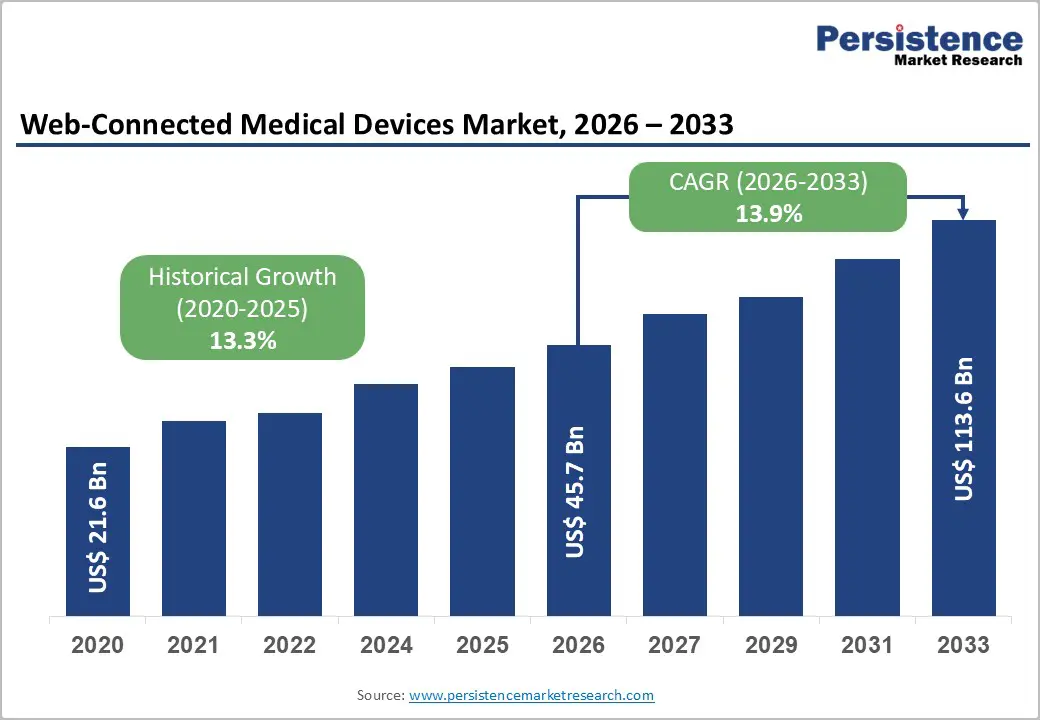
The global web-connected medical devices market size is likely to be valued at US$45.7 billion in 2026, and is expected to reach US$113.6 billion by 2033, growing at a CAGR of 13.9% during the forecast period from 2026 to 2033, driven by rapid digitalization of healthcare, rising adoption of remote patient monitoring, and increasing demand for real-time health data.
Increasing integration of IoT and cloud technology in medical devices for continuous patient monitoring remains a major driver of web-connected medical devices market growth.
Key Industry Highlights:
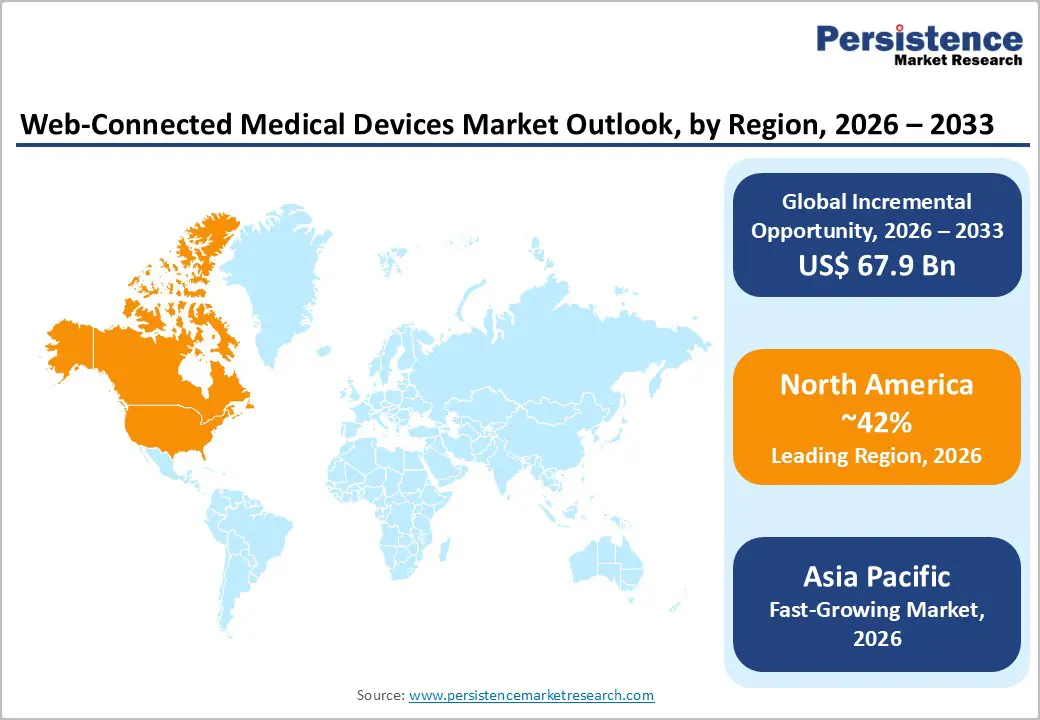
- Leading Region: North America, anticipated to account for a 42% market share in 2026, driven by advanced healthcare infrastructure, digital readiness, and widespread use of connected devices for remote monitoring.
- Fastest-growing Region: Asia Pacific, fueled by expanding healthcare digitization, rising chronic disease prevalence, and government support in China and India.
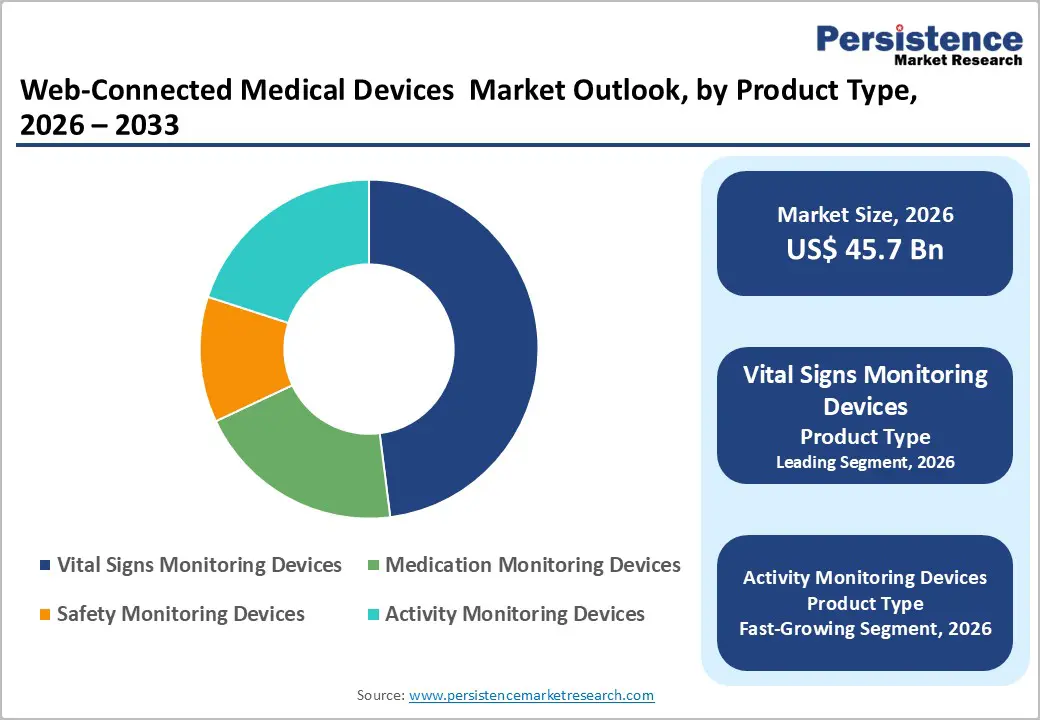
- Dominant Product Type: Vital signs monitoring devices, to hold approximately 49% of the market share, due to widespread use in remote monitoring.
- Leading Modality: Wearable web-connected devices, led by FDA-approved products such as the Masimo W1 watch, are set to dominate with 45% share in 2026 due to continuous, real-time monitoring and home-based care integration.
| Key Insights | Details |
|---|---|
|
Web-Connected Medical Devices Market Size (2026E) |
US$45.7 Bn |
|
Market Value Forecast (2033F) |
US$113.6 Bn |
|
Projected Growth CAGR (2026-2033) |
13.9% |
|
Historical Market Growth (2020-2025) |
13.3% |
Market Factors - Driver, Restraint, and Opportunity Analysis
Driver Analysis - Growing Adoption of Remote Patient Monitoring (RPM)
The shift toward continuous, home-based care is accelerating the use of connected devices that allow clinicians to monitor patients outside traditional clinical settings. Remote patient monitoring enables real-time tracking of vital parameters such as heart rate, blood pressure, glucose levels, and oxygen saturation, helping healthcare providers detect early warning signs and intervene promptly. This approach is particularly valuable for managing chronic conditions such as diabetes, cardiovascular diseases, and respiratory disorders, where ongoing observation is essential for effective treatment. Around 70% of India’s population lives in rural areas, where limited healthcare access is driving the need for remote monitoring and telehealth solutions.
The increasing availability of affordable wearable devices and user-friendly mobile applications has made it easier for patients to participate in their own care. Data collected through these devices is transmitted to healthcare professionals via secure cloud platforms, improving communication and reducing the need for frequent hospital visits. This not only enhances patient convenience but also helps lower healthcare costs by minimizing emergency admissions and readmissions.
Advancements in IoT, AI, and Wireless Technologies
The rapid evolution of connected technologies is transforming how medical devices collect, transmit, and analyze patient data. Smart sensors embedded in devices can continuously capture vital health parameters and transmit them through wireless networks such as Wi-Fi, Bluetooth, and 5G, enabling seamless real-time monitoring. This constant data flow allows healthcare providers to track patient conditions remotely and respond quickly to any abnormalities.
Artificial intelligence enhances this capability by analyzing large volumes of health data to identify patterns, predict potential health risks, and support clinical decision-making. For example, AI-driven algorithms can detect irregular heart rhythms or predict disease progression, enabling early intervention and improved outcomes. Internet of Things (IoT) ecosystems enable multiple devices to communicate with each other and centralized platforms, improving care coordination and operational efficiency. In India, strong digital infrastructure growth supports this trend. According to Ministry of Electronics and Information Technology, the country had over 800 million internet users in recent years, creating a robust foundation for connected healthcare solutions.
Restraint Analysis - Data Privacy and Cybersecurity Concerns
The increasing use of connected medical devices has raised significant concerns about the protection of sensitive patient data. These devices continuously collect and transmit personal health information over networks, making them potential targets for cyberattacks such as hacking, data breaches, and unauthorized access. If compromised, this data can be misused, leading to privacy violations and loss of patient trust.
Healthcare systems often rely on multiple interconnected platforms, which can create vulnerabilities if proper security measures are not implemented. Weak encryption, outdated software, and a lack of regular security updates further increase the risk of attacks. Ensuring compliance with data protection regulations adds complexity for manufacturers and healthcare providers.
Limited Technical Expertise and Training
The effective use of web-connected medical devices requires a certain level of digital proficiency, which is not always present among healthcare professionals and patients. Many clinicians are accustomed to traditional systems and may find it challenging to adapt to devices that involve data analytics, cloud platforms, and software-driven interfaces. Without adequate training, the risk of improper usage, misinterpretation of data, or underutilization of device capabilities increases.
In addition, healthcare facilities, especially in smaller or rural settings, often lack dedicated IT support teams to manage device integration, maintenance, and troubleshooting. This can lead to delays in implementation and reduced efficiency in daily operations. Patients, particularly elderly individuals, may also struggle to operate connected devices or mobile health applications, limiting their participation in remote monitoring programs.
Opportunity Analysis - Development of Wearable and Implantable Devices
Continuous innovation in miniaturized electronics and biosensor technology is enabling the creation of compact devices that can monitor health parameters in real time. Wearable devices such as smartwatches, fitness bands, and patch-based sensors allow users to track vital signs such as heart rate, physical activity, sleep patterns, and even blood oxygen levels throughout the day. These devices promote proactive health management by encouraging users to stay engaged with their own well-being.
Implantable devices take this capability further by providing continuous internal monitoring and therapeutic support. Devices such as pacemakers, insulin pumps, and neurostimulators can automatically adjust treatment based on real-time physiological data, improving precision and patient outcomes. Their ability to function within the body for extended periods reduces the need for frequent clinical visits and enhances convenience for patients with chronic conditions. Advancements in wireless connectivity and battery efficiency ensure that both wearable and implantable devices can seamlessly transmit data to healthcare providers for analysis.
Personalized and Preventive Healthcare Trends
A growing shift toward proactive health management is transforming how individuals and healthcare systems approach care delivery. Instead of relying on treatment after illness occurs, there is increasing emphasis on early detection, lifestyle management, and continuous health tracking. This approach is supported by digital tools such as connected devices, mobile health applications, and wearable sensors that enable real-time monitoring of vital parameters and long-term health trends.
The rising incidence of chronic diseases is a major factor accelerating this transition. Government-backed data indicates that large-scale public health programs are increasingly focused on screening and early intervention. For instance, initiatives such as nationwide non-communicable disease (NCD) programs promote regular check-ups and early diagnosis at the primary care level. India has administered over 220 crore vaccine doses, reflecting a strong national focus on preventive healthcare measures. Digital health infrastructure is also expanding rapidly, with large-scale programs covering over 500 million individuals through integrated health platforms and data systems. These developments enable personalized care by combining patient data, predictive analytics, and continuous monitoring.
Category-wise Analysis
Product Type Insights
Vital signs monitoring devices are anticipated to dominate with nearly 49% of market share in 2026, driven by their essential role in continuous patient assessment across hospitals, clinics, and home settings. These devices, such as blood pressure monitors, pulse oximeters, and temperature monitors, are widely used for routine checkups as well as chronic disease management, making them indispensable in healthcare systems. The high prevalence of conditions such as hypertension and cardiovascular diseases further drives their demand. CardiacSense Ltd, which has developed a medical-grade wearable watch (CSF-3) capable of continuously monitoring vital parameters such as ECG, heart rate, and blood oxygen levels. The device has received regulatory approvals and is used for early detection of conditions such as atrial fibrillation, demonstrating real-world clinical application of vital signs monitoring.
Activity monitoring devices represent the fastest-growing segment, due to increasing consumer focus on fitness, wellness, and preventive healthcare. Devices such as fitness bands, smartwatches, and step trackers enable users to monitor daily activities, calories burned, sleep patterns, and overall physical performance. Their ease of use, affordability, and integration with mobile health applications make them widely accessible across different age groups. Fitbit products such as the Charge series, which monitor steps, heart rate, calories burned, and exercise sessions features central to activity monitoring and fitness goals. These devices sync data with mobile apps, helping users track and improve daily activity patterns.
Modality Insights
Wearable web-connected medical devices are projected to dominate, accounting for 45% of the market share in 2026, fueled by their ability to provide continuous, real-time monitoring of health parameters such as heart rate, blood pressure, glucose levels, and oxygen saturation. Their convenience, portability, and integration with smartphones and cloud platforms make them highly suitable for home-based care, chronic disease management, and preventive healthcare. Masimo W1 Medical watch is a FDA-approved wearable device that continuously monitors oxygen saturation (SpO2) and pulse rate with medical-grade accuracy and transmits this data for health tracking and clinical use. This device performs tens of thousands of measurements per day, making it valuable for individuals with chronic conditions who need reliable continuous monitoring.
Non-wearable web-connected medical devices are the fastest-growing, with their critical role in hospital and clinical settings. Devices such as smart infusion pumps, connected ventilators, telehealth kiosks, and remote monitoring stations enable healthcare providers to collect, transmit, and analyze patient data in real time without requiring wearable sensors. Their adoption is driven by increasing demand for automated, accurate, and continuous monitoring of patients with chronic or acute conditions. Philips offers advanced X-ray, CT, and MRI systems that securely transmit diagnostic data to centralized platforms, enabling easy access, storage, and analysis by clinical teams. These connected systems improve diagnostic precision and streamline clinical workflows across multiple departments.
Regional Insights
North America Web-Connected Medical Devices Market Trends
North America is expected to dominate with over 42% of the share in 2026, powered by its advanced healthcare infrastructure and high digital readiness. A key trend is the widespread integration of connected devices with electronic health records and hospital information systems, enabling seamless data sharing and improved clinical decision-making. Healthcare providers are increasingly using remote monitoring solutions to manage chronic diseases and reduce hospital admissions.
The region also shows a growing preference for home-based care, supported by the expansion of telehealth services and increased use of smart medical devices. Wearable and non-wearable connected devices are being widely adopted for continuous monitoring and early diagnosis. In addition, strong regulatory frameworks and emphasis on data security are encouraging the development of reliable and compliant connected technologies. The use of artificial intelligence and data analytics to derive actionable insights from real-time patient data.
Europe Web-Connected Medical Devices Market Trends
Europe is experiencing steady growth in the adoption of web-connected medical devices, supported by strong public healthcare systems and increasing emphasis on digital transformation. A key trend in the region is the integration of connected devices with national health systems, enabling secure data sharing and improved coordination between hospitals, clinics, and primary care providers. Governments across Europe are actively promoting digital health initiatives to enhance efficiency and patient outcomes.
The rising demand for remote patient monitoring is particularly among the aging population. Europe has one of the largest elderly populations globally, which is increasing the need for continuous monitoring and home-based care solutions. Connected medical devices help manage chronic conditions such as cardiovascular diseases and diabetes more effectively, reducing the burden on healthcare facilities. Data privacy and security remain central to the European market, with strict regulations such as the General Data Protection Regulation (GDPR) shaping how patient data is collected, stored, and shared.
Asia Pacific Web-Connected Medical Devices Market Trends
Asia Pacific is likely to be the fastest-growing region, driven by increasing healthcare demand, rising chronic disease prevalence, and expanding digital infrastructure. Rapid urbanization and improvements in internet penetration have made it easier to deploy connected devices in both urban and semi-urban areas. Hospitals and clinics are increasingly adopting smart medical devices to enhance patient monitoring, reduce hospital readmissions, and streamline clinical workflows.
Home-based care is gaining traction in the region, particularly for managing conditions such as diabetes, cardiovascular disorders, and respiratory illnesses. Connected wearables, telehealth kits, and remote monitoring systems are enabling patients to track vital health parameters and share real-time data with healthcare providers. This trend supports preventive healthcare and reduces the burden on overstretched medical facilities. Government initiatives across countries, including India, China, and Japan, are supporting digital health adoption through investments in telemedicine infrastructure, mobile health platforms, and data interoperability standards. There is also a growing focus on leveraging AI and IoT technologies to analyze patient data, predict health risks, and provide personalized treatment recommendations.
Competitive Landscape
The global web-connected medical devices market is characterized by intense competition, driven by continuous technological innovation and the growing demand for connected healthcare solutions. Leading companies are focusing on developing advanced wearable and non-wearable devices that provide real-time monitoring, remote patient management, and seamless integration with digital health platforms. Emphasis on data security, interoperability, and cloud-based analytics has become a key differentiator, as healthcare providers increasingly rely on these technologies for accurate and timely clinical decision-making.
Major players in the market include Medtronic plc, known for connected cardiac and diabetes management devices; GE Healthcare and Philips Healthcare, which offer connected imaging and monitoring systems; and Abbott Laboratories and Dexcom Inc., which specialize in continuous glucose monitoring solutions. Boston Scientific Corporation, Masimo Corporation, ResMed Inc., Siemens Healthineers, and iRhythm Technologies are also prominent, providing innovative monitoring, diagnostic, and wearable solutions. These companies compete by enhancing device functionality, building strong clinical evidence, and expanding global reach, driving the rapid evolution of the connected medical devices landscape.
Key Industry Developments
- In March 2026, MiniMed launched the MiniMed Flex System, a compact, connected insulin pump designed for easier diabetes management. The system pairs a screen-free pump with SmartGuard™ technology, a continuous glucose monitor, and the MiniMed app for real-time insulin tracking and adjustments. Its smaller size, rechargeable battery, and app-based controls enhance convenience and daily usability.
- In July 2024, KORE, a global leader in Internet of Things (IoT) solutions, and mCare Digital, a provider of assistive technology, launched the mCareWatch 241, the latest innovation in personal emergency alarms. KORE provided the connectivity and provisioning platform that enabled mCare to seamlessly connect the wearable devices. The collaboration allowed healthcare providers to virtually monitor patients in their homes or healthcare facilities, enhancing patient safety and remote care capabilities.
Companies Covered in Web-Connected Medical Devices Market
- Medtronic plc
- GE Healthcare
- Philips Healthcare
- Abbott Laboratories
- Siemens Healthineers
- Dexcom Inc.
- Boston Scientific Corporation
- Masimo Corporation
- ResMed Inc.
- iRhythm Technologies
Frequently Asked Questions
The global web-connected medical devices market is projected to reach US$45.7 billion in 2026.
The web-connected medical devices market is mainly fueled by the growing incidence of chronic diseases and the rising need for real-time remote patient monitoring.
The web-connected medical devices market is poised to witness a CAGR of 13.9% from 2026 to 2033.
Major opportunities in the web-connected medical devices market lie in the development of AI-driven predictive devices, the expansion of wearable health solutions, and increased adoption in emerging markets with growing digital healthcare infrastructure.
Key players in the web-connected medical devices market include Medtronic plc, Philips Healthcare, GE Healthcare, Abbott Laboratories, and Siemens Healthineers.


