




- Automation & Robotics
- Water Test Kit Market
Water Test Kit Market Size, Share, and Growth Forecast 2026 - 2033
Water Test Kit Market by Water Type (Marine Water, Pond Water, Others) Parameter Type (Biological, Physical, Chemical) End-user (Research and Development Agencies, Others), and Regional Analysis for 2026 - 2033

Water Test Kit Market Size and Trends Analysis
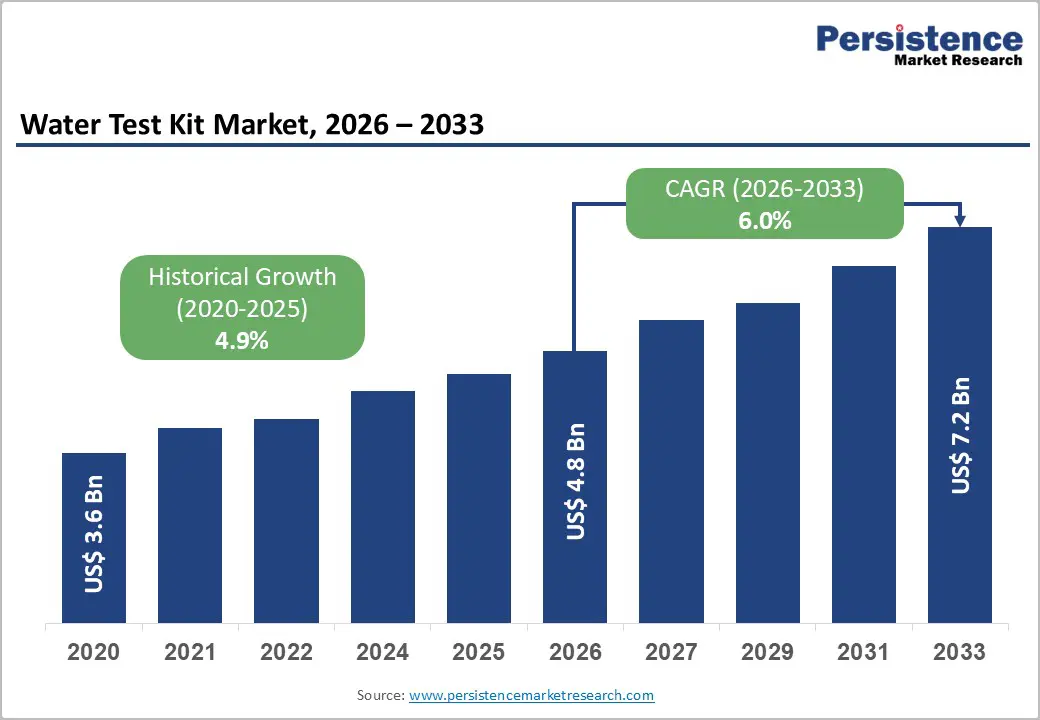
The global water test kit market size is likely to be valued at US$4.8 billion in 2026 and is expected to reach US$7.2 billion by 2033, growing at a CAGR of 6.0% during the forecast period from 2026 to 2033, driven by increasing regulatory pressures on water quality across municipal, industrial, and environmental sectors.
Stricter government regulations on water quality, coupled with growing awareness of contamination risks, are driving demand for reliable water testing solutions. Rising urbanization and industrialization in emerging markets further boost the need for portable, real-time, high-precision testing technologies, such as advanced multi-parameter analyzers, IoT sensors, and digital test kits.
Key Industry Highlights:
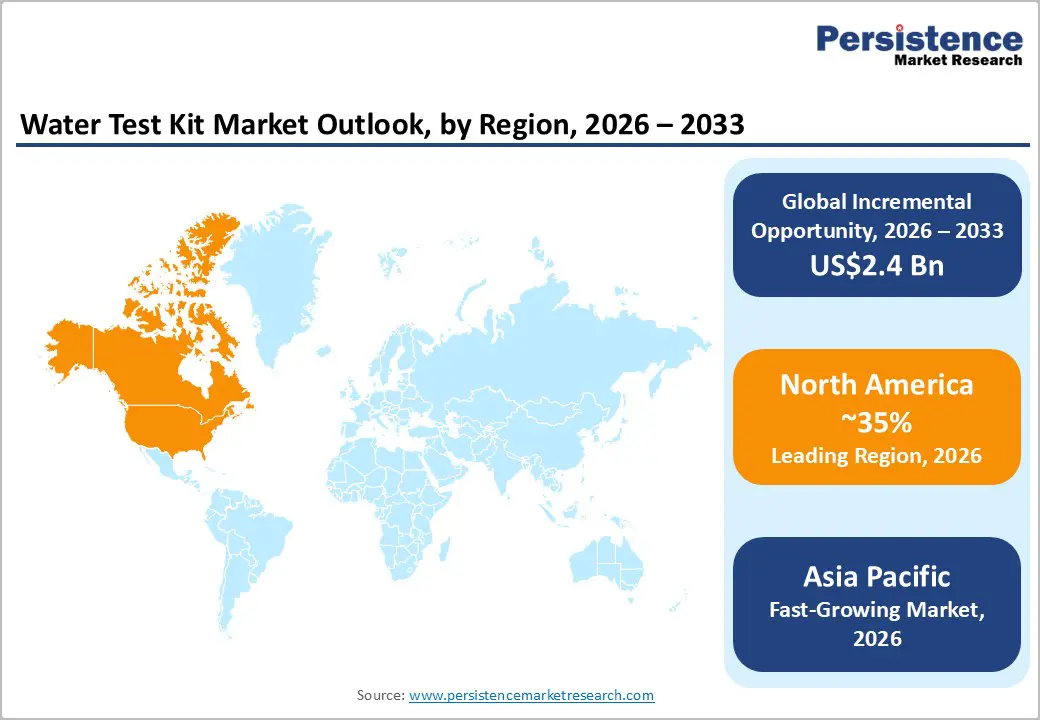
- Leading Region: North America is anticipated to be the leading region, accounting for 35% market share in 2026, driven by the U.S. EPA's monitoring, innovation hubs, Clean Water Act enforcement, and strong R&D investments.
- Fastest-growing Region: Asia Pacific is likely to be the fastest-growing region in 2026, driven by urbanization, water scarcity policies, evolving regulations, and cost-competitive manufacturing.
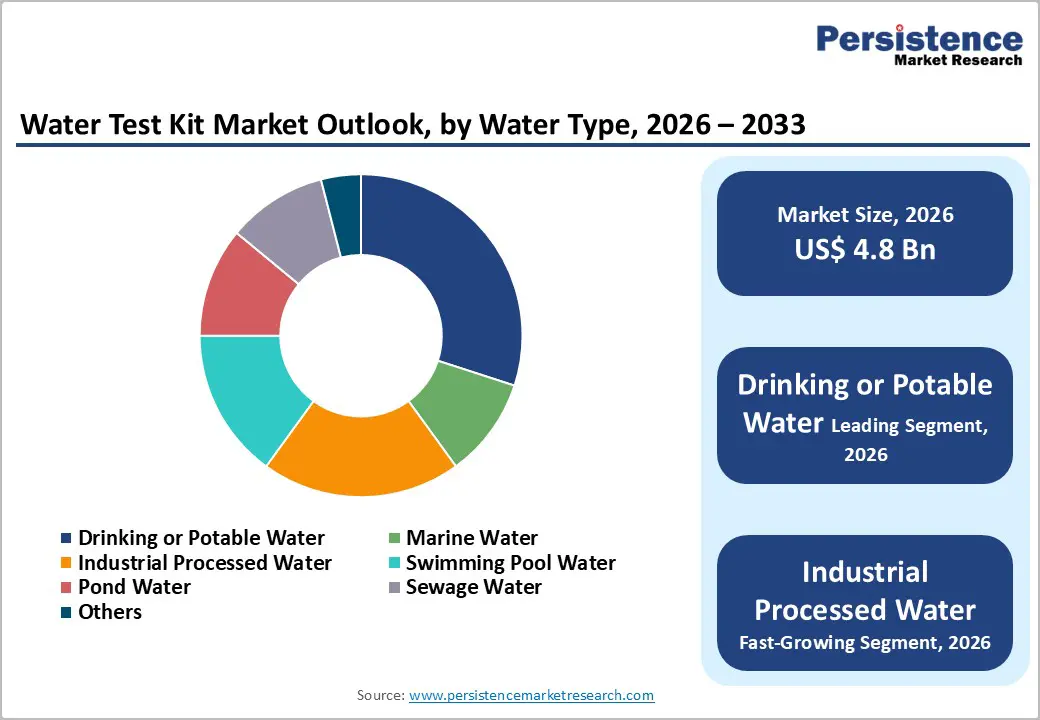
- Leading Water Type: Drinking or potable water is projected to be the leading segment in 2026, accounting for 35% of revenue share, driven by health regulations that ensure safety for billions of consumers.
- Leading Parameter Type: Chemical parameters are anticipated to be the leading segment in 2026, accounting for 45% of revenue share, due to their versatile detection of pH, metals, and contaminants across diverse applications.
- Leading End-user: The industrial & manufacturing segment is projected to be the leading segment in 2026, accounting for 30% of revenue, and complying with ISO standards in water-intensive processes.
| Key Insights | Details |
|---|---|
|
Water Test Kit Market Size (2026E) |
US$4.8 Bn |
|
Market Value Forecast (2033F) |
US$7.2 Bn |
|
Projected Growth CAGR (2026-2033) |
6.0% |
|
Historical Market Growth (2020-2025) |
4.9% |
Market Factors - Growth, Barriers, and Opportunity Analysis
Technological Advancements in Testing
Technological advancements are reshaping water testing by enabling much faster, more accurate, and real-time detection of contaminants. Cutting-edge developments such as biosensors integrated with microfluidics, AI-enhanced multi-sensor arrays, and IoT-enabled continuous monitoring systems now allow detection of chemical pollutants, heavy metals, and microbial pathogens with high sensitivity and minimal manual intervention. These innovations are driving demand for portable and digital water test kits across industrial, municipal, and household applications. They offer affordable, rapid solutions for both developed and emerging markets. Manufacturers are focusing on user-friendly interfaces and compact designs to improve accessibility in remote areas and small-scale operations.
The shift from periodic lab-based testing to portable, on-site, and even remote monitoring platforms dramatically improves responsiveness, especially for drinking water, wastewater, and environmental water bodies. Multi-parameter analyzers, wearable sensors, and cloud-linked sensor networks help operators detect anomalies such as pH shifts or contamination spikes in real time, enabling faster remedial action and better compliance with health and safety standards. The integration of these technologies into commercial water test kits is increasing adoption among the food and beverage, pharmaceutical, and hospitality sectors. Smart and connected kits are supporting regulatory compliance and quality assurance programs, increasing recurring demand for consumables and calibration services.
High Initial Costs and Accessibility
High initial costs and limited accessibility remain the key restraints in the water testing market. Advanced testing technologies, including digital multi-parameter analyzers, IoT-enabled sensors, and biosensor-integrated platforms, often require significant capital investments, making adoption challenging for small-scale industries, municipal authorities in developing regions, and individual households. This barrier limits penetration in emerging markets, where budget constraints are significant, and also slows adoption in sectors such as food and beverage, healthcare, and hospitality that require frequent testing.
Accessibility issues arise due to the uneven distribution of certified testing kits and skilled personnel required for accurate analysis. In many rural and remote areas, a lack of infrastructure, limited supply chains, and insufficient technical support hinder regular water quality monitoring. This gap creates opportunities for low-cost, portable, and user-friendly kits, but their adoption is still hampered by limited awareness and training. These factors collectively slow the widespread adoption of sophisticated water testing solutions, despite growing regulatory and environmental demands. Inconsistent availability of certified kits restricts compliance with regulatory standards in both municipal and industrial applications.
Opportunities in Emerging Markets
The expansion of the water test kit market in emerging markets presents significant opportunities due to urbanization, industrialization, and growing awareness of water safety. Countries in the Asia Pacific, Africa, and Latin America are witnessing growing investments in water infrastructure, sanitation, and regulatory frameworks, creating demand for reliable and cost-effective testing solutions. This growth is particularly strong in sectors such as food and beverage, healthcare, and hospitality, where water quality is critical to operations. Government initiatives and private-public partnerships are driving the adoption of both basic and advanced water test kits in municipal and industrial settings.
The growing adoption of portable, digital, and easy-to-use water-testing kits enables businesses to reach regions with limited laboratory facilities. Expansion into these markets not only addresses critical public health and environmental needs but also offers companies the potential for substantial revenue growth as governments and private sectors increasingly prioritize water safety and compliance. Portable kits enable smaller enterprises and rural communities to conduct frequent testing without heavy infrastructure investments. Increasing awareness campaigns and training programs further support the acceptance and proper use of these testing solutions among diverse end users.
Category-wise Analysis
Water Type Insights
The drinking of potable water is expected to lead the water test kit market, accounting for approximately 35% of the revenue share in 2026, due to health regulations, growing public awareness of waterborne diseases, and rising consumption by urban households and municipal water supply systems. As aging infrastructure, agricultural runoff, and industrial discharge continue to threaten water safety, governments and consumers increasingly turn to testing solutions to ensure compliance with potable water standards and safeguard public health. For example, cities such as Flint, Michigan, expanded the deployment of portable lead test kits after contamination issues to monitor tap water quality frequently and reassure residents.
Industrial processed water is likely to represent the fastest-growing segment, driven by expanding manufacturing activities worldwide and stricter regulatory requirements for wastewater discharge and water reuse in production processes. Industries across manufacturing, food & beverage, pharmaceuticals, and power are scaling up water-quality monitoring to ensure compliance, operational efficiency, and environmental sustainability, fueling rising demand for water-testing and analysis services in industrial settings. For example, major beverage manufacturers are increasingly installing on-site digital multi-parameter analyzers to continuously test process water and wastewater before discharge, in compliance with both environmental and safety regulations.
Parameter Type Insights
The chemical parameter segment is projected to lead the market, capturing around 45% of the total revenue share in 2026, driven by its versatility in detecting pH, heavy metals, and various chemical contaminants across drinking, industrial, and environmental water applications. The versatility and reliability of chemical testing make it essential for municipal water authorities, industries, and laboratories, allowing them to comply with stringent regulatory standards and maintain operational safety. For example, in France, environmental agencies and independent labs use chemical water test kits to monitor drinking water for nitrates, lead, and pesticide residues in municipal supplies, in compliance with the EU Drinking Water Directive and national quality standards.
Biological parameter is likely to be the fastest-growing parameter in 2026, driven by heightened concerns over microbial contamination, including bacteria, viruses, and protozoa, especially after waterborne disease outbreaks in recent years. Public health agencies, the food and beverage industry, and the healthcare sector increasingly rely on biological testing to detect pathogens in real time, preventing potential epidemics. Physical parameters such as turbidity and temperature are key indicators for initial water-quality screening before more detailed chemical or biological analysis. For instance, dairy processors in New Zealand use rapid biological test kits to quickly detect E. coli and coliforms in processing water, ensuring product safety and regulatory compliance.
End-user Type Insights
The industrial and manufacturing segment is projected to lead the market, accounting for approximately 30% revenue share in 2026, driven by stringent ISO standards and the critical need for high-quality water in production cycles. Industries such as chemicals, power generation, textiles, electronics, and metal processing rely heavily on consistent water quality to protect equipment, maintain product integrity, and comply with environmental discharge standards. As factories integrate advanced water recycling and zero-liquid-discharge systems, demand for precise and frequent testing continues to rise. For example, in the U.S., semiconductor manufacturers routinely use advanced multi-parameter water test kits to monitor ultra-pure water used in chip fabrication, ensuring product quality and process stability.
The food and beverage industry is likely to represent the fastest-growing end-user segment in 2026, driven by increasing scrutiny of hygiene practices, stricter FDA and international food safety regulations, and rising consumer expectations for safer packaged goods. Water testing plays a crucial role in beverage production, dairy processing, brewing, and food preparation to prevent contamination and ensure product quality. The industry is rapidly expanding its use of water testing solutions as production grows and new product categories emerge. For example, major breweries in Japan have adopted real-time biological and chemical water testing systems to ensure consistent taste and safety across regional production facilities.
Regional Insights
North America Water Test Kit Trends
North America is anticipated to be the leading region in the water test kit market, accounting for 35% share in 2026, driven by rigorous regulatory frameworks, such as U.S. Environmental Protection Agency (EPA) standards, and robust infrastructure across the U.S. and Canada. Municipalities, industrial plants, and households increasingly rely on testing kits and analytical instruments to ensure compliance with water-quality mandates. Strong public awareness and ongoing infrastructure investment sustain steady demand across municipal, industrial, and environmental water testing. For example, Hach Company (a leading water analysis provider in North America) supplies portable and laboratory test kits to U.S. utilities and industrial clients to meet EPA regulatory requirements for drinking water and wastewater monitoring.
Technological innovations are transforming the water test kit market in North America. There is growing adoption of real-time, online water-monitoring systems, IoT-enabled sensors, and multi-parameter analyzers, enabling continuous surveillance of contaminants such as heavy metals, nitrates, PFAS, and pathogens. Industries from manufacturing to food & beverage to pharmaceuticals are embedding these advanced systems into their processes to meet environmental and safety regulations. Portable and digital water test kits are increasingly used for on-site monitoring in municipal and industrial settings, reducing dependence on centralized laboratories.
Europe Water Test Kit Trends
Europe is likely to be a significant market for water test kits in 2026, supported by stringent environmental and drinking-water standards under the EU Water Framework Directive and the updated EU Drinking Water Directive. These directives mandate frequent monitoring of a wide range of contaminants, including emerging pollutants such as PFAS, microplastics, and endocrine disruptors across municipal drinking water, industrial effluents, and wastewater. Droughts and concerns about pollution are boosting water testing in Southern and Central Europe. For example, Metrohm AG, a leading Swiss analytical instrument provider, supplies advanced chemical and ion-selective water testing solutions used by European utilities and laboratories to meet strict regulatory monitoring requirements.
Technological adoption is rising across Europe, portable, on-site kits and multi-parameter analyzers are becoming more common alongside traditional laboratory setups. Smart, IoT-enabled sensors and real-time monitoring networks are being deployed in urban water systems, enabling quicker detection of anomalies and more proactive water-safety management. Demand is rising for high-precision tests that detect micropollutants, meeting regulations and public expectations for clean water. Food and beverage, pharmaceutical, and industrial sectors are increasingly integrating these advanced testing kits into their routine operations to ensure product safety and regulatory compliance.
Asia Pacific Water Test Kit Trends
Asia Pacific is likely to be the fastest-growing region, driven by rapid urbanization, industrial expansion, and heightened public awareness about water pollution and health risks. Governments in countries such as China and India are ramping up regulatory pressure and investing heavily in water infrastructure, wastewater treatment, and drinking-water safety, driving demand for both basic kits and advanced analytical instruments. For example, Thermo Fisher Scientific has expanded its distribution and support network across India and Southeast Asia, supplying advanced chemical and biological water-testing solutions to municipal and industrial clients to support tightening water-quality regulations.
Technological innovation is transforming the market: portable, handheld, and online water-quality monitoring systems, including sensor-based, multi-parameter analyzers, and real-time IoT-linked devices, are gaining strong traction. Market segments such as PFAS-specific testing are expanding rapidly, driven by increased environmental regulation and demand for accurate contaminant detection in water used for industrial, agricultural, and drinking purposes. Food and beverage, pharmaceutical, and industrial manufacturers in the region are adopting on-site water testing kits to ensure product safety and operational efficiency. The rising availability of affordable, easy-to-use kits is also enabling small municipalities and rural communities to regularly monitor water quality without relying on central laboratories.
Competitive Landscape
The global water test kit market exhibits a moderately fragmented structure, driven by a large number of regional and niche-specialist firms alongside several global players that collectively capture meaningful, but not dominant, portions of the market. Market dynamics are driven by stricter water safety regulations, growing environmental awareness, and demand for both basic and high-precision testing across drinking, industrial, and environmental water.
The competition among key leaders, including Thermo Fisher Scientific, Hach Company (part of Veralto Corporation), Xylem Inc. (and its brand YSI), Palintest Ltd., and Horiba Ltd., centers on broad product portfolios, technological innovation, geographic reach, and service networks. These players compete through R&D to develop advanced kits, secure strategic partnerships, and build strong distribution networks to serve municipal, industrial, and private customers worldwide.
Key Industry Developments:
- In October 2025, Neogen® introduced the MPNTray™, an enhancement to its Colitag™ Water Testing System, tailored for use in laboratories and municipalities. The MPNTray provides quantitative results for total coliforms and E. coli, expanding beyond traditional presence/absence testing to offer more detailed water quality insights. Approved by both the U.S. EPA and FDA, it can detect 1 CFU per 100 mL, delivering results in as little as 16 hours. The sterile 97-well tray format and intuitive design enable fast, accurate testing across municipal, agricultural, and dairy water applications, improving the Colitag system’s reliability and versatility.
- In 2025, DelAgua unveiled its upgraded digital water testing kits, enhancing durability, portability, and accuracy with a built-in digital screen for instant temperature monitoring and incubation cycle tracking. Originally developed in 1985 by the University of Surrey in collaboration with Oxfam for use in remote communities, the kit now supports high-volume testing of WHO key parameters, with reusable, sterilizable components and bacteriological sampling equipment. Designed for emergency response and field applications, the new digital kits streamline workflow while maintaining reliable, low-cost testing for safe drinking water.
Companies Covered in Water Test Kit Market
- Camlab Ltd.
- Hach
- LaMotte Company
- Taylor Technologies Inc.
- PARKER HANNIFIN CORP
- Alterego Technology Ltd.
- Galgo (UK) Limited
- Flinn Scientific
- Palintest (Halma plc)
- Wilh Wilhelmsen Holding ASA
Frequently Asked Questions
The global water test kit market is expected to reach US$7.2 billion by 2033, reflecting robust growth.
Key drivers include stringent water quality regulations, rising public health awareness, and growing industrial and municipal monitoring needs.
The industrial & manufacturing segment is anticipated to lead with about 30% share, complying with ISO standards in water-intensive processes.
North America leads the market with around 35% share, driven by U.S. EPA monitoring, innovation hubs, Clean Water Act enforcement, and strong R&D investments.
A key opportunity in the water test kit market is expanding into emerging markets, where urbanization, industrialization, and a growing need for affordable, portable, and real-time water testing solutions are on the rise.


