




- Home Appliances
- U.S. Nap Pods Market
U.S. Nap Pods Market Size, Share, Trends, Growth, and Forecasts 2025 - 2032
U.S. Nap Pods Market by Product Type (Single Occupancy, Multiple Occupancy, Sleep Pods with Recliners), End User (Hospitals, Corporate Offices, Airport, Academics), and Zone Analysis from 2025 to 2032

U.S. Nap Pods Market Size and Share Analysis
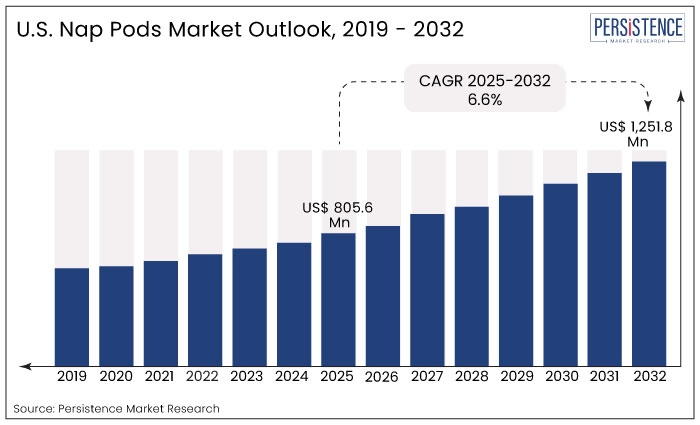
The U.S. nap pods market size is anticipated to reach a value of US$ 805.6 Mn in 2025 and is set to witness a CAGR of 6.6% from 2025 to 2032. The market will likely attain a value of US$ 1,251.8 Mn in 2032.
The U.S. market is likely to rise at a steady pace through 2031 backed by rising awareness of the benefits of short naps on productivity, mental well-being, and health. Employers, especially in tech and corporate sectors, are increasingly adopting office sleeping pods as part of workplace wellness programs to combat fatigue and stress. They are gradually recognizing that well-rested employees often perform better.
Growth in remote and hybrid work models has also led a few other companies to extend these wellness benefits to enhance home-office setups. Additionally, increased focus on mental health has further driven demand for nap pods in public spaces like airports, universities, and hospitals, creating new opportunities across various sectors.
In August 2024, for instance, Phorest, headquartered in Dublin, announced that it is planning to introduce sleeping pods for its staff in the office. This decision came up when the company provided remote work facilities to its employees. However, they are required to visit the office when there are important client calls or meetings.
In such cases, often, several of these employees who have already moved out of the city find it difficult to book hotels as these are expensive. Hence, the company is striving to introduce sleeping pods so that its employees can rest for a few hours without having to move to hotels.
 Key Highlights of the Market
- In terms of product type, single occupancy nap pods are anticipated to witness a CAGR of 7.1% through 2032 as these provide a distraction-free space that enhances relaxation and rest.
- Based on end user, the corporate offices segment is projected to showcase a CAGR of 7.4% through 2032 due to the rising awareness of employee wellness programs.
- Increasing use of nap pods in hospitals to support staff and patient recovery is anticipated to create new opportunities.
- Eco-friendly nap pods are gaining traction among environmentally conscious companies in the U.S.
- Development of modular nap pods catering to diverse workplace needs is projected to boost demand.
- Hotels in the U.S. are gradually incorporating nap pods as premium amenities for guests.
|
Market Attributes |
Key Insights |
|
U.S. Nap Pods Market Size (2025E) |
US$ 805.6 Mn |
|
Projected Market Value (2032F) |
US$ 1,251.8 Mn |
|
U.S. Market Growth Rate (CAGR 2025 to 2032) |
6.6% |
|
Historical Market Growth Rate (CAGR 2019 to 2024) |
5.8% |
Single Occupancy Nap Pods Top the Market with Desire for Privacy and Flexibility
|
Category |
CAGR through 2031 |
|
Product Type- Single Occupancy Nap Pods |
7.1% |
Single occupancy sleeping pods lead the U.S. nap pods industry due to the rising need for privacy and flexibility. These align well with the needs of various environments, especially corporate offices and airports.
The pods provide a personal, distraction-free space that enhances relaxation and rest. It makes them ideal for individuals looking to recharge quickly and comfortably without interruptions. The compact design also allows these pods to be conveniently installed in limited spaces, addressing the spatial constraints common in corporate and public settings. Additionally, single-occupancy options simplify maintenance and reduce the spread of germs, an important factor in high-traffic areas like offices and airports.
Corporate Offices Seek Unique Pods to Increase Employee Productivity
|
Category |
CAGR through 2031 |
|
End User - Corporate Offices |
7.4% |
Corporate offices lead the U.S. nap pods industry due to a growing emphasis on employee wellness and productivity. Employers increasingly recognize that short naps can enhance focus, reduce stress, and improve job satisfaction, which leads to high productivity and low burnout rates.
Corporate nap pods also contribute to a competitive, appealing workplace culture that attracts and retains talent. Additionally, as remote work and flexible schedules become increasingly common, companies are using in-office amenities like nap pods to encourage employees to spend more time in the office, fostering collaboration and team cohesion.
Market Introduction and Trend Analysis
The U.S. nap pods market is gaining momentum, driven by an increasing focus on wellness and productivity across corporate, healthcare, and transportation sectors. Nap pods, which provide private, comfortable spaces for brief rest, are becoming highly sought-after amenities in settings where high productivity and long hours are common.
Corporate offices lead this trend, with companies investing in nap pods to enhance employee wellness, reduce burnout, and foster a positive work environment. Airports are also adopting nap pods, catering to travelers needing rest during layovers. On the other hand, hospitals provide them for healthcare workers to recharge during demanding shifts.
Current trends show a preference for single occupancy pods, as they offer privacy, simplify maintenance, and meet hygiene expectations. Tech-enabled features, such as customizable lighting and soundproofing, are increasingly incorporated to create a restful experience. The U.S. market is projected to rise steadily as more industries recognize the value of well-being initiatives that support both individual health and productivity.
Historical Growth and Course Ahead
The U.S. nap pods market recorded a decent CAGR of 5.9% in the historical period from 2019 to 2023. The market experienced steady growth over the past decade, evolving from a niche concept to a wellness innovation embraced in various high-stress environments.
Initially popularized in corporate offices focused on progressive work culture, nap pods have since broadened into airports, healthcare, and academic settings. This growth reflects changing attitudes toward employees and public wellness. Employers and facility managers are increasingly understanding the productivity and health benefits of short rest periods.
The market is likely to surge further, driven by the constant prioritization of mental and physical wellness, especially in the workplace. As remote work has shifted certain office dynamics, companies are enhancing in-office amenities to attract employees back to physical workspaces, where nap pods serve as an appealing perk.
Innovations in technology are likely to improve pod designs, incorporating features like biometric access, AI-powered environment adjustments, and integrated sound and light therapies. With ongoing emphasis on health and productivity, the U.S. market is set for continued growth and diversification across sectors.
Market Growth Drivers
High Stress Levels to Encourage Adoption across Workplaces
Rising levels of stress and burnouts in today’s fast-paced professional environments are key factors driving the U.S. nap pods market growth. With high workloads and demanding schedules, employees are increasingly seeking ways to boost mental and physical fatigue to maintain productivity and well-being.
Nap pods provide a private, calming space for short naps, which can help mitigate stress, enhance mood, and improve cognitive performance. Companies are recognizing the value of these wellness solutions as tools to support employee health and prevent burnout. As a result, organizations across various sectors, particularly corporate offices, are investing in nap pods as part of broader wellness initiatives. These are aimed at fostering a healthier, more sustainable work environment. This trend is set to fuel continued growth in the market as demand for stress-relief solutions rises across high-pressure settings.
Nap pods also offer a quick and private means for employees to recharge during the workday, helping to prevent the health impacts associated with chronic fatigue and stress. By supporting a well-rested workforce, employers can reduce turnover and improve their productivity.
Various companies are now including nap pods as part of their workplace wellness programs, which is further driving market growth. Moreover, as the health impacts of stress and burnout become more widely acknowledged, the trend of workplace nap pods is anticipated to rise across other sectors.
Rising Shift toward Flexible Workspaces to Foster Demand
The rapid shift toward flexible workspaces is a key driver of growth in the U.S. nap pods market. As organizations embrace hybrid and remote work models, they are rethinking office environments to prioritize employee well-being and productivity. This includes integrating napping chairs into the workplaces to provide employees with dedicated spaces to rest and recharge.
By offering a comfortable, private area for short naps, companies aim to reduce stress, enhance focus, and improve cognitive performance. Growing recognition of the benefits of napping, alongside wellness initiatives focused on mental health, has led to increased demand for nap pods. It is especially evident in industries that prioritize innovation, creativity, and work-life balance.
Market Restraining Factors
Small-scale Companies to Refrain from Installation due to High Cost
The high upfront cost of nap pods is a significant restraining factor in the U.S. nap pods market. These pods, designed with cutting-edge features like zero-gravity reclining, noise cancellation, and integrated ambient lighting, often require substantial investment. These make them costly for businesses, particularly small-scale companies and start-ups, to implement.
The total expense limits widespread adoption, as companies may be hesitant to allocate budget toward nap pods when balancing other pressing business expenses. Premium nap pods are often priced at thousands of dollars each. Hence, the high initial outlay can deter companies from prioritizing them, despite potential wellness benefits for employees.
Key Market Opportunities
Expansion of Corporate Wellness Programs to Create Opportunities
Expansion of corporate wellness programs presents key growth opportunities in the U.S. nap pods industry. As companies increasingly prioritize employee well-being to boost productivity, reduce stress, and lower turnover rates, nap pods are gaining traction as a valuable addition to wellness offerings. With more organizations recognizing the impact of rest on mental and physical health, they are investing in on-site amenities that support employee relaxation.
Demand for wellness solutions, driven by a focus on work-life balance, has also led to higher acceptance of workplace napping. This shift enhances market opportunities, as companies view nap pods as a long-term investment in fostering a healthier, more engaged workforce.
Competitive Landscape for the U.S. Nap Pods Market
The competitive landscape of the U.S. nap station industry is shaped by both established wellness technology companies and innovative new entrants focusing on workplace well-being. Key players such as MetroNaps, GoSleep, and NapCabs lead the market by offering high-tech nap pods with features like ergonomic design, ambient lighting, and sound-blocking capabilities.
Leading companies are also competing in terms of product innovation, customization options, and pricing strategies to attract diverse clients across corporate, healthcare, and educational sectors. Additionally, as awareness of workplace wellness grows, small-scale firms are entering the market.
Emerging firms are introducing budget-friendly options or specialized pods that cater to specific needs. This competition fosters product development and encourages innovations in nap pod technology. It is hence positioning it as an essential wellness solution across workplaces in the U.S.
Recent Industry Developments
- In October 2024, San Francisco-based Brownstone Shared Housing, a company offering low-cost sleeping pods in the city’s downtown area, received an overwhelming response, with over 300 applicants vying for just 17 remaining spaces. The company provides a budget-friendly housing alternative in one of the nation’s most expensive cities, renting out bunkbed-style pods at US$ 700 per month.
- In July 2024, Eight Sleep, based in New York, declared that it will utilize the unique Pod 4 technology during the 2024 Tour de France. It aims to enhance the performance and recovery of athletes as the Official Sleep Partner. By extending sleep by up to an hour each night and cutting wake time by up to three hours every month, the new system is intended to enhance the quality of sleep.
Companies Covered in U.S. Nap Pods Market
- GoSleep
- MetroNaps
- NapCabs GmbH
- Podtime
- SAMS Snooze At My Space
- Sleepbox Ltd.
- Minute Suites, LLC
- HOHM
- Urban Naps
- Podtime
- Rest Space
Frequently Asked Questions
The U.S. market is estimated to increase from US$ 805.6 Mn in 2025 to US$ 1,251.8 Mn in 2032.
The U.S. Nap Pods Market is driven by rising workplace stress and burnout, encouraging companies to adopt nap pods for improving employee rest and productivity.
The market is projected to record a CAGR of 6.6% during the forecast period from 2025 to 2032.
Expansion of corporate wellness programs creates opportunities for nap pod providers to offer rest solutions that enhance employee well-being and performance.
Major players include GoSleep, MetroNaps, NapCabs GmbH, Podtime, SAMS Snooze At My Space, Sleepbox Ltd. and Others.


