




- Semiconductor Materials & Components
- Thin Film Battery Market
Thin Film Battery Market Size, Share, and Growth Forecast, 2026 - 2033
Thin Battery Market by Battery Type (Rechargeable, Disposable), Form (Flexible Thin Film Batteries, Rigid / Planar Thin Film Batteries), Voltage Range ( Below 1.5 V, 1.5 V – 3 V, Above 3V), End Use Industry (Healthcare/Medical, Consumer Electronics, Industrial / Manufacturing, Automotive & Transportation (Micro Energy Storage), Aerospace & Defence, Telecommunications / IoT, Misc.) and Regional Analysis for 2026 - 2033

Thin Film Battery Market Size and Trends Analysis
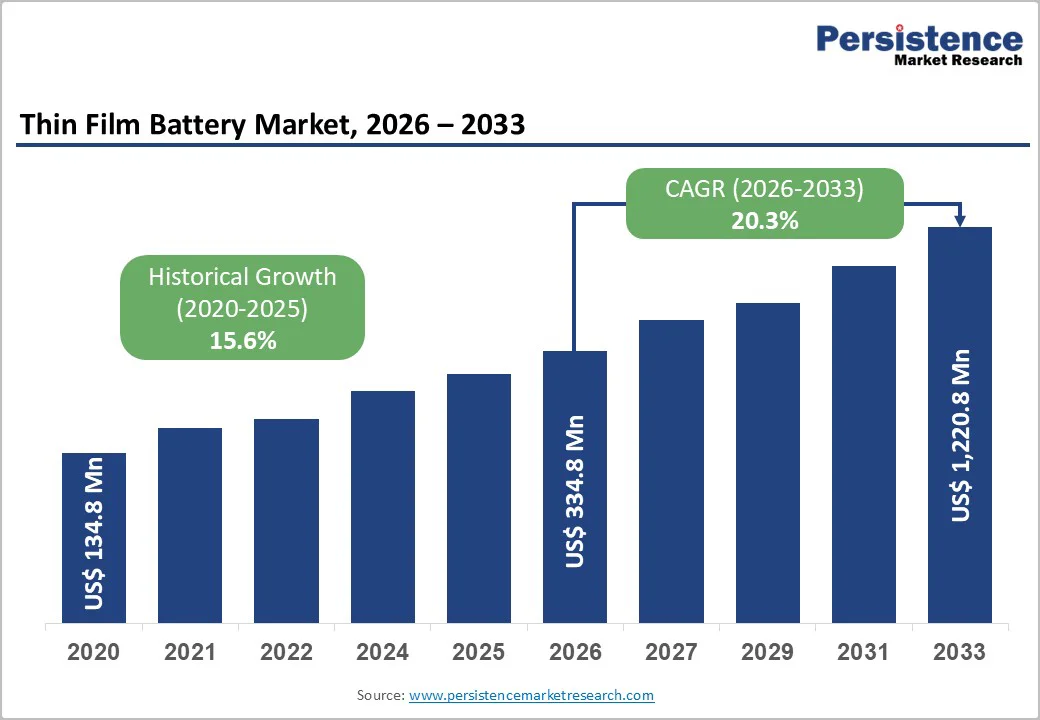
The Global Thin Film Battery Market size was valued at US$ 334.8 million in 2026 and is projected to reach US$ 1,220.8 million by 2033, growing at a CAGR of 20.3% between 2026 and 2033. This exceptional expansion reflects unprecedented demand for micro-energy storage solutions driven by the proliferation of Internet of Things devices, the acceleration of wearable health monitoring technologies, and sustained aerospace and defence infrastructure investments across developed and emerging economies.
The Thin Film Battery Market addresses critical miniaturisation requirements across consumer electronics, medical implants, IoT sensors, and military applications where factor constraints, weight limitations, and power density demands necessitate technologies fundamentally different from conventional lithium-ion batteries.
Key Industry Highlights:
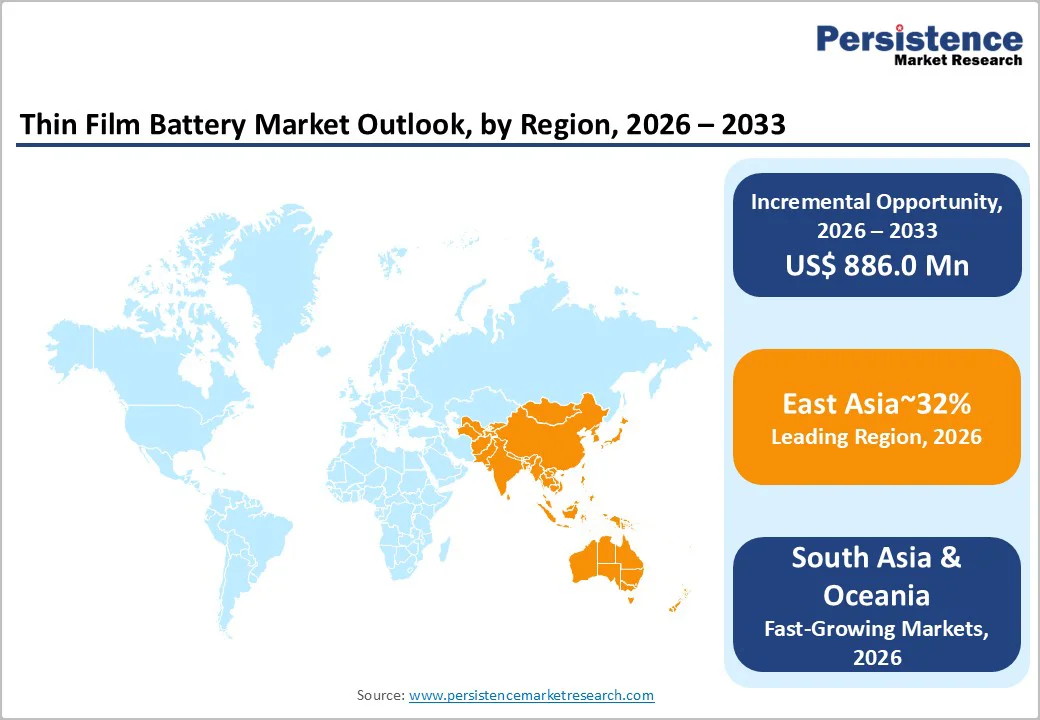
- Regional Leadership: East Asia leads the global Thin Film Battery market with ~31% share, driven by electronics manufacturing dominance, rapid adoption of wearables, and strong government-supported innovation initiatives in China, Japan, and South Korea.
- Strong North American Presence: North America holds ~27% market share, supported by advanced aerospace, defence, medical device, and consumer electronics sectors demanding ultra-compact, reliable power sources.
- Significant European Market: Europe accounts for ~26% share, underpinned by stringent environmental and energy efficiency regulations, advanced automotive and IoT infrastructure, and growing adoption of wearable medical devices.
- Leading Battery Type: Rechargeable thin-film batteries dominate the market with ~72% share, reflecting preference for multi-use applications in medical devices, wearables, and industrial IoT sensors.
- Fastest-Growing Battery Type: Disposable thin-film batteries represent the fastest-growing segment, driven by single-use devices, cost-sensitive applications, and scenarios with limited charging infrastructure.
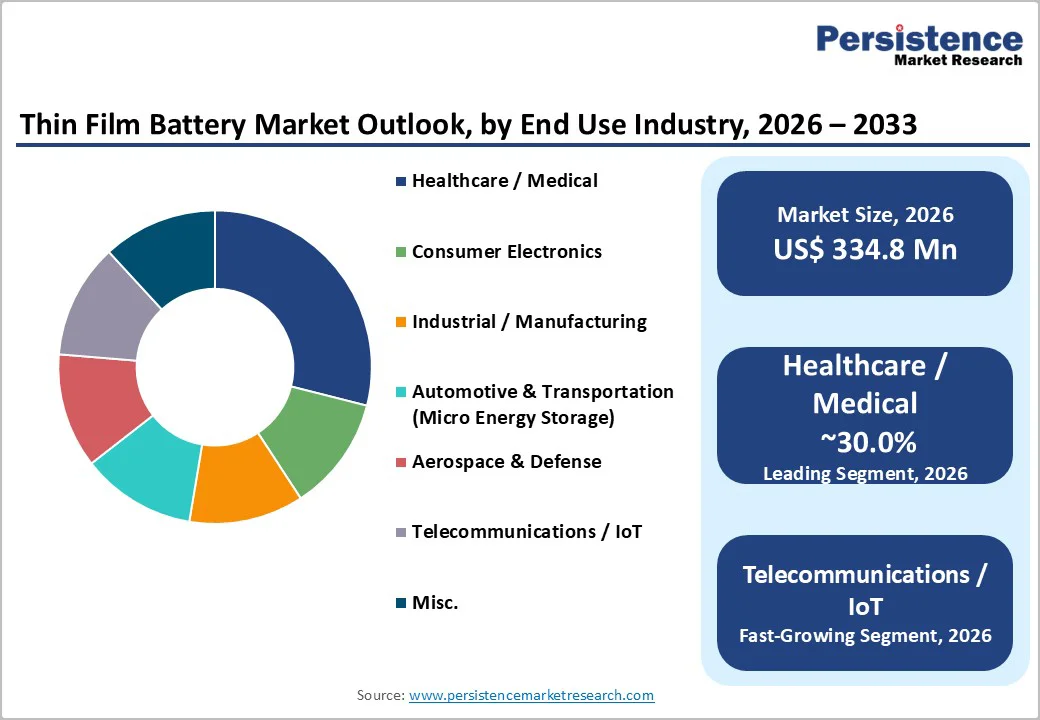
- Key End-Use Leader: Healthcare and medical applications lead with ~30% share, powered by demand for wearable monitoring devices, implantable medical systems, and portable diagnostics.
| Global Market Attributes | Key Insights |
|---|---|
| Thin Film Battery Market Size (2026E) | US$ 334.8 Mn |
| Market Value Forecast (2033F) | US$ 1,220.8 Mn |
| Projected Growth (CAGR 2026 to 2033) | 20.3% |
| Historical Market Growth (CAGR 2020 to 2025) | 15.6% |
Market Dynamics
Growth Drivers
Internet of Things Device Proliferation and Distributed Connectivity Infrastructure
The Thin Film Battery Market is experiencing rapid expansion driven by the exponential proliferation of Internet of Things devices requiring distributed micro-power sources across global infrastructure.
IoT devices surpassed the world's human population in 2011, with 12.5 million connected devices compared to 7 billion people, establishing the initial inflection point that has accelerated dramatically through 2026; global internet users reached 6 billion in 2025, up from 60% in 2020, with nearly 1.3 billion people coming online between 2020 and 2025 representing the largest digital adoption acceleration in history. In the European Union, 29% of enterprises with 10 or more employees deployed Internet of Things devices as of 2021, with adoption rates at 48% among large enterprises compared to 26% for small enterprises, primarily for security applications, 72% of IoT users and energy management (30%).
India's government has catalyzed IoT infrastructure investment through the Smart City Mission, allocating INR 7,060 crores to develop 100 smart cities featuring smart homes, intelligent transportation, and connected public infrastructure, while the Digital India program provides foundational broadband infrastructure and the MeitY-approved FutureSkill PRIME initiative directs INR 436.87 crores toward developing advanced talent in emerging technologies, including IoT.
The Market directly captures this distributed connectivity wave, as IoT devices require ultra-compact power sources that cannot be satisfied by conventional batteries constrained by physical size, weight, and flexibility requirements. Organisations deploying millions of IoT sensors across smart city infrastructure, industrial manufacturing facilities, and distributed healthcare monitoring systems require thin-film batteries capable of functioning in severely space-constrained environments while maintaining multi-year operational lifecycles.
Aerospace and Defense Micro-Power System Requirements and Strategic Infrastructure Investment
Aerospace and defense sector investment is generating sustained demand for Thin Film Battery Market solutions as military and space systems require ultra-compact, lightweight power sources for micro-electromechanical systems, unmanned platforms, and satellite constellations. The U.S. aerospace and defence industry generated nearly US$ 995 billion in total business activity in 2024, which combined US$556 billion direct output with US$ 439 billion from the supply chain, exported US$ 138.6 billion in 2024, and maintained a trade surplus of US$ 73.9 billion, reflecting strong global demand for advanced aerospace and defense technologies requiring micro-power integration.
The European aerospace and defense industry achieved €325.7 billion in turnover in 2024, representing 10.1% year-over-year growth, with the defense sector specifically expanding 13.8% to €183.4 billion, driven by heightened geopolitical tensions, Ukraine support initiatives, and European strategic autonomy objectives, creating substantial demand for advanced power systems across military platforms.
India's defense sector has achieved unprecedented growth momentum under the Atmanirbhar Bharat (self-reliance) initiative, recording ?1.54 lakh crore in defense production in FY 2024-25 (the highest in history), with defense exports surging to ?23,622 crore from less than ?1,000 crore in 2014, and the government allocating ?6.81 lakh crore toward defense budgets in 2025-26 (up from ?2.53 lakh crore in 2013-14).
Aerospace and defense applications create critical requirements for thin-film batteries in unmanned systems, micro-satellite platforms, deployable military equipment, and remote sensor networks where space constraints, weight limitations, and reliability demands exceed what conventional batteries can accommodate. The Thin Film Battery Market directly addresses these micro-power requirements through ultra-compact form factors, minimal weight penalties, and reliable performance across demanding operational environments.
Market Restraining Factors
Manufacturing Scalability Constraints and Production Cost Barriers
Despite strong market demand, thin-film battery production faces substantial scalability challenges that constrain addressable market expansion and limit profitability for manufacturers. Manufacturing processes for thin film batteries require sophisticated deposition technologies, specialised equipment infrastructure, and stringent cleanroom environments, creating capital-intensive production facilities that generate high fixed costs and require substantial production volumes to achieve unit economics acceptability. Small and medium-sized manufacturers often struggle with production scale-up from prototype volumes to commercial manufacturing, creating bottlenecks that limit supply and delay market penetration in high-growth segments such as wearables and medical implants.
The limited expertise in printable electronics in certain regions and constrained supply chains for advanced materials and specialized electrolytes further impede manufacturing expansion and increase production costs relative to conventional battery technologies. High production costs relative to conventional lithium-ion batteries remain a structural barrier restricting adoption to premium applications where miniaturization or flexibility requirements justify cost premiums.
Key Market Opportunities
Flexible Electronics Integration and Printed Battery Manufacturing Convergence
The Thin Film Battery Market is positioned to benefit substantially from emerging flexible electronics ecosystem development and the convergence of printed battery manufacturing with smart device integration. Innovations in solid-state battery technology have resulted in batteries that are inherently safer with lower leakage and combustion risk compared to traditional liquid-electrolyte lithium-ion batteries, while integration of nanotechnology into battery production has improved the performance of printed batteries, making them suitable for high-performance applications, including medical implants and industrial sensors.
The market is experiencing significant investment and R&D focus globally, with advanced materials enabling ultra-thin (<50 μm), mechanically flexible energy storage devices that can conform to arbitrary curved surfaces, including human skin, without compromising performance or safety. Electrochromic energy-storage devices providing visual capacity indication without requiring additional power supply represent emerging innovation expanding application possibilities.
Printed battery fabrication techniques are progressing toward commercial viability, with cost reductions and performance improvements making printed batteries competitive with thin-film deposition approaches for certain applications. Organisations across healthcare, consumer electronics, and industrial sectors are evaluating flexible battery integration into next-generation devices, creating substantial opportunities for Thin Film Battery Market vendors capable of delivering solutions matching emerging form factors and performance requirements.
The printed and thin film battery market reflects accelerating adoption driven by consumer demand for sleek, lightweight, portable devices requiring compact power sources capable of delivering consistent performance without compromising device form factor. Regional adoption patterns demonstrate that North America and Europe lead in premium electronics integration, while Asia-Pacific is witnessing accelerating uptake due to expanding electronics manufacturing hubs, positioning the region as the primary growth engine for the Thin Film Battery Market expansion through 2033.
Medical Device and Healthcare Monitoring Ecosystem Expansion
Healthcare represents the fastest-expanding opportunity for Thin Film Battery Market solutions, driven by ageing global population demographics, healthcare system emphasis on continuous remote monitoring, and regulatory frameworks incentivising non-invasive diagnostic technologies.
The ageing population and demand for continuous, remote patient monitoring have created ripe conditions for flexible battery integration into medical devices, with wearable healthcare technologies becoming integral to chronic disease management, post-operative monitoring, and preventive health initiatives.
Organisations are increasingly integrating thin-film batteries into skin patches, glucose monitors, portable diagnostics, implantable medical devices, and wearable health sensors that demand flexible form factors, biocompatible materials, and long-term operational stability. Healthcare infrastructure is advancing toward continuous health monitoring paradigms where patients remain equipped with wearable sensors throughout daily activities, with power supply requirements addressed through batteries capable of conforming to skin contact without creating pressure points or safety concerns.
Regulatory frameworks in developed markets are establishing reimbursement pathways for remote patient monitoring services, creating economic justification for healthcare provider adoption of wearable monitoring infrastructure. The Thin Film Battery Market directly enables this healthcare transformation by providing power sources uniquely suited to wearable medical device requirements that conventional batteries cannot address due to form factors, flexibility, or miniaturisation constraints.
Category-wise Analysis
Battery Type Insights
Rechargeable thin film batteries maintain market dominance with 72% market share in 2026, reflecting organizational preference for multi-use power sources that reduce lifecycle costs through repeated charging cycles compared to single-use disposable alternatives. Rechargeable thin film batteries demonstrate superior economics for applications supporting extended operational periods, such as smartwatches, fitness trackers, medical monitoring devices, and industrial IoT sensors, where charge-discharge cycling creates cumulative cost advantages offsetting higher initial purchase costs.
The rechargeable thin film battery market specifically is experiencing exceptional growth, representing velocity substantially exceeding the broader battery market and indicating accelerating adoption of rechargeable solutions across consumer electronics, medical devices, and IoT applications.
Disposable thin film batteries represent the fastest-growing segment within the Thin Film Battery Market, driven by cost-sensitive applications, single-use device categories such as smart cards, RFID tags, interactive packaging, and scenarios where charging infrastructure availability is limited or impractical.
End Use Industry Insights
Healthcare and Medical applications command approximately 30% of the Thin Film Battery Market in 2026, reflecting critical demand for wearable monitoring devices, implantable medical systems, and portable diagnostics requiring ultra-thin, biocompatible power sources that conventional batteries cannot accommodate. Healthcare represents the leading application segment due to regulatory mandates requiring biocompatibility testing, long-term stability validation, and clinical efficacy documentation for any power source integrated into patient-contacting devices.
Telecommunications and IoT applications represent the fastest-growing end-use industry for the Thin Film Battery Market, driven by the explosive expansion of connected device ecosystems, 5G infrastructure deployment, and emerging IoT applications requiring ultra-compact distributed power sources. Global internet users reached 6 billion in 2025, up from 60% in 2020, with telecommunications providers worldwide expanding network infrastructure to accommodate accelerating data consumption and emerging service categories. India's telecom sector achieved gross revenue of US$ 43.42 billion in FY25, up from US$ 39.22 billion in FY24, with 5G already contributing nearly a quarter of wireless data usage, driving demand for micro-power solutions across 5G infrastructure and emerging telecommunications IoT applications.
The Telecommunications/IoT segment's dominance as the fastest-growing category reflects recognition that next-generation connectivity infrastructure will depend critically on distributed IoT sensors, remote monitoring systems, and edge computing nodes requiring ultra-compact, reliable power sources.
Regional Insights and Trends
North America Market Trend
North America commands 27% of the Global Thin Film Battery Market, reflecting organizational maturity in medical device development, aerospace and defense procurement, and consumer electronics manufacturing. The U.S. aerospace and defense industry supports 2.2 million workers across direct and indirect roles, with direct employment reaching 914,000 workers earning average wages of US$ 115,000, generating extraordinary demand for advanced power systems, including thin film batteries for military platforms and space systems.
The American medical device industry is among the world's most advanced, driving substantial wearable health monitoring device development and FDA-regulated implantable device innovation requiring thin-film batteries meeting biocompatibility and long-term reliability standards. The U.S. A&D sector recorded strong global performance, exporting US$ 138.6 billion in 2024, up from US$ 135.9 billion in 2023, with aeronautics and aircraft accounting for 468,000 direct jobs and space systems employing 156,000 workers, creating critical infrastructure demand for micro-power solutions. North America's wearable device market and consumer electronics innovation ecosystems are generating sustained demand for thin film batteries integrated into next-generation products, emphasizing miniaturization, weight reduction, and form factor flexibility.
East Asia Market Trend
East Asia represents 31% of the Global Thin Film Battery Market, with particularly strong growth trajectories driven by electronics manufacturing dominance, government-supported innovation initiatives, and rapid wearable technology adoption.
China's internet ecosystem reached 1.108 billion internet users, which is 78.6% penetration by December 2024, with 1.105 billion mobile internet users, 99.7% of netizens and online payment users surpassing 1.029 billion, creating massive IoT and wearable device demand. The rechargeable thin film battery market in China is expanding, driven by strong demand from consumer electronics, wearable devices, and electric mobility sectors, with Chinese manufacturers investing heavily in research and development to improve battery energy density and charging efficiency.
East Asia's manufacturing dominance, government innovation support, and massive consumer markets position the region as the primary growth engine for the Thin Film Battery Market, with China capturing the majority of incremental market expansion through 2033.
Europe Market Trend
Europe captures 26% of the global market, driven by strict regulatory frameworks regarding data privacy and a strong focus on sustainability. Germany serves as the region's industrial hub, producing nearly 4.1 million passenger cars and investing €30 billion in automotive R&D. The region's market is heavily influenced by environmental regulations; Germany’s "Electric Mobility Act" and the deployment of over 106,000 charging stations have spurred demand for managed services in the energy and utility sectors.
Eurostat data highlights that adoption is highest in the "electricity, gas, steam, and air conditioning" sectors (46%), reflecting the region's priority on energy efficiency. Additionally, the EU maintains a trade surplus of €81 billion in the automotive sector, necessitating global logistics and tracking services managed through IoT platforms to secure high-value exports to markets like the US and China.
Competitive Landscape
The Global Thin-Film Battery market is moderately fragmented with mild oligopolistic tendencies at the top, where a few key players influence technology and market trends. Leading companies such as STMicroelectronics, Blue Spark Technologies, BrightVolt, Enfucell, LG Chem, and Samsung SDI drive innovation in flexible, solid-state, and printed thin-film batteries for wearables, IoT, and medical devices.
While large firms like LG Chem and Samsung SDI leverage scale and R&D for advanced lithium-based solutions, smaller specialists such as Enfucell and Blue Spark focus on niche applications and flexible designs. Emerging players like Ilika Plc., LionVolt, BTRY AG, NGK Insulators, and Ultralife Corporation contribute innovative technologies in microbatteries and 3D architecture. The market combines fragmentation among niche innovators with consolidation at the leading tier, reflecting a competitive yet evolving landscape.
Key Industry Developments
- June 17, 2024 – e-motec / AGC Inc.: AGC Inc., through its industrial thin-film coatings unit, AGC Plasma Technology Solutions, is leveraging decades of experience in high-volume thin-film manufacturing to scale up production of next-generation thin-film battery materials. The company’s vacuum coating platforms, including magnetron sputtering and PlasmaMAX™ PECVD, enable uniform coatings on both rigid and flexible substrates, supporting mass production of lightweight, high-performance thin-film batteries for applications such as wearables and electric vehicles. This development addresses critical challenges in energy density, form factor flexibility, and material sourcing for lithium-ion batteries.
Companies Covered in Thin Film Battery Market
- Blue Spark Technologies
- BrightVolt.
- Enfucell
- STMicroelectronics
- LG Chem
- LionVolt
- SAMSUNG SDI Co. Ltd.
- Ilika Plc.
- BTRY AG
- NGK Insulators, Ltd.
- The Kurt J. Lesker Company
- Ultralife Corporation
Frequently Asked Questions
The global Thin Film Battery Market is projected to be valued at US$ 334.8 Mn in 2026.
Rechargeable Segment is expected to account for approximately 72% of the global Thin Film Battery Market by Battery type in 2026.
The market is expected to witness a CAGR of 20.3% from 2026 to 2033.
The Thin Film Battery Market is driven by the rapid proliferation of IoT devices and growing demand for ultra-compact, lightweight, and reliable micro-power sources in aerospace, defense, and smart infrastructure applications.
Key market opportunities in the Thin Film Battery Market lie in flexible electronics integration, printed battery manufacturing, and expanding adoption in medical devices and wearable healthcare monitoring systems.
The key players in the Thin Film Battery Market include STMicroelectronics, Blue Spark Technologies, BrightVolt, Enfucell, LG Chem, and Samsung SDI.


