Soy Sauce Powder Market Size, Share, Growth, and Regional Forecast, 2026 to 2033

Soy Sauce Powder Market is segmented by Nature (Organic, Conventional), by End Use (Soups & Sauces, Dips & Seasonings, Meat & Seafood, Others), by Sales Channel (B2B, B2C), and Regional Analysis, 2026 - 2033

ID: PMRREP12799
Calendar

March 2026

260 Pages

Author : Amol Patil

Key Industry Highlights

  • Leading Region: Asia Pacific, holding 41% market share, driven by strong cultural consumption of soy-based products, large-scale manufacturing, and high demand from instant noodles and snack industries.
  • Leading Nature Segment: Conventional, dominating due to cost efficiency, large-scale availability, and strong demand from industrial food manufacturers.
  • Fastest-Growing End Use Segment: Snacks & Convenience Food, driven by rising demand for globally inspired flavors and high-volume usage in snack coatings and ready-to-eat products.
  • Market Drivers: Increasing consumer preference for umami-rich flavors and growing use in sodium reduction and plant-based food formulations.
  • Opportunities: Innovation in instant noodles, soups, and packaged meal solutions leveraging soy sauce powder’s stability and flavor consistency.
  • Key Developments: In November 2025, Kikkoman Trading Europe GmbH sponsored the Grand Sumo Tournament in London. In October 2025, Woodland Gourmet expanded capabilities through the acquisition of International Spices.
Global Market Attributes Key Insights
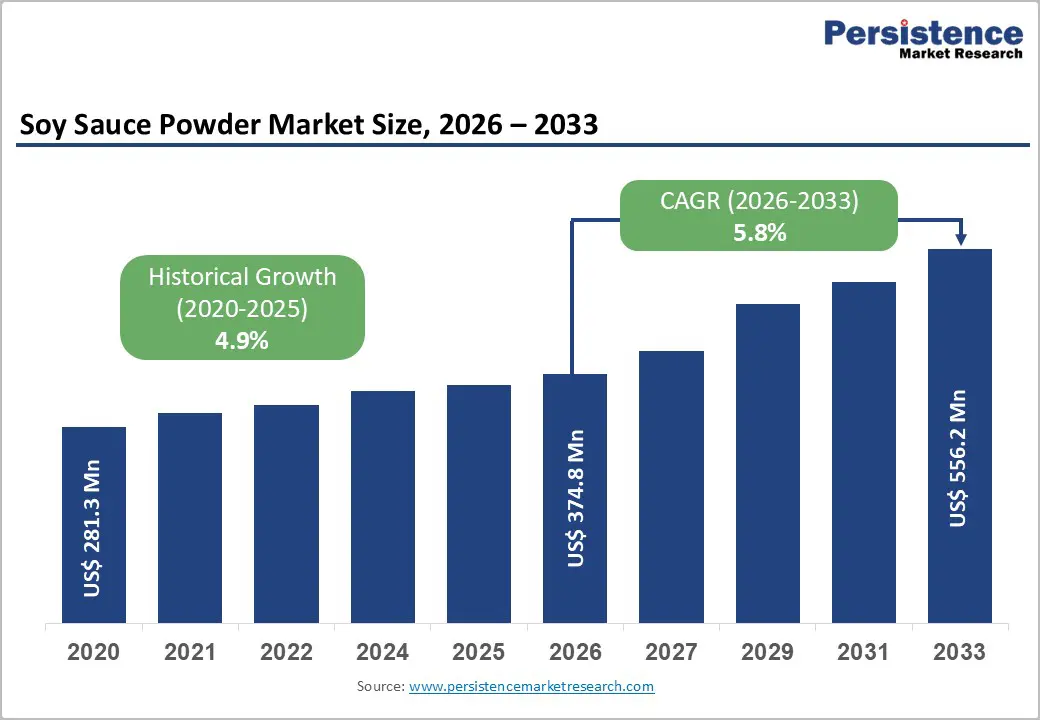
Soy Sauce Powder Market Size (2026E) US$ 374.8 Mn
Market Value Forecast (2033F) US$ 556.2 Mn
Projected Growth (CAGR 2026 to 2033) 5.8%
Historical Market Growth (CAGR 2020 to 2025) 4.9%

soy-sauce-powder-market-size-2026-2033

Market Dynamics

Driver - Increasing Consumer Preference for Umami Flavor Driving the Demand for Soy Sauce Powder

The growing consumer inclination toward savory and flavor-enhanced foods is significantly driving demand for soy sauce powder globally. Umami, recognized as the fifth basic taste, is gaining prominence for its ability to deliver a rich, satisfying flavor profile across a wide range of food applications. As consumers increasingly seek indulgent yet balanced taste experiences, food manufacturers are incorporating umami-rich ingredients such as soy sauce powder into soups, seasonings, bouillons, and ready meals. Its ability to enhance palatability while maintaining a natural flavor profile makes it a preferred choice in modern food formulations.

Additionally, umami ingredients play a crucial role in sodium-reduction strategies, enabling manufacturers to lower salt content without compromising taste. Soy sauce powder, along with yeast extracts and hydrolyzed proteins, is widely used in vegan and vegetarian products to replicate meat-like savory notes, further expanding its application across health-conscious and plant-based food segments.

Restraints - High sodium content concerns impacting health-conscious consumer adoption

A significant barrier to market expansion is the high salt content inherent to traditional soy sauce formulations. As health organizations like the World Health Organization (WHO) urge global populations to reduce sodium intake to combat hypertension and cardiovascular diseases, consumers are becoming increasingly wary of sodium-heavy seasonings. While manufacturers are innovating with low-sodium variants, the spray-drying process used to create the powder often requires carriers such as maltodextrin, which can alter the nutritional profile. This health-centric scrutiny can deter health-conscious demographics from frequent consumption of products containing Soy Sauce Powder, forcing manufacturers to invest in expensive reformulation technologies to maintain taste while meeting strict nutritional labeling requirements in North America and Europe.

Opportunity - Innovation in instant noodles, soups, and packaged meal solutions

The rapid expansion of the global convenience food sector is creating strong opportunities for soy sauce powder manufacturers. Instant noodles, ready-to-eat soups, and packaged meals rely heavily on flavor consistency, ease of handling, and long shelf life, areas where soy sauce powder offers clear advantages over liquid alternatives. Its dry format enhances storage stability, simplifies transportation, and enables precise dosing in seasoning blends, making it highly suitable for large-scale food processing. As manufacturers innovate with new flavors and premium product lines, soy sauce powder is increasingly used to deliver authentic umami taste in compact, shelf-stable formats.

Additionally, the rising demand for fusion flavors and international cuisines is pushing food brands to experiment with Asian-inspired profiles in convenience meals. Soy sauce powder plays a key role in enhancing savory depth while supporting clean-label and low-moisture formulations across global packaged food categories.

Category-wise Analysis

Nature Analysis

The Conventional segment remains the dominant leading segment in 2025, accounting for the vast majority of volume sales in the industrial B2B channel. Its lower price point and widespread availability make it the preferred choice for mass-market snack and instant noodle manufacturers. However, the Organic segment is experiencing the fastest growth as consumer scrutiny over pesticide use and soil health intensifies. Brands like Woodland Foods and Organic Tattva (associated with the broader soy sector) are seeing increased demand for certified organic powders that align with the Clean Label movement. This shift is particularly pronounced in Western Europe and North America, where consumers are willing to pay a premium for verified non-GMO and pesticide-free flavorings.

End Use Analysis

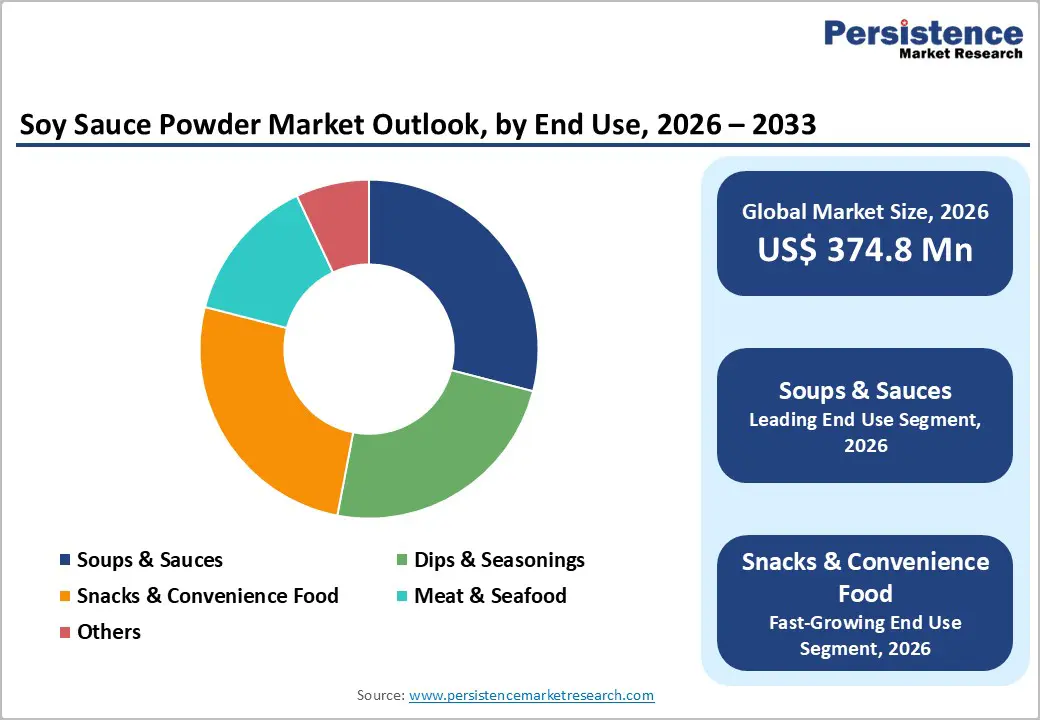
The Soups & Sauces segment is the leading end-user, with a 29% market share in 2025. Soy sauce powder is the foundational ingredient for dehydrated bouillon cubes, instant miso soups, and dry gravy mixes. Its ease of reconstitution and consistent flavor delivery make it indispensable for this category. Furthermore, the Snacks & Convenience Food segment is identified as the fastest-growing segment through 2033. The explosion of globally-inspired snack flavors such as teriyaki-flavored beef jerky or soy-ginger popcorn is driving high-volume demand for concentrated powders. The meat and seafood processing industry also utilizes the powder for moisture management in sausages and as a natural curing agent, further diversifying the market’s reach.
soy-sauce-powder-market-outlook-by-end-use-2026-203

Region-wise Insights

Asia Pacific Soy Sauce Powder Market Trends and Insights

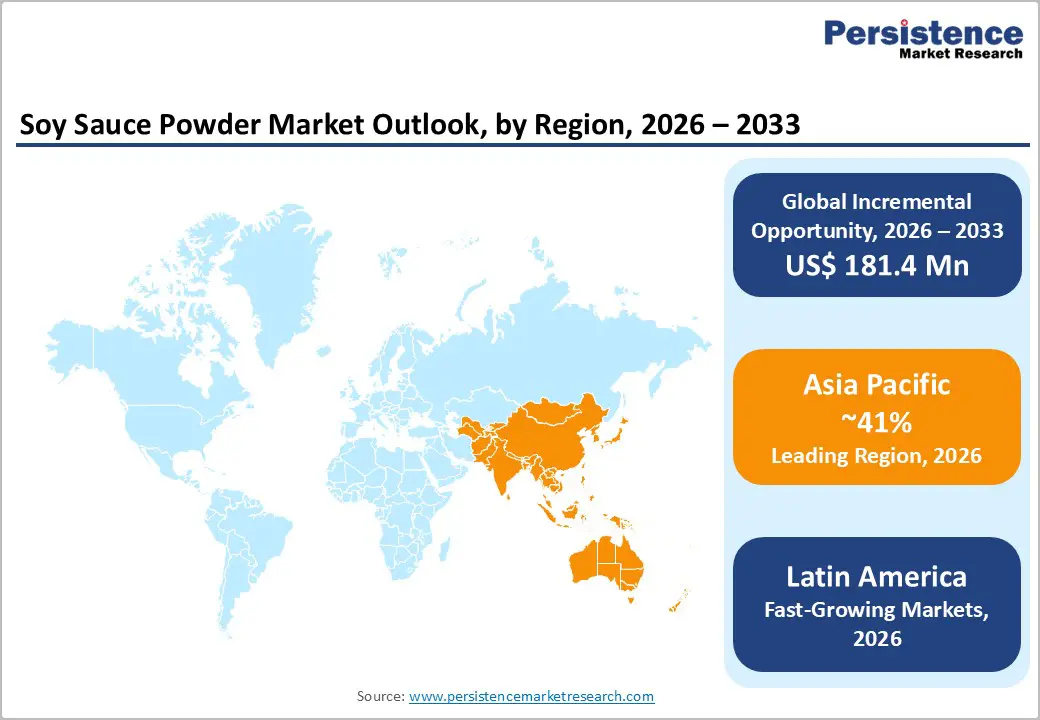
Asia Pacific is the leading region in the global market, holding a dominant 41% market share in 2025. The region's leadership is underpinned by the deep-seated cultural heritage of soy sauce consumption in Japan, China, and South Korea. Japan, in particular, is a hub of innovation, with pioneers such as YAMASA Corporation and Nikken Foods leading the development of high-functionality powders.

The growth dynamics in this region are further supported by a massive manufacturing base and the expansion of the modern retail sector. In China, the rapid growth of the instant noodle and savory snack industries has created a massive internal requirement for industrial-grade soy sauce powder. Furthermore, the region benefits from significant manufacturing advantages and proximity to soybean raw materials. As Asian food exports continue to surge globally, the demand for dehydrated ingredients that can survive international shipping remains a core driver, ensuring the Asia Pacific region remains the primary engine for global market value throughout the forecast period.

Latin America Soy Sauce Powder Market Trends and Insights

Latin America is identified as the fastest-growing segment for the soy sauce powder market through 2033. This rapid expansion is primarily driven by the increasing westernization of diets and the rising popularity of Asian fusion cuisine in major urban centers such as São Paulo and Mexico City. As the middle class expands, demand for packaged snacks and ready-to-eat meals with soy-based flavorings is surging.

The region's growth is also supported by manufacturing advantages, as local food processors seek cost-effective ways to enhance the umami profiles of traditional Latin American stews and meat products. The expansion of modern retail chains and hypermarkets across Brazil and Mexico is making branded seasoning powders more accessible to a wider demographic. While still a developing market compared to Asia, Latin America's high growth rates offer significant first-mover advantages for international companies like Kikkoman Corporation looking to establish a foothold in new geographic revenue pockets.
soy-sauce-powder-market-outlook-by-region-2026-2033

Market Competitive Landscape

The Soy Sauce Powder Market exhibits a moderately consolidated structure, with a few global giants dominating the large-scale industrial supply chain while a vibrant group of specialized regional players caters to niche markets. Market leaders like Kikkoman Corporation, Nikken Foods, and YAMASA Corporation leverage their long histories of traditional fermentation to maintain high quality standards and brand trust. These companies employ strategies focused on geographic expansion, particularly in the Middle East & Africa and Latin America, and strategic partnerships with global snack food corporations. Key differentiators in this market include the fermentation depth of the starting liquid and the purity of the spray-dried output. Emerging business models are increasingly prioritizing sustainability and non-GMO sourcing to appeal to the transparency demands of modern industrial buyers. As the market moves toward high-value segments, we are seeing a shift toward specialized category-specific powders, such as those designed specifically for seafood or poultry, helping companies stand out in a competitive landscape.

Key Developments:

  • In November 2025, Kikkoman Trading Europe GmbH strengthened brand visibility by sponsoring the Grand Sumo Tournament in London, leveraging event-driven promotions and media exposure to showcase its product portfolio across European markets.
  • In October 2025, Woodland Gourmet expanded its flavor innovation capabilities through the acquisition of International Spices, strengthening its portfolio in customized seasoning solutions for snacks, proteins, and prepared foods.

Companies Covered in Soy Sauce Powder Market

  • Kikkoman Corporation
  • AmTech Ingredients
  • Nikken Foods
  • YAMASA Corporation
  • Woodland Foods
  • Aipu Food Industry
  • Maeil Foods
  • Chaitanya Biologicals Pvt. Ltd
  • Beijing Shenglun Food Co., Ltd.
  • Dream Foods
  • Others
Frequently Asked Questions

The global Soy Sauce Powder market is projected to be valued at US$ 374.8 Mn in 2026.

Increasing Consumer Preference for Umami Flavor is a major factor driving the global Soy Sauce Powder market.

The Global Soy Sauce Powder market is poised to witness a CAGR of 5.8% between 2026 and 2033.

Innovation in instant noodles, soups, and packaged meal solutions is a significant opportunity in the Soy Sauce Powder market.

Major players in the Global Soy Sauce Powder market include Kikkoman Corporation, AmTech Ingredients, Nikken Foods, YAMASA Corporation, Woodland Foods, and others.

Global Soy Sauce Powder Market Report Scope
Report Attributes Details
Historical Data/Actuals 2020 - 2025
Forecast Period 2026 - 2033
Market Analysis Value: US$ Mn
Geographical Coverage
  • North America
  • Europe
  • East Asia
  • South Asia and Oceania
  • Middle East and Africa
  • Latin America
Segmental Coverage
  • Nature
  • End Use
  • Sales Channel
  • Region
Competitive Analysis
  • Kikkoman Corporation
  • AmTech Ingredients
  • Nikken Foods
  • YAMASA Corporation
  • Woodland Foods
  • Aipu Food Industry
  • Maeil Foods
  • Chaitanya Biologicals Pvt. Ltd
  • Beijing Shenglun Food Co., Ltd.
  • Dream Foods
  • Others
Report Highlights
  • Market Forecast and Trends
  • Competitive Intelligence & Share Analysis
  • Growth Factors and Challenges
  • Strategic Growth Initiatives
  • Future Opportunities and Revenue Pockets
  • Industry Market Analysis Tools
Global Soy Sauce Powder Market Segmentation

By Nature

  • Organic
  • Conventional

By End Use

  • Soups & Sauces
  • Dips & Seasonings
  • Snacks & Convenience Food
  • Meat & Seafood
  • Others

By Sales Channel

  • B2B
  • B2C
    • Hypermarket/Supermarket
    • Convenience Stores
    • Specialty Stores
    • Online Retail
    • Others

By Region

  • North America
  • Europe
  • East Asia
  • South Asia and Oceania
  • Latin America
  • Middle East and Africa

Related Reports

  1. Executive Summary
    1. Global Soy Sauce Powder Market Snapshot 2026 and 2033
    2. Market Opportunity Assessment, 2026-2033, US$ Mn
    3. Key Market Trends
    4. Industry Developments and Key Market Events
    5. Demand Side and Supply Side Analysis
    6. PMR Analysis and Recommendations
  2. Market Overview
    1. Market Scope and Definitions
    2. Market Dynamics
      1. Driver
      2. Restraint
      3. Opportunities
      4. Trends
    3. Macro-Economic Factors
    4. Forecast Factors - Relevance and Impact
    5. COVID-19 Impact Assessment
  3. Value Added Insights
    1. Value Chain analysis
    2. Key Market Players
    3. Key Promotional Strategies by key players
    4. PESTLE Analysis
    5. Porter's Five Forces Analysis
    6. Regulatory Landscape
  4. Price Trend Analysis, 2025
    1. Region-wise Price Analysis
    2. Price by Segments
    3. Price Impact Factors
  5. Global Soy Sauce Powder Market Outlook: Historical (2020 - 2025) and Forecast (2026 - 2033)
    1. Key Highlights
    2. Global Soy Sauce Powder Market Outlook: Nature
      1. Introduction/Key Findings
      2. Historical Market Size (US$ Mn) Analysis by Nature, 2020-2025
      3. Current Market Size (US$ Mn) Forecast, by Nature, 2026-2033
        1. Organic
        2. Conventional
      4. Market Attractiveness Analysis: Nature
    3. Global Soy Sauce Powder Market Outlook: End Use
      1. Introduction/Key Findings
      2. Historical Market Size (US$ Mn) Analysis by End Use, 2020-2025
      3. Current Market Size (US$ Mn) Forecast, by End Use, 2026-2033
        1. Soups & Sauces
        2. Dips & Seasonings
        3. Meat & Seafood
        4. Others
      4. Market Attractiveness Analysis: End Use
    4. Global Soy Sauce Powder Market Outlook: Sales Channel
      1. Introduction/Key Findings
      2. Historical Market Size (US$ Mn) Analysis by Sales Channel, 2020-2025
      3. Current Market Size (US$ Mn) Forecast, by Sales Channel, 2026-2033
        1. B2B
        2. B2C
          1. Hypermarket/Supermarket
          2. Convenience Stores
          3. Specialty Stores
          4. Online Retail
          5. Others
      4. Market Attractiveness Analysis: Sales Channel
  6. Global Soy Sauce Powder Market Outlook: Region
    1. Key Highlights
    2. Historical Market Size (US$ Mn) Analysis by Region, 2020-2025
    3. Current Market Size (US$ Mn) Forecast, by Region, 2026-2033
      1. North America
      2. Europe
      3. East Asia
      4. South Asia & Oceania
      5. Latin America
      6. Middle East & Africa
    4. Market Attractiveness Analysis: Region
  7. North America Soy Sauce Powder Market Outlook: Historical (2020 - 2025) and Forecast (2026 - 2033)
    1. Key Highlights
    2. Pricing Analysis
    3. North America Market Size (US$ Mn) Forecast, by Country, 2026-2033
      1. U.S.
      2. Canada
    4. North America Market Size (US$ Mn) Forecast, by Nature, 2026-2033
      1. Organic
      2. Conventional
    5. North America Market Size (US$ Mn) Forecast, by End Use, 2026-2033
      1. Soups & Sauces
      2. Dips & Seasonings
      3. Meat & Seafood
      4. Others
    6. North America Market Size (US$ Mn) Forecast, by Sales Channel, 2026-2033
      1. B2B
      2. B2C
        1. Hypermarket/Supermarket
        2. Convenience Stores
        3. Specialty Stores
        4. Online Retail
        5. Others
  8. Europe Soy Sauce Powder Market Outlook: Historical (2020 - 2025) and Forecast (2026 - 2033)
    1. Key Highlights
    2. Pricing Analysis
    3. Europe Market Size (US$ Mn) Forecast, by Country, 2026-2033
      1. Germany
      2. Italy
      3. France
      4. U.K.
      5. Spain
      6. Russia
      7. Rest of Europe
    4. Europe Market Size (US$ Mn) Forecast, by Nature, 2026-2033
      1. Organic
      2. Conventional
    5. Europe Market Size (US$ Mn) Forecast, by End Use, 2026-2033
      1. Soups & Sauces
      2. Dips & Seasonings
      3. Meat & Seafood
      4. Others
    6. Europe Market Size (US$ Mn) Forecast, by Sales Channel, 2026-2033
      1. B2B
      2. B2C
        1. Hypermarket/Supermarket
        2. Convenience Stores
        3. Specialty Stores
        4. Online Retail
        5. Others
  9. East Asia Soy Sauce Powder Market Outlook: Historical (2020 - 2025) and Forecast (2026 - 2033)
    1. Key Highlights
    2. Pricing Analysis
    3. East Asia Market Size (US$ Mn) Forecast, by Country, 2026-2033
      1. China
      2. Japan
      3. South Korea
    4. East Asia Market Size (US$ Mn) Forecast, by Nature, 2026-2033
      1. Organic
      2. Conventional
    5. East Asia Market Size (US$ Mn) Forecast, by End Use, 2026-2033
      1. Soups & Sauces
      2. Dips & Seasonings
      3. Meat & Seafood
      4. Others
    6. East Asia Market Size (US$ Mn) Forecast, by Sales Channel, 2026-2033
      1. B2B
      2. B2C
        1. Hypermarket/Supermarket
        2. Convenience Stores
        3. Specialty Stores
        4. Online Retail
        5. Others
  10. South Asia & Oceania Soy Sauce Powder Market Outlook: Historical (2020 - 2025) and Forecast (2026 - 2033)
    1. Key Highlights
    2. Pricing Analysis
    3. South Asia & Oceania Market Size (US$ Mn) Forecast, by Country, 2026-2033
      1. India
      2. Southeast Asia
      3. ANZ
      4. Rest of SAO
    4. South Asia & Oceania Market Size (US$ Mn) Forecast, by Nature, 2026-2033
      1. Organic
      2. Conventional
    5. South Asia & Oceania Market Size (US$ Mn) Forecast, by End Use, 2026-2033
      1. Soups & Sauces
      2. Dips & Seasonings
      3. Meat & Seafood
      4. Others
    6. South Asia & Oceania Market Size (US$ Mn) Forecast, by Sales Channel, 2026-2033
      1. B2B
      2. B2C
        1. Hypermarket/Supermarket
        2. Convenience Stores
        3. Specialty Stores
        4. Online Retail
        5. Others
  11. Latin America Soy Sauce Powder Market Outlook: Historical (2020 - 2025) and Forecast (2026 - 2033)
    1. Key Highlights
    2. Pricing Analysis
    3. Latin America Market Size (US$ Mn) Forecast, by Country, 2026-2033
      1. Brazil
      2. Mexico
      3. Rest of LATAM
    4. Latin America Market Size (US$ Mn) Forecast, by Nature, 2026-2033
      1. Organic
      2. Conventional
    5. Latin America Market Size (US$ Mn) Forecast, by End Use, 2026-2033
      1. Soups & Sauces
      2. Dips & Seasonings
      3. Meat & Seafood
      4. Others
    6. Latin America Market Size (US$ Mn) Forecast, by Sales Channel, 2026-2033
      1. B2B
      2. B2C
        1. Hypermarket/Supermarket
        2. Convenience Stores
        3. Specialty Stores
        4. Online Retail
        5. Others
  12. Middle East & Africa Soy Sauce Powder Market Outlook: Historical (2020 - 2025) and Forecast (2026 - 2033)
    1. Key Highlights
    2. Pricing Analysis
    3. Middle East & Africa Market Size (US$ Mn) Forecast, by Country, 2026-2033
      1. GCC Countries
      2. South Africa
      3. Northern Africa
      4. Rest of MEA
    4. Middle East & Africa Market Size (US$ Mn) Forecast, by Nature, 2026-2033
      1. Organic
      2. Conventional
    5. Middle East & Africa Market Size (US$ Mn) Forecast, by End Use, 2026-2033
      1. Soups & Sauces
      2. Dips & Seasonings
      3. Meat & Seafood
      4. Others
    6. Middle East & Africa Market Size (US$ Mn) Forecast, by Sales Channel, 2026-2033
      1. B2B
      2. B2C
        1. Hypermarket/Supermarket
        2. Convenience Stores
        3. Specialty Stores
        4. Online Retail
        5. Others
  13. Competition Landscape
    1. Market Share Analysis, 2025
    2. Market Structure
      1. Competition Intensity Mapping
      2. Competition Dashboard
    3. Company Profiles
      1. Kikkoman Corporation
        1. Company Overview
        2. Product Portfolio/Offerings
        3. Key Financials
        4. SWOT Analysis
        5. Company Strategy and Key Developments
      2. AmTech Ingredients
      3. Nikken Foods
      4. YAMASA Corporation
      5. Woodland Foods
      6. Aipu Food Industry
      7. Maeil Foods
      8. Chaitanya Biologicals Pvt. Ltd
      9. Beijing Shenglun Food Co., Ltd.
      10. Dream Foods
      11. Others
  14. Appendix
    1. Research Methodology
    2. Research Assumptions
    3. Acronyms and Abbreviations

Research Methodology Framework for Market Research Excellence

At Persistence Market Research, we implement a comprehensive, validated, and multi-dimensional approachto market analysis that delivers actionable insights across complex market landscapes. Our methodology combines the analytical rigor of leading consulting firms with innovative research techniques, ensuring robust market assessments that guide strategic decision-making with confidence.

Core Research Philosophy

Our methodology is built on four foundational pillars:

Research Philosophy Image

At Persistence Market Research, our methodology is designed to transcend conventional market studies by combining analytical rigor, multi-source validation, and future-focused insights.

We integrate advanced research frameworks, robust data collection strategies, cutting-edge analytics, and innovative technologies to deliver a 360-degree view of complex markets.

We integrate advanced research frameworks, robust data collection strategies, cutting-edge analytics, and innovative technologies to deliver a 360-degree view of complex markets.

Each stage spanning from strategic scoping and hypothesis-building to competitive intelligence, quality validation, and actionable recommendations is engineered to provide clients with unmatched clarity, precision, and confidence in decision-making.

By embedding innovation and technology at the core, our approach ensures that insights are not only comprehensive but also predictive, empowering businesses to seize opportunities, mitigate risks, and achieve sustainable growth

Research Philosophy Image

Capturing Key Information and Events

During this phase, key research objectives focus on essential information and data points for assessing the market, including:

Research Philosophy Image

TAM-SAM-SOM Framework Implementation

We employ both top-down and bottom-up approaches to ensure accurate market sizing.

Top-Down Market SizingBottom-Up Market Sizing
Universe Definition: Total global/regional market identificationUnit Economics: Average transaction values, purchase frequencies, customer lifecycle
Segmentation Filters: Geographic, demographic, and behavioral constraintsCustomer Segmentation: Detailed buyer persona development and sizing
Market Share Analysis: Competitive landscape assessment and share allocationPenetration Analysis: Market penetration rates by segment and geography
Growth Rate Application: Historical trends and forward-looking growth assumptionsScaling Methodology: Extrapolation techniques with confidence intervals

Validation & Cross-Verification

  • Triangulation: Comparing top-down and bottom-up results for consistency
  • Sensitivity Analysis: Testing key assumptions and parameter variations
  • Peer Benchmarking: Comparison with analogous markets and industry benchmarks
  • Expert Review: External validation through industry specialist consultation

Research Philosophy Image

Forecasting & Projection Modeling

Our proprietary forecasting models incorporate multiple variables and scenarios.

Forecasting Components

  • Historical Trend Analysis: 10-year historical growth patterns and cyclical variations
  • Driver-Based Modeling: Economic indicators, demographic shifts, technology adoption
  • Scenario Planning: Base case, optimistic, and conservative projections
  • Monte Carlo Simulations: Probability-weighted outcomes and risk assessments

Model Validation

  • Back-Testing: Historical accuracy assessment over 3–5-year periods
  • Cross-Validation: Multiple modeling approaches for result comparison
  • External Benchmarking: Comparison with established market forecasts
  • Continuous Calibration: Quarterly model updates based on new data

Comprehensive Data Collection Strategy

Our secondary research phase establishes a robust knowledge base utilizing diverse, credible sources.

Secondary Data Sourcess

  • Industry Publications & Reports
  • Government & Regulatory Data
  • Financial Intelligence (filings & reports)
  • Academic Research & Digital Intelligence

Quality Assurance Protocol

  • Source credibility assessment and publication date validation
  • Data consistency checks across multiple sources
  • Bias identification and neutralization techniques
  • Information gap tracking for primary research prioritization

Research Philosophy Image

Primary Research Excellence

Our primary research methodology employs best-in-class techniques to capture unique market insights.

Quantitative Research Methods

  • Large-Scale Surveys: Statistically representative samples with 95% confidence intervals
  • Survey Methodology: Multi-channel deployment (online, telephone, in-person)
  • Question Architecture and Response Optimization

Qualitative Research Methods

  • Executive Interviews
  • Focus Groups
  • Expert Consultations

Quality Assurance & Validation Framework

Multi-Stage Validation Process

  • Source Verification and Consistency Testing
  • Outlier Detection and Bias Assessment
  • Peer Review Process and External Validation
  • Sensitivity Analysis and Confidence Intervals

Research Philosophy Image

Methodology Validation & Credibility

Our research methodology has been extensively validated through:

  • Academic Partnerships: Collaborations with top-tier business schools and research institutions
  • Client Success Stories: Documented case studies demonstrating research impact and ROI
  • Continuous Benchmarking: Performance comparison with leading global research firms

This comprehensive methodology framework positions Persistence Market Research at the forefront of market intelligence, combining the analytical sophistication of top-tier consulting firms with innovative research techniques. Our approach ensures that every market assessment delivers precise, actionable, and strategically valuable insights that drive business success in competitive market environments.

Ready to unlock your market potential? Contact our research experts to discuss how our validated methodology can transform your strategic decision-making with data-driven market intelligence.

Copyright © 2026 Persistence Market Research. All Rights Reserved

Connect With Us -