




- Beauty & Personal Care
- Smart Mask Market
Smart Mask Market Size, Share and Growth Forecast, 2026 - 2033
Smart Mask Market by Product Type (Reusable, Disposable, Hybrid), Technology Integration (Sensors, Connectivity, Analytics, Infotainment), End-User (Healthcare, Industrial, Consumer), and Regional Analysis for 2026 - 2033

Smart Mask Market Share and Trends Analysis
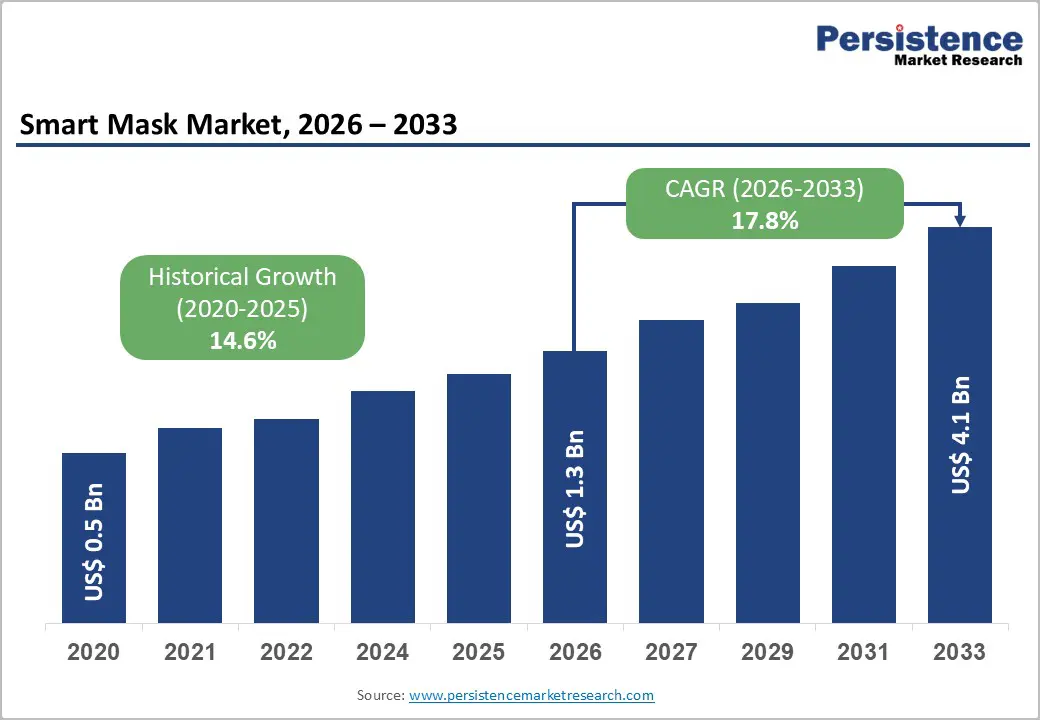
The global smart mask market size is likely to be valued at US$ 1.3 billion in 2026, and is projected to reach US$ 4.1 billion by 2033, growing at a CAGR of 17.8 % during the forecast period of 2026–2033.
This growth is primarily driven by rising urban pollution levels, which have heightened public awareness of air quality risks, prompting individuals and institutions to adopt advanced protective solutions. In parallel, increasing workplace safety mandates across industrial and healthcare sectors are accelerating the procurement of smart masks to ensure regulatory compliance and protect employee health. Consumer demand is surging as connected health wearables gain popularity, creating opportunities for technologically advanced masks. Integration of sensors, connectivity, and analytics differentiates smart masks from conventional personal protective equipment (PPE), while regulatory emphasis on breathable, data-enabled protective gear reinforces adoption across diverse markets, enhancing both safety and usability.
Key Industry Highlights
- Leading Product Types: Reusable masks are expected to lead with around 42% revenue share in 2026, while hybrid masks are likely to be the fastest-growing during 2026–2033, reflecting cost-efficiency and hygiene benefits.
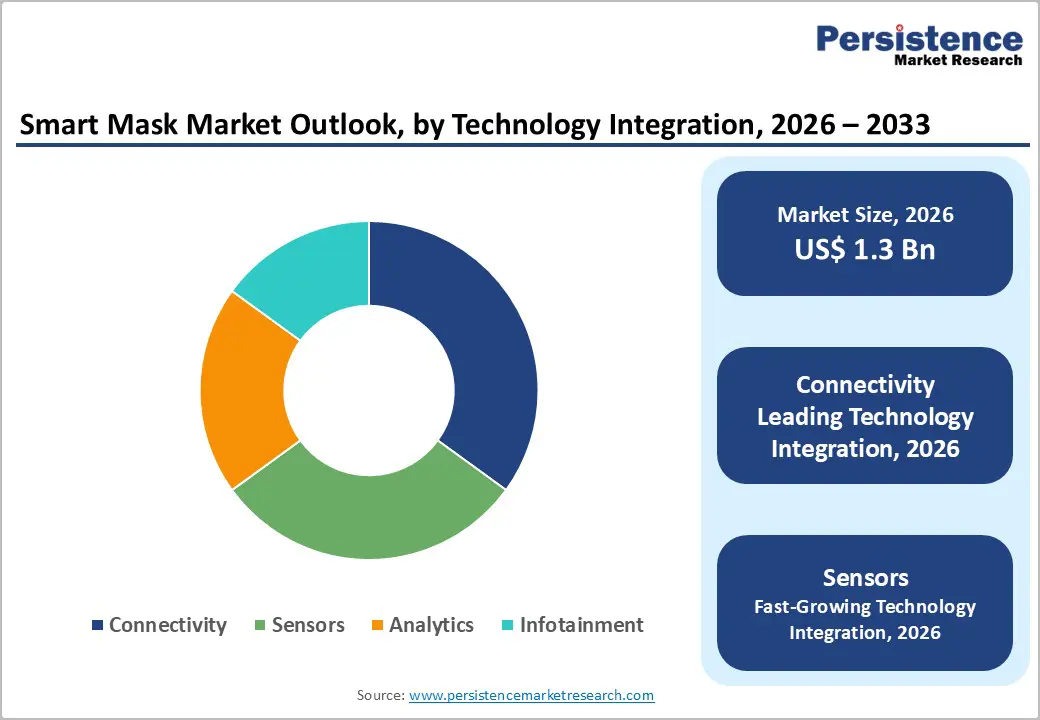
- Dominant Technology Integration: Connectivity-enabled masks are set to hold roughly 35% revenue share in 2026, while IoT-integrated sensors and analytics are likely to grow the fastest at about 17% CAGR through 2033, as demand for data-driven health monitoring rises.
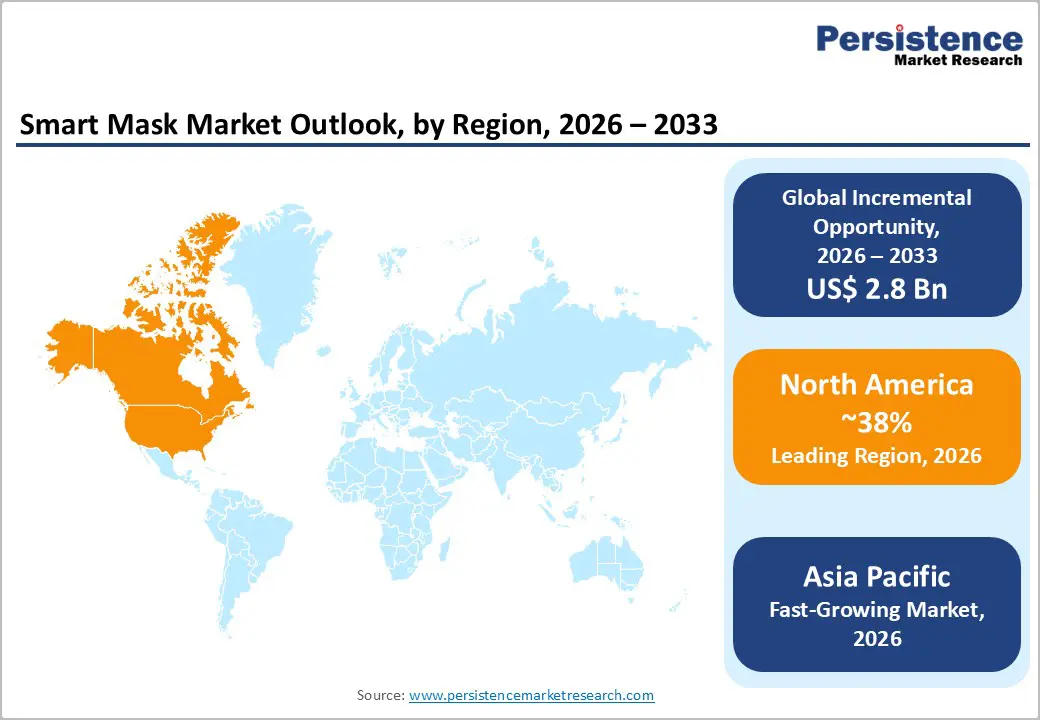
- Regional Leadership: North America is poised to lead with an estimated 38% market share in 2026, while Asia Pacific is likely to register 18% CAGR through 2033, led by manufacturing advantages of China, Japan, India, and ASEAN.
- Competitive Environment: Competitive dynamics include product innovation through AI adaptive filtration, strategic international distribution expansions, and cross-sector partnerships to enhance market presence across geographies.
| Key Insights | Details |
|---|---|
|
Smart Mask Market Size (2026E) |
US$ 1.3 Bn |
|
Market Value Forecast (2033F) |
US$ 4.1 Bn |
|
Projected Growth (CAGR 2026 to 2033) |
17.8% |
|
Historical Market Growth (CAGR 2020 to 2025) |
14.6% |
Market Factors - Growth, Barriers, and Opportunity Analysis
Heightened Awareness of Air Quality and Respiratory Protection
Global exposure to airborne health risks, including pollution, allergens, and communicable diseases, has significantly boosted demand for smart protective equipment that delivers real-time feedback. In 2024, approximately 64 % of growth in smart mask purchases was attributed to rising public awareness of pollution and disease risks, encouraging both healthcare providers and urban consumers to adopt advanced respiratory wearables. Urban air quality indexes (AQI) continue to show pollutant concentrations above recommended health thresholds in many major cities, reinforcing the need for data-enabled protective gear that can provide actionable insights. Consumers are increasingly seeking devices that offer personalized alerts and recommendations, allowing them to adjust daily behavior based on real-time exposure.
Real-time environmental monitoring technologies, powered by IoT sensing and edge analytics, have gained traction as public health authorities and civic administrations emphasize hyperlocal air quality tracking to guide pollution mitigation and public alert systems. Such initiatives complement smart mask capabilities and help contextualize personal exposure data against broader environmental trends, expanding user understanding of localized risk beyond static station measurements. Early adoption programs in several metropolitan areas have shown positive engagement, demonstrating that connected wearables enhance compliance with safety advisories and improve public health outcomes. This synergy between environmental monitoring and wearable devices supports broader adoption of connected protective gear in daily urban life.
High Price Points and Cost Barriers
One of the most significant restraints in the smart mask market remains the comparatively high average selling price (ASP) of tech-enabled models, often exceeding US$ 150 per unit for premium devices with embedded sensors and connectivity. This elevated cost structure creates a clear adoption barrier, particularly in developing economies where budget constraints influence both institutional procurement and individual purchase decisions. Even in mature markets, organizations with fixed PPE budgets often prioritize traditional protective gear over higher-priced connected variants, slowing conversion rates. The higher entry price can also delay purchasing decisions as buyers weigh long-term return on investment against upfront expenditure. High costs now compound with tariff impacts on PPE introduced in 2025, which industry bodies warn could raise protective gear prices and reduce access for many buyers.
Despite proven performance benefits, cost sensitivity remains a defining restraint. In 2024, approximately 41 % of surveyed buyers cited unit price as the primary deterrent to adoption, limiting market penetration in price-sensitive regions and among individual buyers. Heavy investment requirements disproportionately affect small and medium enterprises (SMEs) and budget-constrained institutions that may defer or forego smart mask purchases. Without policy support or targeted subsidies, adoption growth will continue to vary significantly by region and buyer segment. Industry stakeholders have publicly urged policymakers to consider PPE cost mitigation strategies to protect worker safety without widening the affordability gap.
Expansion in Industrial and Occupational Safety
Industrial environments, construction, manufacturing, and mining are increasingly adopting smart masks for real-time hazard exposure alerting and compliance tracking, reflecting broader trends in data-driven safety. Updated PPE standards of the U.S. Occupational Safety and Health Administration (OSHA) emphasize proper fit and protection, encouraging employers to invest in connected PPE with sensor-based monitoring. European and Asia-Pacific countries are promoting smart safety solutions through national occupational safety framework updates, expanding the addressable market. Sensor-enabled masks integrated with enterprise safety systems allow automated hazard alerts, reporting, and reduced incident risks. These initiatives align with corporate compliance programs and workforce well-being strategies, strengthening adoption incentives. Digital dashboards and predictive alerts enhance operational safety while offering actionable environmental data.
Industrial smart mask procurement is projected to exceed 4.1 million units in 2025, a 44 % increase over 2023, as companies replace traditional PPE with intelligent gear. Workplace safety experts note that IoT-enabled wearables are increasingly considered essential, not optional. B2B contracts integrating smart mask fleets with monitoring dashboards are creating scalable revenue opportunities for original equipment manufacturers (OEMs). Adoption in high-risk sectors such as oil & gas and warehousing is accelerating due to regulatory emphasis and safety program alignment. Connected PPE delivers measurable improvements in compliance, incident reduction, and employee confidence. As regulatory expectations and corporate safety programs converge, industrial smart masks are poised for sustained growth.
Category-wise Analysis
Technology Integration Insights
Connectivity-enabled masks are set to hold an estimated 35% of the smart mask market revenue share in 2026, capturing environmental metrics such as PM2.5, volatile organic compounds (VOCs), AQI, and biometric data, including oxygen saturation and respiration. Adoption is driven by healthcare and industrial demand for real-time exposure tracking and compliance with occupational safety programs. Continuous improvements in low-power, accurate sensors enhance usability and reliability across settings, including hospitals, laboratories, and industrial sites. These devices also feed data into dashboards for predictive risk analysis and early intervention. The U.S. Food and Drug Administration (FDA) issued guidance clarifying low-risk regulation of health and fitness wearables, encouraging the integration of advanced sensors into preventive health devices. This has further boosted market confidence and institutional adoption of sensor-driven smart masks.
IoT-integrated sensors and analytics are likely to grow the fastest at around 17% CAGR through 2033, enabling mask data to sync with mobile apps and cloud dashboards for real-time alerts, filter monitoring, and exposure tracking. Enterprise adoption benefits include compliance dashboards, automated reporting, and workforce safety monitoring. Consumers gain personalized insights on air quality and health metrics, enhancing daily engagement. In 2026, Qualcomm unveiled Snapdragon Wear Elite at Mobile World Congress, featuring enhanced connectivity and AI processing for wearables, signaling the industry's move toward smart, networked safety devices. Integration with analytics engines also enables predictive alerts and recurring engagement, positioning connected masks as both functional PPE and a consumer lifestyle device.
End-User Insights
Healthcare is likely to continue to lead with an estimated 45% share of smart mask deployments in 2026, anchored by institutional demand for staff and patient protection. Masks with integrated sensors and connectivity monitor air quality and vital signs, providing actionable insights that support preventive care and infection control. Adoption aligns with broader digital health initiatives and telehealth programs, enabling hospitals to track environmental hazards in real time. In 2025, the U.S. Department of Health and Human Services launched a campaign promoting wearable devices for proactive health monitoring, encouraging healthcare facilities to integrate connected PPE into standard workflows. This initiative reinforces healthcare adoption and sets a benchmark for safety, compliance, and technology-driven care.
The industrial segment is expected to be the fastest-growing end-user subsegment, with a projected CAGR of 18% through 2033, driven by stricter occupational safety regulations and digital transformation initiatives. Smart masks in manufacturing, construction, and cleanroom environments monitor particulate matter, VOCs, and worker respiration in real time, supporting automated compliance reporting and risk mitigation. Adoption is expanding beyond large corporations into mid-sized facilities and emerging markets. In 2025, construction wearable technology adoption surged, integrating connected safety devices into operational dashboards, reflecting industrial momentum for smart, data-driven PPE solutions. These devices enhance risk management, operational efficiency, and employee safety culture, making industrial adoption a rapidly expanding and strategically important segment.
Regional Insights
North America Smart Mask Market Trends
North America is poised to dominate with an estimated 38% of the smart mask market share in 2026, supported by strong institutional demand in healthcare, manufacturing, and construction sectors. Government emphasis on workplace safety, including OSHA regulations, and regulatory frameworks such asNIOSH certification and FDA guidance enhance buyer confidence and encourage adoption of connected PPE. Hospitals and enterprises increasingly deploy masks with sensors and connectivity for exposure monitoring, compliance tracking, and employee health management. Advanced IoT ecosystems allow real-time data integration into dashboards, enhancing predictive safety insights and operational risk reduction. Consumer awareness of personal air quality monitoring also fuels adoption in urban areas. Regional OEMs continue to innovate on design, comfort, and connectivity features, further solidifying North America’s market leadership.
North America’s growth is reinforced by expanding adoption in medium and small enterprises, particularly in industrial and healthcare sectors, where connected PPE improves worker safety and compliance monitoring. In 2025, U.S. industrial firms and large hospital networks accelerated deployment of smart wearable systems for hazard prediction, infection control, and environmental monitoring, reflecting a proactive approach to workplace safety. Enterprise investment in digital safety ecosystems, coupled with innovation from major OEMs headquartered in the region, strengthens leadership while creating opportunities for recurring revenue through service-integrated devices. Growing partnerships between tech and PPE providers enhance market depth and long-term adoption prospects.
Europe Smart Mask Market Trends
Europe accounts for a significant portion of the market, supported by CE certification and harmonized safety standards across Germany, U.K., France, and Spain, which encourage enterprise and healthcare adoption. Industrial dust and emission regulations, combined with investments in modernizing hospitals and clinics, create strong demand for connected protective wearables. Enterprises are deploying smart masks to monitor environmental hazards, track worker exposure, and comply with evolving occupational safety mandates. Sustainability policies and ergonomic design preferences also support reusable and sensor-enabled mask adoption. Enhanced analytics from connected PPE enables predictive monitoring and timely interventions, reinforcing workplace safety outcomes.
The fastest-growing sub-trend in Europe is technology-driven occupational safety adoption, where connected PPE integrates into predictive risk and environmental monitoring platforms. In 2025, European industrial and healthcare firms deployed wearable safety devices that deliver real-time alerts, compliance reporting, and exposure tracking, supporting worker safety culture. Government incentives for health tech innovation and digital safety compliance further encourage adoption. The integration of smart mask data into broader workplace safety ecosystems strengthens operational efficiency, enhances employee well-being, and positions Europe as a stable, strategically important market in smart PPE.
Asia Pacific Smart Mask Market Trends
Asia Pacific is expected to be the fastest-growing regional market for smart masks, expected to register a CAGR of 18% through 2033, driven by high urban pollution, increasing industrial safety adoption, and large consumer populations. China leads regional sales, followed by Japan, India, and ASEAN, supported by low-cost electronics supply chains and competitive manufacturing capabilities. Urban air quality concerns, government workplace safety initiatives, and increasing regulatory enforcement encourage both consumer and institutional adoption of connected smart masks. Regional OEMs are expanding production and exports, leveraging economies of scale to reach broader markets. Integration with IoT networks allows real-time hazard alerts and exposure monitoring, making smart masks essential tools for workplace compliance and personal health protection.
The fastest-growing opportunity in APAC stems from converging policy support and rapid IoT adoption, where enterprises integrate wearable PPE into industrial safety and environmental monitoring programs. In 2025–2026, construction, manufacturing, and urban enterprises across Asia Pacific accelerated investments in connected safety devices that track air quality, particulate exposure, and worker health metrics. Public-private initiatives promoting air quality monitoring, alongside proactive regulatory enforcement, bolster market growth. These trends, combined with large addressable populations and cost-efficient manufacturing, ensure Asia Pacific remains the fastest-growing smart mask region globally, with strong adoption across both business-to-business (B2B) and business-to-consumer (B2C) segments.
Competitive Landscape
The global smart mask market structure is moderately consolidated, with leading players such as 3M, Honeywell, ResMed, Philips Respironics, and LG Electronics accounting for over 60% of revenue in 2026. These companies leverage healthcare, industrial, and consumer networks, regulatory compliance expertise, and integrated hardware-software platforms for connectivity, sensors, and analytics. Heavy R&D investment supports innovations in filtration, wearable comfort, IoT integration, and AI-driven environmental and biometric monitoring.
Regional and niche players such asXiaomi, Blueair, and AirPop target specific geographies and market segments, including Asia Pacific consumers and industrial safety. Barriers such as cost and regulatory complexity limit new entrants, but cloud-connected PPE platforms and IoT software solutions are enabling smaller firms to participate. In 2025, collaborations between OEMs and tech start-ups introduced connected smart masks with enterprise dashboards, reinforcing consolidation and technology-driven competition.
Key Industry Developments
- In March 2026, Bengaluru-based startup Adevair Technologies tested its AI-powered smart mask, Securio, in high-traffic areas to monitor real-time air quality and user health risks. The device tracks hyper-local AQI, detects pollutants such as PM2.5, and provides alerts, while integrating features such as filtration, physiological monitoring, and emergency SOS functions for environmental health awareness.
- In March 2025, Boston Scientific completed acquisitions totaling approximately US$ 1.3 billion, taking over Bolt Medical and SoniVie. These moves highlight strong industry interest in AI-driven and minimally invasive device technologies, which support predictive safety and monitoring capabilities relevant to connected wearable and smart PPE ecosystems.
- In January 2025, Stryker’s US$ 4.9 billion acquisition of Inari Medical marked a major consolidation in the MedTech sector, reflecting growing investor appetite for device and wearable-adjacent businesses. This deal is part of broader US$ 8.1 billion MedTech, digital health, and wearables M&A activity in Q1-2025, reinforcing industry confidence in connected health and protective technologies.
Companies Covered in Smart Mask Market
- AirPop
- LG PuriCare
- Razer Zephyr
- Dyson Zone
- Xiaomi
- Philips
- O2O2
- Aō Air
- MASKFONE
- Willtex
Frequently Asked Questions
The global smart mask market is projected to reach US$ 1.3 billion in 2026.
Rising air pollution, workplace safety mandates, and growing demand across healthcare, industrial, and consumer segments are driving the market.
The market is poised to witness a CAGR of 17.8% from 2026 to 2033.
Expansion in industrial safety, connected consumer health wearables, and telehealth integration represent key growth opportunities.
3M, Honeywell, ResMed, Philips Respironics, LG Electronics, Xiaomi, Blueair, and AirPop are some of the leading players.


