




- Specialty & Fine Chemicals
- Methyl Salicylate Market
Methyl Salicylate Market Size, Share, and Growth Forecast, 2026 - 2033
Methyl Salicylate Market By Product Type (Natural, Synthetic), Application (Pharmaceuticals, Personal Care and Cosmetics, Food and Beverages, Industrial, Others), End-user (Healthcare, Food Industry, Personal Care Industry, Others), and Regional Analysis for 2026 - 2033

Methyl Salicylate Market Size and Trends Analysis
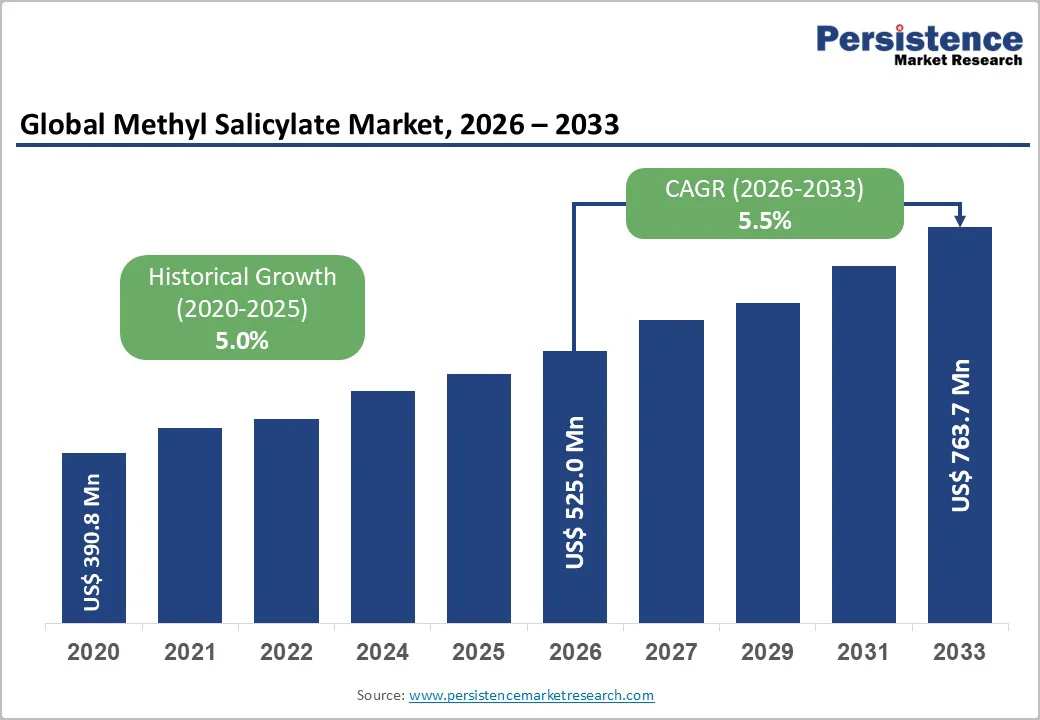
The global methyl salicylate market size is likely to be valued at US$525.0 million in 2026, projected to US$763.7 million by 2033, growing at a CAGR of 5.5% during the forecast period from 2026 to 2033, driven by the increasing prevalence of topical analgesics in personal care, rising demand for natural fragrances in food & beverages, and advancements in extraction technologies.
Rising demand for cooling and pain-relief products, particularly in pharmaceuticals, is driving the adoption of methyl salicylate. Innovations in natural and synthetic variants meet consumer preferences for purity and versatility, while their widespread use in muscle rubs and flavorings, particularly in healthcare, fuels market growth.
Key Industry Highlights:
- Leading Region: North America is projected to account for 45% market share in 2026, driven by high consumer demand for personal care, pharmaceuticals, and food products containing methyl salicylate.
- Fastest-growing Region: Asia Pacific is likely to be the fastest-growing, driven by rising consumer demand for personal care, healthcare, and food products, coupled with rapid urbanization and increasing disposable incomes.
- Dominant Product Type: Synthetic, to hold approximately 60% of the market share in 2026, due to cost-effectiveness and consistency.
- Leading Application: Personal care and cosmetics, to account for over 40% of market revenue in 2026, driven by pain relief needs.
- Leading End-user: Healthcare, to contribute nearly 35% of the market revenue in 2026, due to topical formulations.
| Key Insights | Details |
|---|---|
| Methyl Salicylate Market Size (2026E) | US$525.0 Mn |
| Market Value Forecast (2033F) | US$763.7 Mn |
| Projected Growth (CAGR 2026 to 2033) | 5.5% |
| Historical Market Growth (CAGR 2020 to 2025) | 5.0% |
Market Factors - Growth, Barriers, and Opportunity Analysis
Rising Prevalence of Topical Analgesics in Personal Care and Demand for Natural Fragrances in Food & Beverages
The rising prevalence of topical analgesics in personal care globally is a primary driver of the methyl salicylate market. In the individual care and healthcare sectors, methyl salicylate is widely recognized for its warming and soothing properties, making it an essential ingredient in muscle rubs, pain-relief creams, massage oils, and medicated balms.
The growing awareness of musculoskeletal disorders, joint pain, sports injuries, and age-related ailments is driving consumer adoption of these topical analgesics, particularly over-the-counter formulations that offer convenient, fast-acting relief. This trend not only boosts demand in mature markets such as North America and Europe but also fuels growth in emerging regions, driven by increasing healthcare accessibility and rising disposable incomes.
The food and beverage industry is witnessing heightened interest in clean-label and naturally flavored products. Consumers are increasingly seeking natural fragrance and flavoring agents that enhance sensory appeal without relying on synthetic additives. Methyl salicylate, with its characteristic minty aroma, is being integrated into candies, chewing gums, beverages, and specialty foods, aligning with health-conscious and premium product trends.
High Development and Regulatory Costs
High costs associated with the development and regulatory approval of methyl salicylate pose a significant restraint. Developing high-purity or multifunctional methyl salicylate formulations requires substantial investment in research and development, advanced chemical synthesis, and purification processes.
These costs are further amplified when targeting pharmaceutical, personal care, or food-grade applications, which demand stringent quality, stability, and performance standards.
Regulatory compliance adds another significant layer of expense. In regions such as North America and Europe, agencies such as the FDA and ECHA enforce rigorous testing, documentation, and safety evaluations to ensure consumer protection. Obtaining approvals for new formulations or applications often involves lengthy clinical or safety studies, analytical testing, and detailed reporting, all of which contribute to time-consuming and expensive development cycles.
Failure to comply can result in fines, recalls, or market restrictions, making adherence essential yet costly. Evolving regulations around environmental impact, sustainable sourcing, and chemical usage require ongoing investment in cleaner production technologies and continuous monitoring. Smaller and mid-sized companies may find it challenging to absorb these costs, limiting market entry and innovation.
Innovations in Natural-Derived and Multifunctional Salicylates
Innovations in natural-derived and multifunctional salicylates present significant growth opportunities for the methyl salicylate market. Increasing consumer awareness of health, wellness, and environmental sustainability has driven demand for naturally sourced ingredients, particularly in personal care, cosmetics, and functional foods.
Companies are investing in bio-based production methods to extract methyl salicylate from plant sources, offering cleaner, safer, and more eco-friendly alternatives to synthetic counterparts. These innovations cater to the growing clean-label and natural product trends, enabling brands to differentiate their offerings and appeal to premium consumers.
Multifunctional salicylates, which combine therapeutic, aromatic, and flavor-enhancing properties, expand the versatility of methyl salicylate applications across industries. In pharmaceuticals, multifunctional derivatives enable the development of enhanced topical pain-relief formulations with improved efficacy and stability.
In cosmetics and personal care, these compounds provide dual benefits of fragrance and soothing effects. At the same time, in the food and beverage sector, they enhance sensory experiences without the need for multiple additives.
Category-wise Analysis
Product Type Insights
Synthetic dominates the market, expected to account for approximately 60% of the share in 2026, due to its consistent quality, cost efficiency, and ability to support large-scale production. Their uniform purity, stability, and predictable performance make them essential in pharmaceuticals, industrial applications, and mass-market personal care products.
Synthetic ingredients can easily meet strict regulatory standards and high-volume manufacturing requirements, strengthening their leading position across industries. For example, synthetic glycerin, used by companies such as Dow, is widely used in cosmetics and pharmaceutical formulations for its reliability and purity.
Natural is the fastest-growing segment, driven by the rising popularity of clean beauty trends and growing consumer preference for plant-derived, minimally processed ingredients. Naturally sourced methyl salicylate is increasingly used in premium cosmetics, wellness products, and functional food formulations due to its safety, sustainability, and high-quality profile.
The shift toward eco-friendly and transparent ingredient sourcing further accelerates adoption across personal care and specialty food sectors. For example, Botanical-derived methyl salicylate from companies such as Symrise is widely used in natural skincare and aromatherapy products for its soothing and refreshing properties.
Application Insights
The personal care and cosmetics segment leads the market, accounting for over 40% of revenue in 2026, driven by the extensive use of methyl salicylate in pain-relief gels, creams, massage oils, and aromatic skincare formulations. The soothing, warming, and fragrant properties make it a key ingredient in wellness and self-care products.
Rising consumer focus on therapeutic and holistic personal care further supports the segment’s dominance. For example, in 2022, Ilesol Pharmaceuticals launched its “Heat Is On CBD Gel”, combining methyl salicylate with other actives to provide warming, pain-relieving benefits, reflecting innovation in this space.
Pharmaceuticals are the fastest-growing application, driven by rising demand for oral and topical analgesics that use Methyl salicylate for pain relief and soothing effects. The rising incidence of muscle strains, headaches, and inflammatory conditions is driving the use of such products.
Rising use of over-the-counter (OTC) medications and continuous innovation in therapeutic products are driving growth in this segment. For instance, in 2024 - 2025, brands such as Advil Targeted Relief launched topical formulations that combine multiple pain-relieving ingredients, including methyl salicylate, to deliver targeted relief for muscle soreness, sprains, strains, and back pain.
End-user Insights
Healthcare is likely to dominate, with nearly 35% market share in 2026, driven by the widespread use of topical treatments such as muscle rubs, joint creams, and arthritis-relief ointments containing pain-relieving agents such as methyl salicylate. Rising cases of joint pain, sports injuries, and age-related mobility issues are fueling demand.
The growing preference for fast-acting, over-the-counter (OTC) therapeutic products further reinforces this dominance. For example, in 2025, Arthro MD+ Joint Relief Cream was launched as a non-prescription solution for joint pain and stiffness, while ArthriCare Pain Relief Cream introduced fast-acting relief for muscle and joint discomfort, reflecting ongoing innovation in healthcare products.
The food industry is likely to be the fastest-growing end-user segment, driven by rising consumer preference for natural, clean-label flavors and refreshing taste experiences. Methyl salicylate is increasingly used in candies, chewing gum, beverages, and specialty foods for its strong minty “wintergreen” profile, providing a distinctive cooling flavor that appeals to modern consumers.
Its stability during processing and compatibility with various formulations make it highly attractive to manufacturers. For example, methyl salicylate is widely used in wintergreen-flavored chewing gums and mint candies. Innovations by flavor houses in both natural and synthetic methyl salicylate to meet growing demand for authentic, health-conscious flavoring.

Regional Insights
North America Methyl Salicylate Market Trends
North America is anticipated to dominate, accounting for nearly 45% of the global market share in 2026, driven by the region’s advanced healthcare infrastructure, strong pharmaceutical manufacturing base, and rising consumer preference for effective pain relief and therapeutic products.
Methyl salicylate is widely used in topical analgesics, sports balms, and muscle-relief formulations, and its demand continues to grow as musculoskeletal issues, sports injuries, and active-lifestyle habits become more prevalent. The increasing popularity of over-the-counter pain-relief products and natural-feeling formulations further supports market growth.
North America’s mature personal care and cosmetics sector contributes significantly to consumption, with methyl salicylate functioning as a fragrance, flavoring, and cooling agent in various skincare and oral-care products. Regulatory agencies such as the FDA maintain strict monitoring for ingredient purity and safety, encouraging refinements in production processes and adherence to high-quality standards.
Food and beverage manufacturers in the region also incorporate methyl salicylate in select flavoring applications, strengthening demand from the specialty food segment. Ongoing research in safer, cleaner chemical synthesis and a shift toward environmentally responsible production practices are shaping market development.
Europe Methyl Salicylate Market Trends
Europe is supported by the region’s strong regulatory framework, advanced manufacturing capabilities, and increasing demand from pharmaceutical, personal care, and food-flavoring industries.
European consumers place high emphasis on product safety, quality, and transparency, which drives the adoption of high-purity methyl salicylate in topical pain-relief formulations, cosmetics, and oral-care products. The region’s aging population and rising incidence of joint and muscle disorders are also contributing to higher usage of therapeutic creams and ointments that incorporate methyl salicylate as a key active ingredient.
Europe’s robust growth in the cosmetics and personal-care sector, particularly in France, Germany, Italy, and the U.K., supports consistent demand due to widespread use of fragrances and flavor-enhancing components in skincare and grooming formulations.
Regulatory bodies such as the European Chemicals Agency (ECHA) emphasize strict compliance, pushing manufacturers toward cleaner synthesis routes, improved safety standards, and environmentally responsible production processes.
The growing interest in natural and safer chemical ingredients is further encouraging refinements in product formulation. The food and beverage industry is increasingly incorporating methyl salicylate as a flavoring agent in confectionery and specialty items.
Asia Pacific Methyl Salicylate Market Trends
Asia Pacific is likely to be the fastest-growing region, driven by rising industrialization, expanding consumer markets, and increasing demand from key end-user sectors such as pharmaceuticals, personal care, and food flavoring.
Rapid urbanization and higher disposable incomes across countries such as China, India, Japan, and South Korea are boosting consumption of analgesic balms, topical pain-relief products, cosmetics, and oral-care formulations, all of which use methyl salicylate as an active or functional ingredient. The region’s large manufacturing base and cost-efficient production capabilities further support steady supply and competitive pricing.
Increasing awareness of health and wellness trends is fueling demand for topical therapeutic products, while growth in sports activities and lifestyle-related muscle disorders is expanding the market for pain-relief applications. The food and beverage sector also contributes to demand through the widening use of flavoring agents.
Technological advancements in chemical synthesis, improved refining processes, and growing regulatory emphasis on product purity are shaping product development in the region. The shift toward sustainable and compliant production practices is encouraging manufacturers to adopt cleaner processes and safer formulations.

Competitive Landscape
The global methyl salicylate market is highly competitive, characterized by a concentrated mix of multinational chemical manufacturers and strong regional specialists. Leading players such as Novacyl, Zhenjiang Gaopeng Pharmaceutical Co., Ltd., and Alta Laboratories Ltd. maintain a clear competitive edge through large-scale production capabilities, stringent quality standards, and robust distribution networks across key end-user industries.
Their ability to consistently deliver high-purity and pharma-grade methyl salicylate positions them favorably, especially in pharmaceutical, personal care, and flavor-fragrance applications where compliance and reliability are critical.
Key manufacturers are increasingly focusing on responsible sourcing of salicylic acid, reduced environmental impact, and energy-efficient production processes. This strategic shift not only aligns with global regulatory trends but also enhances brand credibility among customers seeking eco-friendly ingredients.
Investments in advanced purification technologies, R&D for bio-based alternatives, and partnerships with downstream formulators help these leading companies expand market share.
Key Industry Developments
- In January 2024, Hunan Jiudian Pharmaceutical received market authorization from the NMPA (National Medical Products Administration) for methyl salicylate APIs (Active Pharmaceutical Ingredients), which will help the company expand its market in China.
Companies Covered in Methyl Salicylate Market
- Novacyl
- Zhenjiang Gaopeng Pharmaceutical Co., Ltd.
- Alta Laboratories Ltd.
- Siddharth Carbochem Products Ltd.
- Tokyo Chemical Industry Co., Ltd.
- Shandong Longxin Chemical
- Rochem International Inc.
- Pharm-RX Chemical Corp.
- Thermo Fisher Scientific India Pvt. Ltd.
- Rephine Ltd.
- Others
Frequently Asked Questions
The global methyl salicylate market is projected to reach US$525.0 million in 2026.
Rising demand for topical analgesics in personal care and natural fragrances in food & beverages are the primary drivers.
The methyl salicylate market is expected to grow at a CAGR of 5.5% from 2026 to 2033.
Expansion in organic cosmetics and functional foods with high-purity natural methyl salicylate offers major opportunities.


